
Key Takeaways
- Japanese minimalism is built on the concept of ma (purposeful empty space), not just owning fewer things
- The average studio apartment redesign in this style costs between $800 and $4,000 depending on furniture choices and whether you hire a designer
- Low-profile furniture, platform beds, and floor seating are the core pieces that make small spaces feel taller and more open
- Japanese minimalism differs from Scandinavian minimalism in its emphasis on impermanence, wabi-sabi (beauty in imperfection), and floor-level living
- Hidden storage — under-bed drawers, built-in shelving, and multi-use ottomans — is non-negotiable in a studio applying this style
- This design approach has documented benefits for anxiety reduction and mental clarity, making it especially useful for people managing stress
- The biggest mistake is stripping a space bare and calling it minimalist; true Japanese minimalism is intentional, warm, and personal
- A neutral palette of whites, warm greys, natural wood, and muted earth tones is the foundation of authentic Japanese minimalist design
- Books and hobby equipment can absolutely coexist with this style when stored with discipline and displayed with intention
- Maintaining the style long-term requires a “one in, one out” habit and regular editing sessions, not perfection from day one
What Exactly Is Japanese Minimalism and How Does It Work in Small Spaces
Japanese minimalism is a design and lifestyle philosophy rooted in Zen Buddhism, the concept of ma (the value of empty space), and wabi-sabi (finding beauty in simplicity and imperfection). In a small apartment, it works by treating open floor space as a design element rather than wasted room, and by ensuring every object present serves a clear purpose.
The core principles that apply directly to studio living:
- Ma (negative space): Empty areas on shelves, floors, and walls are intentional. They give the eye a place to rest and make rooms feel larger.
- Wabi-sabi: Imperfect, natural materials — rough linen, unfinished wood, handmade ceramics — are preferred over polished, synthetic ones.
- Mono no aware: Awareness of impermanence encourages owning fewer, better things rather than accumulating.
- Functional beauty: Objects should be beautiful because they work well, not decorative for decoration’s sake.
In a studio apartment specifically, these principles solve real problems. Low-profile furniture keeps sightlines open. Hidden storage removes visual clutter. Natural light is maximized rather than blocked. The philosophy doesn’t just make a space look better — it makes it easier to live in.
How Much Does It Cost to Redesign a Studio Apartment in This Style
A full Japanese minimalist studio redesign typically costs between $800 and $4,000 for most renters doing it themselves, or $5,000 to $15,000 if you hire an interior designer and invest in quality custom pieces.
The wide range depends on three factors: what you already own, how much you replace versus repurpose, and whether you buy new or secondhand.
| Budget Level | Estimated Cost | What It Covers |
|---|---|---|
| Budget DIY | $800 – $1,500 | Declutter existing items, add shoji-style panels, buy a platform bed frame, neutral bedding, basic storage boxes |
| Mid-range DIY | $1,500 – $4,000 | New low-profile sofa, platform bed, quality storage furniture, natural textiles, select ceramics |
| Designer-assisted | $5,000 – $15,000+ | Custom built-ins, quality natural wood furniture, professional space planning, curated decor |
Where to save money: Secondhand stores, Facebook Marketplace, and IKEA’s KALLAX and LACK lines approximate the low-profile, clean-lined aesthetic at low cost. The IKEA NEIDEN bed frame, for example, sits just 10 inches off the floor and costs under $100 as of 2026.
Where to spend: Invest in one quality natural wood piece (a dining table, a low shelf) and quality bedding in natural linen or cotton. These anchor the space and age well.
Japanese Minimalism vs. Scandinavian Minimalism: Key Differences
Both styles share clean lines and neutral palettes, but they come from different philosophies and produce different results in a studio apartment.
Japanese minimalism emphasizes floor-level living, impermanence, and the spiritual value of empty space. Furniture sits low or on the floor. Asymmetry is acceptable. Natural imperfection in materials is celebrated.
Scandinavian minimalism (often called “Scandi” or hygge-influenced design) emphasizes comfort, warmth, and functionality. Furniture is at standard height. Symmetry and clean geometry are preferred. The goal is cozy efficiency rather than contemplative stillness.
| Feature | Japanese Minimalism | Scandinavian Minimalism |
|---|---|---|
| Furniture height | Low to floor | Standard height |
| Emotional tone | Contemplative, serene | Warm, cozy |
| Imperfection | Celebrated (wabi-sabi) | Minimized |
| Color palette | Warm neutrals, muted earth | Whites, greys, black accents |
| Key materials | Natural wood, bamboo, linen, clay | Pine, wool, concrete, leather |
| Floor space | Maximized, often bare | Rugs common |
For a tiny studio, Japanese minimalism often works better because the emphasis on low furniture and open floor space makes the room feel physically taller and more open.
Best Furniture Pieces for Maximizing Space in a Tiny Apartment
The right furniture is the single biggest factor in making Japanese minimalism work in a small studio. Low-profile pieces, multi-function items, and hidden storage are the three categories that matter most.
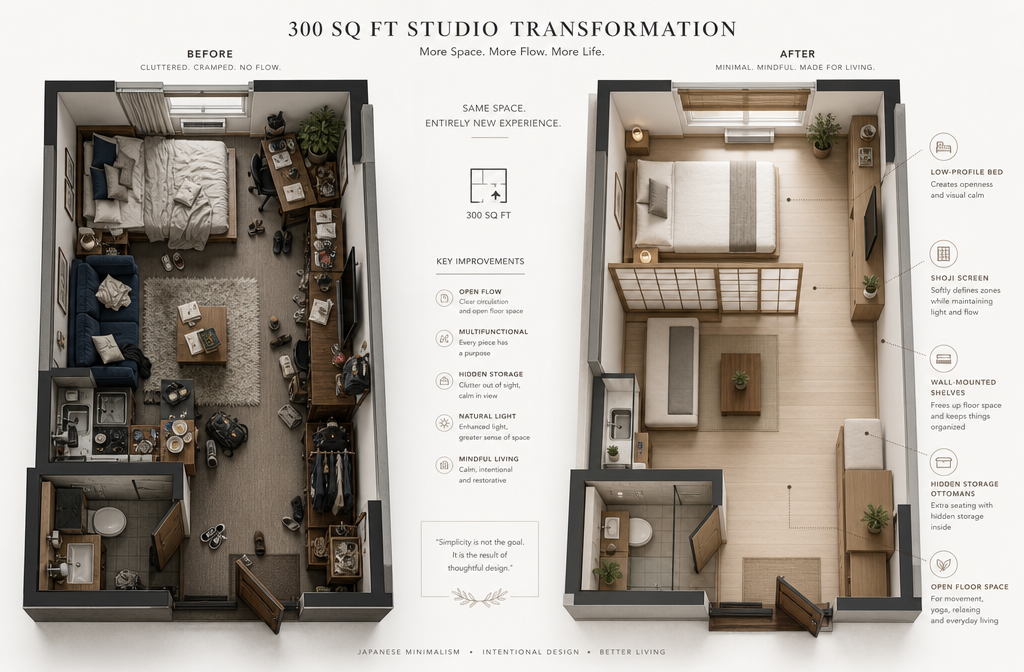
Top furniture choices for a Japanese minimalist studio:
- Platform or floor bed: A bed frame that sits 6–12 inches off the ground lowers the visual center of the room, making ceilings feel higher. Under-bed storage drawers are essential.
- Zaisu floor chairs: Legless chairs used for floor seating double as meditation seats and can be stacked or stored flat when not in use.
- Low dining table (chabudai style): A table 12–16 inches high can serve as a dining table, desk, and coffee table. Folds flat for storage in many designs.
- Shoji screen room divider: A translucent rice-paper panel diffuses light while separating the sleeping area from the living area without a solid wall.
- Storage ottoman: A large, lidded ottoman in natural linen replaces a coffee table and hides blankets, books, or hobby supplies.
- Wall-mounted shelving: Floating shelves keep floor space clear. Limit to one or two shelves with intentional spacing between objects.
- Futon sofa-bed: A Japanese-style futon that folds from sofa to bed is the most space-efficient sleeping solution for a true micro-studio.
Decision rule: If a piece of furniture serves only one function and takes up more than 10% of your floor space, it needs to justify its presence. If it can’t, replace it with something multi-functional or remove it entirely.
Storage Solutions for a Studio Apartment Using Japanese Minimalist Concepts
Hidden, integrated storage is the backbone of Japanese minimalism in a tiny studio. The goal is to remove objects from sight without eliminating them from your life.
Practical storage strategies:
- Under-bed storage: Platform beds with built-in drawers or simple bed risers with flat storage bins handle off-season clothing, extra bedding, and bulky items.
- Vertical wall storage: Use the full height of walls. A single floor-to-ceiling shelving unit with closed lower cabinets and open upper shelves keeps daily items accessible while hiding clutter.
- Entryway storage bench: A bench with interior storage near the door handles shoes, bags, and outer layers — keeping them out of the main living area.
- Drawer organizers and boxes: Japanese storage culture uses small, identical boxes (often in natural wood or plain cardboard) to organize drawer contents. This reduces visual noise even inside closed storage.
- Pegboard or wall hooks: A single row of wall hooks replaces a coat rack and keeps floor space clear.
- Tension rod shelf under sink: In a studio bathroom or kitchen, a tension rod creates a second tier of storage under the sink for cleaning supplies.
The key principle: Storage in Japanese minimalist design is meant to be invisible. If you can see it, it should be beautiful. If it’s not beautiful, it should be hidden.
Can This Design Style Work If You Have Lots of Books and Hobby Equipment
Yes, Japanese minimalism can work with books and hobby equipment, but it requires a specific approach to curation and storage rather than wholesale elimination.
Books are actually compatible with this aesthetic when handled intentionally. A single, well-organized low bookshelf with books arranged by spine color or size creates a calm visual. The mistake is keeping every book you’ve ever owned. A practical rule: keep books you will re-read or reference, donate the rest.
For hobby equipment:
- Assign one dedicated storage zone (a closet, a trunk, a cabinet) for all hobby materials. When the zone is full, something leaves before something new enters.
- Choose storage containers that match your palette — natural wood boxes, plain linen baskets, or matte black bins rather than colorful branded packaging.
- If your hobby produces physical output (art, crafts, collections), rotate what’s displayed rather than showing everything at once. Display three pieces, store the rest.
The honest truth: Japanese minimalism doesn’t require you to own nothing. It requires you to own intentionally. A studio with 200 carefully curated books and a dedicated art corner can still feel serene if the storage is disciplined and the empty space is protected.
Is Japanese Minimalism Good for People With Anxiety or Mental Health Challenges
Research consistently supports the connection between cluttered environments and elevated stress. A 2010 study published in Personality and Social Psychology Bulletin found that women who described their homes as cluttered had higher cortisol levels throughout the day compared to those who described their homes as restful (Saxbe & Repetti, 2010).
Japanese minimalism in a tiny studio apartment directly addresses the visual and cognitive load that contributes to anxiety. Fewer objects mean fewer decisions, less visual stimulation, and a clearer mental environment.
Specific benefits for people managing anxiety:
- Reduced decision fatigue: A curated wardrobe and organized space mean fewer micro-decisions each morning.
- Easier cleaning: A minimalist studio takes significantly less time to clean, removing a common source of low-grade stress.
- Sensory calm: Natural materials, muted colors, and soft lighting create a sensory environment that is less stimulating than a cluttered, brightly decorated space.
- Sense of control: Maintaining an intentional space provides a tangible area of life where order is achievable.
Caveat: For some people, an extremely bare space can feel cold or anxiety-inducing rather than calming. Japanese minimalism at its best is warm, not sterile. If a completely empty shelf makes you uncomfortable, put one meaningful object on it. The goal is calm, not deprivation.
Pros and Cons of Marie Kondo-Style Minimalism in a Really Small Apartment
Marie Kondo’s KonMari method is one of the most widely known approaches to minimalism and is closely aligned with Japanese minimalist principles. In a tiny studio, it has real advantages and a few genuine drawbacks.
Pros:
- The “spark joy” framework gives a clear decision rule for every object, which is especially useful when downsizing into a small space
- The category-by-category approach (clothing, books, papers, komono, sentimental items) is systematic and prevents re-cluttering
- Folding methods for clothing maximize drawer space significantly — a genuine practical benefit in a studio with limited closet space
- The process forces a one-time confrontation with everything you own, which most people find clarifying
Cons:
- “Spark joy” is a subjective standard that doesn’t account for functional items you need but don’t love (a spare phone charger, a plunger)
- The method works best as a one-time reset; it doesn’t provide a long-term maintenance system
- In a studio apartment, the initial sorting process requires spreading everything out, which is physically difficult in a small space
- Some people find the emotional framing of the method (thanking objects before discarding them) uncomfortable or impractical
Best use: Use KonMari as a starting point to declutter aggressively, then build a personal maintenance system on top of it rather than relying on the method indefinitely.
What Are the Biggest Mistakes People Make With Japanese Minimalist Design
The most common mistake is confusing minimalism with emptiness. A studio stripped of all personality, warmth, and personal objects isn’t Japanese minimalism — it’s just a bare room.
Other frequent mistakes:
- Buying new “minimalist” items before decluttering: Adding matching storage boxes or new furniture before removing existing clutter just adds more stuff. Declutter first, buy second.
- Ignoring texture: Japanese minimalist spaces are warm because they layer natural textures — rough linen, smooth wood, woven grass, matte ceramic. Without texture, a neutral palette looks clinical.
- Hiding everything: Not all objects should be hidden. A single ceramic bowl, a well-chosen plant, or a handmade textile on display creates the warmth that makes the space livable.
- Neglecting lighting: Harsh overhead lighting destroys the atmosphere. Warm-toned lamps at floor or table level are essential.
- Treating it as permanent: Japanese philosophy embraces impermanence. Your space should evolve with your life. Don’t be so rigid about the aesthetic that you can’t adapt.
Recommended Color Palettes and Materials for Japanese Minimalist Design
The color palette for Japanese minimalism in a tiny studio apartment is built on restraint and natural warmth, not stark white.
Core palette:
- Shiro (white): Warm white, not cool bright white. Think linen white or rice paper white.
- Hai (grey): Warm, medium grey — the color of stone or ash.
- Chairo (brown/wood tones): Natural wood in light to medium tones. Avoid dark stains.
- Midori (muted green): One or two plants or a single muted green textile as an accent.
- Kurogane (dark iron): Matte black or dark iron for hardware, lamp bases, or a single accent piece.
Materials that define the aesthetic:
- Natural linen and cotton for bedding and cushions
- Unfinished or lightly oiled wood for furniture and shelving
- Washi paper or shoji panels for light diffusion
- Bamboo for small accessories or a bath mat
- Handmade or irregular ceramics for dishes and decorative objects
- River stone or smooth pebbles as simple, cost-free accents
What to avoid: Glossy plastics, chrome finishes, bold patterns, and synthetic fabrics. These materials read as modern Western minimalism, not Japanese minimalism, and they don’t age as gracefully in a small space.
How to Maintain a Minimalist Space Without Feeling Like You’re Living in an Empty Room
Maintaining Japanese minimalism in a tiny studio apartment long-term comes down to two habits: a regular editing practice and a clear rule for new items entering the space.
The one-in, one-out rule: Every time something new enters the apartment — a book, a kitchen tool, a piece of clothing — something else leaves. This single rule prevents re-accumulation more effectively than any organizational system.
Monthly editing sessions: Once a month, spend 20 minutes walking through the apartment and asking of each visible object: “Does this earn its place?” This isn’t a full KonMari purge — it’s a light audit that catches drift before it becomes clutter.
Keeping warmth in the space:
- Rotate seasonal textiles (a heavier blanket in winter, lighter linen in summer) to keep the space feeling alive without adding permanent objects
- Keep one living plant. A single healthy plant adds organic warmth and movement to a neutral space
- Use candlelight or warm-toned bulbs in the evening. Lighting changes the emotional quality of a minimalist space dramatically
- Allow one “joy shelf” — a small shelf or surface where you display a few personally meaningful objects, rotated seasonally
The goal is a space that feels like it belongs to a real person living a real life, not a showroom. Warmth and personality are not the enemies of Japanese minimalism — excess is.
FAQ
What is the difference between Japanese minimalism and just having less stuff? Japanese minimalism is a philosophy, not just a quantity of objects. It involves intentional placement, respect for empty space, natural materials, and a specific aesthetic sensibility. Having less stuff without those principles is just a sparse room.
How small is too small for Japanese minimalist design? There is no lower limit. The principles were developed in part for traditional Japanese homes with very small rooms. A 150-square-foot studio can apply these principles as effectively as a 400-square-foot one.
Do I need to buy Japanese furniture to achieve this look? No. IKEA, secondhand stores, and many mainstream retailers carry low-profile, natural-material furniture that fits the aesthetic. Authenticity comes from the principles applied, not the brand of furniture.
How long does it take to convert a studio apartment to Japanese minimalist style? The decluttering phase typically takes one to three weekends. Furniture changes and styling can happen gradually over one to three months. You don’t need to do everything at once.
Is a tatami mat necessary for a Japanese minimalist studio? No, but it’s a useful option. A tatami mat defines a floor-level seating or sleeping area and adds authentic texture. A natural jute or sisal rug achieves a similar visual effect at lower cost.
Can I have a TV in a Japanese minimalist studio? Yes. Mount it on the wall to keep floor space clear, or use a low TV console that doubles as storage. When not in use, some people cover it with a simple linen panel to reduce visual noise.
What’s the best first step for someone starting from scratch? Declutter before you buy anything. Remove everything from the apartment that you don’t use, love, or need. Then assess what furniture and storage gaps remain. Buying before decluttering is the most common and most expensive mistake.
Does Japanese minimalism work with a roommate or partner? It works, but requires agreement on shared spaces. Each person can maintain their own zone with their own approach, while shared areas (kitchen, living space) follow the minimalist principles together.
Conclusion
Applying Japanese minimalism in a tiny studio apartment is one of the most practical design decisions you can make in 2026, particularly as urban living spaces continue to shrink and the cost of square footage rises. The philosophy doesn’t ask you to own nothing — it asks you to own intentionally and to treat empty space as a feature rather than a problem.
Actionable next steps:
- Spend one weekend decluttering by category, starting with clothing and working toward sentimental items
- Identify the two or three largest visual problems in your studio (usually: visible clutter, too-tall furniture, poor lighting) and address those first
- Replace one piece of furniture with a lower-profile, multi-functional alternative before buying anything decorative
- Establish a one-in, one-out rule before the redesign is complete, so you don’t re-accumulate
- Choose your palette (warm white, warm grey, natural wood) and apply it consistently across textiles, walls, and furniture before adding any accent colors
The philosophy rewards patience. Start with less, live with it for a few weeks, and add only what genuinely improves the space. That measured approach is, in itself, the most Japanese thing you can do.
References
- Saxbe, D. E., & Repetti, R. (2010). No place like home: Home tours correlate with daily patterns of mood and cortisol. Personality and Social Psychology Bulletin, 36(1), 71–81. https://doi.org/10.1177/0146167209352864
- Kondo, M. (2014). The Life-Changing Magic of Tidying Up. Ten Speed Press.
- Tanizaki, J. (1977). In Praise of Shadows. Leete’s Island Books. (Original work published 1933)
Read next: Sustainable Care for Hand-Welted Leather Business Shoes: The Complete Guide. A closer look at leather shoe care.