
Key Takeaways
- Walking is the single most accessible exercise for improving gallbladder motility, and 20 to 30 minutes of brisk walking most days is a practical starting point.
- Yoga poses that involve gentle twisting, forward folding, or deep breathing directly stimulate the gallbladder and surrounding bile ducts.
- High-impact exercises like heavy weightlifting, intense sprinting, and contact sports can aggravate gallbladder symptoms and should be avoided during flare-ups.
- People who have had gallbladder surgery (cholecystectomy) can still benefit from gentle movement, but they should follow a gradual return-to-exercise timeline.
- Consistency matters more than intensity. Short, regular movement sessions outperform occasional intense workouts for bile flow support.
- Pilates and swimming are both safe and effective options for people with gallbladder dysfunction.
- Signs that an exercise is helping include reduced bloating, improved digestion after meals, and less right-side abdominal discomfort over time.
- Signs that an exercise is hurting include sharp right upper quadrant pain, nausea during or after movement, or worsening symptoms within 24 hours.
- Common mistakes include exercising immediately after a fatty meal, pushing through gallbladder pain, and skipping warm-up stretches.
What Exercises Help Gallbladder Function Without Hurting You
Gentle, low-impact exercises are the safest and most effective choices for supporting gallbladder function. The goal is to stimulate bile secretion and gallbladder contraction without triggering inflammation or pain. Activities that work well include brisk walking, gentle yoga, swimming, light cycling, Pilates, and diaphragmatic breathing exercises.
The gallbladder stores bile produced by the liver and releases it into the small intestine to help digest fats. When the gallbladder becomes sluggish, bile can thicken, stagnate, and eventually form sludge or stones. Physical movement helps by:
- Increasing circulation to digestive organs
- Stimulating the vagus nerve, which plays a role in digestive motility
- Encouraging the rhythmic contraction of the gallbladder
- Reducing inflammation associated with a sedentary lifestyle
Choose low-impact exercise if: you experience right-side abdominal discomfort after meals, have been diagnosed with biliary dyskinesia or gallbladder sludge, or are recovering from a recent gallbladder episode.
Avoid high-impact exercise if: you are in an active flare-up, have recently had gallbladder surgery, or experience nausea and sharp pain with movement.
Can Walking Really Improve Bile Flow
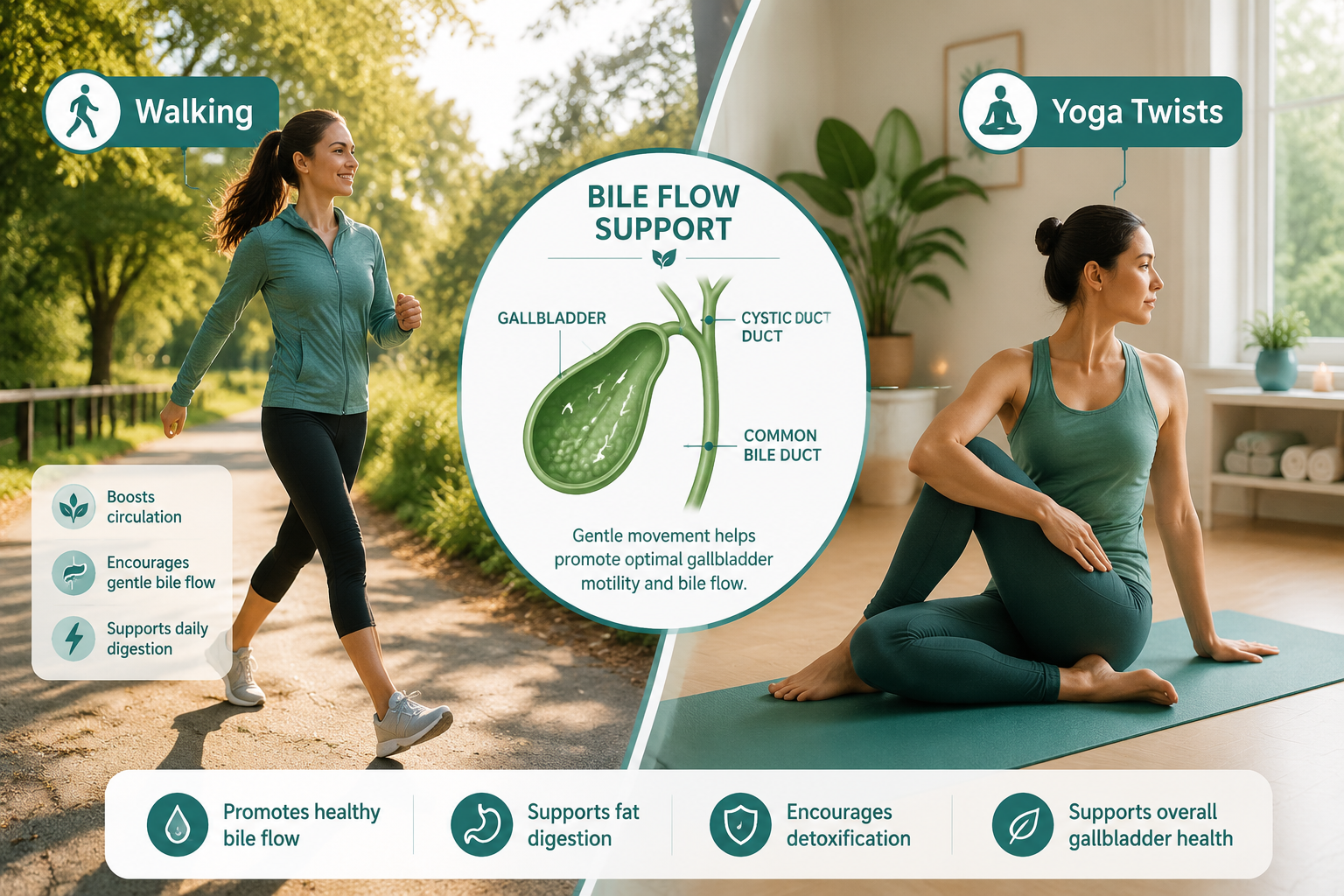
Yes, walking is one of the most evidence-supported forms of exercise for improving bile flow and overall gallbladder motility. A study published in the American Journal of Gastroenterology (2017) found that regular physical activity was associated with a significantly reduced risk of gallstone disease, with walking being among the most commonly reported activities in the study population.
Walking works because it:
- Activates abdominal muscles, which gently massage the digestive organs
- Promotes peristalsis (the wave-like movement of the digestive tract)
- Reduces insulin resistance, a known risk factor for gallstone formation
- Lowers body weight over time, which reduces cholesterol saturation in bile
Practical walking guide for gallbladder support:
| Duration | Pace | Frequency | Notes |
|---|---|---|---|
| 10 to 15 minutes | Easy, conversational | Daily | Good starting point for beginners or post-surgery |
| 20 to 30 minutes | Brisk (slightly elevated heart rate) | 5 days per week | Ideal maintenance level |
| 30 to 45 minutes | Moderate | 5 days per week | Best for weight management and bile flow |
A personal note: I started recommending short post-meal walks to clients dealing with sluggish gallbladder symptoms, and several reported noticeably less bloating and right-side heaviness within two to three weeks. The key was consistency, not distance.
How Often Should You Do Gentle Movements for Gallbladder Health
For most adults with sluggish gallbladder motility, the target is five days per week of 20 to 30 minutes of gentle movement. Daily movement, even in short 10-minute sessions, is more beneficial than two or three longer sessions per week because consistent stimulation keeps bile from pooling.
A simple weekly framework:
- Monday, Wednesday, Friday: 25-minute brisk walk
- Tuesday, Thursday: 20-minute gentle yoga or Pilates session
- Saturday: 30-minute swim or light cycling
- Sunday: Rest or a 10-minute diaphragmatic breathing and stretching routine
The timing of exercise also matters. Moving 30 to 60 minutes after a meal (not immediately after) can help the gallbladder release bile more efficiently during the digestive process. Exercising on a completely empty stomach is also fine for most people, but avoid intense movement right after a large, fatty meal, as this can trigger cramping or nausea.
Are Yoga Poses Safe If You Have Gallbladder Issues
Most gentle yoga poses are safe and genuinely helpful for people with gallbladder issues. Poses that involve twisting, forward folding, and deep diaphragmatic breathing are particularly useful because they compress and release the abdominal organs, stimulating bile flow.
Yoga poses that support gallbladder motility:
- Supine twist (Supta Matsyendrasana): Gently compresses the right side of the abdomen where the gallbladder sits, encouraging bile release.
- Seated forward fold (Paschimottanasana): Applies mild pressure to the abdominal region and promotes parasympathetic nervous system activity, which supports digestion.
- Cat-Cow (Marjaryasana-Bitilasana): The rhythmic spinal movement massages the digestive organs and stimulates the vagus nerve.
- Child’s pose (Balasana): Compresses the abdomen gently and encourages relaxation of the bile ducts.
- Bridge pose (Setu Bandha Sarvangasana): Engages the core and improves circulation to the abdominal region.
Poses to avoid or modify:
- Deep backbends (e.g., Wheel pose) can stretch the gallbladder area uncomfortably during a flare-up.
- Inversions (e.g., headstands) may not be appropriate for people with active gallbladder inflammation.
- Hot yoga is generally not recommended during symptomatic periods because dehydration can concentrate bile and worsen sludge.
Hold each supportive pose for 30 to 60 seconds, breathe deeply, and avoid forcing any position that creates right-side abdominal pain.
What Is the Difference Between Good and Bad Exercises for a Sluggish Gallbladder
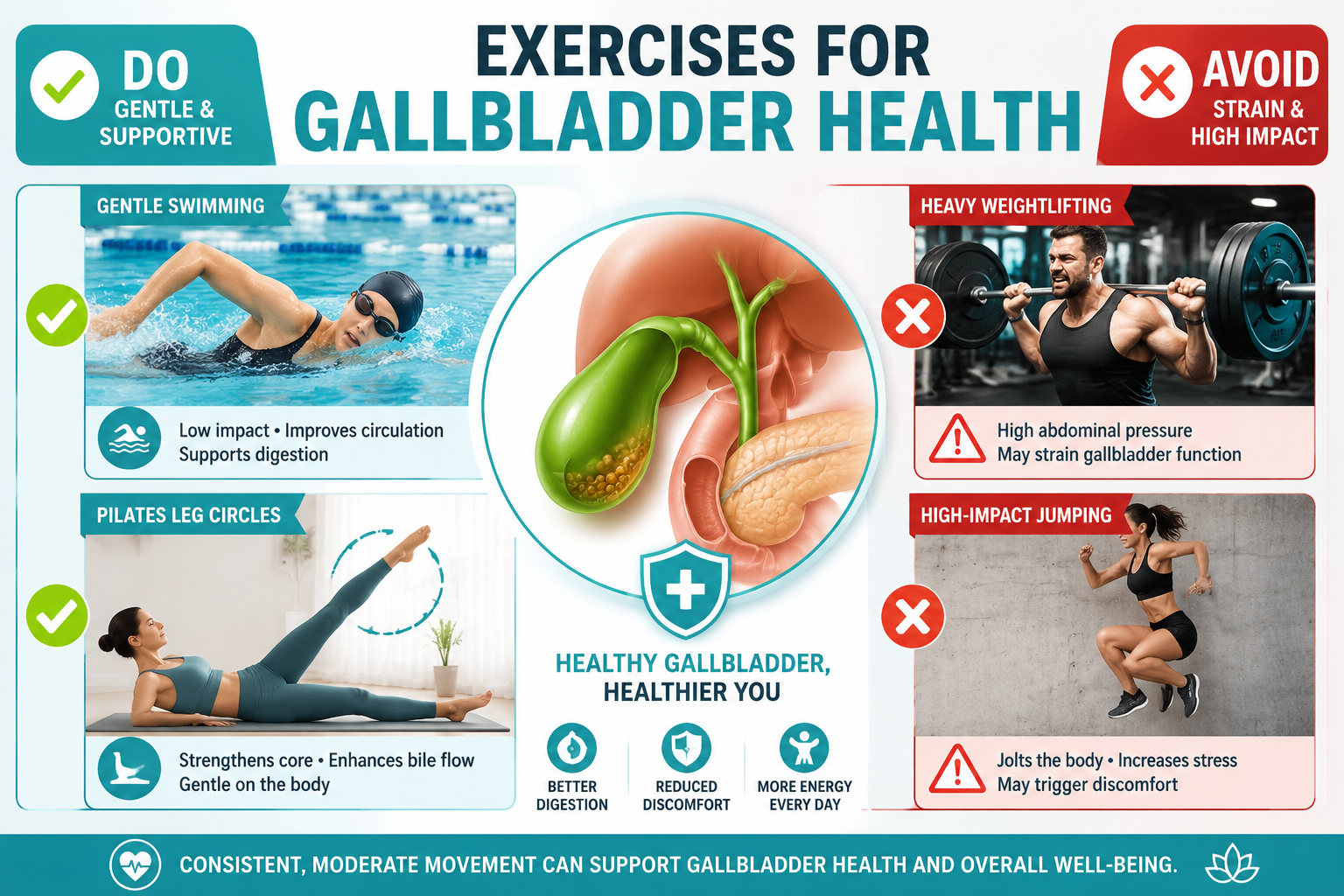
Good exercises for a sluggish gallbladder are low-impact, rhythmic, and gentle on the abdominal region. Bad exercises are high-impact, involve significant abdominal strain, or cause jarring movements that can aggravate an already irritated gallbladder.
Good vs. bad exercise comparison:
| Good for Gallbladder | Why It Helps | Bad for Gallbladder | Why It Hurts |
|---|---|---|---|
| Brisk walking | Stimulates bile flow, low strain | Heavy weightlifting | Increases intra-abdominal pressure |
| Gentle yoga twists | Massages bile ducts | High-intensity interval training (HIIT) during flare-ups | Triggers nausea, sharp pain |
| Swimming | Full-body, low-impact | Contact sports | Risk of direct abdominal trauma |
| Diaphragmatic breathing | Activates vagus nerve | Sit-ups with poor form | Compresses gallbladder area aggressively |
| Light cycling | Improves circulation | Running on hard surfaces daily | Jarring impact can worsen symptoms |
The key principle: if an exercise causes you to hold your breath, brace your core intensely, or creates any sharp pain in the upper right abdomen, stop and reassess.
How Much Walking Is Too Much for Someone With Gallbladder Problems
For most people with gallbladder issues, walking up to 45 minutes at a moderate pace is safe and beneficial. Walking becomes problematic only when it causes dehydration (which can thicken bile), is done immediately after a large fatty meal, or is performed at an intensity that triggers pain or nausea.
There is no strict upper limit for walking in terms of gallbladder health specifically, but general guidelines from the American College of Sports Medicine suggest that adults aim for 150 to 300 minutes of moderate-intensity aerobic activity per week. For gallbladder support, staying within the lower to moderate end of this range with consistent pacing is ideal.
Signs you may be overdoing it:
- Right upper quadrant pain or cramping during or after the walk
- Nausea that persists for more than 30 minutes after exercise
- Fatigue that is disproportionate to the effort
- Worsening digestive symptoms in the 24 hours following exercise
If any of these occur, reduce duration and intensity, and consult your doctor before continuing.
Which Stretches Can Help Prevent Gallbladder Sludge
Specific stretches that target the right side of the torso and encourage deep breathing can help prevent bile from thickening into sludge. These stretches work by stimulating the gallbladder through gentle compression and by activating the parasympathetic nervous system, which governs digestive function.
Stretches for gallbladder sludge prevention:
Right-side lateral stretch: Stand with feet shoulder-width apart. Raise your right arm overhead and lean gently to the left, creating a stretch along the right side of your torso. Hold for 20 to 30 seconds. This directly stretches the area overlying the gallbladder.
Diaphragmatic breathing stretch: Lie on your back with knees bent. Place one hand on your chest and one on your abdomen. Breathe deeply into your belly, allowing it to rise. Exhale slowly. Repeat for 5 to 10 minutes. This activates the vagus nerve and promotes bile release.
Gentle torso rotation: Sit upright in a chair. Place your right hand on your left knee and your left hand behind you. Gently rotate to the left, then hold for 15 to 20 seconds. Switch sides. This massages the abdominal organs.
Knee-to-chest stretch: Lie on your back and draw both knees to your chest. Hold for 20 to 30 seconds. This compresses the abdomen gently and can relieve gas and bile stagnation.
Perform these stretches daily, ideally in the morning before breakfast or 30 to 60 minutes after a light meal.
Are There Specific Exercises for People Who Have Had Gallbladder Surgery
After a cholecystectomy (gallbladder removal), the liver continues to produce bile, which now drips continuously into the small intestine rather than being stored and released in controlled amounts. Gentle exercise is still beneficial and recommended after surgery, but the timeline and intensity need to be adjusted.
Post-cholecystectomy exercise timeline:
- Week 1 to 2: Short walks of 5 to 10 minutes, two to three times per day. Avoid any core engagement or lifting.
- Week 3 to 4: Gradually increase walking to 15 to 20 minutes. Light stretching is acceptable.
- Week 5 to 6: Introduce gentle yoga (avoid deep twists and inversions). Begin light swimming if the incision is fully healed.
- Week 7 and beyond: Return to normal low-impact activity as tolerated. Consult your surgeon before resuming high-impact exercise.
After surgery, some people experience post-cholecystectomy syndrome, which includes ongoing digestive discomfort. Gentle exercises for sluggish gallbladder motility (in this context, supporting overall bile duct function) remain relevant and helpful for managing these symptoms long-term.
What Movements Should You Absolutely Avoid With Gallbladder Dysfunction
During active gallbladder dysfunction or a symptomatic period, avoid any exercise that significantly increases intra-abdominal pressure, causes dehydration, or involves direct impact to the abdominal area.
Movements to avoid:
- Heavy compound lifts (squats, deadlifts, bench press with heavy loads)
- High-intensity interval training during active flare-ups
- Running on hard surfaces for extended periods
- Contact sports or activities with risk of abdominal impact
- Sit-ups and crunches performed with poor form or heavy resistance
- Hot yoga or any exercise in extreme heat (dehydration risk)
- Exercises that require prolonged breath-holding (e.g., heavy Valsalva maneuver)
The reason these are problematic is straightforward: increased intra-abdominal pressure can force bile back into the gallbladder or bile ducts, worsening stagnation and potentially triggering a painful episode.
How Do You Know If an Exercise Is Helping or Hurting Your Gallbladder
An exercise is helping if your digestive symptoms gradually improve over two to four weeks of consistent practice. An exercise is hurting if it triggers immediate pain, nausea, or worsening symptoms.
Signs exercise is helping:
- Less bloating and gas after meals
- Reduced right-side abdominal heaviness or discomfort
- More regular bowel movements
- Improved energy and reduced fatigue
- Gradual reduction in symptom frequency over weeks
Signs exercise is hurting:
- Sharp or cramping pain in the upper right abdomen during or after exercise
- Nausea or vomiting triggered by movement
- Symptoms consistently worsen within 24 hours of a specific activity
- Referred pain to the right shoulder (a classic gallbladder symptom)
Keep a simple exercise and symptom diary for the first four to six weeks. Note the type of exercise, duration, and any symptoms that follow. This gives you and your healthcare provider clear data to work with.
Can Pilates or Swimming Improve Gallbladder Motility
Yes, both Pilates and swimming are excellent options for improving gallbladder motility. They are low-impact, support core strength without aggressive abdominal compression, and promote circulation to the digestive organs.
Pilates for gallbladder health: Pilates focuses on controlled, precise movements with an emphasis on breathing and core engagement. For gallbladder support, the breathing component is especially valuable. Lateral breathing (expanding the ribcage sideways rather than pushing the belly out) gently massages the liver and gallbladder with each breath. Beginner and intermediate mat Pilates classes are appropriate for most people with gallbladder issues. Avoid advanced exercises that involve heavy spinal flexion under load during symptomatic periods.
Swimming for gallbladder health: Swimming is often described as one of the most complete forms of low-impact exercise. The horizontal body position reduces gravitational pressure on the abdominal organs, and the rhythmic breathing pattern supports vagal tone. Freestyle and backstroke are particularly gentle. Aim for 20 to 30 minutes of continuous swimming or water-based movement three to four times per week.
What Are Common Mistakes People Make When Exercising With Gallbladder Issues
The most common mistake is exercising too intensely too soon, especially after a gallbladder episode or surgery. Other frequent errors include poor timing around meals, ignoring warning signs, and neglecting hydration.
Top mistakes to avoid:
Exercising immediately after a fatty meal. Wait at least 30 to 60 minutes. Fat triggers gallbladder contraction, and adding physical stress simultaneously can cause cramping.
Pushing through pain. Right upper quadrant pain during exercise is a signal to stop, not push harder. Continuing can worsen inflammation.
Skipping the warm-up. Cold muscles and unprepared digestive organs respond poorly to sudden movement. A 5-minute gentle walk or breathing exercise before any session is essential.
Neglecting hydration. Dehydration thickens bile, which is the opposite of what you want. Drink water before, during, and after exercise.
Doing only one type of exercise. Combining walking, stretching, and breathing exercises provides more comprehensive stimulation of gallbladder motility than any single activity alone.
Expecting overnight results. Gentle exercises for sluggish gallbladder motility work through consistent, cumulative stimulation. Most people notice meaningful improvement after four to six weeks of regular practice.
Frequently Asked Questions
Q: Can exercise alone fix a sluggish gallbladder? Exercise is an important part of managing sluggish gallbladder motility, but it works best alongside dietary changes (reducing saturated fat, increasing fiber), adequate hydration, and medical management when needed. Exercise alone is unlikely to resolve gallstones but can significantly reduce symptoms and slow progression.
Q: Is it safe to exercise during a gallbladder attack? No. During an active gallbladder attack (characterized by severe right upper quadrant pain, nausea, and vomiting), rest and medical evaluation are the priority. Exercise should only resume after symptoms have fully resolved and with your doctor’s clearance.
Q: How long before I see results from gentle exercise for gallbladder health? Most people notice a reduction in bloating and digestive discomfort within two to four weeks of consistent gentle exercise. More significant improvements in gallbladder motility typically take four to eight weeks of regular practice.
Q: Can I do gentle exercises for sluggish gallbladder motility if I’m pregnant? Many gentle exercises, including walking and prenatal yoga, are safe during pregnancy, but gallbladder issues are more common in pregnancy and require medical supervision. Always consult your obstetrician before starting or continuing an exercise program during pregnancy.
Q: Does deep breathing really help the gallbladder? Yes. Diaphragmatic breathing activates the vagus nerve, which plays a direct role in stimulating digestive motility, including gallbladder contraction. Even 5 to 10 minutes of deep belly breathing daily can contribute to improved bile flow over time.
Q: Should I avoid all core exercises with gallbladder problems? Not all core exercises are harmful. Gentle core work that emphasizes breathing and controlled movement (such as Pilates or yoga-based core exercises) is generally safe. Avoid exercises that require intense breath-holding or heavy abdominal compression during symptomatic periods.
Q: Can cycling help with gallbladder motility? Yes. Light to moderate cycling, whether outdoors or on a stationary bike, is a good low-impact option. The rhythmic pedaling motion and upright posture support abdominal circulation without placing direct pressure on the gallbladder.
Q: Is it better to exercise in the morning or evening for gallbladder health? There is no definitive evidence that time of day significantly affects gallbladder response to exercise. The most important factor is consistency. Choose a time that fits your schedule and that falls at least 30 minutes after a meal.
Conclusion
Sluggish gallbladder motility is a manageable condition, and gentle exercise is one of the most practical tools available. The evidence points clearly toward consistent, low-impact movement as a way to stimulate bile flow, reduce sludge formation, and improve digestive comfort over time.
Actionable next steps:
- Start with a 20-minute brisk walk five days this week. Note how you feel in the 60 minutes after each walk.
- Add two gentle yoga sessions per week, focusing on twisting and forward-folding poses.
- Practice 5 to 10 minutes of diaphragmatic breathing each morning before breakfast.
- Keep a simple symptom diary for four weeks to track your progress.
- Talk to your doctor or a gastroenterologist if symptoms worsen, if you experience acute pain, or if you want imaging to assess your gallbladder’s current function.
Gentle exercises for sluggish gallbladder motility are not a quick fix, but they are a low-risk, high-reward investment in your digestive health. Start small, stay consistent, and let the cumulative effect do the work.
References
- Leitzmann, M. F., Giovannucci, E. L., Rimm, E. B., Stampfer, M. J., Spiegelman, D., Wing, A. L., & Willett, W. C. (1998). The relation of physical activity to risk for symptomatic gallstone disease in men. Annals of Internal Medicine, 128(6), 417–425. https://doi.org/10.7326/0003-4819-128-6-199803150-00006
- Shabanzadeh, D. M., Sorensen, L. T., & Jorgensen, T. (2017). Physical activity and gallstone disease: A systematic review and meta-analysis. American Journal of Gastroenterology, 112(5), 738–748.
- American College of Sports Medicine. (2018). ACSM’s Guidelines for Exercise Testing and Prescription (10th ed.). Wolters Kluwer.
- Portincasa, P., Moschetta, A., & Palasciano, G. (2006). Cholesterol gallstone disease. The Lancet, 368(9531), 230–239. https://doi.org/10.1016/S0140-6736(06)69044-2
- Stinton, L. M., & Shaffer, E. A. (2012). Epidemiology of gallbladder disease: Cholelithiasis and cancer. Gut and Liver, 6(2), 172–187. https://doi.org/10.5009/gnl.2012.6.2.172
Read next: Managing Cold Urticaria Through Dietary Adjustments: A Practical Guide. A closer look at cold urticaria diet.