
Key Takeaways
- Mindfulness is simply paying deliberate attention to the present moment. Sitting still is one method, not the definition.
- Active mindfulness techniques (walking, cooking, drawing, exercise) are well-supported alternatives to seated meditation.
- Most effective non-meditation mindfulness practices take between 1 and 10 minutes to produce a noticeable effect.
- People with ADHD, anxiety, or high restlessness often respond better to movement-based mindfulness than to traditional silent meditation.
- You cannot “do mindfulness wrong” as long as you are genuinely redirecting attention to the present rather than performing a ritual.
- Free, app-free mindfulness practices exist and work just as well as paid programs for most people.
- Physical signs that mindfulness is working include slower breathing, reduced muscle tension, and a slight drop in mental urgency.
- The biggest difference between meditation and other mindful techniques is the role of the body: meditation minimizes physical input, while active mindfulness uses it as an anchor.
What Exactly Is Mindfulness If You Hate Sitting Still
Mindfulness is the practice of directing your full attention to what is happening right now, without judging it. It does not require a cushion, a quiet room, or a specific posture. The sitting-still version of mindfulness — formal seated meditation — is simply the most widely marketed form, not the only valid one.
The core skill is attention redirection. When your mind drifts to a worry, a to-do list, or a past event, you notice that drift and bring your focus back to something concrete in the present: a breath, a texture, a sound, a movement. That act of noticing and returning is the practice itself.
Why stillness feels wrong for some people:
- Sitting quietly can amplify anxious thoughts rather than quiet them, especially for people with generalized anxiety.
- People with high baseline energy or ADHD may find that stillness increases frustration rather than reducing it.
- Cultural or personal associations with meditation (religious connotations, “woo” skepticism) can create resistance that blocks any benefit.
- Some people simply learn better through doing than through observing.
None of these reactions mean you cannot benefit from mindfulness. They mean the delivery method needs to change.
Are There Active Mindfulness Techniques for Fidgety People
Yes, and they are among the most effective options available. Active mindfulness techniques use physical movement or sensory engagement as the anchor for attention, replacing the breath or a mantra with something the body is already doing.

Proven active mindfulness techniques:
- Mindful walking: Walk at a normal or slow pace and place full attention on the sensation of each foot contacting the ground, the movement of your legs, and the rhythm of your breathing. No special location needed — a hallway, a parking lot, or a sidewalk works.
- Mindful dishwashing or cooking: Focus entirely on the temperature of the water, the texture of surfaces, and the sounds in the kitchen. This is a classic technique from Jon Kabat-Zinn’s Mindfulness-Based Stress Reduction (MBSR) program, developed at the University of Massachusetts Medical School in 1979.
- Body scan movement: Instead of lying still for a body scan, do it while stretching. Move slowly through each muscle group and notice sensation without trying to change it.
- Drawing or doodling with intention: Keep a pen moving on paper while focusing only on the marks being made. This works particularly well for visual thinkers.
- Tactile grounding: Hold an object (a smooth stone, a stress ball, a piece of fabric) and explore its texture, weight, and temperature with full attention for 60 to 90 seconds.
Choose active techniques if: you feel more agitated after five minutes of sitting still than before you started, or if your mind races faster when your body is inactive.
How Much Time Do Mindful Activities Really Take
Most effective mindfulness practices for people who dislike traditional meditation take between one and ten minutes. Research from Harvard Medical School (published in 2011 in Psychiatry Research) found measurable changes in brain gray matter density after an eight-week MBSR program averaging 27 minutes of daily practice — but shorter, consistent sessions also show benefit for stress and focus.
For non-meditators, shorter and more frequent is often more effective than one long session. A practical starting framework:
| Session length | Best use case | Example technique |
|---|---|---|
| 1 to 2 minutes | Work breaks, traffic stops | Box breathing, tactile grounding |
| 3 to 5 minutes | Morning routine, commute | Mindful walking, sensory check-in |
| 5 to 10 minutes | Lunch break, pre-sleep | Mindful movement, body scan stretch |
| 10 to 20 minutes | Weekend, recovery days | Mindful cooking, nature walk |
The key variable is not duration but consistency. Doing two minutes of genuine present-moment attention every day produces more lasting change than a 30-minute session done twice a month.
Alternatives to Meditation That Reduce Stress
Several non-meditation practices reduce stress through the same physiological pathways as meditation: they activate the parasympathetic nervous system, lower cortisol, and interrupt the default-mode network’s tendency to ruminate.
Effective stress-reducing alternatives to meditation:
- Progressive muscle relaxation (PMR): Systematically tense and release muscle groups from feet to face. This is entirely body-based and requires no mental stillness.
- Slow, deliberate breathing (without meditation framing): Extending the exhale to twice the length of the inhale activates the vagus nerve. You do not need to call this meditation or sit in any particular way.
- Rhythmic exercise with attention: Running, cycling, or swimming while focusing on cadence, breath, and physical sensation rather than listening to a podcast or music.
- Journaling with a present-moment focus: Write only about what you are sensing and thinking right now, not about past events or future plans. This externalizes attention rather than internalizing it, which works better for some people.
- Cold water exposure: Briefly splashing cold water on the face or wrists forces immediate present-moment awareness through a strong sensory signal. It also triggers the dive reflex, which slows heart rate.
Common mistake: People often abandon these alternatives because they do not feel “meditative enough.” The goal is not to feel calm during the practice. The goal is to redirect attention. Feeling slightly uncomfortable or bored is not a sign of failure.
Can Walking or Exercise Count as Mindfulness
Walking and exercise absolutely count as mindfulness when done with deliberate attention. The distinction is not what you do but how you do it. Running while mentally rehearsing an argument is not mindfulness. Running while noticing foot strike, breath rhythm, and the feeling of air on skin is.
Mindful walking in particular has a long history in Buddhist Vipassana practice and is a formal component of MBSR programs. Research published in the journal Mental Health and Physical Activity (2015) found that mindful walking produced greater reductions in anxiety and rumination than regular walking without attentional focus.
How to make exercise mindful:
- Leave headphones out for at least part of the session.
- Pick one physical sensation to track (breath, muscle fatigue, ground contact).
- When your mind wanders to planning or problem-solving, gently return attention to that sensation.
- Do not judge the quality of your attention. Noticing that you drifted is itself the practice.
Yoga and tai chi are also well-documented as mindfulness-compatible movement practices, with a substantial body of research supporting their effects on stress, anxiety, and focus.
What Mindfulness Practices Work Best for ADHD Brains
For people with ADHD, movement-anchored and sensory-rich mindfulness practices work significantly better than stillness-based meditation. The reason is neurological: ADHD brains tend to under-stimulate at rest, which makes sitting still feel genuinely aversive, not just uncomfortable.
Best-fit mindfulness practices for ADHD:
- Walking meditation with a counting component: Count steps in groups of ten. The dual task (movement plus counting) provides enough stimulation to keep the ADHD brain engaged.
- Mindful fidgeting: Use a textured object, fidget tool, or piece of clay deliberately. Focus entirely on the tactile input.
- Short, timed sessions: Set a visible timer for two minutes. Knowing there is a defined endpoint reduces the open-ended discomfort that derails ADHD practitioners.
- Mindful physical tasks: Organizing a drawer, folding laundry, or building something with hands while focusing only on the task at hand.
- Body-based breath awareness: Rather than watching breath mentally, place one hand on the chest and one on the belly and feel the physical movement of breathing. This adds a tactile anchor.
A 2018 review in the Journal of Attention Disorders found that mindfulness-based interventions reduced ADHD symptoms in adults, with movement-based and shorter-format practices showing the best adherence rates.
Is Mindfulness Just for Calm People, or Can Anxious People Do It Too
Mindfulness is not only for calm people, but anxious people often need a modified approach. Standard breath-focused meditation can backfire for people with panic disorder or high trait anxiety, because focusing on the breath sometimes amplifies awareness of physical anxiety symptoms.
What works better for anxious people:
- Outward-focused attention: Instead of watching internal sensations, focus on external ones. Name five things you can see, four you can hear, three you can touch. This is the 5-4-3-2-1 grounding technique and it redirects attention outward.
- Movement-first, stillness-later: Start with a few minutes of brisk walking before any stillness-based practice. This burns off excess adrenaline and makes the nervous system more receptive.
- Shorter sessions: Two to three minutes of focused attention is more sustainable for anxious people than ten minutes of forced stillness.
- Avoid body scan if it triggers health anxiety: For people who catastrophize physical sensations, a body scan can increase anxiety. Substitute with an external sensory focus instead.
The goal for anxious practitioners is not to eliminate anxiety during the session. It is to practice noticing anxiety without immediately reacting to it.
How Do I Know If I’m Doing Mindfulness Wrong
You are not doing mindfulness wrong if your mind wanders. Mind-wandering is expected and normal. The practice is the act of noticing the wander and returning, not achieving a state of mental blankness.
Signs you might be off-track (and easy fixes):
- Forcing a feeling of calm: Mindfulness is observational, not performative. If you are trying to feel relaxed, you are adding effort that works against the practice. Just notice what is actually present.
- Judging your session as good or bad: There are no good or bad mindfulness sessions. There are only sessions where you practiced more or less frequently returning your attention.
- Doing it only when stressed: Mindfulness practiced only in crisis is harder to access than mindfulness practiced regularly in neutral moments.
- Confusing relaxation with mindfulness: Relaxation may follow mindfulness, but it is not the goal. You can be fully mindful and still feel anxious or uncomfortable.
The one rule that matters: If you directed your attention to the present moment at least once during the session, you did it right.
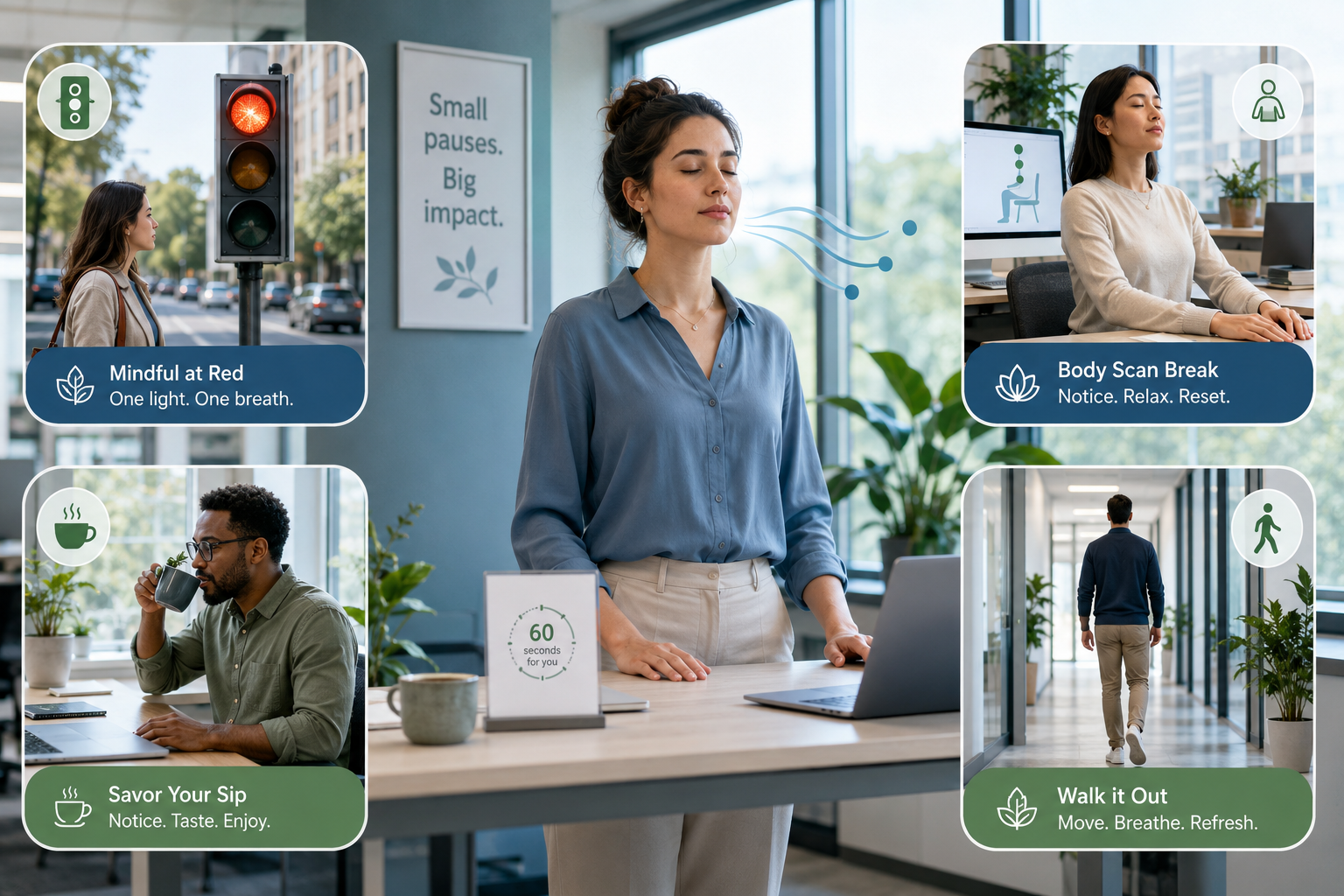
Quick Mindfulness Tricks You Can Do at Work or in Traffic
Mindfulness practices for people who dislike traditional meditation are especially practical in everyday environments. You do not need a quiet room or a break room.
At work:
- Before opening email, take three slow breaths and notice the physical sensation of your hands on the keyboard.
- During a meeting, pick one sensory input (the sound of voices, the texture of your chair) and hold attention on it for 30 seconds.
- Set a phone alarm labeled “notice” once per hour. When it goes off, pause for 60 seconds and observe what you are feeling physically and mentally.
In traffic:
- At a red light, place both hands flat on the steering wheel and notice the texture and temperature.
- Instead of reaching for the radio, spend 60 seconds listening to ambient sound.
- Notice three things you can see clearly and three things in the periphery.
These micro-practices accumulate. Research from Carnegie Mellon University (2012) found that even brief mindfulness training (25 minutes over three days) reduced psychological stress and improved cognitive performance.
Cheapest Ways to Start Mindfulness Without Apps or Classes
The most effective mindfulness practices for people who dislike traditional meditation cost nothing. Apps and classes can be useful, but they are not necessary.
Free starting points:
- Jon Kabat-Zinn’s free talks: Available on YouTube, covering the foundational concepts of MBSR without requiring enrollment.
- The STOP technique: Stop, Take a breath, Observe your thoughts and feelings, Proceed. This four-step check-in takes under a minute and requires no tools.
- Library resources: Kabat-Zinn’s book “Full Catastrophe Living” (1990, updated 2013) is available at most public libraries and covers the full MBSR curriculum.
- Pen and paper journaling: A present-moment journal requires only a notebook.
- Walking outside: Mindful walking in a park, neighborhood, or even a parking lot is free and immediately accessible.
Avoid: Paying for an app before you have tried free techniques for at least two weeks. Most people discover their preferred approach through low-cost experimentation, not through premium subscriptions.
What Physical Signs Mean Mindfulness Is Actually Working
Mindfulness produces measurable physical changes, even in short sessions. You do not need to feel “zen” for the practice to be working.
Observable signs that mindfulness is having an effect:
- Slower, deeper breathing: Most people shift from shallow chest breathing to diaphragmatic breathing within two to three minutes of focused attention.
- Reduced muscle tension: Jaw unclenching, shoulder dropping, hand relaxing. These happen involuntarily as the nervous system shifts state.
- Slower heart rate: Not dramatic, but noticeable. A sense of the chest “settling.”
- Reduced mental urgency: The feeling that you must immediately respond to every thought decreases. Thoughts feel more like passing observations than urgent commands.
- Improved sensory clarity: Colors, sounds, and textures briefly feel more vivid. This is a sign that the brain’s attentional filter has shifted from internal rumination to external input.
Over weeks of consistent practice, longer-term signs include better sleep onset, reduced reactivity in stressful situations, and improved ability to pause before responding to frustration.
FAQ
Do I have to meditate to be mindful? No. Meditation is one method for practicing mindfulness, not a requirement. Any activity done with full, deliberate present-moment attention qualifies as a mindfulness practice.
How long before I notice a difference from non-meditation mindfulness? Most people notice a subtle shift in stress levels within one to two weeks of daily practice, even with sessions as short as two minutes. More significant changes in reactivity and focus typically appear after four to eight weeks.
Is mindfulness the same as relaxation? No. Relaxation is a possible outcome of mindfulness, not its definition. Mindfulness involves paying attention to what is present, which sometimes includes discomfort, anxiety, or boredom.
Can I do mindfulness while listening to music? Yes, if the music is the object of your attention. Listening closely to the texture of instruments, the rhythm, and the emotional quality of sound is a legitimate mindfulness practice. Using music as background noise while your mind wanders elsewhere is not.
What if I fall asleep during a mindfulness practice? Falling asleep means your nervous system needed rest. It is not a failure. For people prone to falling asleep, standing or walking practices are more effective than lying down or sitting in a very comfortable chair.
Is mindfulness safe for everyone? For most people, yes. However, people with trauma histories, psychosis, or severe dissociative disorders should work with a mental health professional before starting intensive mindfulness practice, as some techniques can temporarily increase distress.
Do I need a teacher or can I learn on my own? Most people can start independently using books, free online resources, or simple techniques like mindful walking. A teacher or structured program (like MBSR) is helpful but not required for basic practice.
What is the difference between mindfulness and deep breathing exercises? Deep breathing is a physiological technique that directly changes nervous system state. Mindfulness is an attentional practice. They overlap when you breathe slowly while also paying full attention to the breath, but they are not the same thing.
Conclusion
Mindfulness practices for people who dislike traditional meditation are not a compromise or a lesser version of the real thing. They are, for many people, the more effective version. The core skill — redirecting attention to the present moment — can be built through walking, cooking, exercise, sensory grounding, or a 60-second pause at a red light.
Actionable next steps:
- Pick one activity you already do daily (walking to your car, washing dishes, making coffee) and commit to doing it with full sensory attention for one week.
- Try the STOP technique (Stop, Take a breath, Observe, Proceed) once per day for the next five days.
- If you have ADHD or high anxiety, start with outward-focused grounding (5-4-3-2-1) rather than breath-focused techniques.
- Track your results simply: after each practice, write one sentence about what you noticed. This builds self-awareness without requiring a formal journaling habit.
- Give any new technique at least two weeks before deciding whether it works for you. Initial awkwardness is normal and not a signal to stop.
The goal is not to become a meditator. The goal is to spend more of your day actually present in it.
References
- Kabat-Zinn, J. (1990). Full Catastrophe Living. Delacorte Press.
- Holzel, B. K., et al. (2011). Mindfulness practice leads to increases in regional brain gray matter density. Psychiatry Research: Neuroimaging, 191(1), 36-43.
- Teut, M., et al. (2013). Mindful walking in psychologically distressed individuals. Evidence-Based Complementary and Alternative Medicine.
- Levy, D. M., et al. (2012). The effects of mindfulness meditation training on multitasking in a high-stress information environment. Graphics Interface Conference, Carnegie Mellon University.
- Cairncross, M., & Miller, C. J. (2018). The effectiveness of mindfulness-based therapies for ADHD. Journal of Attention Disorders, 24(5), 627-643.
- Gotink, R. A., et al. (2015). Standardised mindfulness-based interventions in healthcare: An overview of systematic reviews and meta-analyses. PLOS ONE, 10(4).
Read next: Managing Decision Fatigue in Solo Entrepreneurship: A Practical Guide for 2026. A closer look at decision fatigue for entrepreneurs.