
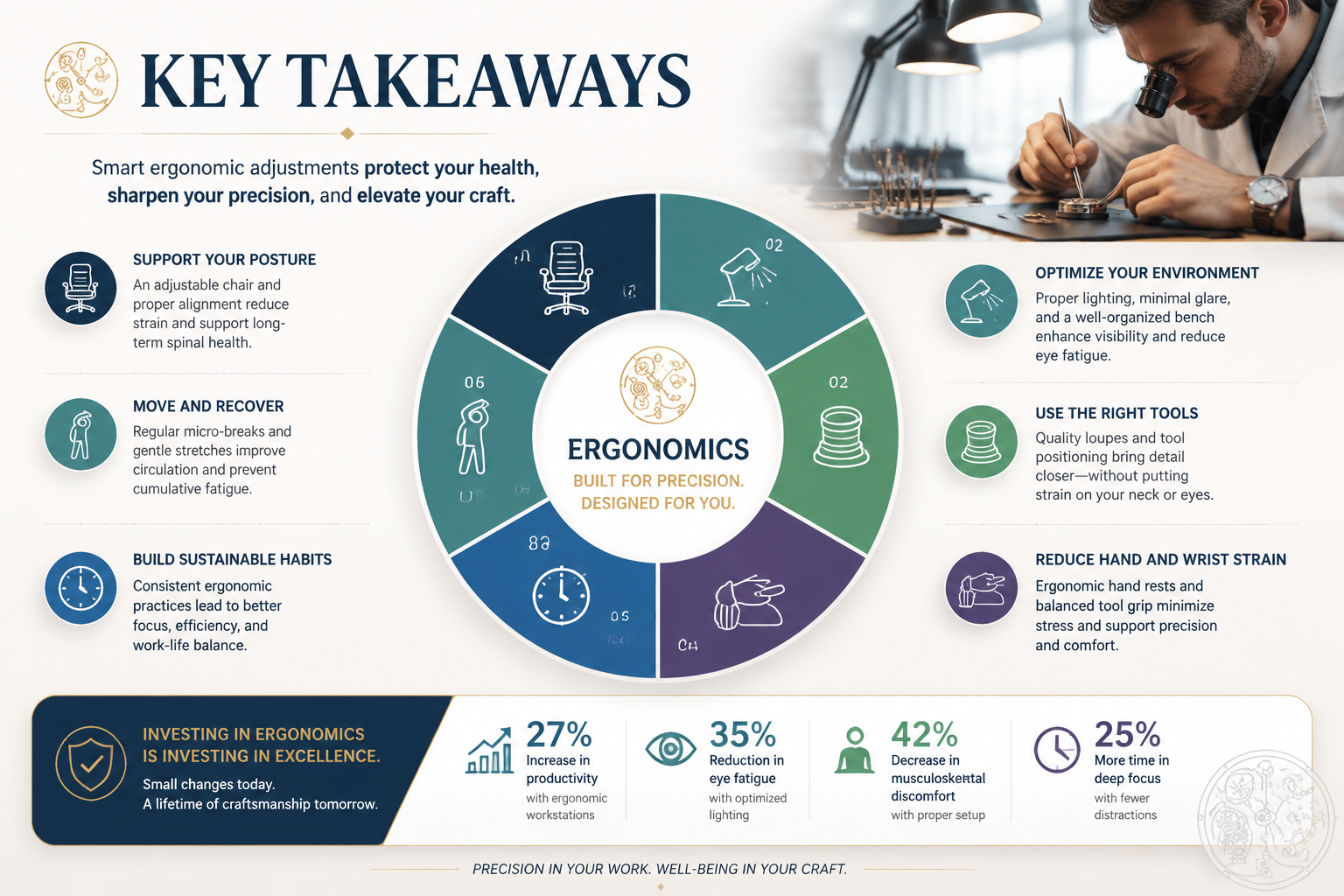
Key Takeaways
- Watchmakers face unusually high rates of musculoskeletal strain because of sustained static postures, fine motor demands, and prolonged close-focus visual work.
- The most important ergonomic adjustments are workbench height, chair support, and magnification positioning, because these directly affect the spine, wrists, and eyes simultaneously.
- Anti-fatigue mats, wrist rests, and ergonomic tweezers are low-cost tools that make a measurable difference in daily comfort.
- Proper lighting, including a combination of adjustable task lighting and anti-glare diffusers, reduces neck flexion caused by leaning toward dim work surfaces.
- Physical therapy exercises targeting the hands, wrists, forearms, and cervical spine are recommended as a daily routine for professional watchmakers.
- A professional ergonomic watchmaking setup typically costs between $800 and $4,000 depending on the quality of the chair, bench, and magnification system.
- Older watchmakers benefit most from height-adjustable benches, higher-magnification loupes, and more frequent movement breaks.
- Swiss watch manufacturers and vocational training institutes increasingly include ergonomic training as part of formal watchmaking curricula.
What Are the Most Common Ergonomic Issues for Watchmakers?
The most common ergonomic problems for watchmakers are neck and upper back pain from forward head posture, wrist and finger strain from repetitive fine motor tasks, and eye fatigue from sustained close-focus work under inadequate lighting. These issues develop gradually, often over years, and many watchmakers do not connect their physical symptoms to their work habits until the damage is significant.
Here is a breakdown of the most frequently reported issues:
- Forward head posture: Leaning toward a flat workbench pulls the cervical spine out of alignment. For every inch the head moves forward, the effective load on the neck increases substantially (according to occupational health research published by the National Institute for Occupational Safety and Health, NIOSH).
- Carpal tunnel syndrome and tendinitis: Sustained gripping of fine tools like tweezers and screwdrivers places repetitive stress on the tendons of the hand and wrist.
- Eye strain and headaches: Working at high magnification under inconsistent lighting forces the eyes to constantly readjust, causing fatigue and tension headaches.
- Lower back pain: Sitting on a non-supportive stool for six to eight hours without lumbar support compresses the lumbar discs over time.
- Shoulder tension: Holding the arms in a raised or unsupported position while manipulating small components creates chronic tension in the trapezius and deltoid muscles.
Common mistake: Many watchmakers treat these symptoms with pain relief rather than addressing the root cause in their workstation setup. Ergonomic adjustments for professional watchmakers should be the first line of response, not the last.
How to Set Up an Ergonomic Workbench for Precision Watch Repair
An ergonomic watchmaking workbench should be set at a height where the work surface sits approximately 2 to 4 inches above the watchmaker’s elbow when seated, allowing the forearms to rest comfortably without raising the shoulders. The work surface should ideally tilt between 10 and 20 degrees toward the user to reduce neck flexion.
Step-by-step workbench setup:
- Set bench height first. Sit in your working chair and measure from the floor to just above your elbow. Adjust the bench (or use a height-adjustable desk) to match.
- Add a tilted work surface insert. A 15-degree tilted board or watchmaker’s bench mat brings the work closer to eye level without requiring you to hunch.
- Position your movement holder centrally. The watch movement or component being worked on should sit directly in front of you, not off to one side.
- Install an articulating magnification arm. A boom-mounted binocular loupe or stereo microscope on an adjustable arm allows you to position optics at eye level rather than bending toward the work.
- Place tools within a 12-inch reach zone. Tools used most frequently should be within arm’s reach without twisting the torso.
- Use a green baize or anti-slip mat. This protects components and provides a soft surface that reduces wrist contact pressure.
- Add an anti-fatigue mat underfoot. Even when seated, a footrest or anti-fatigue mat under the feet improves circulation and reduces lower back load.
“The bench is the foundation of everything. Get that wrong, and no amount of stretching or supportive gear will fully compensate.” – A common principle among experienced watchmaking instructors.
Best Chairs and Seating Positions for Watchmaking Professionals
The best chair for a professional watchmaker is a height-adjustable saddle stool or an ergonomic task chair with lumbar support, adjustable armrests, and a seat pan that allows the hips to sit slightly higher than the knees. This posture keeps the pelvis in a neutral tilt and reduces pressure on the lumbar spine.
Key seating criteria:
| Feature | Recommended Specification |
|---|---|
| Seat height range | 18 to 30 inches (adjustable) |
| Lumbar support | Adjustable depth and height |
| Armrests | Height and width adjustable |
| Seat pan depth | Adjustable, 2 to 3 fingers behind knees |
| Base | Five-point caster base for stability |
| Material | Breathable mesh or firm foam |
Saddle stools vs. task chairs: Saddle stools encourage a more upright pelvis and are popular in Swiss watchmaking schools, but they require core strength to use comfortably for long sessions. A full ergonomic task chair with lumbar support is better for watchmakers who already have lower back issues.
Seating position checklist:
- Feet flat on the floor or on a footrest
- Knees at approximately 90 degrees or slightly open
- Hips at or slightly above knee height
- Lower back supported by the chair’s lumbar curve
- Shoulders relaxed, not raised
- Elbows close to the body, forearms parallel to the bench surface
What Tools Help Reduce Hand Strain When Working with Tiny Watch Components?
Ergonomic hand tools specifically designed for micro-mechanical work reduce grip force, improve control, and lower the risk of repetitive strain injury. The key tools are wide-grip or cushioned tweezers, anti-vibration finger cots, padded screwdriver handles, and wrist support rests.
Recommended tools for hand strain reduction:
- Ergonomic tweezers: Models with wider, textured grips require less pinch force than standard watchmaker’s tweezers. Brands like Dumont and Horotec offer professional-grade options.
- Padded screwdriver handles: Larger diameter handles distribute grip force over a wider area, reducing tendon stress.
- Wrist and palm rests: Gel or memory foam wrist rests keep the wrist in a neutral position during fine work.
- Anti-vibration finger cots: Thin silicone covers worn on the fingertips dampen micro-vibrations from tools and reduce tactile fatigue.
- Movement holders and watch vises: Holding the watch movement in a proper vise eliminates the need to grip the case with the non-dominant hand for extended periods.
- Ball-bearing tool handles: Handles that rotate freely reduce the torque transferred to the wrist during screwdriving tasks.
Choose ergonomic tweezers if: You work more than four hours daily on movements and notice finger fatigue or numbness by midday. Standard tweezers are fine for occasional hobbyist work but are inadequate for professional daily use.
How Much Does a Professional Ergonomic Watchmaking Setup Cost?
A complete professional ergonomic watchmaking setup costs between $800 and $4,000, depending on the quality of the chair, bench, and magnification system. Budget setups using mid-range components can be assembled for under $1,200, while high-end configurations with a stereo microscope and height-adjustable bench can exceed $3,500.
Estimated cost breakdown:
| Component | Budget Option | Professional Option |
|---|---|---|
| Ergonomic chair or saddle stool | $150 – $300 | $500 – $1,200 |
| Height-adjustable workbench | $200 – $400 | $600 – $1,500 |
| Magnification (loupe or microscope) | $80 – $200 | $400 – $1,500 |
| Task lighting (LED adjustable) | $40 – $80 | $150 – $400 |
| Wrist rests and anti-fatigue mat | $30 – $60 | $80 – $150 |
| Ergonomic tools (tweezers, handles) | $50 – $100 | $150 – $300 |
Edge case: Many professional watchmakers working in high-volume repair shops are not provided ergonomic equipment by their employer. In those cases, personal investments in a quality chair and wrist support tools offer the highest return on comfort per dollar spent.
What Health Risks Do Watchmakers Face from Long-Term Precision Work?
Long-term precision work exposes watchmakers to a specific cluster of occupational health risks, including musculoskeletal disorders, vision deterioration, and stress-related conditions. Without ergonomic adjustments for professional watchmakers, these risks compound over a career spanning decades.
Primary long-term health risks:
- Repetitive strain injury (RSI): Affects the tendons of the fingers, wrists, and forearms from sustained fine motor repetition.
- Cervical spondylosis: Degenerative changes in the neck vertebrae accelerated by chronic forward head posture.
- Carpal tunnel syndrome: Compression of the median nerve at the wrist, causing numbness and weakness in the hand.
- Presbyopia acceleration: While age-related, prolonged close-focus work may increase the rate at which near vision deteriorates.
- Chronic lower back pain: From prolonged sitting without adequate lumbar support.
- Occupational stress: The mental demand of high-precision work combined with physical discomfort creates a compounding stress load.
Can You Prevent Repetitive Strain Injury as a Watchmaker?
Repetitive strain injury is largely preventable for watchmakers through a combination of ergonomic workstation setup, tool selection, scheduled rest breaks, and daily stretching exercises. Prevention is far more effective than treatment, and most RSI cases in watchmaking develop over months or years of accumulated poor habits.
Prevention strategies:
- Take a 5-minute break every 45 to 60 minutes of precision work. Stand, walk briefly, and shake out the hands.
- Use the minimum grip force necessary for each task. Many watchmakers over-grip tools out of habit, not necessity.
- Alternate between tasks requiring different hand positions when possible.
- Perform daily wrist and finger stretches before and after work sessions (see the physical therapy section below).
- Keep the wrist in a neutral, straight position during tool use. Avoid sustained ulnar or radial deviation.
Are There Specific Physical Therapy Exercises for Watchmakers?
Yes, physical therapists who work with precision craftspeople recommend a specific set of exercises targeting the cervical spine, shoulders, forearms, wrists, and fingers. These exercises are most effective when performed daily, both before starting work and during breaks.

Recommended daily exercise routine:
Wrist and hand (perform 2 sets, 10 reps each):
- Wrist flexion and extension stretches (hold 15 seconds each direction)
- Finger spread and squeeze (open hand wide, then make a loose fist)
- Thumb opposition (touch each fingertip to the thumb in sequence)
- Prayer stretch (press palms together, lower hands until a stretch is felt in the wrists)
Neck and upper back (perform 2 sets, 10 reps each):
- Chin tucks (gently pull the chin straight back, hold 5 seconds)
- Neck side bends (ear toward shoulder, hold 15 seconds each side)
- Shoulder rolls (backward, 10 slow rotations)
- Doorway chest stretch (arms at 90 degrees against a doorframe, lean forward gently)
Lower back:
- Seated pelvic tilts (flatten the lower back against the chair back, hold 5 seconds)
- Standing hip flexor stretch (lunge position, hold 20 seconds each side)
A registered physiotherapist can tailor these exercises further based on individual symptoms. Watchmakers with existing RSI or cervical pain should seek professional assessment before beginning a new exercise program.
Lighting and Magnification Tips to Reduce Eye and Neck Strain
Proper lighting for watchmaking should combine a bright, adjustable LED task light positioned at a 45-degree angle to the work surface with an anti-glare diffuser to eliminate reflective hotspots on metal components. Magnification should be positioned at eye level to eliminate the need to tilt the head downward.
Lighting recommendations:
- Use a color temperature between 4,000K and 5,000K (neutral to cool white) for accurate color rendering of watch components.
- Minimum illuminance of 1,000 lux at the work surface is recommended for fine watch repair (based on occupational lighting guidelines from the Illuminating Engineering Society).
- Position the light source to the side and slightly behind the work to minimize glare and shadow.
- Avoid fluorescent overhead lighting as the sole source, as it creates flat illumination with poor depth perception.
Magnification and neck posture:
- A stereo microscope on an adjustable arm is the gold standard for professional watchmakers. It allows the head to remain upright while providing 10x to 40x magnification.
- Headband loupes (2.5x to 5x) are portable and useful for bench work, but they must be fitted correctly to avoid neck flexion.
- The magnification eyepiece or loupe should be adjusted so the watchmaker’s gaze is level or only slightly downward (no more than 15 degrees below horizontal).
Ergonomic Modifications That Work Best for Older Watchmakers
Older watchmakers benefit most from three specific ergonomic adjustments: higher magnification systems to compensate for presbyopia, height-adjustable benches to accommodate changing flexibility, and more frequent structured movement breaks to counteract reduced tissue recovery rates.
Additional considerations for watchmakers over 50:
- Higher magnification: As near vision changes with age, upgrading from a 2.5x loupe to a 4x or 5x loupe (or a stereo microscope) reduces the temptation to lean closer to the work.
- Softer grip tools: Reduced grip strength with age makes wide-handle, cushioned tools even more important.
- Increased break frequency: Moving from 60-minute to 40-minute work intervals with 5-minute movement breaks helps manage fatigue accumulation.
- Heated wrist supports: For watchmakers with arthritis, low-level heat therapy wraps worn during breaks can reduce morning stiffness and improve joint mobility.
- Footrests: Circulation in the lower legs often decreases with age; a footrest that allows slight leg movement (a rocking footrest) helps maintain blood flow.
Differences Between Amateur and Professional Ergonomic Workstations
A professional ergonomic watchmaking workstation differs from an amateur setup primarily in adjustability, durability, and the integration of magnification and lighting systems. Amateur setups typically use fixed-height benches, basic stools, and clip-on loupes. Professional setups use height-adjustable benches, certified ergonomic chairs, boom-mounted stereo microscopes, and calibrated task lighting.
| Feature | Amateur Setup | Professional Setup |
|---|---|---|
| Bench height | Fixed | Height-adjustable |
| Seating | Basic stool | Ergonomic saddle or task chair |
| Magnification | Clip-on or hand loupe | Boom-mounted stereo microscope |
| Lighting | Single desk lamp | Calibrated LED task light with diffuser |
| Wrist support | None | Gel or foam wrist rest |
| Tool ergonomics | Standard tweezers | Wide-grip, cushioned professional tools |
| Break structure | Informal | Scheduled, timer-based |
The investment gap is real, but the professional setup pays back through reduced injury risk, better work quality, and career longevity.
How Do Professional Swiss Watchmakers Manage Physical Workplace Stress?
Swiss watchmaking schools and manufacturers like those in the Vallée de Joux region incorporate ergonomic training into their apprenticeship programs, teaching posture, tool handling, and break scheduling as core professional skills alongside movement assembly. The Swiss approach treats physical sustainability as inseparable from craft excellence.
Key practices from Swiss professional environments:
- Formal ergonomic assessments are conducted when watchmakers transition to new benches or roles.
- Apprentices are taught correct posture and tool grip from their first week of training.
- Manufacturers provide height-adjustable benches and quality seating as standard equipment, not optional upgrades.
- Regular occupational health check-ins monitor early signs of RSI or vision changes.
- Mental rest, including brief periods away from the bench between complex tasks, is built into the working day.
Recommended Wrist and Hand Protection for Micro-Mechanical Work
The most effective wrist and hand protection for watchmakers combines neutral-position wrist rests, anti-vibration finger cots, and compression glove liners worn during breaks. These tools do not impair dexterity during active work but significantly reduce cumulative strain over a full working day.
Protection options by use case:
- During active work: Gel wrist rest on the bench edge; anti-vibration silicone finger cots on the dominant index finger and thumb.
- During breaks: Light compression gloves to maintain circulation and reduce swelling in the hands and wrists.
- After work: Cold or contrast therapy (alternating warm and cool water immersion) for watchmakers with existing tendinitis symptoms.
- For travel or commuting: A wrist brace worn in a neutral position during long commutes can prevent additional strain on already-fatigued tendons.
Avoid: Tight wrist braces during active watchmaking. They restrict the fine motor movement required for precision work and can actually increase compensatory strain in the fingers.
FAQ: Ergonomic Adjustments for Professional Watchmakers
Q: How often should a watchmaker take breaks during a workday? A: A structured break of 5 minutes every 45 to 60 minutes is the standard recommendation for precision craftspeople. During these breaks, stand up, move around, and perform brief hand and neck stretches.
Q: Is a saddle stool better than an ergonomic task chair for watchmaking? A: It depends on the individual. Saddle stools promote an upright pelvis and are excellent for watchmakers with good core strength. Task chairs with lumbar support are better for those with existing lower back pain or who work very long sessions.
Q: What magnification level is best for daily watch repair work? A: Most professional watchmakers use 2.5x to 5x for general assembly and 10x to 40x stereo microscopy for hairspring and escapement work. The right level depends on the task and the watchmaker’s natural vision.
Q: Can ergonomic adjustments reverse existing RSI damage? A: Ergonomic changes can stop further damage and allow healing, but they do not reverse structural changes like tendon scarring or nerve compression. A physiotherapist should evaluate existing RSI before relying solely on ergonomic changes.
Q: How long does it take to notice benefits from ergonomic changes? A: Most watchmakers report reduced daily fatigue within one to two weeks of implementing proper seating and bench height adjustments. Longer-term improvements in chronic pain take two to three months of consistent ergonomic practice.
Q: Do I need a stereo microscope, or is a loupe sufficient? A: For occasional repair work, a quality loupe is sufficient. For full-time professional watchmaking, a stereo microscope is strongly recommended because it allows the head to remain upright and eliminates the neck strain associated with prolonged loupe use.
Q: What is the single most impactful ergonomic change a watchmaker can make? A: Correcting bench height is the single most impactful change. If the bench is too high or too low, every other adjustment is compensating for a fundamental misalignment.
Q: Are there ergonomic certifications for watchmaking workstations? A: There is no single universal certification, but occupational health standards from organizations like NIOSH (USA) and SUVA (Switzerland) provide relevant guidelines for precision craft workstations.
Q: How do I know if my current setup is causing harm? A: Warning signs include end-of-day neck or wrist pain, numbness or tingling in the fingers, frequent headaches, and eye fatigue that persists after leaving work. Any of these symptoms warrant a workstation review.
Q: Can younger watchmakers skip ergonomic investments? A: No. Ergonomic habits established early in a career prevent the cumulative damage that becomes debilitating later. Starting with good practices is far easier than correcting years of bad posture and tool habits.
Conclusion: Taking Action on Ergonomic Adjustments for Professional Watchmakers
The physical demands of watchmaking are real and often underestimated. A career built on precision and patience deserves a workspace built on the same principles. Ergonomic adjustments for professional watchmakers are not a luxury or a sign of weakness; they are a professional investment in the quality of your work and the longevity of your career.
Actionable next steps:
- Audit your current setup this week. Sit at your bench in your normal working position and check: Are your shoulders raised? Is your neck bent forward? Are your wrists angled? Each “yes” identifies a priority adjustment.
- Start with bench height and seating. These two changes have the greatest impact and the clearest return on investment.
- Add a structured break schedule. Set a timer. Take 5 minutes every 45 minutes. Do the wrist and neck exercises described above.
- Upgrade your magnification if you lean toward your work. A boom-mounted loupe or entry-level stereo microscope will change your posture immediately.
- Consult a physiotherapist if you have existing symptoms. Do not wait for pain to become chronic before seeking professional guidance.
The watchmakers who sustain long, productive careers are not necessarily the most talented. They are often the ones who treated their bodies with the same care they gave to the movements on their bench.
References
- National Institute for Occupational Safety and Health (NIOSH). Work-Related Musculoskeletal Disorders & Ergonomics. CDC/NIOSH, 2020. https://www.cdc.gov/niosh/topics/ergonomics/
- Illuminating Engineering Society (IES). Lighting Handbook, 10th Edition. IES, 2011.
- SUVA Swiss National Accident Insurance Fund. Ergonomics at the Workplace: Guidelines for Precision Work. SUVA, 2019. https://www.suva.ch
- Punnett, L., & Wegman, D. H. Work-related musculoskeletal disorders: the epidemiologic evidence and the debate. Journal of Electromyography and Kinesiology, 14(1), 13-23, 2004.
- Kapandji, I. A. The Physiology of the Joints, Volume 3: The Spinal Column, Pelvic Girdle and Head. Churchill Livingstone, 2008.
Read next: The Art of Kintsugi for Beginners: Repairing Broken Ceramic Mugs with Gold Mica. A closer look at kintsugi for beginners.