
Key Takeaways
- Kintsugi translates roughly to “golden joinery” and treats breakage as part of an object’s history rather than a flaw to conceal.
- Gold mica powder mixed with food-safe epoxy or a dedicated kintsugi adhesive is the most accessible method for beginners in 2026.
- A starter kit costs between $20 and $50; buying individual materials separately can be cheaper if you plan multiple repairs.
- Most ceramic mugs, bowls, and plates are suitable for kintsugi, but very thin porcelain and glazed pieces with large missing chunks are harder to work with.
- The repair process has three main stages: bonding, filling, and finishing, spread over one to three days of drying time.
- Common beginner mistakes include rushing the adhesive cure, applying too much gold powder at once, and skipping surface preparation.
- Kintsugi-repaired mugs can be food-safe and durable if you use the right adhesive, but they should not go in the dishwasher or microwave.
- Kids aged 10 and older can participate with adult supervision, especially with modern non-toxic kintsugi kits.
What Exactly Is Kintsugi and How Does It Work
Kintsugi (pronounced “kin-tsoo-gi”) is a centuries-old Japanese art form that repairs broken pottery by joining the pieces with lacquer or adhesive mixed with powdered gold, silver, or platinum. The philosophy behind it holds that breakage and repair are part of an object’s story, not something to be ashamed of or hidden.
The technique works by treating the adhesive itself as a decorative element. Instead of using clear glue and hoping the crack disappears, you deliberately highlight the break with a metallic finish. Traditional kintsugi uses urushi lacquer, a natural resin that requires weeks of curing in a humidity-controlled environment. The modern beginner version replaces urushi with two-part epoxy or specialized kintsugi adhesive, then adds gold mica powder to create the signature golden seam.
The art of kintsugi for beginners: repairing broken ceramic mugs with gold mica follows this same visual logic, just with materials that are safer and faster for home use. The result is a mug that looks intentionally beautiful rather than merely patched.
The core philosophy in one sentence: Kintsugi reframes damage as character, which is why the practice has attracted growing interest in Western craft communities alongside its traditional Japanese roots.
What Materials Do You Need to Do Kintsugi on a Broken Mug
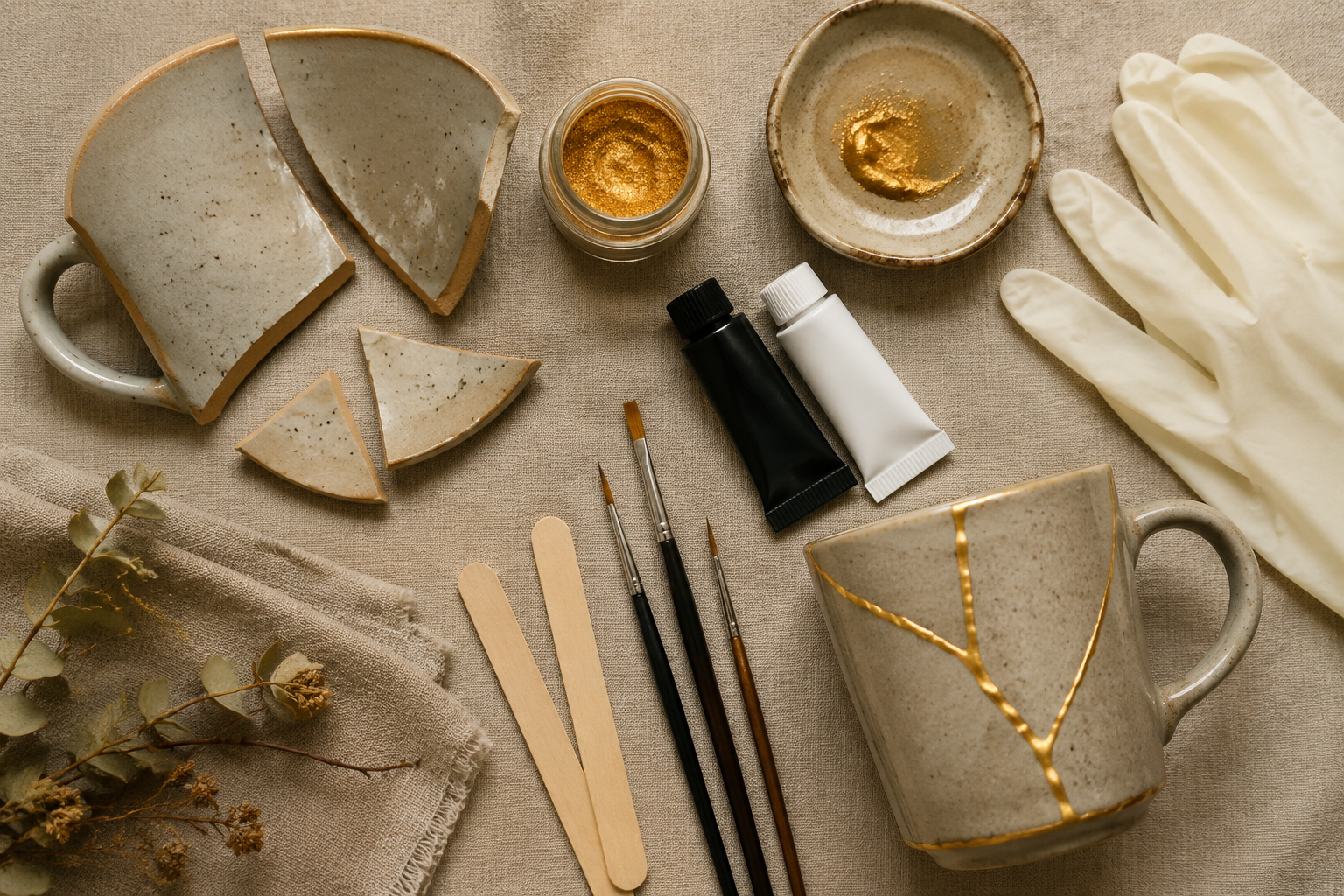
You need five core materials to complete a basic kintsugi repair at home: an adhesive, gold mica powder, fine brushes, mixing tools, and surface prep supplies.
Here is a clear breakdown:
| Material | What to Look For | Approximate Cost |
|---|---|---|
| Two-part epoxy or kintsugi adhesive | Food-safe, clear-drying, 5-minute or slow-cure | $8 to $15 |
| Gold mica powder | Cosmetic or food-grade, fine particle size | $5 to $12 per ounce |
| Fine artist brushes | Size 0 or 00, synthetic bristles | $3 to $8 |
| Mixing sticks and palette | Wooden sticks, ceramic tile, or silicone mat | $2 to $5 |
| Isopropyl alcohol (70% or higher) | For cleaning ceramic surfaces before bonding | $2 to $4 |
Optional but helpful: painter’s tape to hold pieces in place during curing, a magnifying glass for fine crack work, and nitrile gloves to protect your hands from epoxy.
Choose a slow-cure epoxy (30-minute or longer) if your mug has multiple pieces or complex breaks. Fast-setting 5-minute epoxy is fine for a single clean crack but gives you almost no time to adjust piece alignment.
How Much Does It Cost to Learn Kintsugi at Home
A beginner kintsugi repair costs between $20 and $50 total, depending on whether you buy a pre-made kit or source materials individually. Pre-made kits sold by craft retailers in 2026 typically include adhesive, gold powder, and brushes in one package, which is convenient but slightly more expensive per repair.
If you plan to repair more than two or three pieces, buying materials separately is more economical. A single ounce of gold mica powder, for example, can cover dozens of repairs.
Cost comparison:
- Pre-made beginner kit (3 to 5 repairs): $25 to $50
- Individual materials (10 or more repairs): $20 to $35 upfront
There are also online courses and in-person workshops that teach kintsugi, typically priced between $40 and $120 per session. These are worth considering if you want hands-on guidance, but they are not necessary for a basic mug repair.
Is Kintsugi Hard for Someone with No Craft Experience
No, kintsugi is not hard for beginners. The basic technique requires steady hands and patience, but no drawing ability, artistic training, or prior craft experience. If you can apply glue carefully and follow a sequence of steps, you can complete a successful repair.
The learning curve is mostly about timing: knowing when the adhesive is tacky enough to accept gold powder but not so dry that the powder won’t stick. Most beginners get this right by the second or third repair.
What actually trips people up is not skill, it is patience. The biggest source of failed repairs is rushing the curing step. Epoxy needs time to set fully before you add the gold layer, and the gold layer needs time to cure before you handle the piece.
Can I Use Kintsugi to Fix Any Type of Ceramic or Just Certain Kinds
Kintsugi works on most fired ceramics, including stoneware, earthenware, and standard porcelain. It works best on pieces with clean breaks where the fragments fit back together without large gaps.
Ceramics that work well:
- Stoneware mugs and bowls (the most forgiving surface for beginners)
- Earthenware plates and pots
- Standard porcelain cups with single or double fractures
Ceramics that are harder to repair:
- Very thin bone china or fine porcelain (the pieces are fragile and hard to align)
- Items with large missing chunks (you’d need a filler paste, which adds complexity)
- Unglazed porous ceramics (they absorb adhesive unevenly)
- Non-ceramic materials like glass, which require a different adhesive chemistry
The art of kintsugi for beginners: repairing broken ceramic mugs with gold mica is ideally suited to everyday stoneware mugs because they are thick, heavy, and have clean break lines that fit back together predictably.
Where Can I Buy Gold Mica for Kintsugi Repairs
Gold mica powder for kintsugi is widely available from craft stores, online marketplaces, and specialty art suppliers. In 2026, the easiest sources are Amazon, Etsy (from independent craft suppliers), and dedicated pottery supply shops like Sheffield Pottery or The Ceramic Shop.
What to look for when buying:
- Particle size: Fine or extra-fine grades (under 40 microns) blend more smoothly into epoxy and create a cleaner gold seam.
- Grade: Cosmetic-grade or food-safe mica is preferable for mugs you plan to drink from.
- Color: “Rich gold” or “antique gold” shades look most authentic. Avoid overly yellow or orange-tinted powders if you want a traditional look.
A standard one-ounce jar costs $5 to $12 and is enough for many repairs. Avoid craft glitter marketed as mica, since glitter has a much coarser particle size and will look chunky rather than smooth.
How Long Does a Typical Kintsugi Repair Take to Complete
A single kintsugi mug repair takes one to three days from start to finish, though active hands-on time is only about 30 to 60 minutes. The rest is waiting for adhesive to cure.
Step-by-step timeline:
- Surface preparation (10 minutes): Clean broken edges with isopropyl alcohol and let dry completely.
- Bonding (15 to 20 minutes active): Mix epoxy, apply to broken edges, press pieces together, and secure with tape. Let cure for the time specified on your adhesive (typically 24 hours for full strength).
- Gold application (10 to 15 minutes): Mix a small amount of gold mica powder into a fresh batch of epoxy or use a thin layer of adhesive as a base and dust powder over it while tacky. Apply along the seam with a fine brush.
- Final cure (4 to 24 hours): Let the gold layer set fully before handling.
- Optional finishing (10 minutes): Gently buff away any excess gold powder with a soft cloth once fully cured.
Total elapsed time: 24 to 48 hours for a clean, durable finish.
What Are Common Mistakes Beginners Make with Kintsugi
The most common beginner mistakes are rushing the cure, using too much gold powder, and skipping surface cleaning. Each of these leads to a repair that either fails structurally or looks messy.
Mistake 1: Not cleaning the ceramic edges before bonding. Oils, dust, and old residue prevent epoxy from bonding properly. Always wipe edges with isopropyl alcohol and let them dry for five minutes before applying adhesive.
Mistake 2: Using fast-setting epoxy on complex breaks. Five-minute epoxy sets before you can align multiple pieces. Use 30-minute or slow-cure epoxy for anything more than a single crack.
Mistake 3: Applying gold powder before the adhesive is tacky. If you add gold too early, it sinks into wet epoxy and loses its surface shimmer. If you add it too late, it won’t stick. The right window is when the adhesive feels slightly sticky but no longer transfers to your finger when touched lightly.
Mistake 4: Piling on too much gold powder. A thin, even layer looks far more elegant than a thick clump. Apply gold in light passes with a dry brush, building up gradually.
Mistake 5: Washing the repaired mug in the dishwasher. Dishwasher heat and detergent degrade epoxy bonds over time. Hand-wash kintsugi pieces only.
Is Kintsugi More Expensive Than Just Buying a New Mug
For a single repair, kintsugi is often more expensive than buying a replacement mug. A basic ceramic mug costs $5 to $15 at most retailers, while your first kintsugi repair kit costs $20 to $50. However, this comparison misses the point for most people who choose kintsugi.
People repair mugs with kintsugi because the mug has sentimental value, because they want to learn the craft, or because they find the aesthetic result more appealing than a factory-new piece. Once you own the materials, each additional repair costs almost nothing extra.
Choose kintsugi if: The mug has personal significance, you want a creative project, or you plan to repair multiple pieces over time.
Buy a replacement if: The mug has no sentimental value and you need a functional cup quickly.
Can Kids Do Kintsugi or Is It Just for Adults
Children aged 10 and older can do kintsugi with adult supervision, especially using modern non-toxic kintsugi kits designed for home use. The main safety concern is epoxy, which can irritate skin and eyes during mixing. Nitrile gloves and good ventilation address this.
Younger children (under 10) should not handle epoxy directly, but they can participate in the gold powder application step once an adult has prepared the adhesive base. Several craft brands now sell water-based kintsugi kits with lower toxicity profiles specifically marketed for family use.
The art of kintsugi for beginners: repairing broken ceramic mugs with gold mica is actually a meaningful activity to do with older children because it teaches patience, the value of repair over replacement, and a concrete lesson in the Japanese concept of wabi-sabi (finding beauty in imperfection).
How Durable Are Kintsugi-Repaired Items After Fixing
A properly cured epoxy kintsugi repair is structurally sound for everyday use, but it is not as strong as the original unfired ceramic bond. The repaired mug can hold liquid, be used for hot beverages, and be hand-washed without issue.
What the repair can handle:
- Hot liquids (coffee, tea) at normal drinking temperatures
- Hand washing with mild soap
- Normal daily use and light handling
What will shorten the repair’s life:
- Dishwasher cycles (heat and detergent degrade epoxy over time)
- Microwave use (uneven heating can stress the bond line)
- Dropping the mug again (the repaired seam is a weak point)
- Soaking in water for extended periods
With proper care, a well-executed kintsugi repair can last for years. Traditional urushi-based repairs, used by professional kintsugi artists, are considered food-safe and extremely durable, but they require specialized skills and weeks of curing that are beyond the scope of a beginner home project.
Step-by-Step Guide to Your First Kintsugi Repair
The art of kintsugi for beginners: repairing broken ceramic mugs with gold mica follows a straightforward sequence. Here is a condensed process you can follow on your first attempt.
What you need: Broken ceramic mug, two-part slow-cure epoxy, gold mica powder, two fine brushes, isopropyl alcohol, cotton swabs, nitrile gloves, painter’s tape, mixing stick, and a ceramic tile or silicone mat for mixing.
Step 1: Prepare the surfaces. Clean all broken edges with isopropyl alcohol. Let dry for five minutes. Lay out all pieces on your work surface so you know how they fit together before you add any adhesive.
Step 2: Mix and apply the adhesive. Mix a small amount of two-part epoxy according to package directions. Apply a thin, even layer to one broken edge using a mixing stick or brush. Press the pieces together firmly and hold for 60 seconds. Secure with painter’s tape and let cure for the time specified on your epoxy package (at least 12 hours, ideally 24).
Step 3: Apply the gold seam. Mix a small amount of gold mica powder into a fresh drop of epoxy until you get a thick, paint-like consistency. Using a fine brush, apply this mixture along the crack line. Work slowly and build up the layer in thin passes. Alternatively, apply a thin layer of plain epoxy along the seam and dust gold powder over it while the adhesive is tacky, then tap off the excess.
Step 4: Cure and finish. Let the gold layer cure fully (at least four hours, ideally overnight). Once cured, use a soft dry cloth to gently buff away any stray gold powder around the seam.
Step 5: Test before use. Fill the mug with water and check for leaks along the seam before using it for hot beverages.
FAQ
What does kintsugi mean in English? Kintsugi translates roughly to “golden joinery” or “golden repair” in Japanese. The word combines “kin” (gold) and “tsugi” (joinery or repair).
Do I need real gold for kintsugi? No. Traditional kintsugi uses gold dust mixed with urushi lacquer, but modern beginner versions use gold mica powder mixed with epoxy. Mica is a mineral pigment that mimics the appearance of gold at a fraction of the cost.
Is a kintsugi-repaired mug safe to drink from? Yes, if you use food-safe or cosmetic-grade gold mica and a food-safe epoxy. Avoid industrial-grade epoxies or craft glitters that contain non-food-safe pigments.
How do I keep the pieces aligned while the glue dries? Use painter’s tape wrapped around the mug to hold pieces in place. You can also prop the mug in a bowl of dry rice or sand to keep it stable during curing.
Can I repair a mug that is missing a small chip? Yes. Mix epoxy with gold mica to create a thick paste and fill the missing area. It will not perfectly match the original ceramic surface, but it will be structurally sound and visually intentional.
What is the difference between traditional kintsugi and modern kintsugi kits? Traditional kintsugi uses urushi lacquer (a natural tree resin) and real gold powder, requires weeks of humidity-controlled curing, and is practiced by trained artisans. Modern kits use epoxy and mica powder, cure in hours, and are designed for home use by beginners.
Can I use nail polish or craft glue instead of epoxy? Craft glue (like PVA) is not strong enough for structural ceramic repairs and will fail when exposed to liquid. Nail polish is not food-safe. Use two-part epoxy or a dedicated kintsugi adhesive for any mug you plan to drink from.
How do I remove excess gold powder after the repair cures? Use a soft dry cloth or a clean dry brush to gently buff away stray powder. Do not use water or solvent on the gold seam until it is fully cured.
Is kintsugi the same as Japanese wabi-sabi? They are related but not the same. Wabi-sabi is a broader Japanese aesthetic philosophy that finds beauty in imperfection and impermanence. Kintsugi is one specific practice that embodies wabi-sabi principles.
How many pieces can I repair from one kintsugi kit? Most beginner kits include enough materials for three to five repairs. If you buy materials individually, a single ounce of gold mica and a standard epoxy kit can cover ten or more repairs.
Conclusion
Kintsugi is one of the most accessible craft practices you can start at home in 2026, and it delivers something rare: a finished object that is more visually interesting than the original. The art of kintsugi for beginners: repairing broken ceramic mugs with gold mica requires no artistic background, costs under $50 to start, and produces results that are both functional and genuinely beautiful.
Your actionable next steps:
- Gather the mug you want to repair and assess the break. Clean breaks with two or three pieces are ideal for a first attempt.
- Order a beginner kintsugi kit or buy materials individually: slow-cure epoxy, fine gold mica powder, and size 00 brushes.
- Set aside a weekend so you are not rushed through the curing steps.
- Follow the five-step process above, and resist the urge to speed up the adhesive cure.
- Once you complete your first repair, consider repairing other ceramics in your home before buying replacements.
The crack in your mug is not a flaw. With kintsugi, it becomes the most interesting thing about it.
References
- Christy Bartlett, “Flickwerk: The Aesthetics of Mended Japanese Ceramics,” Museum für Lackkunst, 2008.
- Motoji Niikura, “The Art of Kintsugi,” Kyoto National Museum, 2015.
- Sheffield Pottery, “Ceramic Repair Supplies Guide,” sheffieldpottery.com, 2022.
Read next: How to Recycle Leftover Candle Wax Scraps into Clean-Burning Tealights. A closer look at recycle candle wax.