
Key Takeaways
- Sub-zero temperatures reduce the skin’s ability to retain moisture, causing the stratum corneum (the outermost protective layer) to crack and lose its barrier function rapidly.
- Windburn and repeated freeze-thaw cycles are more damaging to the skin barrier than cold alone, making wind protection as important as moisturizing.
- Professional barrier repair creams differ from regular lotions primarily in their occlusive ingredient content, not their price point.
- Ceramide-based products and petrolatum-heavy formulations are the most evidence-supported options for repairing damaged skin in extreme cold.
- Ingredients like alcohol, fragrance, and certain preservatives actively worsen cracked, weathered skin and should be avoided.
- Most barrier repair products show visible results within seven to fourteen days for mild damage; severe cracking or fissures may take four to eight weeks.
- Workplace safety programs in several Canadian provinces and Scandinavian countries recognize skin protection as an occupational health requirement, and some employer insurance plans cover barrier repair products.
- The cheapest effective approach combines petroleum jelly (around $3 to $5 per jar) with cotton glove liners worn under work gloves.
- Workers with sensitive skin can safely use barrier repair products, but should choose fragrance-free, dye-free formulations with minimal active ingredients.
What Is the Skin Barrier and Why Does It Break Down in Cold Weather
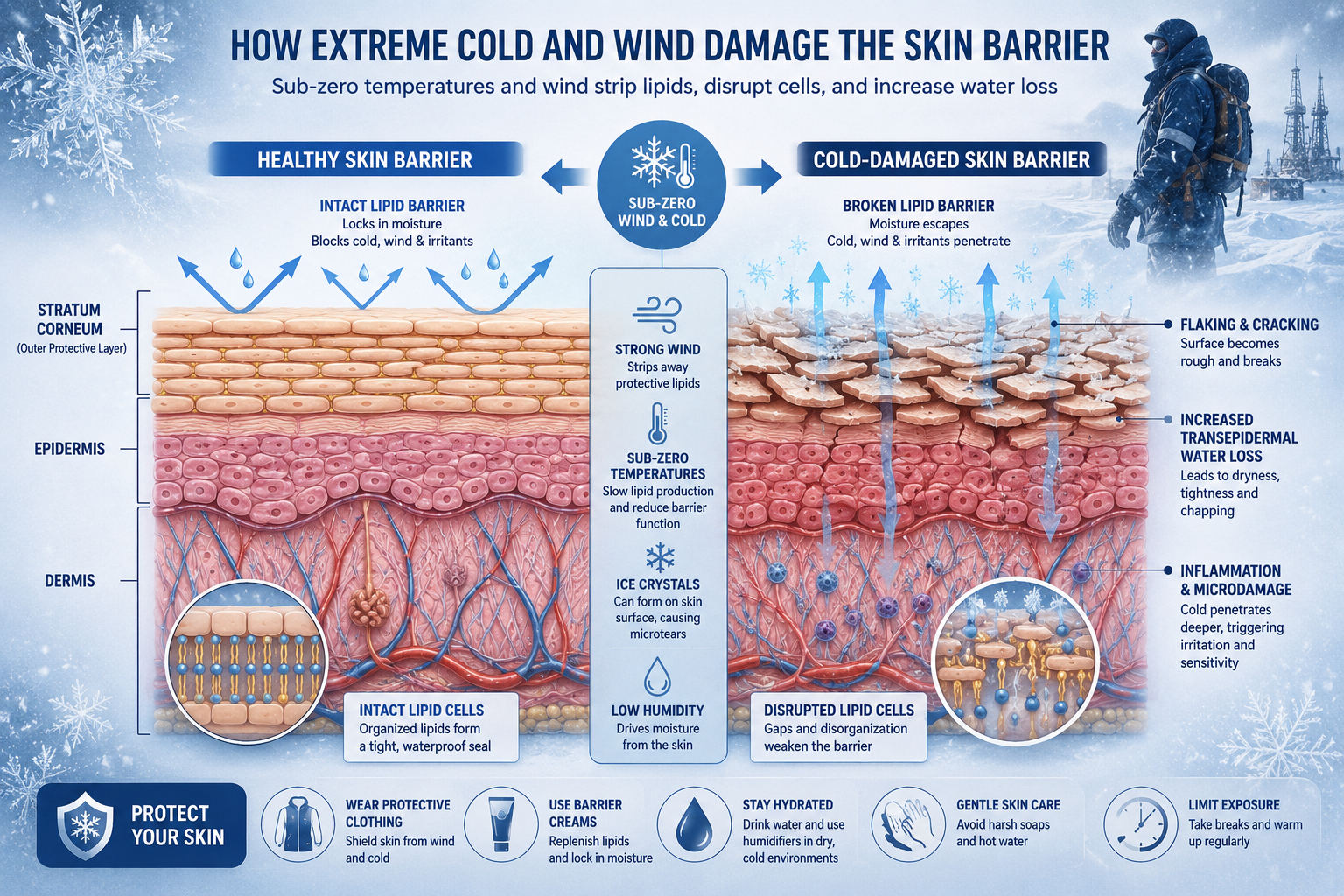
The skin barrier, specifically the stratum corneum, is the outermost layer of the epidermis. It acts as a physical seal made up of dead skin cells (corneocytes) held together by lipids, including ceramides, cholesterol, and fatty acids. In sub-zero temperatures, this lipid matrix loses flexibility, moisture evaporates faster from exposed skin, and the barrier physically cracks under mechanical stress from wind and repeated movement.
Cold air holds very little moisture. When outdoor workers are exposed to temperatures below freezing, the humidity gradient between their skin and the surrounding air pulls water out of the stratum corneum continuously. Wind accelerates this process dramatically. Research published in the journal Contact Dermatitis has documented that transepidermal water loss (TEWL) increases significantly in cold, windy conditions compared to indoor environments (Engebretsen et al., 2016).
What makes this worse for outdoor workers specifically:
- Repeated hand washing or contact with solvents, concrete, or metal strips residual lipids.
- Wearing gloves creates a wet-dry cycle inside the glove that further degrades the barrier.
- Facial skin exposed to wind and cold without protection experiences both physical abrasion and lipid depletion simultaneously.
- Workers rarely have time for extended skincare routines, so damage accumulates over weeks and months.
“The skin barrier doesn’t fail all at once. It erodes gradually, and most workers only notice the problem once cracking and bleeding begin, which means the barrier has already been compromised for weeks.”
Signs Your Skin Barrier Is Damaged from Working Outside in Winter
Damaged skin barrier from cold outdoor work presents in recognizable stages. Early signs are easy to dismiss; late-stage damage is painful and can interfere with work performance.
Early signs (weeks one to three of cold exposure):
- Skin feels tight or dry after washing
- Mild redness or rough texture on hands, face, or neck
- Slight itching, especially after coming indoors
Mid-stage signs:
- Visible flaking or scaling, particularly on knuckles and fingertips
- Redness that doesn’t resolve overnight
- Skin feels raw or sensitive to touch
Late-stage signs (barrier significantly compromised):
- Deep cracks or fissures, especially at knuckle joints and fingertips
- Bleeding from skin fissures
- Burning or stinging when water or cleaning products contact the skin
- Increased susceptibility to contact dermatitis from materials handled at work
If you’re experiencing bleeding fissures or signs of infection (swelling, warmth, pus), see a healthcare provider. These go beyond standard barrier repair and may require prescription treatment.
Best Moisturizers for Construction Workers and Outdoor Laborers in Arctic Conditions
The best moisturizers for outdoor workers in sub-zero climates are occlusive-dominant formulations that physically seal moisture into the skin rather than just adding water. For construction workers, oil rig crews, and others doing manual labor in extreme cold, the product also needs to be durable enough to last through glove wear and partial hand washing.
Top ingredient categories, ranked by evidence:
| Ingredient Type | Examples | Best For | Durability Under Gloves |
|---|---|---|---|
| Occlusive agents | Petrolatum, lanolin, beeswax | Sealing cracked skin, fissure repair | High |
| Ceramides | Ceramide NP, AP, EOP | Restoring lipid barrier structure | Moderate |
| Humectants | Glycerin, urea (5-10%) | Drawing moisture into skin | Low (needs occlusive on top) |
| Emollients | Shea butter, dimethicone | Smoothing and softening | Moderate |
Recommended product types for outdoor workers:
- Heavy barrier creams in tubs (not pumps): Products like CeraVe Healing Ointment, Eucerin Original Healing Cream, or Vaseline Intensive Care Advanced Repair contain petrolatum or ceramides and cost $8 to $20 at most pharmacies.
- Occupational barrier creams: Brands like Deb Group’s Stokoderm or O’Keeffe’s Working Hands are formulated for manual labor environments and are available through workplace safety suppliers.
- Lanolin-based products: Particularly effective for workers whose hands are exposed to both cold and mechanical abrasion. Bag Balm, originally a veterinary product, has a strong following among outdoor workers for this reason.
Choose a product based on your situation:
- Choose petrolatum-based products if your hands are already cracked and bleeding.
- Choose ceramide-rich creams if your barrier is mildly damaged and you want to rebuild its structure over time.
- Choose urea-based creams (10-20% urea) if your skin is thickened and callused, as urea helps soften and normalize the skin surface.
Difference Between Regular Lotion and Professional Barrier Repair Creams
Regular body lotions are designed primarily for cosmetic hydration in normal conditions. Professional barrier repair creams are formulated to restore compromised skin function in harsh environments. The difference is not always about price but about ingredient concentration and formulation structure.
Regular lotions typically contain 60-80% water, light emollients, and fragrance. They absorb quickly, feel pleasant, but provide minimal protection in sub-zero wind. For skin barrier repair for outdoor workers in sub-zero climates, these products evaporate too quickly to be effective during a work shift.
Key differences:
- Occlusive content: Professional barrier creams contain 10-40% petrolatum, lanolin, or wax. Regular lotions contain less than 5%.
- Water content: Lower water content in barrier creams means less evaporative cooling and better durability.
- Fragrance: Most professional barrier repair products are fragrance-free; many regular lotions are not.
- pH: Some barrier repair creams are formulated to match the skin’s natural acidic pH (around 4.5-5.5), which supports the skin’s own repair mechanisms.
A $4 jar of petroleum jelly outperforms a $25 scented body lotion for actual barrier repair in cold conditions. Price is not the determining factor.
How Much Do Professional Skin Barrier Repair Treatments Cost
Costs range from under $5 to over $200 depending on whether you’re using over-the-counter products, prescription treatments, or clinical procedures.
Cost breakdown by category:
- Over-the-counter barrier creams: $4 to $25 per unit. Petroleum jelly is the cheapest effective option. Ceramide-based creams (CeraVe, Eucerin) run $12 to $20. Occupational-grade products like O’Keeffe’s Working Hands cost $8 to $12.
- Prescription treatments: If barrier damage leads to eczema or dermatitis, a dermatologist may prescribe topical corticosteroids ($15 to $80 with insurance) or newer barrier-repair prescription creams.
- Dermatologist consultation: $100 to $300 per visit without insurance in most of the US and Canada. Many workplace health programs cover this.
- Clinical skin barrier treatments: Procedures like prescription clobetasol or tacrolimus for severe occupational dermatitis can run $50 to $150 per month.
For most outdoor workers, the effective cost of prevention and basic repair is $10 to $30 per month.
Can Outdoor Workers with Sensitive Skin Use Barrier Repair Products
Yes, workers with sensitive skin can and should use barrier repair products, but product selection matters. Sensitive skin is often a sign of an already-compromised barrier, which makes barrier repair even more important, not less.
What to look for on the label:
- Fragrance-free (not just “unscented,” which can still contain masking fragrances)
- Dye-free
- Free of preservatives like methylisothiazolinone (MI) or methylchloroisothiazolinone (MCI), which are common contact allergens in occupational settings
- Free of lanolin if you have a known lanolin sensitivity (uncommon but real)
Products like Vanicream Moisturizing Skin Cream and CeraVe Moisturizing Cream are widely recommended for sensitive skin in clinical settings and are affordable enough for daily occupational use.
If you develop a rash or increased redness after starting a new product, stop using it and patch-test alternatives on your inner arm for 48 hours before applying to damaged skin.
Cheapest Ways to Prevent Skin Damage When Working in Extreme Cold
Effective prevention doesn’t require expensive products. The cheapest and most evidence-supported approach for skin barrier repair for outdoor workers in sub-zero climates combines basic occlusive protection with behavioral changes.
Low-cost prevention strategy (under $15 total):
- Apply a thin layer of petroleum jelly to hands, face, and any exposed skin before your shift.
- Wear cotton glove liners under work gloves to reduce the wet-dry cycle inside the glove.
- Use a balaclava or neck gaiter to protect facial skin from wind.
- After your shift, wash with a gentle, soap-free cleanser (Dove Sensitive Skin bar, around $2) rather than harsh soaps.
- Apply a heavier barrier cream immediately after washing while skin is still slightly damp.
- Drink adequate water throughout the shift. Dehydration worsens TEWL.
What doesn’t work:
- Applying lotion and immediately going back outside in the cold without an occlusive layer on top.
- Using hand sanitizer repeatedly without following up with a barrier cream (alcohol-based sanitizers strip lipids rapidly).
- Relying on gloves alone without skin preparation underneath.
Ingredients to Avoid If You Have Rough, Weathered Skin from Manual Labor
Certain ingredients actively damage an already-compromised skin barrier and should be avoided by outdoor workers with weathered skin.
Avoid these ingredients:
- Alcohol (ethanol, isopropyl alcohol): Found in many hand sanitizers and some toners. Strips lipids and increases TEWL.
- Fragrance and parfum: One of the most common causes of contact dermatitis in occupational settings. Even “natural” fragrances can trigger reactions.
- Sodium lauryl sulfate (SLS): A detergent in many hand soaps that is particularly irritating to compromised skin. Switch to SLS-free cleansers.
- Retinoids (retinol, tretinoin): While useful for anti-aging in controlled settings, these thin the skin barrier and increase photosensitivity and cold sensitivity.
- Alpha hydroxy acids (AHAs) and beta hydroxy acids (BHAs): Exfoliating acids are counterproductive when the barrier is already damaged. They remove the very cells that are trying to rebuild the barrier.
- High concentrations of urea (above 20%): Lower concentrations (5-10%) are beneficial, but high concentrations act as a keratolytic (skin-removing) agent and can worsen raw or cracked skin.

Common Mistakes People Make Treating Windburn and Skin Cracking
The biggest mistake is treating windburn and cracking as a cosmetic problem rather than a functional one. This leads to product choices that feel good but don’t repair the barrier.
Frequent mistakes:
- Using light lotion instead of an occlusive: A water-based lotion on cracked skin evaporates within 30 minutes, leaving skin drier than before.
- Hot showers after cold exposure: Hot water strips residual skin oils and dramatically increases TEWL. Lukewarm water is better.
- Skipping application before the shift: Many workers apply moisturizer at night but not before going out. The protective layer needs to be in place before cold exposure, not just after.
- Picking or peeling cracked skin: This removes the partial barrier that’s already forming and introduces infection risk.
- Using the same product for face and hands: Facial skin is thinner and more reactive. What works on calloused hands may be too heavy or comedogenic for the face.
- Stopping the routine when skin improves: Barrier repair takes weeks, and the cold environment is still present. Stopping early leads to rapid re-damage.
Which Skin Barrier Products Work Fastest for Frostbite Prevention
For frostbite prevention specifically, occlusive products are the priority because they reduce heat loss from the skin surface and prevent moisture loss simultaneously. No topical product prevents frostbite on its own, but occlusive barriers reduce the risk of superficial frostbite (frostnip) on exposed skin.
Fastest-acting options:
- Petrolatum-based products (Vaseline, Aquaphor): Form an occlusive film within minutes of application and last several hours under mild conditions.
- Lanolin-based products: Similar occlusive properties with slightly better adherence to skin in wet conditions.
- Dimethicone-based barrier creams: Used in some military cold-weather protocols for their durability and water resistance.
Apply any of these products 10 to 15 minutes before going outside to allow the product to set. Reapply every two to three hours during extended outdoor exposure.
Important: Frostbite prevention is primarily about insulation and limiting exposure time. Topical products are a supplement to proper clothing, not a replacement.
Are Barrier Repair Products Covered by Work Safety Insurance
In some jurisdictions, yes. Whether barrier repair products are covered depends on your employer’s occupational health program, your country or province, and whether a healthcare provider has documented a work-related skin condition.
What’s typically covered:
- In Canada, Workers’ Compensation Boards in provinces like Alberta and British Columbia recognize occupational contact dermatitis as a compensable condition. Treatment costs, including prescription barrier repair products, may be reimbursable.
- In Scandinavian countries (Norway, Sweden, Finland), occupational skin disease is a recognized category under national workers’ compensation schemes, and dermatologist-prescribed treatments are generally covered.
- In the United States, OSHA does not mandate skin barrier protection specifically, but employers in industries like construction and oil and gas are increasingly including skin protection in their personal protective equipment (PPE) programs. Some employer-provided health plans cover prescription dermatology visits and treatments.
How to pursue coverage:
- Document your skin condition with photographs and a log of symptoms.
- See an occupational health physician or dermatologist who can link the condition to your work environment.
- Submit a claim through your employer’s occupational health or workers’ compensation program.
- Request that your employer include barrier creams in their PPE supply, which removes the cost entirely.
How Long Does It Take to Fully Repair the Skin Barrier After Winter Exposure
Recovery time depends on the severity of damage, consistency of treatment, and whether you continue working in the same cold conditions.
General timelines:
- Mild dryness and tightness: Three to seven days with consistent use of an occlusive moisturizer twice daily.
- Moderate damage (flaking, redness, early cracking): Two to four weeks with daily barrier cream application morning and night.
- Severe damage (deep fissures, bleeding, dermatitis): Four to eight weeks, and may require prescription treatment alongside over-the-counter products.
- Ongoing cold exposure: Full repair is difficult while the damaging environment persists. The realistic goal is management and prevention of worsening rather than complete resolution until the cold season ends.
Consistency matters more than product choice. Applying a basic petroleum jelly every day outperforms an expensive ceramide cream used sporadically.
FAQ
Q: Can I use cooking oils like coconut oil or olive oil instead of barrier creams? A: Coconut oil and olive oil have some occlusive properties and can help in mild cases. However, olive oil in particular has been shown in some studies to disrupt the skin barrier in people with eczema-prone skin. For outdoor workers with significant damage, purpose-formulated products with petrolatum or ceramides are more reliable.
Q: How often should I apply barrier cream during a work shift? A: For most workers in sub-zero conditions, applying before the shift and once during a break (every three to four hours) is sufficient. If you’re washing your hands frequently or working with water, reapply after each wash.
Q: Is petroleum jelly safe to use on the face every day? A: Yes. Petroleum jelly is non-comedogenic for most people and is widely used in clinical wound care. It’s one of the safest occlusive agents available. Some people with acne-prone skin prefer lighter alternatives, but for weathered, cold-damaged facial skin, it’s effective and safe.
Q: What’s the difference between windburn and frostbite? A: Windburn is superficial skin irritation caused by wind stripping moisture and lipids from the skin surface. It causes redness, stinging, and dryness but does not damage deeper tissue. Frostbite involves actual freezing of skin and underlying tissue and requires medical treatment. Windburn is a skin barrier issue; frostbite is a medical emergency.
Q: Should I use a humidifier at home if I work in cold outdoor conditions? A: Yes. Indoor heating systems in cold climates reduce indoor humidity significantly, which continues to dry out your skin even when you’re not outside. A humidifier set to 40-50% relative humidity at home supports overnight skin barrier recovery.
Q: Can gloves alone protect my hands without any moisturizer? A: Gloves reduce cold exposure and wind contact, but the wet-dry cycle inside gloves can actually worsen skin barrier damage over time. Moisturizing before putting on gloves and after removing them is necessary for complete protection.
Q: Are there any oral supplements that help with skin barrier repair? A: Omega-3 fatty acids (from fish oil or flaxseed) have some evidence supporting their role in skin barrier function. Vitamin D deficiency, which is common in workers with limited sun exposure in winter, has also been linked to impaired barrier function. Consult a healthcare provider before starting supplements.
Q: What should I do if my skin doesn’t improve after four weeks of treatment? A: See a dermatologist or occupational health physician. Persistent or worsening skin damage despite consistent treatment may indicate contact dermatitis, a secondary infection, or an underlying skin condition like psoriasis or eczema that requires specific treatment.
Conclusion
Skin barrier repair for outdoor workers in sub-zero climates is a practical occupational health issue, not a cosmetic concern. The cold strips the skin’s lipid barrier faster than most people realize, and the damage accumulates quietly until it becomes painful and functionally limiting.
Actionable next steps:
- Start before the damage is visible. Apply an occlusive barrier cream (petrolatum or ceramide-based) before every shift, not just when your skin hurts.
- Audit your current products. Check for alcohol, fragrance, and SLS in your soap and lotion. Replace them with fragrance-free, SLS-free alternatives.
- Add cotton glove liners. This single change reduces the wet-dry cycle that damages hands more than cold alone.
- Talk to your employer. Ask whether barrier creams can be added to your PPE kit. Many employers in construction, oil and gas, and forestry already supply them.
- Be consistent for at least four weeks. Barrier repair is slow. Daily application of even a basic product beats expensive products used inconsistently.
- See a professional if symptoms persist. Bleeding fissures, spreading redness, or skin that doesn’t improve after a month of consistent treatment warrants a dermatology visit.
The good news is that most outdoor workers can achieve meaningful skin barrier repair with products costing under $15 a month. The barrier wants to heal. Your job is to stop breaking it down faster than it can recover.
References
- Engebretsen, K. A., Johansen, J. D., Kezic, S., Linneberg, A., & Thyssen, J. P. (2016). The effect of environmental humidity and temperature on skin barrier function and dermatitis. Journal of the European Academy of Dermatology and Venereology, 30(2), 223-249. https://doi.org/10.1111/jdv.13301
- Elias, P. M. (2005). Stratum corneum defensive functions: An integrated view. Journal of Investigative Dermatology, 125(2), 183-200. https://doi.org/10.1111/j.0022-202X.2005.23668.x
- Fluhr, J. W., Darlenski, R., & Surber, C. (2008). Glycerol and the skin: Holistic approach to its origin and functions. British Journal of Dermatology, 159(1), 23-34. https://doi.org/10.1111/j.1365-2133.2008.08643.x
- Slodownik, D., Lee, A., & Nixon, R. (2008). Irritant contact dermatitis: A review. Australasian Journal of Dermatology, 49(1), 1-11. https://doi.org/10.1111/j.1440-0960.2007.00418.x
- Loden, M. (2003). Role of topical emollients and moisturizers in the treatment of dry skin barrier disorders. American Journal of Clinical Dermatology, 4(11), 771-788. https://doi.org/10.2165/00128071-200304110-00005
Read next: Air Filtration Strategies for Woodworkers with Asthma: A Complete Safety Guide. A closer look at air filtration for woodworkers.