
Quick Answer
Woodworkers with asthma need a layered approach to air quality: source capture (dust collection at the tool), ambient air filtration (ceiling or floor-mounted air cleaners rated for fine dust), and personal respiratory protection (a properly fitted respirator). No single device eliminates all risk, but combining these three strategies reduces airborne wood dust to levels that most asthmatic woodworkers can manage safely. Medical oversight from a pulmonologist familiar with occupational exposures is also strongly recommended.
Key Takeaways
- Wood dust contains particles smaller than 1 micron that bypass standard shop vacuums and trigger asthma attacks even hours after a work session ends.
- A true HEPA filter captures 99.97% of particles at 0.3 microns, making it the minimum standard for woodshop air cleaners used by asthmatic woodworkers.
- Table saws, routers, and random-orbit sanders generate the finest and most dangerous dust; these tools demand the most aggressive filtration at the source.
- Ambient air cleaners sized for woodshops should deliver at least 6 air changes per hour (ACH) for the workshop volume.
- Shop vacuums and dedicated dust collectors serve different purposes; you likely need both.
- Portable HEPA air cleaners are a legitimate option for small home workshops, provided they are correctly sized for the room.
- Half-face respirators with P100 filters outperform surgical masks and basic dust masks for asthmatic woodworkers.
- Good filtration reduces risk but does not eliminate it; asthmatic woodworkers should always have a rescue inhaler within reach.
- A common mistake is running dust collection only while cutting, then stopping it immediately after. Fine dust stays airborne for 30 minutes or more.
- Regular filter maintenance is as important as choosing the right equipment; a clogged filter can perform worse than no filter at all.
What Exactly Is Woodworking Dust and Why Is It Dangerous for Asthma
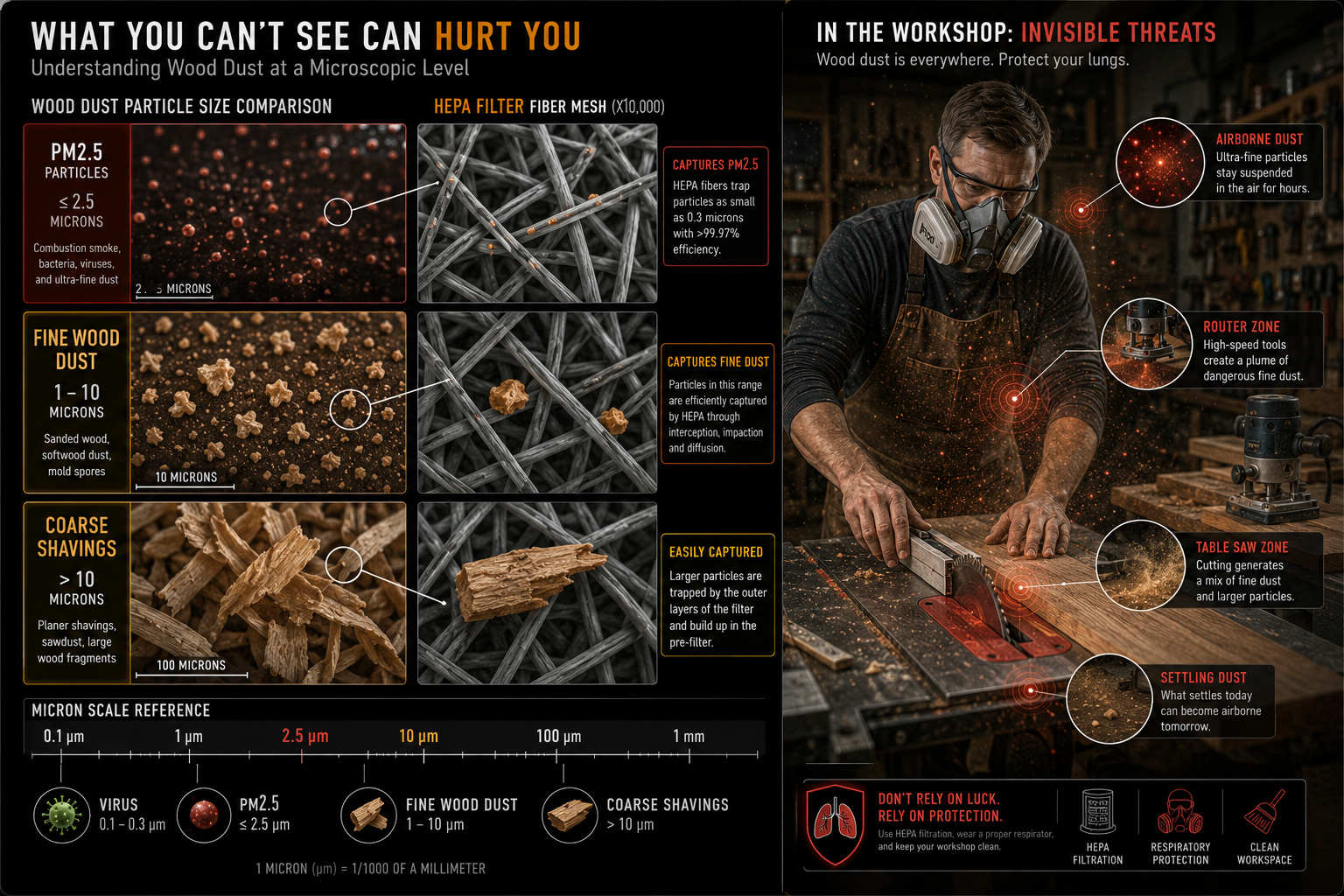
Wood dust is not a single substance. It is a mixture of wood fiber fragments, resins, adhesives, finishes, and biological material (mold spores, bacteria) that vary by species and processing method. For people with asthma, the most dangerous fraction is the respirable dust: particles smaller than 10 microns that travel deep into the airways.
Why it triggers asthma specifically:
- Fine particles (under 4 microns) reach the bronchioles and alveoli, causing direct irritation and inflammation.
- Certain wood species, including western red cedar, oak, and birch, contain sensitizing agents that can cause occupational asthma even in people who had no prior respiratory issues.
- Terpenes and aldehydes released during cutting act as chemical irritants independent of particle size.
- Composite materials like MDF and plywood release formaldehyde, a known airway irritant, in addition to fine cellulose dust.
According to the U.S. National Institute for Occupational Safety and Health (NIOSH), wood dust is classified as a potential occupational carcinogen, and the Occupational Safety and Health Administration (OSHA) sets a permissible exposure limit (PEL) of 5 mg/m3 for wood dust in general industry. For asthmatic individuals, even exposures well below this limit can provoke symptoms.
“For an asthmatic woodworker, the relevant question is not just ‘how much dust is present’ but ‘what size are the particles, and what species am I cutting today.'”
Which Woodworking Tools Create the Most Harmful Dust
Routers, random-orbit sanders, and table saws produce the finest and highest-volume dust of any common woodworking tools. These three tools should be your first priority when planning air filtration strategies for woodworkers with asthma.
Dust output by tool (ranked from highest fine-particle risk to lowest):
- Random-orbit sander – generates extremely fine particles, many under 2 microns; high sustained output during use
- Router – high-speed cutting creates very fine chips and dust; often used for extended periods
- Table saw – large volume of dust, mix of coarse and fine particles; blade speed determines fine fraction
- Miter saw / chop saw – concentrated dust plume directed downward, often not captured well by standard guards
- Planer and jointer – mostly coarse shavings, but fine dust fraction still significant
- Hand tools (chisels, hand planes) – lower volume but no powered collection; dust falls and resettles
MDF and particleboard deserve a separate warning. Cutting these materials with any powered tool releases formaldehyde-laden fine dust that is more chemically aggressive than solid wood dust of the same particle size.
Can HEPA Filters Really Remove All Wood Dust Particles
HEPA filters capture 99.97% of particles at 0.3 microns, which covers the vast majority of respirable wood dust. However, they do not remove chemical vapors (formaldehyde, terpenes) or gases released during finishing work, and they cannot capture particles already settled on surfaces.
What HEPA does well:
- Captures fine and ultrafine wood fiber particles
- Removes mold spores and biological debris common in wood
- Reduces overall particulate load in the air
What HEPA does not do:
- Remove volatile organic compounds (VOCs) from finishes, stains, or adhesives (activated carbon filters are needed for this)
- Clean surfaces where dust has already settled
- Work effectively if airflow is blocked by a clogged filter
For woodshops, look for air cleaners that combine a HEPA filter with a pre-filter (to catch coarse dust and extend HEPA life) and, if finishing work is done in the same space, an activated carbon stage for VOCs.
Best Air Purifiers Specifically Designed for Woodshop Environments
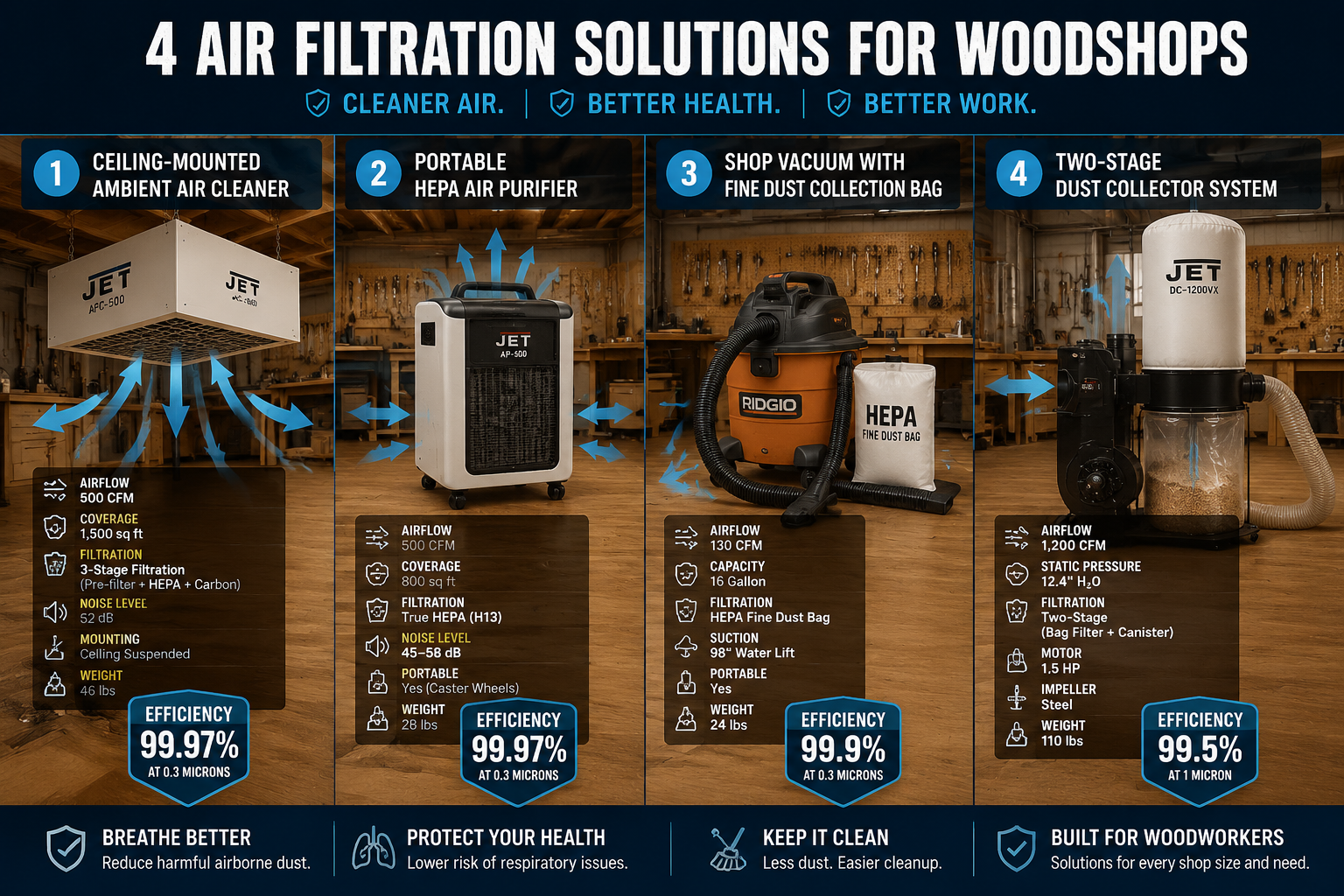
The best air purifiers for woodshop use are ceiling-mounted ambient air cleaners designed for industrial or commercial environments, not residential HEPA units from a big-box store. Woodshop-rated units handle the higher dust loads and continuous run times that residential purifiers are not built for.
What to look for in a woodshop air cleaner:
- Airflow rating (CFM): Match to your shop volume. A 500 sq ft shop with 9 ft ceilings (4,500 cubic feet) needs at least 450 CFM to achieve 6 ACH.
- Filtration stages: Pre-filter + main filter rated at 1 micron or better (HEPA preferred)
- Motor durability: Continuous-duty rated motors for all-day operation
- Noise level: Units above 70 dB become fatiguing; look for 65 dB or lower at working speed
Commonly recommended product categories (not brand endorsements):
- Ceiling-mounted shop air cleaners (e.g., the JET or Powermatic categories) designed for 1,000-1,500 CFM
- Wall-mounted ambient air filtration units with remote controls for hands-free adjustment
- Portable HEPA units with woodshop-rated pre-filters for smaller spaces
Decision rule: Choose a ceiling-mounted unit if your shop is over 300 sq ft and you work more than a few hours per week. Choose a portable unit if you work in a shared garage or basement where permanent installation is not possible.
How Much Do Professional Woodworking Air Filtration Systems Cost
A complete air filtration setup for an asthmatic woodworker typically costs between $500 and $3,000 depending on shop size, equipment quality, and whether dust collection at the source is included.
Rough cost breakdown (2026 estimates):
| Component | Budget Option | Mid-Range | Professional |
|---|---|---|---|
| Ambient air cleaner (ceiling/wall) | $150-$300 | $400-$800 | $900-$2,000+ |
| Dust collector (2-stage) | $200-$400 | $500-$900 | $1,200-$3,000+ |
| Shop vacuum (HEPA-rated) | $100-$200 | $250-$400 | $500+ |
| Respirator (half-face + filters) | $30-$60 | $80-$150 | $200+ (powered air) |
| Filter replacement (annual) | $50-$100 | $100-$200 | $200-$500 |
The biggest cost mistake asthmatic woodworkers make is buying a residential air purifier rated for 200 sq ft and placing it in a 600 sq ft shop. An undersized unit running at full speed still fails to achieve adequate air changes, and the false sense of security is genuinely dangerous.
Are There Air Filtration Options for Small Home Workshops
Yes. Small home workshops, including single-car garages and basement shops under 400 sq ft, can be managed effectively with portable HEPA air cleaners, compact two-stage dust collectors, and a HEPA shop vacuum. The key is sizing correctly and positioning units strategically.
Practical setup for a small home workshop:
- Place a portable HEPA air cleaner (rated for at least 300 CFM) in the corner diagonally opposite your primary work area to create cross-room airflow.
- Connect your table saw and sander to a compact dust collector or HEPA shop vac with a hose and blast gate system.
- Run the ambient air cleaner for at least 30 minutes after you finish cutting to clear residual fine dust.
- If the workshop shares HVAC with living spaces, seal the door gap and consider a dedicated exhaust fan to prevent dust migration.
For basement workshops specifically, humidity control matters as much as filtration. High humidity causes fine dust to clump and settle faster, which sounds helpful but actually means more dust on surfaces that gets resuspended when you move around.
Difference Between Shop Vacs and Dedicated Air Filtration Units
Shop vacuums capture dust at the source (directly from the tool port), while ambient air filtration units clean the air in the room after dust has become airborne. For asthmatic woodworkers, both are necessary because they solve different problems.
Shop vac strengths:
- Captures 80-90% of dust before it becomes airborne when properly connected to tools
- Portable and easy to reposition
- Doubles as a cleanup tool
Shop vac limitations:
- Standard shop vacs exhaust fine particles back into the air; only HEPA-rated shop vacs prevent this
- Cannot capture dust from hand tool work or dust that escapes tool connections
- Not designed for continuous all-day operation
Dedicated air filtration unit strengths:
- Runs continuously to clean ambient air throughout the shop
- Handles dust that escapes source capture
- Higher CFM ratings suited to large spaces
The practical rule: A HEPA shop vac connected to your tools is your first line of defense. A ceiling or wall-mounted air cleaner is your second. Skipping either one leaves a significant gap in your air filtration strategy for woodworking with asthma.
What Respirator Masks Work Best for Woodworkers with Asthma
Half-face respirators with P100 particulate filters are the best choice for most asthmatic woodworkers doing dry cutting and sanding. For finishing work involving solvents or stains, add an organic vapor cartridge to the same respirator.
Mask comparison for asthmatic woodworkers:
| Mask Type | Filtration | Fit | Breathing Resistance | Asthma Suitability |
|---|---|---|---|---|
| Disposable N95 | 95% at 0.3 microns | Moderate | Low-moderate | Acceptable for short tasks |
| Half-face + P100 | 99.97% at 0.3 microns | Good (with fit test) | Moderate | Recommended |
| Full-face + P100 | 99.97% + eye protection | Best | Moderate-high | Best for heavy exposure |
| Powered Air Purifying Respirator (PAPR) | 99.97%+ | Excellent | Very low | Ideal if breathing resistance is a concern |
Important note for asthma: Breathing resistance from a tight-fitting respirator can feel uncomfortable and may increase anxiety during an asthma episode. If standard respirators feel too restrictive, a PAPR (powered air-purifying respirator) uses a battery-powered blower to push filtered air to a hood or loose-fitting facepiece, eliminating the need to pull air through the filter. PAPRs cost $500-$1,500 but are worth considering for woodworkers with moderate to severe asthma.
Recommended Air Exchange Rates for a Safe Woodworking Space
A woodworking shop should achieve a minimum of 6 air changes per hour (ACH) during active work, with some sources recommending 10-15 ACH for heavy dust-generating operations. This is the rate at which the total volume of air in the shop is filtered and recirculated.
How to calculate the CFM you need:
- Measure your shop: length x width x height = cubic feet
- Multiply by target ACH (use 6 as a minimum): cubic feet x 6 = cubic feet per hour
- Divide by 60 to get CFM needed: result / 60 = minimum CFM rating
Example: A 20 x 25 ft shop with 9 ft ceilings = 4,500 cubic feet. At 6 ACH: 4,500 x 6 = 27,000 cubic feet/hour. Divided by 60 = 450 CFM minimum.
Most single ceiling-mounted shop air cleaners range from 400 to 1,500 CFM. For larger shops, two units positioned at opposite ends of the space work better than one oversized unit in the center.
Common Mistakes Woodworkers Make with Air Quality Management
The most common mistake is treating air filtration as a one-time purchase rather than an ongoing system that requires maintenance, correct sizing, and consistent use. Many asthmatic woodworkers buy reasonable equipment and then undermine it with poor habits.
Mistakes to avoid:
- Stopping dust collection immediately after cutting: Fine particles stay airborne for 20-30 minutes. Run your ambient air cleaner for at least 30 minutes after you finish work.
- Skipping filter maintenance: A filter at 50% capacity may perform at 30% efficiency. Check and clean pre-filters monthly; replace HEPA filters per manufacturer schedules.
- Using the wrong filter for MDF: Standard 5-micron filters miss the formaldehyde-laden fine fraction from MDF. Use a 1-micron or HEPA-rated filter whenever cutting composite materials.
- Relying on a dust mask instead of a respirator: Paper dust masks (not N95 or better) offer minimal protection against fine wood dust. They are not appropriate for asthmatic woodworkers.
- Ignoring surface dust: Dust that settles on surfaces gets resuspended when you walk through the shop or move materials. Damp-wipe surfaces and use a HEPA vacuum (not a broom) for cleanup.
- Working with the garage door cracked: This creates unpredictable airflow patterns that can pull fine dust toward your breathing zone rather than out of the shop.
Can Woodworking Trigger an Asthma Attack Even with Good Filtration
Yes. Even with well-maintained, correctly sized air filtration, woodworking can trigger asthma symptoms in sensitized individuals. Filtration reduces exposure but does not reduce it to zero, and some wood species cause immunological sensitization that makes even low exposures problematic.
Woodworkers who have developed occupational asthma from specific species (cedar, oak, mahogany) may react to trace exposures that no practical filtration system can eliminate. In these cases, the medical recommendation is often to avoid the sensitizing species entirely rather than to increase filtration.
Precautions that go beyond filtration:
- Keep a rescue bronchodilator inhaler in the shop at all times, stored where it is immediately accessible.
- Tell a family member or neighbor when you are working alone in the shop.
- Use a peak flow meter before and after work sessions to track lung function trends over time.
- Schedule regular spirometry with a pulmonologist, especially if you notice worsening symptoms.
- Consider a wood dust monitor (particle counter) to get real data on your shop’s air quality rather than relying on visual estimates.
What Medical Precautions Should Asthmatic Woodworkers Take
Asthmatic woodworkers should work with a pulmonologist or occupational medicine physician who understands wood dust exposure, not just general asthma management. The medical side of air filtration strategies for woodworkers with asthma is as important as the equipment side.
Recommended medical steps:
- Baseline spirometry: Establish your current lung function before increasing woodworking activity.
- Allergy testing: Identify whether you have sensitization to specific wood species; this directly affects which woods you can safely work with.
- Medication review: Ensure your controller medication (inhaled corticosteroid or combination inhaler) is optimized for an environment with regular dust exposure.
- Action plan: Work with your doctor to define symptom thresholds at which you stop work, use a rescue inhaler, or seek emergency care.
- Annual follow-up: Repeat spirometry annually to detect subclinical decline in lung function before it becomes symptomatic.
Some pulmonologists who specialize in occupational lung disease can also help you interpret air quality monitoring data from your shop and advise on whether your current exposure level is medically acceptable given your specific asthma severity.
Implementing Air Filtration Strategies for Woodworkers with Asthma: A Step-by-Step Checklist
Getting the full system right requires addressing source capture, ambient filtration, personal protection, and medical oversight together. Here is a practical sequence for setting up or auditing your woodshop:
Phase 1: Source capture
- Connect all powered tools to a HEPA-rated dust collector or shop vac
- Install blast gates to direct suction to the active tool
- Use a dust separator (cyclone) before the collector to extend filter life
Phase 2: Ambient air filtration
- Calculate your shop’s CFM requirement (volume x 6 ACH / 60)
- Select a ceiling or wall-mounted unit that meets or exceeds that CFM
- Position the unit to draw air across the main work area, not just recirculate corner air
Phase 3: Personal protection
- Purchase a half-face respirator with P100 filters (or PAPR if breathing resistance is a concern)
- Perform a fit check each time you put on the respirator
- Keep a rescue inhaler in the shop
Phase 4: Maintenance schedule
- Check pre-filters monthly; clean or replace as needed
- Replace HEPA filters per manufacturer schedule (typically every 12-24 months depending on use)
- Damp-wipe all surfaces weekly; HEPA-vacuum floors before sweeping
Phase 5: Medical oversight
- Schedule baseline spirometry with a pulmonologist
- Establish a written asthma action plan for the workshop
- Review annually
FAQ
Q: Is MDF more dangerous than solid wood for asthmatic woodworkers? Yes. MDF releases formaldehyde in addition to fine cellulose dust when cut or sanded. The combination of chemical irritants and fine particles makes MDF one of the highest-risk materials for asthmatic woodworkers. Use it only with source capture, HEPA ambient filtration, and a respirator rated for both particulates and organic vapors.
Q: How long does fine wood dust stay airborne after I stop cutting? Fine particles under 10 microns can remain suspended in still air for 30 minutes or more. In a shop with active air circulation, a well-sized ambient air cleaner can reduce this significantly, but running the system for at least 30 minutes after work ends is still recommended.
Q: Can I use a regular household HEPA air purifier in my woodshop? Residential HEPA purifiers are not designed for the dust loads or continuous run times of a woodshop. They can work as a temporary measure in a very small space (under 150 sq ft) with light use, but they clog quickly and their motors are not rated for continuous operation. A woodshop-rated unit is a better investment.
Q: Do air filtration systems remove the smell of wood? Standard HEPA filters do not remove odors or VOCs. To address wood smells and chemical vapors from finishes, you need an activated carbon (charcoal) filter stage in addition to HEPA. Many woodshop air cleaners offer combination filter packs.
Q: What is the safest wood species for asthmatic woodworkers? No wood is completely risk-free, but species with lower sensitization rates and fewer chemical irritants include poplar, pine (with adequate ventilation), and most domestic hardwoods used in small quantities. Western red cedar, exotic tropical hardwoods, and rosewood carry higher sensitization risks and should be avoided or used with maximum precautions by asthmatic woodworkers.
Q: Should I wear a respirator even if I have good shop filtration? Yes. Ambient air filtration and source capture reduce the overall dust load but cannot eliminate exposure at the point of cutting, where concentrations are highest. A respirator provides a personal protection layer that ambient systems cannot replicate.
Q: How do I know if my air filtration is actually working? A particle counter (air quality monitor) is the most reliable way to measure fine particle concentrations in your shop. Consumer-grade monitors that measure PM2.5 are available for $50-$200 and give real data on whether your filtration is achieving safe levels.
Q: Can I build my own air filtration unit for a woodshop? DIY box fan and furnace filter units (the “Corsi-Rosenthal box” design) have been studied for general air quality and can be a low-cost supplement. However, for asthmatic woodworkers, the filtration efficiency and airflow of DIY units is harder to verify, and they should not replace a properly rated commercial unit as the primary system.
Q: Does humidity level affect wood dust behavior in my shop? Yes. Very low humidity (below 30%) allows fine dust to stay suspended longer. Very high humidity (above 60%) causes dust to clump and settle faster but also promotes mold growth on wood and surfaces, which is itself an asthma trigger. Aim for 40-50% relative humidity in the shop.
Q: How often should I replace HEPA filters in my woodshop air cleaner? In an active woodshop, HEPA filters typically need replacement every 12-24 months, but pre-filters should be checked and cleaned monthly. A heavily used shop cutting MDF or doing daily sanding may need filter changes more frequently. Follow the manufacturer’s guidelines and inspect visually for clogging.
Conclusion
Developing effective air filtration strategies for woodworkers with asthma is not complicated, but it does require committing to a system rather than a single device. The framework is straightforward: capture dust at the source with a HEPA-rated collector, filter the ambient air with a correctly sized shop air cleaner, protect yourself personally with a P100 respirator, and back all of it up with regular medical oversight.
Your next steps:
- Calculate your shop’s CFM requirement today using the formula in this guide, and check whether your current equipment meets it.
- If you do not already own a half-face respirator with P100 filters, purchase one before your next work session.
- Schedule a spirometry appointment with a pulmonologist if you have not had one in the past 12 months.
- Set a monthly calendar reminder to inspect and clean your pre-filters.
- If you are cutting MDF or exotic hardwoods, add an activated carbon filter stage to your ambient air cleaner.
Woodworking with asthma is manageable. Many woodworkers with significant asthma histories work safely for decades by taking the air quality side of the craft as seriously as the joinery side. The investment in proper filtration is modest compared to the cost of an emergency room visit or the long-term consequences of uncontrolled occupational exposure.
References
- U.S. Occupational Safety and Health Administration (OSHA). Wood Dust. osha.gov/wood-dust
- National Institute for Occupational Safety and Health (NIOSH). Wood Dust: Occupational Exposure. cdc.gov/niosh (2016)
- American Lung Association. Asthma Triggers: Gain Control. lung.org (2023)
- Asthma and Allergy Foundation of America. Occupational Asthma. aafa.org (2022)
- Corsi, R., et al. “Filtration Efficiency of DIY Air Cleaners.” Environmental Science & Technology Letters (2021)
- OSHA. Permissible Exposure Limits: Annotated Tables. osha.gov (2023)
Read next: Detoxifying Your Home Workshop from Heavy Metal Dust: A Complete Safety Guide. A closer look at workshop metal dust safety.