
Key Takeaways
- Lead, cadmium, chromium, manganese, and nickel are the most common toxic metal dusts found in home workshops
- Metal dust particles smaller than 10 microns (PM10) penetrate deep into the lungs and are not visible to the naked eye
- A standard woodworking dust mask (N95) does not provide adequate protection against metal fumes and fine metal particles — you need a P100 or OV/P100 combination respirator
- HEPA-rated air purifiers and shop vacuums are the most cost-effective first investments for reducing airborne metal contamination
- Symptoms of heavy metal exposure can take months or years to appear, making early prevention critical
- Wet wiping and HEPA vacuuming surfaces after each metalworking session is more effective than dry sweeping, which re-suspends particles
- Home air quality test kits and professional industrial hygiene assessments can confirm whether your workshop has dangerous particle levels
- Dedicated metalworking clothing that stays in the shop prevents carrying contamination into living spaces
What Exactly Counts as Heavy Metal Dust in a Workshop
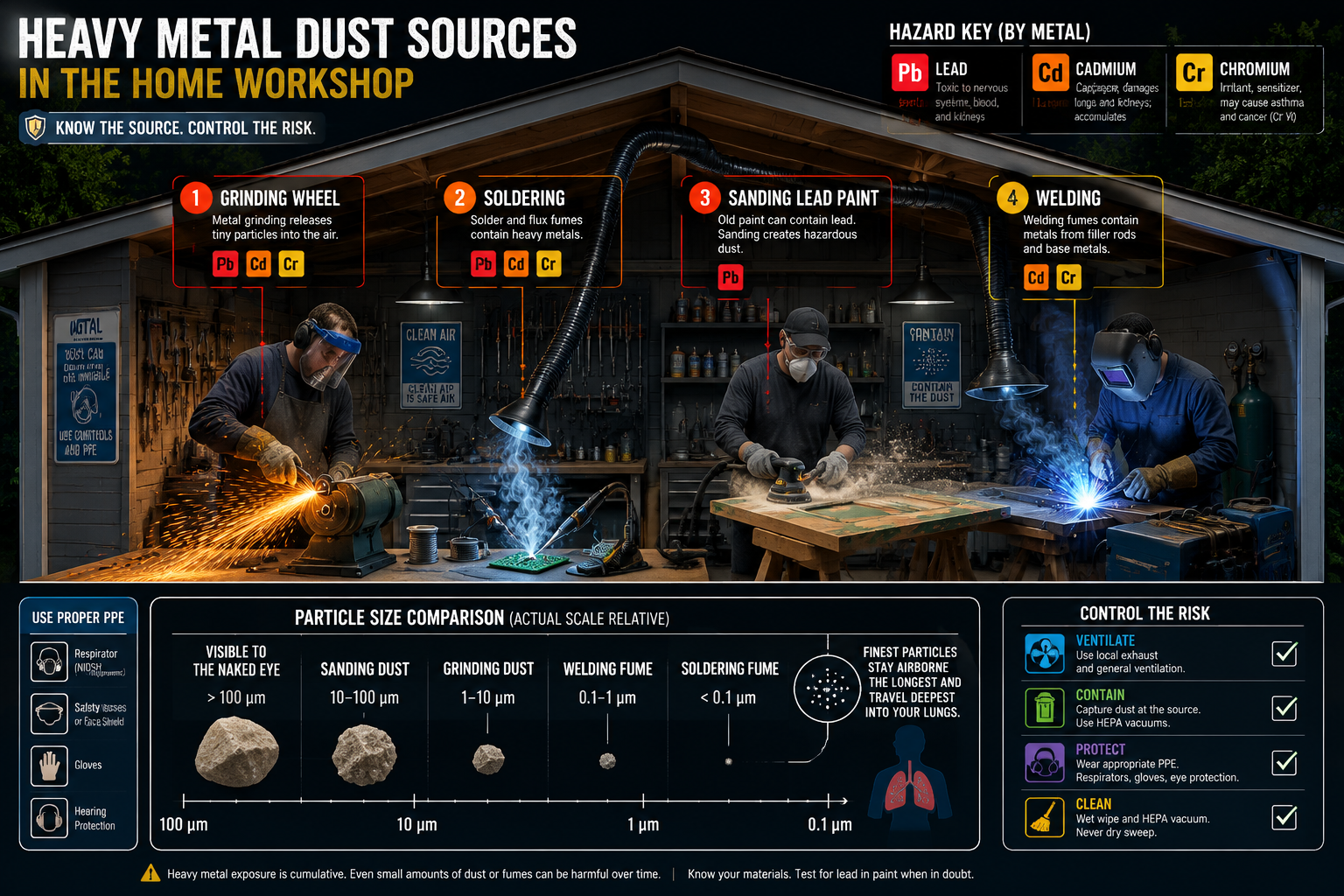
Heavy metal dust in a workshop refers to airborne or surface-settled particles of metals with high atomic weight and density, including lead, cadmium, chromium, manganese, nickel, zinc, copper, and beryllium. These particles are released during grinding, cutting, welding, soldering, sanding painted surfaces, and machining operations.
Not all metal dust is equally dangerous, but the term “heavy metal” in occupational health specifically covers metals that accumulate in body tissue and disrupt biological processes. In a typical home workshop, the most common sources include:
- Lead: Old solder, lead-based paint on reclaimed wood or metal, wheel weights, and some older plumbing fittings
- Cadmium: Found in some older paints, electroplated hardware, and certain alloys
- Chromium (hexavalent): Released when grinding or welding stainless steel
- Manganese: Present in welding rods and filler metals
- Nickel: Released from grinding nickel alloys and some stainless steels
- Zinc: Produced when cutting or welding galvanized steel (causes metal fume fever)
- Beryllium: Rare but extremely toxic; found in some specialty alloys and electrical contacts
The particle size matters as much as the metal type. Particles under 10 microns (PM10) are inhalable. Particles under 2.5 microns (PM2.5) reach the deepest lung tissue. Many welding and grinding operations produce particles well below 1 micron that are invisible without specialized equipment.
Are Some Metal Dusts More Toxic Than Others
Yes, toxicity varies significantly between metals. Understanding this hierarchy helps you prioritize your protective measures when detoxifying your home workshop from heavy metal dust.
| Metal | Primary Workshop Source | Key Health Risk | OSHA PEL (8-hr TWA) |
|---|---|---|---|
| Beryllium | Specialty alloys, electrical contacts | Chronic beryllium disease, lung cancer | 0.2 micrograms/m3 |
| Cadmium | Electroplated hardware, old paints | Kidney damage, lung cancer | 5 micrograms/m3 |
| Hexavalent Chromium | Welding/grinding stainless steel | Lung cancer, nasal perforation | 5 micrograms/m3 |
| Lead | Solder, old paint, batteries | Neurological damage, kidney disease | 50 micrograms/m3 |
| Manganese | Welding rods, steel alloys | Parkinson’s-like neurological damage | 5 mg/m3 (ceiling) |
| Nickel | Stainless steel grinding | Lung and nasal cancer | 1 mg/m3 |
| Zinc Oxide | Galvanized steel welding/cutting | Metal fume fever (acute, usually reversible) | 5 mg/m3 |
Decision rule: If your work regularly involves stainless steel welding, cadmium-plated hardware, or any beryllium-containing material, treat those sessions as high-hazard and use supplied-air or powered air-purifying respirators (PAPRs), not just a half-face respirator. For occasional lead solder work or zinc-containing grinding, a properly fitted P100 half-face respirator and good ventilation are generally adequate.
How Dangerous Is Metal Dust Exposure for Home Metalworkers
Metal dust exposure is a serious occupational and recreational health hazard. The danger for home workshop users is often underestimated because symptoms develop slowly and are easy to attribute to other causes.
According to the U.S. National Institute for Occupational Safety and Health (NIOSH), metalworkers face elevated risks of lung disease, certain cancers, and neurological disorders compared to the general population. Home workshop users face the additional problem of poor or absent ventilation, no industrial hygiene monitoring, and inconsistent use of protective equipment.
Key risks include:
- Pulmonary fibrosis and pneumoconiosis: Scarring of lung tissue from chronic metal dust inhalation
- Occupational asthma: Sensitization to metals like nickel and chromium
- Heavy metal poisoning: Accumulation of lead, cadmium, or manganese in organs
- Cancer: Hexavalent chromium and cadmium are classified as Group 1 human carcinogens by the International Agency for Research on Cancer (IARC)
- Metal fume fever: An acute flu-like illness from zinc oxide fumes, common after cutting galvanized steel
The home workshop setting is particularly risky because the same space may be used for other activities, contaminated clothing may be worn into the house, and children or pets may enter the space.
Symptoms of Heavy Metal Dust Poisoning
Symptoms of heavy metal dust poisoning range from acute reactions that appear within hours to chronic conditions that develop over years. Recognizing early warning signs is critical because many people assume they are simply getting a cold or feeling tired from physical work.
Acute symptoms (appear within hours to days):
- Metallic taste in the mouth
- Headache, nausea, and fatigue after a workshop session
- Flu-like chills and fever (classic sign of metal fume fever from zinc)
- Eye, nose, and throat irritation
- Shortness of breath or chest tightness
Chronic symptoms (develop over months to years):
- Persistent cough or shortness of breath with exertion
- Memory problems, difficulty concentrating, or mood changes (manganese, lead)
- Numbness or tingling in hands and feet (lead)
- Abdominal pain and fatigue (lead, cadmium)
- Reduced kidney function (cadmium)
Common mistake: Many hobbyists dismiss early symptoms as general fatigue or seasonal illness. If you regularly do metalwork and notice any combination of the above, ask your doctor for a blood lead level test and a heavy metals panel. Early detection makes a significant difference in outcomes.
Which Metal Dusts Are Most Common in Home Workshops
The most commonly encountered toxic metal dusts in home workshops are lead, manganese, hexavalent chromium, zinc oxide, and nickel. Lead is particularly widespread because it appears in many unexpected places beyond obvious sources like old solder.
Likely sources most home hobbyists overlook:
- Reclaimed or antique wood: May have lead-based paint that generates lead dust when sanded or cut
- Old automotive parts: Brake dust contains heavy metals including lead and cadmium
- Galvanized steel: Cutting or welding releases zinc oxide fumes
- Stainless steel: Grinding releases chromium and nickel particles
- Brass and bronze: Contain lead and copper; machining generates fine dust
- Battery terminals and casings: Lead-acid batteries are a significant lead source
If you work with any of these materials more than occasionally, the risk of cumulative exposure is real and worth addressing systematically.
What Protective Gear Do Professional Metalworkers Use
Professional metalworkers rely on a layered PPE system that addresses inhalation, skin contact, and eye protection simultaneously. Home workshop users should adopt the same approach scaled to their exposure level.
Respiratory protection:
- P100 half-face respirator: Filters 99.97% of airborne particles; suitable for grinding, cutting, and light welding
- OV/P100 combination cartridge: Adds organic vapor protection; needed for welding fumes and soldering
- Powered Air-Purifying Respirator (PAPR): Battery-powered blower unit; best for extended sessions or high-hazard metals like beryllium and hexavalent chromium
- Supplied-air respirator: Required for the highest-hazard operations; impractical for most home shops
Skin and clothing:
- Long-sleeved cotton or flame-resistant shirts and pants
- Dedicated workshop clothing that stays in the shop and is laundered separately
- Nitrile or leather gloves appropriate to the task
Eye and face protection:
- Safety glasses with side shields for grinding
- Full face shield for heavy grinding or cutting operations
- Welding helmet with appropriate shade rating
Common mistake: Wearing a simple dust mask or surgical mask for metalwork. These do not filter fine metal particles effectively. Only respirators with N95, P100, or higher ratings with proper face seal provide meaningful protection.
Difference Between Respirators for Woodworking vs. Metalworking
Woodworking and metalworking require different respirator types, and using the wrong one is a common and dangerous mistake. A woodworking dust mask filters larger particles but is not rated for the fine metal fumes produced by grinding or welding.
Woodworking respirators (N95 or P100 particulate filters) are designed for organic dust particles that are generally larger than 10 microns. They work well for sawdust, MDF dust, and similar materials.
Metalworking respirators require:
- P100 filters (minimum) for grinding and cutting metal, which produces sub-micron particles
- OV/P100 combination cartridges for welding and soldering, which produce both fine particles and chemical vapors
- A proper face seal, which means a fitted half-face or full-face respirator, not a disposable mask
The key technical difference is filtration efficiency and the addition of vapor protection. P100 filters remove 99.97% of particles at 0.3 microns, compared to N95 at 95% efficiency. For metal fumes, the extra filtration margin is not a luxury.
Choose a P100 half-face respirator if you do occasional grinding or cutting. Choose an OV/P100 combination if you weld, solder, or work with paints and coatings. Choose a PAPR if you do extended sessions or work with high-hazard metals.
Best Air Purifiers for Filtering Metal Particles
HEPA-rated air purifiers with activated carbon pre-filters are the most effective residential-grade units for capturing metal dust in a home workshop. The key specification is true HEPA filtration (captures 99.97% of particles at 0.3 microns) combined with sufficient airflow for your shop’s volume.
What to look for:
- True HEPA filter (not “HEPA-type” or “HEPA-like”)
- CADR rating appropriate for your space (a 400 sq ft shop needs at least 200+ CFM CADR)
- Activated carbon pre-filter to capture metal vapors and odors from welding
- Continuous operation capability for running during and after metalwork sessions
Recommended approach by budget:
- Under $150: A quality true-HEPA shop air purifier (brands like Winix, Levoit, or Coway) placed near the work area. Supplement with a HEPA shop vacuum for surface cleaning.
- $150-$400: A dedicated ambient air cleaner with high CADR plus a separate activated carbon filter stage. Some units designed for workshops (such as the JET or Powermatic ambient air cleaners) move more air volume than residential units.
- $400+: Industrial-grade ambient air cleaners with multi-stage filtration and higher CFM ratings. Worth the investment for daily metalwork.
Important note: No air purifier eliminates the need for a respirator during active metalworking. Air purifiers are most effective for reducing background contamination between sessions and during cleanup.
Cheapest Ways to Protect Yourself from Metal Dust
Effective protection from metal dust does not require expensive equipment. The cheapest and most impactful measures, in order of cost-effectiveness, are:
- Improve ventilation first: Open windows and doors, position a box fan to exhaust air out of the shop during metalwork. Cost: $0 to $30.
- Buy a P100 half-face respirator: A 3M 6502 or similar half-face respirator with P100 cartridges costs $30-$50 and lasts for years with cartridge replacement.
- Use a HEPA shop vacuum for cleanup: A basic HEPA-filtered shop vac costs $60-$100 and prevents re-suspension of settled dust during cleanup.
- Wet wipe surfaces after each session: Damp microfiber cloths capture settled metal particles far better than dry wiping. Cost: under $10.
- Keep a dedicated set of workshop clothes: Prevents carrying contamination home. Cost: $20-$40 for a set of used work clothes.
- Wash hands and face before leaving the shop: Removes surface contamination before it can be ingested or transferred. Cost: $0.
Total investment for solid basic protection: approximately $120-$180. This covers the highest-impact measures before spending on air purifiers or more advanced equipment.
Steps to Decontaminate a Workshop After Metalworking
Decontaminating a workshop after metalworking is a structured process that removes both airborne and surface-settled metal particles. Doing this consistently after every session prevents cumulative buildup that becomes harder to address over time.
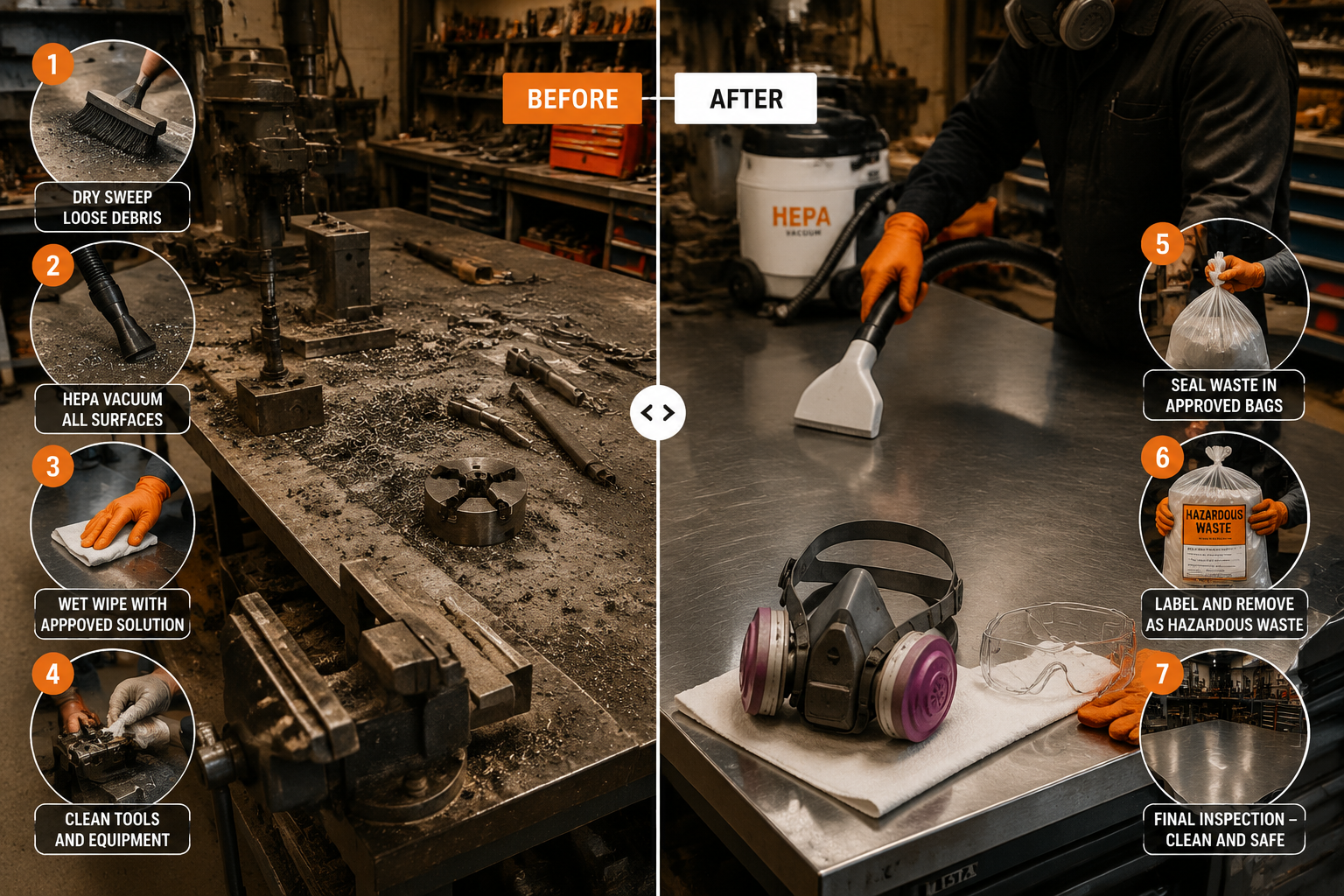
Step-by-step decontamination process:
- Stop work and let the air settle for 10-15 minutes with ventilation running. This allows airborne particles to settle before you begin cleaning.
- Put on your P100 respirator and nitrile gloves before starting cleanup. Cleaning disturbs settled dust.
- HEPA vacuum all horizontal surfaces: Workbench, tool surfaces, shelving, and the floor. Use slow, overlapping passes. Never use a standard shop vac without a HEPA filter for metal dust.
- Wet wipe all hard surfaces with damp microfiber cloths. Start from high surfaces and work down to the floor. Dispose of cloths or rinse thoroughly.
- HEPA vacuum the floor after wet wiping, then damp mop if the floor is sealed concrete or tile.
- Bag and seal waste: Place used cloths, filter media, and collected debris in sealed plastic bags for disposal.
- Change and bag workshop clothing before entering living areas. Launder separately.
- Wash hands, face, and forearms thoroughly with soap and water.
- Run the air purifier on high for at least 30-60 minutes after cleanup is complete.
Frequency: After every metalworking session for high-hazard metals (lead, cadmium, chromium). After every 2-3 sessions for lower-hazard work like mild steel grinding.
How Often Should You Clean Your Workshop to Reduce Metal Contamination
For active metalworking, clean after every session. For occasional metalwork, a thorough deep clean at least monthly prevents dangerous accumulation of settled particles on surfaces, in cracks, and in floor joints.
A useful framework:
- After every session: HEPA vacuum work surfaces and immediate floor area, wet wipe the bench
- Weekly (if working multiple times per week): Full floor HEPA vacuum and damp mop, wipe down all tool surfaces
- Monthly: Deep clean including wall surfaces, stored tools, pegboards, and any fabric items (aprons, rags) that may have accumulated dust
- Annually: Consider professional cleaning or a full shop wipe-down if you do significant metalwork regularly
Seasonal deep cleaning is especially important if children or pets ever enter the workshop space, even briefly.
How to Test If Your Workshop Has Dangerous Metal Particle Levels
Testing for dangerous metal particle levels in a home workshop can be done with consumer-grade air quality monitors, surface wipe test kits, or professional industrial hygiene assessments. The right choice depends on your budget and the level of concern.
Consumer options:
- Lead surface test kits (3M LeadCheck or similar): Swab-based tests that detect lead on surfaces. Cost: $10-$30 for a pack. Good for identifying lead contamination on workbenches and floors.
- Particle counter monitors: Devices like the Temtop or IQAir AirVisual measure PM2.5 and PM10 concentrations in real time. Cost: $50-$200. They don’t identify specific metals but show whether fine particle levels are elevated during and after work.
Professional options:
- Industrial hygiene air sampling: A certified industrial hygienist (CIH) can place personal or area air samplers in your shop during a work session. Lab analysis identifies specific metals and compares them to OSHA or NIOSH exposure limits. Cost: $300-$800 depending on the number of metals tested.
- Surface wipe sampling: A professional collects surface wipe samples and sends them to an accredited lab. This is the most reliable way to confirm whether lead or other heavy metals have accumulated on workshop surfaces.
When to get professional testing: If you regularly weld stainless steel, work with lead-containing materials, or have symptoms that could indicate metal exposure, professional testing gives you defensible data to guide your protective measures.
Can Metal Dust Cause Long-Term Health Problems
Yes. Chronic exposure to heavy metal dust causes permanent, progressive health damage that does not fully reverse even after exposure stops. This is one of the most important facts for home workshop users to understand, because the hobby nature of the work creates a false sense of low risk.
Long-term health problems linked to specific metals include:
- Lead: Permanent neurological damage, reduced IQ (particularly serious for children in or near the workshop), kidney disease, hypertension, and reproductive harm
- Cadmium: Irreversible kidney damage (cadmium nephropathy), osteoporosis, and lung cancer
- Hexavalent chromium: Lung cancer, nasal and sinus cancer, and chronic obstructive pulmonary disease (COPD)
- Manganese: Manganism, a progressive neurological disorder resembling Parkinson’s disease
- Crystalline silica (present in some metal grinding operations): Silicosis, an irreversible and potentially fatal lung disease
The cumulative nature of heavy metal toxicity means that even low-level, intermittent exposure over years adds up. There is no safe threshold for lead exposure, according to the U.S. Centers for Disease Control and Prevention (CDC). For carcinogens like hexavalent chromium and cadmium, any exposure carries some risk.
Conclusion: Taking Action on Detoxifying Your Home Workshop from Heavy Metal Dust
Detoxifying your home workshop from heavy metal dust is not a one-time project. It’s an ongoing practice built from consistent habits: wearing the right respirator, maintaining ventilation, cleaning properly after each session, and knowing which materials carry the highest risk.
The good news is that the most protective steps are also the most affordable. A fitted P100 respirator, a HEPA shop vacuum, and a commitment to wet-wiping surfaces after metalwork will eliminate the majority of your exposure risk for well under $200.
Actionable next steps to take this week:
- Audit your workshop for high-risk materials: old solder, galvanized steel, stainless steel, reclaimed painted metal or wood
- Purchase a P100 half-face respirator with OV/P100 combination cartridges if you weld or solder
- Pick up a HEPA-filtered shop vacuum if you don’t already have one
- Buy a pack of lead surface test swabs and check your workbench and floor
- Establish a post-session cleanup routine and stick to it
- If you have children, make the workshop a strict no-entry zone during and after metalwork until surfaces are cleaned
The long-term health stakes are real. Lung disease, neurological damage, and cancer are not abstract risks for people who work regularly with metal without protection. But they are largely preventable with the right knowledge and consistent habits. Start with the basics, build from there, and treat your workshop safety with the same seriousness you’d give any other part of your health.
Frequently Asked Questions
Q: Can I use a standard N95 mask for metal grinding? A: An N95 filters 95% of particles at 0.3 microns and provides some protection, but a P100 respirator (99.97% efficiency) is strongly preferred for metal grinding because it captures a much higher proportion of the finest, most dangerous particles. For welding fumes, you also need organic vapor cartridges, which an N95 does not provide.
Q: Is metal fume fever from galvanized steel dangerous long-term? A: Metal fume fever from zinc oxide is typically acute and self-limiting, resolving within 24-48 hours. It does not appear to cause permanent lung damage from isolated incidents. However, repeated exposure is not well-studied for long-term effects, and the fever symptoms indicate you inhaled a significant dose of metal fumes. Use proper ventilation and a respirator to avoid it entirely.
Q: How do I know if my old solder contains lead? A: Solder manufactured before the mid-2000s is very likely to contain lead (typically 60/40 tin-lead). Modern electronics solder is often lead-free (RoHS compliant), but plumbing solder and some hobby solder still contains lead. If you’re unsure, use a lead surface test swab on your work area, or assume it contains lead and use appropriate precautions.
Q: Can my family be harmed by metal dust I bring home on my clothing? A: Yes. Lead and other heavy metals on work clothing can transfer to furniture, carpets, and be ingested by children and pets. This is called “take-home” contamination and is a documented pathway for childhood lead poisoning. Keep dedicated workshop clothing in the shop and change before entering living areas.
Q: Do I need a special vacuum for metal dust, or will any shop vac work? A: You need a shop vacuum with a true HEPA filter. Standard shop vacs exhaust fine particles back into the air, making contamination worse. HEPA-filtered shop vacs (such as those from Festool, Bosch, or Ridgid with HEPA filters) capture particles down to 0.3 microns.
Q: How long do P100 respirator cartridges last? A: P100 particulate filters do not have a set expiration based on use time; they should be replaced when breathing resistance increases noticeably or if they become physically damaged or wet. Combination OV/P100 cartridges should be replaced based on the organic vapor service life schedule (typically 8 hours of use in moderate concentrations, or sooner if you detect odors through the mask).
Q: Is it safe to use an air compressor to blow metal dust off surfaces? A: No. Using compressed air to blow dust off surfaces launches settled particles back into the air at high velocity, dramatically increasing inhalation risk. Always use a HEPA vacuum followed by wet wiping for metal dust cleanup.
Q: Should I seal my workshop floor to make cleanup easier? A: Yes. Sealing bare concrete with an epoxy or polyurethane floor coating makes metal dust cleanup significantly easier and more effective because particles cannot penetrate into the porous concrete surface. This is one of the best long-term investments for a metalworking shop.
Sources
- U.S. National Institute for Occupational Safety and Health (NIOSH). “Metal and Metalworking Hazards.” CDC/NIOSH. https://www.cdc.gov/niosh/topics/metalworking/
- International Agency for Research on Cancer (IARC). “IARC Monographs on the Identification of Carcinogenic Hazards to Humans.” IARC, 2012. https://monographs.iarc.who.int/
- U.S. Occupational Safety and Health Administration (OSHA). “Permissible Exposure Limits (PELs).” OSHA. https://www.osha.gov/annotated-pels
- U.S. Centers for Disease Control and Prevention (CDC). “Lead Exposure.” CDC, 2023. https://www.cdc.gov/niosh/topics/lead/
- U.S. Environmental Protection Agency (EPA). “Protect Your Family from Sources of Lead.” EPA, 2022. https://www.epa.gov/lead/protect-your-family-sources-lead
Read next: The Impact of Soluble Fiber on Chronic Idiopathic Pruritus: A Comprehensive Guide. A closer look at soluble fiber for chronic itch.