
Key Takeaways
- Red rot is caused by sulfuric acid attacking the collagen fibers in vegetable-tanned leather, making it powdery and brittle
- You can stop red rot from spreading further, but you cannot restore leather that has already fully degraded
- Leather books made between roughly 1830 and 1930 are the most vulnerable because of industrial tanning practices used during that period
- Consolidants such as Klucel G (hydroxypropyl cellulose) are the current conservation standard for stabilizing actively crumbling leather
- Ideal storage conditions are 60-65 degrees Fahrenheit and 30-50% relative humidity, away from direct light and pollutants
- Red rot is not contagious in a biological sense, but acidic dust from affected books can accelerate degradation in neighboring volumes
- Professional leather book restoration typically costs between $150 and $800 or more per volume, depending on severity
- DIY stabilization is feasible for minor cases, but significant structural damage requires a trained conservator
- Avoid petroleum-based leather dressings like neatsfoot oil on red-rotted leather, as they can accelerate breakdown
- Museums such as the Library of Congress and the British Library publish freely available conservation guidelines
What Exactly Is Red Rot in Leather Books?
Red rot is the powdery, reddish-brown deterioration of vegetable-tanned leather caused by acid hydrolysis of the leather’s collagen structure. When sulfuric acid (formed from atmospheric sulfur dioxide reacting with moisture) penetrates the leather, it breaks down the collagen fibers that give leather its strength and flexibility. The result is leather that turns brick-red, loses all cohesion, and crumbles to a fine powder at the touch.
The term “red rot” is specific to vegetable-tanned leather. Chrome-tanned and other modern leathers do not suffer from this particular form of decay, though they have their own deterioration pathways. Red rot does not involve mold or bacteria; it is a purely chemical process, which is why it cannot be “cured” the way biological damage sometimes can.
Key characteristics of red rot:
- Powdery or dusty surface that rubs off easily
- Brick-red or orange-brown discoloration
- Leather feels brittle, stiff, or completely structurally unsound
- Surface may crack into small rectangular sections (called “cubing”)
- Damage is often worse on the spine and turn-ins of a binding
How Can I Tell If My Old Leather Book Has Red Rot?
You can identify red rot by rubbing a white cloth or cotton swab gently across the leather surface. If a reddish-brown powder transfers to the cloth, red rot is present. A healthy leather binding will leave little to no residue.
Signs to look for:
| Symptom | Likely Cause | Severity |
|---|---|---|
| Reddish powder on fingertips after touching | Active red rot | Moderate to severe |
| Leather surface cracks in a grid pattern | Advanced acid hydrolysis | Severe |
| Spine or cover feels brittle and snaps | Collagen breakdown complete | Critical |
| Slight tackiness with faint red tinge | Early-stage degradation | Mild |
| No powder, leather supple and dark | Healthy or well-preserved | None |
A simple pH test can also confirm acid damage. Conservation-grade pH indicator strips placed against the leather surface (dampened very slightly) will show readings below 4.0 in red-rotted leather. Healthy leather typically reads between 4.5 and 5.5.
Common mistake: Many collectors assume a book is “just dirty” when they first notice reddish residue. If cleaning does not remove the discoloration and the powder keeps returning, it is almost certainly red rot, not surface grime.
What Causes Leather Book Bindings to Crumble Over Time?
Leather bookbindings crumble primarily because of sulfuric acid buildup within the leather itself, combined with low humidity, heat, and light exposure. The acid originates from two main sources: atmospheric sulfur dioxide (historically from coal burning, now from vehicle emissions and industrial pollution) and residual sulfuric acid left in the leather from certain 19th-century tanning and finishing processes.
The main causes of leather deterioration:
- Atmospheric pollution: Sulfur dioxide reacts with moisture in the air and in the leather to form sulfuric acid
- Poor original tanning: Leather tanned with sulfuric acid as a processing aid (common between 1830 and 1930) retains residual acid
- Low relative humidity: Dry conditions cause leather to desiccate and crack; the collagen fibers lose flexibility
- Heat: Elevated temperatures accelerate chemical reactions, speeding up acid hydrolysis
- Light exposure: Ultraviolet light degrades both the leather surface and any protective dressings
- Biological agents: Mold and insects can weaken leather structure, making it more vulnerable to chemical decay
The period from approximately 1830 to 1930 produced the most vulnerable books. Industrial-era tanning introduced shortcuts that left leather chemically unstable. Books from before 1830 (using traditional oak-bark tanning) and after 1930 (using improved processes) tend to hold up considerably better, though no leather is immune to poor storage.
Are Some Types of Leather More Prone to Red Rot?
Yes. Vegetable-tanned leather from the industrial era (roughly 1830 to 1930) is by far the most susceptible to red rot. Chrome-tanned leather, which became dominant in the 20th century, does not develop red rot in the same way.
Leather types ranked by red rot risk:
- High risk: Vegetable-tanned calf, sheep, and goat leather from 1830 to 1930, particularly from British and American binderies
- Moderate risk: Earlier vegetable-tanned leather (pre-1830), especially if stored in polluted or humid environments
- Low risk: Chrome-tanned leather (post-1930), modern bookbinding leathers treated with buffering agents
- Minimal risk: Alum-tawed leather (a different tanning process using alum salts), vellum, and parchment
Calf leather (calfskin) from the Victorian era is particularly notorious for red rot. Many 19th-century British publishers used cheap, acid-processed calf that began deteriorating within decades of production.
Is Red Rot Fixable, or Will My Book Be Permanently Damaged?
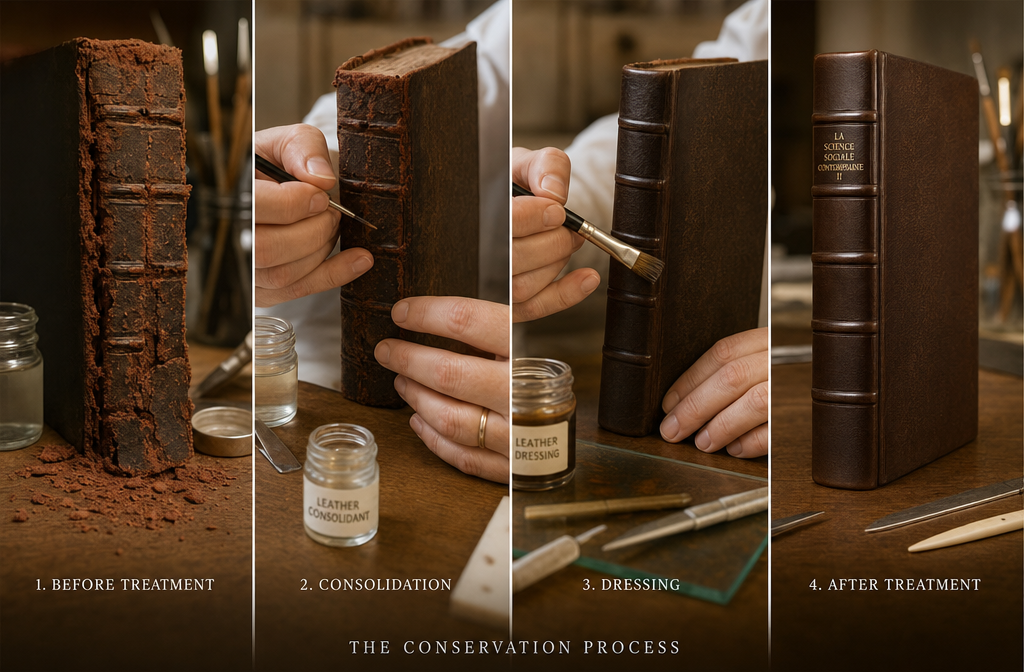
Red rot cannot be reversed, but its progression can be stopped. Leather that has already turned to powder is gone permanently. However, leather that is in the early to middle stages of red rot can be stabilized so that it holds together, remains usable, and does not deteriorate further.
Think of it this way: you cannot rebuild collagen fibers that have been chemically destroyed, but you can consolidate the remaining structure so the book survives for decades more. The goal of restoring leather bookbindings and stopping red rot is preservation, not resurrection.
What is achievable:
- Stabilizing powdery leather so it no longer crumbles
- Preventing acid from continuing to attack remaining sound leather
- Protecting the book structurally so it can still be handled carefully
- Slowing or halting further color loss and surface breakdown
What is not achievable:
- Returning leather to its original suppleness if fibers are fully degraded
- Eliminating the reddish discoloration entirely
- Making severely damaged leather as strong as new
What Tools and Materials Do You Need to Stop Leather Book Decay?
For basic stabilization of a red-rotted leather binding, you need a consolidant, soft brushes, a clean workspace, and appropriate protective gear. For more advanced restoration, additional materials and skills are required.
Essential materials for DIY stabilization:
- Klucel G (hydroxypropyl cellulose): The current conservation standard for consolidating red-rotted leather. Mixed with water or isopropyl alcohol, it penetrates the leather and binds loose fibers without darkening the surface significantly. Available from conservation suppliers such as Talas or Preservation Equipment Ltd.
- Cellugel: A pre-mixed cellulose-based consolidant, essentially a ready-to-use version of Klucel G
- Soft Japanese tissue: For facing fragile areas before treatment
- Fine soft brushes (sizes 0 to 4): For applying consolidant without disturbing loose powder
- Nitrile gloves: To protect both your hands and the book from skin oils
- Blotter paper: For absorbing excess moisture during treatment
- Microspatula: For gently lifting flaking areas
What to avoid:
- Neatsfoot oil, lanolin, or petroleum-based leather dressings on red-rotted leather: these can accelerate breakdown and cause further damage
- Scotch tape or household adhesives: they cause long-term damage and are very difficult to reverse
- Excessive moisture: water can cause further swelling and distortion
Can I Restore Leather Book Bindings Myself at Home?
DIY stabilization is realistic for mild to moderate red rot cases, but significant structural damage should go to a professional conservator. If the leather is still mostly intact and just powdery on the surface, applying a consolidant like Klucel G is something a careful, patient person can learn to do safely.
Choose DIY if:
- The leather is powdery but structurally present (not missing large sections)
- The book has sentimental but not high monetary or historical value
- You are willing to practice on a less important book first
- You can source proper conservation-grade materials
Choose a professional conservator if:
- The spine or boards are partially detached or missing
- The book is rare, valuable, or historically significant
- The text block is also damaged (water staining, mold, torn pages)
- You are unsure of the extent of the damage
Basic DIY stabilization steps:
- Work in a clean, well-ventilated space. Wear nitrile gloves throughout.
- Gently remove loose dust with a soft brush, working away from the book.
- Prepare a 2% solution of Klucel G in water or isopropyl alcohol (follow supplier instructions).
- Using a fine brush, apply the consolidant in thin layers to the affected areas. Work from the edges inward.
- Allow each layer to dry fully before applying the next. Two to three thin coats are better than one heavy application.
- Once dry, assess whether the leather feels more stable. If so, store the book in a clamshell box or wrap it in acid-free tissue.
- Do not apply any leather dressing until the book has been assessed by a conservator.
What Preservation Techniques Prevent Red Rot in Antique Books?
The most effective prevention for red rot is controlling the storage environment and keeping leather books away from pollutants, excessive humidity, and light. For books that are already at risk, applying a stable leather dressing (on sound leather only, not on red-rotted areas) and storing them in acid-free enclosures adds significant protection.
Best preservation practices:
- Temperature: Store between 60 and 65 degrees Fahrenheit (15 to 18 degrees Celsius). Avoid attics, basements, and areas near heating vents.
- Relative humidity: Maintain 30 to 50% RH. Fluctuations are as damaging as consistently wrong levels.
- Light: Keep books away from direct sunlight and fluorescent lighting. UV-filtering sleeves or cases help significantly.
- Air quality: Use HEPA air filtration in storage areas. Avoid storing books near kitchens, garages, or areas with chemical fumes.
- Enclosures: Store vulnerable books in acid-free clamshell boxes or phase boxes. This limits exposure to airborne pollutants and buffers humidity fluctuations.
- Leather dressing: For sound (non-red-rotted) leather, the British Library recommends Preservation Leather Dressing (a mixture of lanolin and beeswax in hexane) applied sparingly every few years. Do not apply dressings to actively red-rotted leather.
- Shelving: Store books upright with support, or flat for very large volumes. Do not pack tightly, as restricted airflow encourages mold.
How Much Does Professional Leather Book Restoration Cost?
Professional leather book restoration costs typically range from $150 to $800 or more per volume in 2026, depending on the severity of the damage, the rarity of the book, and the conservator’s location and experience. Simple consolidation of a moderately damaged binding sits at the lower end; full rebinding with period-appropriate leather and gold tooling can exceed $1,500 for complex projects.
Typical cost ranges (2026 estimates):
| Service | Estimated Cost |
|---|---|
| Condition assessment and report | $50 to $150 |
| Surface consolidation (mild red rot) | $150 to $300 |
| Spine repair and consolidation | $250 to $500 |
| Full rebinding with new leather | $500 to $1,500+ |
| Combined text block and binding repair | $600 to $2,000+ |
To find a qualified conservator, contact the American Institute for Conservation (AIC) Book and Paper Specialty Group, which maintains a searchable directory of credentialed professionals. In the UK, the Institute of Conservation (ICON) provides a similar resource.
Edge case: For books with very high monetary value (rare first editions, for example), a professional appraisal before restoration is worth the cost. Some interventions, if done incorrectly, can reduce a book’s market value even while improving its physical condition.
Is Red Rot Contagious Between Books in a Collection?
Red rot is not biologically contagious. It is a chemical process, not caused by a living organism, so it cannot “spread” the way mold does. However, books with active red rot do shed acidic powder, and this dust can settle on neighboring volumes and contribute to their degradation over time.
The more significant risk is shared environmental conditions. If one book in a collection has red rot, the storage environment is almost certainly contributing to that decay. Other books on the same shelf are likely experiencing the same conditions and may be at risk even if they show no symptoms yet.
Practical steps when red rot is found in a collection:
- Isolate the affected book in an acid-free enclosure to contain powdery residue
- Assess neighboring books for early signs of degradation
- Check and correct the storage environment (temperature, humidity, air quality)
- Do not assume unaffected books are safe without inspection
Which Museums and Libraries Have Best Practices for Leather Book Conservation?
The Library of Congress, the British Library, and the Smithsonian Institution have published some of the most widely respected and freely available guidelines for leather book conservation. These institutions have decades of practical experience and ongoing research programs.
Key resources:
- Library of Congress (Preservation Directorate): Publishes care and handling guides for leather-bound books, available free at loc.gov/preservation
- British Library: Has conducted extensive research on leather deterioration and publishes technical bulletins on consolidants and leather dressings
- Northeast Document Conservation Center (NEDCC): Offers free preservation leaflets covering leather care, environmental controls, and when to seek professional help
- Canadian Conservation Institute (CCI): Publishes practical notes on leather deterioration and treatment options
These institutions generally recommend a “do as little as possible” approach: stabilize what is there, improve the environment, and consult a professional before attempting any intervention that cannot be undone.
How Do Environmental Conditions Affect Leather Book Degradation?
Environmental conditions are the primary driver of how fast leather deteriorates. Temperature, humidity, light, and air quality each play a distinct role, and poor conditions in any one area can accelerate red rot even in leather that was well-tanned originally.
- High temperature speeds up the chemical reactions that break down collagen. Every 10-degree Celsius increase in temperature roughly doubles the rate of chemical deterioration (a principle known as the Arrhenius equation in conservation science).
- Low humidity causes leather to dry out and crack; high humidity encourages mold and can reactivate acids within the leather
- Fluctuating humidity is often more damaging than a consistently wrong level, because repeated swelling and shrinking stresses the leather fibers
- Ultraviolet light degrades the surface of leather and breaks down any protective dressings applied to it
- Air pollutants (sulfur dioxide, nitrogen oxides, ozone) react with moisture to form acids that attack leather directly
The single most impactful change most collectors can make is moving books out of attics, garages, and basements and into a climate-controlled interior room.
Common Mistakes People Make When Trying to Restore Leather Books
The most damaging mistakes in leather book restoration involve using the wrong products, applying too much moisture, or attempting structural repairs without the right skills. Good intentions combined with bad technique can accelerate deterioration rather than slow it.
Mistakes to avoid:
- Using neatsfoot oil or petroleum-based conditioners on red-rotted leather: These products can penetrate the already-weakened structure and cause further breakdown. They are appropriate only for sound, healthy leather.
- Applying too much moisture at once: Water can cause leather to swell, distort, and in some cases reactivate acids. Always work with minimal moisture and allow full drying between steps.
- Using household glues (PVA, Elmer’s, rubber cement): These are not reversible and can cause long-term damage that is very difficult for a conservator to undo later.
- Scrubbing or rubbing the surface: This removes more material and spreads acidic powder further into the leather.
- Skipping the enclosure step: Stabilizing a book and then returning it to the same damaging environment accomplishes very little.
- Assuming “leather food” products from hardware stores are safe: Many commercial leather conditioners contain chemicals that are harmful to historic leather.
FAQ
Can I use Murphy’s Oil Soap or saddle soap on a red-rotted leather book? No. Both products introduce too much moisture and contain chemicals that can accelerate deterioration in already-compromised leather. Use only conservation-grade consolidants on red-rotted leather.
How long does it take for Klucel G to dry on a leather binding? At room temperature and moderate humidity, a thin application of Klucel G typically dries within 30 to 60 minutes. Always wait for complete drying before applying a second coat.
Will stabilizing red rot make the book safe to read and handle normally? Not always. Stabilization preserves the leather but does not restore its original strength. Treat stabilized books as fragile objects: handle with clean cotton gloves, support the spine fully when open, and limit how often the book is used.
Can I use a humidifier to help leather books? Only with great caution. Raising humidity in a very dry environment can help prevent further desiccation, but overshooting the target range encourages mold. Aim for 30 to 50% RH and use a calibrated hygrometer to monitor conditions.
Is it worth restoring a book that has lost more than half its leather cover? It depends on the book’s value and your goals. A conservator can create a new leather cover in period style, but this is a significant expense. For rare or sentimental books, it is often worthwhile. For common titles, a protective enclosure may be a more practical solution.
How do I find a certified book conservator? In the United States, search the American Institute for Conservation (AIC) directory at culturalheritage.org/find-a-conservator. In the UK, use the ICON (Institute of Conservation) Find a Conservator tool. Always ask for references and a written treatment proposal before work begins.
Does red rot affect the text inside the book? Red rot primarily attacks the leather binding, not the paper text block. However, acidic dust from red-rotted leather can transfer to paper pages and accelerate their own acid degradation over time. Keeping affected books in enclosures limits this risk.
Can I use beeswax on a leather book binding? Pure beeswax can be used as part of a protective dressing on sound leather, but it should not be applied to actively red-rotted areas. The British Library’s recommended Preservation Leather Dressing combines lanolin and beeswax in a specific formulation; using beeswax alone without the correct preparation is not advised.
Conclusion
Restoring leather bookbindings and stopping red rot from destroying a collection is genuinely achievable, even for non-specialists, as long as the approach is careful and the right materials are used. The core principles are straightforward: identify the problem early, use conservation-grade consolidants rather than household products, fix the storage environment, and call a professional when the damage is beyond basic stabilization.
Actionable next steps:
- Inspect your leather-bound books now, especially any published between 1830 and 1930. Use the white cloth test to check for red rot.
- Order pH indicator strips and a calibrated hygrometer if you have a significant collection. Knowing your storage conditions is the foundation of everything else.
- Source Klucel G or Cellugel from a conservation supplier if you have mildly affected books you want to stabilize yourself.
- Move vulnerable books out of attics, basements, and any space with temperature or humidity fluctuations.
- For valuable or severely damaged books, contact an AIC- or ICON-credentialed conservator for a condition assessment before attempting any treatment.
The books that survive another century will be the ones whose owners paid attention in 2026. A small investment of time and the right materials now can mean the difference between a book that lasts and one that becomes a pile of red dust on a shelf.
References
- American Institute for Conservation (AIC). “Find a Conservator.” culturalheritage.org. (Ongoing resource)
- British Library. “Leather Deterioration and Conservation.” British Library Preservation Advisory Centre. (Various technical bulletins)
- Library of Congress Preservation Directorate. “Care, Handling, and Storage of Books.” loc.gov/preservation. (Ongoing resource)
- Northeast Document Conservation Center (NEDCC). “Preservation Leaflet 4.6: Leather Dressings and Protectants.” nedcc.org. 2012.
- Canadian Conservation Institute (CCI). “Care of Leather, Skin, and Fur Objects.” cci-icc.gc.ca. 2017.
- Larsen, R. (ed.). “Improved Identification of Genuine Skin Bookbindings.” Royal Danish Academy of Fine Arts. 2002.
- Calnan, C., and Haines, B. (eds.). “Leather: Its Composition and Changes with Time.” Leather Conservation Centre. 1991.
Read next: How to Safely De-Rust Antique Iron Cookware Without Using Harsh Chemicals. A closer look at de-rust antique iron cookware.