
Key Takeaways
- Foxing stains appear as reddish-brown, rust-colored, or tan spots on aged paper and are most common on 19th-century prints made from wood-pulp or rag paper with iron impurities.
- The exact cause of foxing is still debated among conservators, but the leading theories involve iron-catalyzed oxidation, fungal growth, or a combination of both, triggered by humidity.
- Foxing differs from water damage: foxing spots are typically round, isolated, and reddish-brown, while water damage leaves tide lines, grey staining, or large irregular blotches.
- Professional paper conservators use aqueous washing, chemical reduction agents, and light bleaching under controlled conditions to treat foxing.
- DIY cleaning of 19th-century prints carries a high risk of irreversible damage; amateur bleaching is one of the most common causes of paper loss in vintage collections.
- Prints stored in stable environments (45-55% relative humidity, 60-70 degrees Fahrenheit) are significantly less likely to develop new foxing.
- Minor foxing on antique prints does reduce market value in most cases, though heavily foxed pieces by notable artists can still command strong prices depending on rarity.
- Museums treat foxing through aqueous immersion, enzyme treatments, and controlled light reduction, always documenting each step for future reference.
What Exactly Are Foxing Stains and Why Do They Happen
Foxing stains are discrete, reddish-brown to tan spots found on aged paper, particularly on prints, books, maps, and drawings from the 18th and 19th centuries. The term “foxing” likely derives from the fox-like reddish color of the spots, though its exact origin is uncertain.
The cause of foxing has been studied for decades without a single definitive answer. Current conservation science points to two main mechanisms, often working together:
- Iron-catalyzed oxidation: Many 19th-century papers contained iron impurities introduced during manufacturing. When exposed to moisture and oxygen over time, these iron particles oxidize and create localized brown staining.
- Fungal activity: Some foxing spots show evidence of fungal hyphae under microscopic analysis. Mold spores present in the paper or environment can germinate in humid conditions, producing pigmented metabolites that stain the paper.
Research published in the journal Studies in Conservation (Meier, 2012) found that both mechanisms are often present simultaneously, with humidity acting as the trigger for both. This is why foxing is far more common in prints that were stored in damp basements, attics, or coastal environments.
Key point: Not all brown spots on old paper are foxing. Distinguishing foxing from other forms of deterioration is the first step before any cleaning attempt.
What Causes Foxing: Is It Mold or Something Else
Foxing is most accurately described as a multi-factor phenomenon rather than a single-cause problem. Humidity is the common thread.
The three leading contributing factors are:
- Metal impurities in the paper pulp (especially iron and manganese) that oxidize over time
- Fungal colonization, particularly species from the genera Aspergillus and Penicillium, which thrive in humid conditions
- Inherent paper acidity, which accelerates chemical breakdown and creates conditions favorable to both oxidation and mold
Wood-pulp papers introduced in the mid-19th century are particularly vulnerable because they contain higher levels of lignin and residual metals compared to earlier rag papers. However, even high-quality rag papers from the period can develop foxing if storage conditions are poor.
Common mistake: Assuming foxing is purely a mold problem and treating it with antifungal agents alone. This approach may kill active mold but will not address the iron-oxidation component, leaving the staining largely unchanged.
Are Some Types of Paper More Prone to Foxing
Yes, paper composition strongly influences foxing susceptibility. Papers made after roughly 1850, when wood-pulp production became widespread, are generally more prone to foxing than earlier handmade rag papers.
| Paper Type | Era | Foxing Risk | Reason |
|---|---|---|---|
| Handmade rag paper | Pre-1850 | Moderate | Lower metal content, but still vulnerable to humidity |
| Machine-made wood-pulp paper | Post-1850 | High | High lignin and iron content |
| Albumen photographic prints | 1850-1900 | High | Egg-white coating traps moisture and organic material |
| Lithographic prints on coated stock | 1870-1900 | Moderate-High | Coating can seal in humidity |
| Watercolor paper (cotton rag) | Throughout 19th c. | Low-Moderate | Higher purity, but not immune |
Choose archival-quality storage if you own prints on wood-pulp paper from the second half of the 19th century, as these are the highest-risk items in most vintage collections.
How Can I Tell the Difference Between Foxing and Water Damage
Foxing and water damage are the two most commonly confused forms of paper deterioration, but they have distinct visual signatures that make identifying and cleaning foxing stains on 19th-century paper prints much more accurate when you know what to look for.
Foxing characteristics:
- Round or oval spots, usually 1mm to 10mm in diameter
- Reddish-brown, rust, or tan coloration
- Spots appear randomly distributed across the paper surface
- Edges of spots are often slightly darker than the center
- Paper texture beneath the spot is usually intact
Water damage characteristics:
- Irregular tide lines or wave-like staining patterns
- Grey, brown, or yellowish discoloration over large areas
- Cockled (warped) paper surface
- May include mold blooms that appear fuzzy or powdery
- Often concentrated near edges or corners where water entered
A practical field test: hold the print up to raking light at a low angle. Water damage typically causes visible paper distortion. Foxing spots usually sit on a flat paper surface without topographic change.
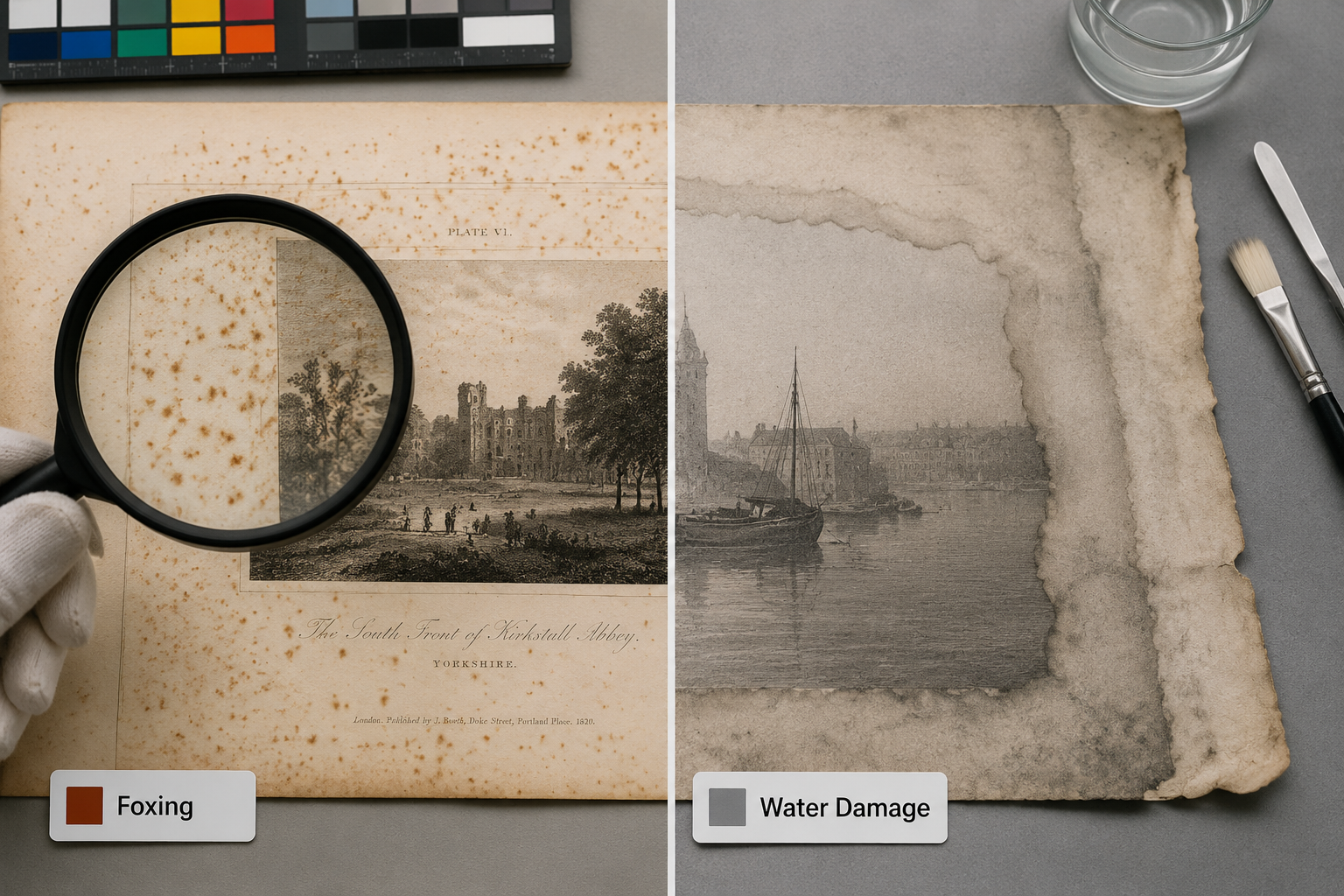
Edge case: Old prints can have both foxing and water damage simultaneously. In that case, treat the water damage (structural) concern first, and address foxing staining separately.
What Environmental Conditions Make Foxing More Likely to Develop
Foxing develops and spreads most aggressively in warm, humid environments with poor air circulation. Relative humidity above 65% is consistently identified in conservation literature as a threshold above which fungal activity and oxidation accelerate significantly.
Key environmental risk factors:
- High relative humidity (above 60-65%): the single most important trigger
- Temperature fluctuations: cycling between warm and cool causes condensation on paper surfaces
- Poor air circulation: stagnant air allows humidity to concentrate around stored items
- Exposure to light: ultraviolet light accelerates paper acidity, which worsens foxing over time
- Proximity to organic materials: cardboard boxes, wooden frames, and fabric mats off-gas acids that degrade paper
Recommended storage conditions for 19th-century paper prints, based on guidelines from the American Institute for Conservation (AIC):
- Relative humidity: 45-55%
- Temperature: 60-70 degrees Fahrenheit (15-21 degrees Celsius)
- Acid-free enclosures and mats
- Darkness or UV-filtered light when on display
Can I Prevent Foxing from Spreading in My Vintage Art Collection
Yes, you can slow or stop active foxing from spreading by controlling the storage environment. Foxing that is already present cannot be reversed through environmental control alone, but new spot formation can be significantly reduced.
Practical prevention steps:
- Store prints in acid-free, lignin-free folders or clamshell boxes
- Use silica gel packets in storage enclosures to regulate humidity, replacing them every 6-12 months
- Keep prints away from exterior walls, basements, and attics where humidity fluctuates
- Interleave prints with acid-free tissue paper rather than stacking them directly
- Inspect your collection every 6-12 months for new spot development
- Frame prints with UV-filtering glazing if displayed on walls
- Avoid wooden frames that are not sealed, as wood off-gasses acetic acid
If you find active mold (fuzzy, powdery growth), isolate the affected print in a sealed polyethylene bag immediately and consult a conservator before attempting any cleaning.
What’s the Best Way to Remove Foxing Stains from Old Prints Without Damaging Them
The safest and most effective method for removing foxing stains from 19th-century paper prints is professional aqueous washing combined with chemical reduction, performed by a trained paper conservator. For collectors considering identifying and cleaning foxing stains on 19th-century paper prints themselves, the risk of irreversible damage is significant.
Professional treatment methods, in order of increasing intervention:
- Surface cleaning: Removal of loose surface dirt with soft brushes or dry cleaning sponges. Does not address foxing staining but prepares the paper for further treatment.
- Aqueous washing: Immersing or locally washing the paper in deionized or calcium hydroxide-buffered water. This can reduce acidity and partially lift some staining.
- Chemical reduction: Application of dilute sodium borohydride or other reducing agents to break down oxidized iron compounds. Requires precise concentration control.
- Light bleaching: Controlled exposure to dilute hydrogen peroxide or calcium hypochlorite solutions. Effective but carries the highest risk of paper weakening if misapplied.
- Enzyme treatments: Targeted application of enzymes to address fungal components of foxing. Used in specialized cases.
What not to do at home:
- Do not use household bleach (sodium hypochlorite at household concentrations). It will yellow paper rapidly and weaken fibers.
- Do not wet the paper without understanding its structural integrity first. Wet paper tears easily.
- Do not use commercial “stain removers” or art supply erasers on foxing spots.
Is It Worth Trying to Clean Foxing Myself or Should I Always Hire an Expert
For most 19th-century paper prints with historical, artistic, or monetary value, hiring a professional conservator is the right choice. DIY cleaning is appropriate only for low-value items where the risk of further damage is acceptable.
Hire a professional conservator if:
- The print has significant monetary or sentimental value
- The foxing is extensive or covers important image areas
- The paper is already fragile, torn, or brittle
- The print is a unique item (original artwork, rare map, family document)
DIY surface cleaning may be acceptable if:
- The print is a common reproduction with no significant value
- You limit yourself to dry methods only (soft brush, dry cleaning pad)
- You are not attempting to remove the foxing staining itself, only surface dust
A professional paper conservator certified through the American Institute for Conservation can assess the print, recommend a treatment plan, and provide a written condition report. This documentation also matters for insurance and resale purposes.
How Much Does Professional Paper Restoration Cost for Foxing
Professional paper conservation for foxing treatment typically ranges from $150 to $800 or more per item in 2026, depending on the severity of the foxing, the size of the print, and the methods required. Highly complex treatments on large or fragile items can exceed $1,500.
Cost factors include:
- Extent of foxing: Light, scattered spots cost less to treat than dense, widespread staining
- Paper condition: Brittle or torn paper requires stabilization before foxing treatment, adding time and cost
- Treatment method: Aqueous washing is less expensive than multi-step chemical reduction
- Conservator’s location and experience: Rates vary by region and the conservator’s specialization
Many conservators offer a free or low-cost initial consultation. The American Institute for Conservation maintains a “Find a Conservator” directory at culturalheritage.org, which is a reliable starting point.
Important: Get a written estimate and treatment proposal before authorizing any work. A reputable conservator will always explain risks and alternatives before proceeding.
What Tools Do Professional Conservators Use to Clean Old Paper
Professional paper conservators use a combination of specialized tools and laboratory-grade chemicals that are not available in standard art supply stores. Understanding these tools helps collectors appreciate why professional treatment is so different from home remedies.
Common tools and materials:
- Deionized water and calcium hydroxide solutions for aqueous washing
- Japanese tissue and wheat starch paste for paper repair and lining
- Sable brushes (sizes 0-4) for local application of chemicals
- Suction table for controlled washing of fragile paper
- Sodium borohydride solution for chemical reduction of iron-based staining
- pH meters and conductivity meters to monitor water chemistry
- Magnification loupes and UV lamps for condition assessment
- Blotters and felts for controlled drying under weight
- Microscope for identifying fungal components
UV lamps are particularly useful in the diagnostic phase: foxing spots often fluoresce differently under UV light than surrounding paper, helping conservators map the extent of staining before treatment begins.
How Do Museums Handle Foxing on Rare Historical Documents
Museums treat foxing on rare documents as a conservation priority, but they approach it conservatively. The guiding principle in institutional conservation is “do as little as possible, and only what is reversible.” Identifying and cleaning foxing stains on 19th-century paper prints within a museum context always begins with thorough documentation.
Museum conservation protocol typically follows these stages:
- Condition survey and photography under normal, raking, and UV light
- Written treatment proposal reviewed by a senior conservator or curator
- Stabilization of any structural damage (tears, losses) before addressing staining
- Minimal intervention first: aqueous washing before chemical treatment
- Post-treatment documentation with before-and-after photography
- Archival housing in acid-free enclosures after treatment
Major institutions such as the Library of Congress and the British Library have published their paper conservation guidelines online, which provide useful reference material for private collectors seeking to understand best practices.
Are Vintage Prints with Minor Foxing Less Valuable or More Valuable
Minor foxing generally reduces the market value of antique prints, but the degree of impact depends heavily on the rarity and desirability of the piece. For common 19th-century decorative prints, even light foxing can reduce value by 20-40% compared to a clean example. For rare prints by significant artists or cartographers, foxing has less impact on collector demand.
Key value considerations:
- Rarity: A foxed print that rarely appears at auction may still sell well because collectors have few alternatives
- Severity and location: Foxing in the image area is more damaging to value than foxing in the margins
- Treatment history: A print that has been professionally cleaned and documented may actually command a premium over an untreated foxed example
- Market segment: Fine art buyers are more sensitive to condition than antiquarian map or book collectors, who often accept foxing as inherent to age
Do not attempt to clean a print to increase its value without professional advice. Poorly executed cleaning can reduce value far more than the original foxing.
FAQ
What is foxing on paper? Foxing refers to reddish-brown or tan spots that develop on aged paper, caused by iron oxidation, fungal activity, or both. The term comes from the fox-like rust color of the spots. It is most common on 19th-century prints, books, and maps stored in humid conditions.
Can foxing spread from one print to another? If foxing has an active fungal component, spores can potentially spread to adjacent papers in storage. Isolating heavily foxed items in sealed acid-free enclosures reduces this risk. However, not all foxing is fungal, and purely oxidative foxing does not spread by contact.
Is foxing dangerous to handle? Handling foxed paper poses minimal health risk for most people. However, if active mold is present (visible fuzzy growth, musty odor), wear nitrile gloves and a dust mask, and handle the item minimally until a conservator can assess it.
How long does professional foxing treatment take? Treatment time varies from a few hours for minor local cleaning to several weeks for complex aqueous washing and drying cycles on large or fragile prints. Most conservators will provide a time estimate along with the cost proposal.
Does foxing always get worse over time? Foxing tends to progress slowly in poor storage conditions and may appear stable for years in good conditions. Controlling humidity and temperature is the most reliable way to slow progression. It does not reverse on its own.
Can UV light remove foxing? UV light is used diagnostically to map foxing, not to remove it. Prolonged UV exposure actually accelerates paper deterioration and is never used as a treatment method.
What is the difference between foxing and acid burn? Acid burn appears as overall yellowing or browning of the paper, often concentrated at edges (edge burn). Foxing appears as discrete spots. Both involve paper acidity, but they have different visual patterns and causes.
Should I frame a foxed print under glass? Yes, framing under UV-filtering glass or acrylic protects the print from further light damage and helps stabilize the microenvironment. Use acid-free mats and backing board, and ensure the glazing does not touch the paper surface.
Can I store foxed prints with unfoxed ones? It is safer to store them separately, particularly if active mold is suspected. Use individual acid-free enclosures for each print regardless of condition.
Is there a home test to confirm foxing versus mold? A UV lamp (365nm wavelength) can help: active mold often fluoresces differently than iron-based foxing under UV. However, this is a rough guide, not a definitive test. A conservator with a microscope can provide a definitive diagnosis.
Conclusion
Foxing on 19th-century paper prints is a well-documented but nuanced conservation problem. The process of identifying and cleaning foxing stains on 19th-century paper prints starts with accurate diagnosis: confirming that you are dealing with foxing rather than water damage, acid burn, or another form of deterioration. From there, the path forward depends on the value of the piece, the severity of the staining, and your willingness to accept risk.
Actionable next steps:
- Assess your collection now. Pull out any 19th-century prints stored in basements, attics, or humid rooms and move them to a stable environment with 45-55% relative humidity.
- Photograph each print under normal light and, if possible, UV light, to document current condition before any treatment.
- For prints with significant value, contact a conservator through the American Institute for Conservation directory at culturalheritage.org for a professional assessment.
- Re-house all prints in acid-free enclosures with acid-free tissue interleaving, regardless of whether foxing is present.
- Do not attempt chemical cleaning at home on any print you value. The risk of permanent damage far outweighs the potential benefit.
Foxing does not have to be the end of a print’s life. With proper storage and, where warranted, professional treatment, many heavily foxed 19th-century prints can be significantly improved and stabilized for future generations.
References
- American Institute for Conservation. (n.d.). Find a Conservator. culturalheritage.org
- Meier, M. (2012). Foxing: A review of the literature. Studies in Conservation, 57(2), 85-102.
- Library of Congress. (2017). Care, Handling, and Storage of Works on Paper. loc.gov/preservation
- British Library. (2019). Paper Conservation at the British Library. bl.uk/conservation
- Image Permanence Institute. (2020). Storage Guide for Color Photographic Materials. imagepermanenceinstitute.org
Read next: Rescuing Water-Damaged Vintage Comic Books: A Step-by-Step Pressing Guide. A closer look at restore water-damaged comics.