
Key Takeaways
- Always squat down to the load, keep your back straight, and drive upward through your heels when lifting soil bags, compost, or heavy planters.
- The general safe lifting guideline for an untrained adult is 50 pounds or less for a single-person lift; anything heavier should involve a second person or mechanical aid.
- Ergonomic tools with extended handles, two-wheel garden carts, and hand trucks dramatically reduce strain during routine garden tasks.
- Older gardeners and those with physical limitations should reduce single-lift loads to 20-30 pounds and use assistive equipment as standard practice, not as a last resort.
- Warming up with light movement before heavy work and taking rest breaks every 20-30 minutes cuts muscle strain risk significantly.
- Twisting the spine while holding a load is the single most common cause of acute back injury in garden settings.
- Asking for help is not optional when a load exceeds your safe limit; community gardens are, by definition, communal spaces.
- Lightweight tool alternatives exist for nearly every heavy garden task and are worth the modest investment for regular gardeners.
What Is the Right Way to Lift Heavy Garden Tools Without Hurting Your Back
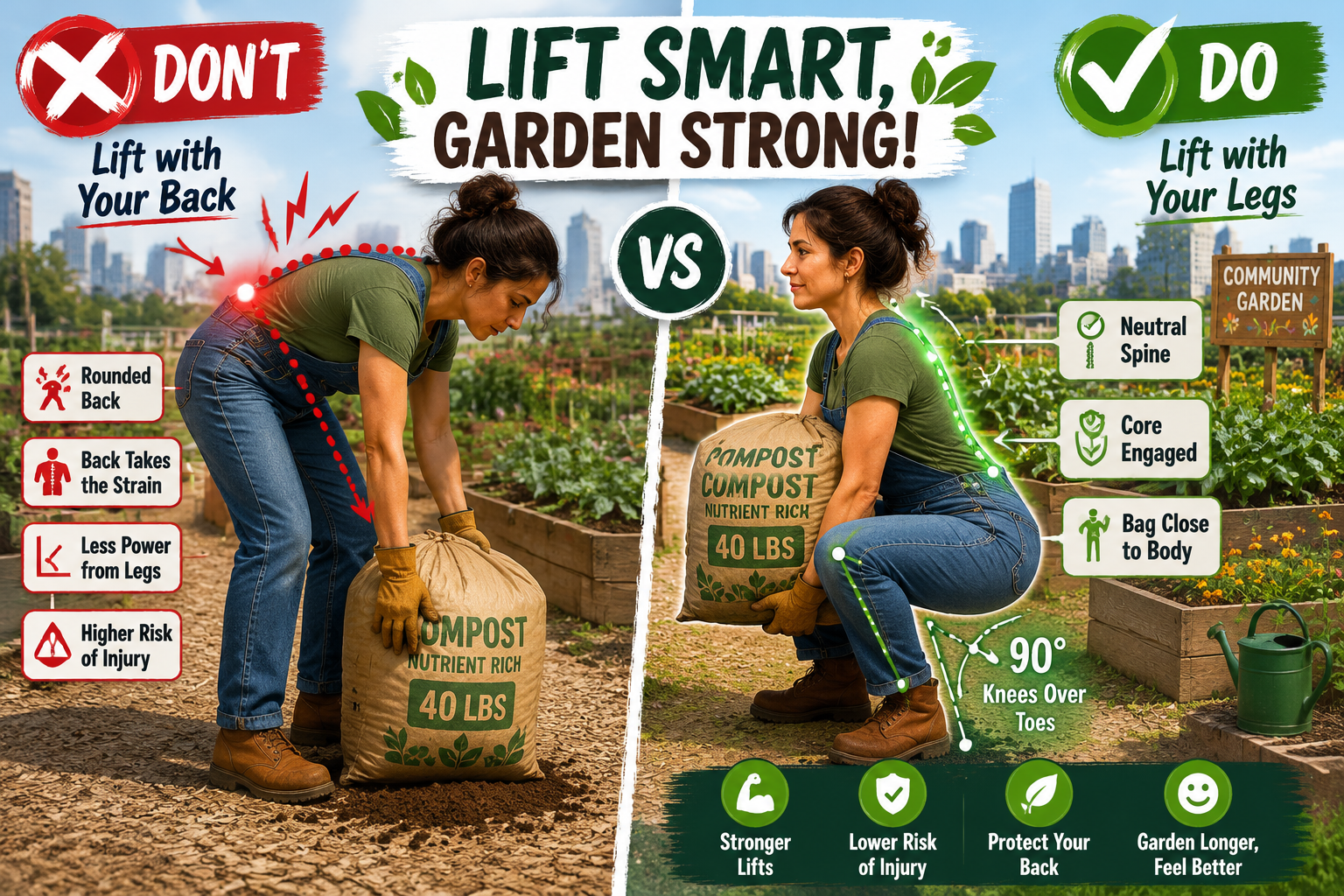
The correct lifting technique for heavy garden tools and materials follows a consistent sequence: position your feet shoulder-width apart, squat to the load with your knees bent, grip the object firmly and close to your body, then stand by straightening your legs while keeping your back neutral and upright.
This sequence matters because the lumbar spine is most vulnerable when it is both flexed (bent forward) and loaded. Bending at the waist to pick up a 40-pound bag of compost places enormous shear force on the lower vertebrae. Squatting shifts that force to the large muscles of the thighs and glutes, which are far better equipped to handle it.
Step-by-step lifting sequence for community gardeners:
- Stand close to the object. Your feet should nearly touch it.
- Lower yourself by bending at the knees and hips, not the waist.
- Keep your chest up and your lower back in its natural slight arch.
- Grip the object with both hands. Use handles, straps, or a firm two-handed grip.
- Breathe in, brace your core gently (as if bracing for a light punch to the stomach), then exhale as you stand.
- Keep the load against your body as you rise and move.
- To set the load down, reverse the sequence. Bend your knees, lower the load, then stand.
Common mistake: Many gardeners lift correctly but then twist at the waist to place the load to one side. That twist, combined with the weight, is where injuries happen. Instead, move your feet to change direction, keeping your hips and shoulders aligned.
How Much Weight Can an Average Person Safely Lift in a Community Garden
For most healthy adults, occupational health guidelines suggest a single-person lift should not exceed 50 pounds under ideal conditions, meaning the load is close to the body, at a comfortable height, and lifted infrequently. In a garden setting, conditions are rarely ideal: loads are often at ground level, awkwardly shaped, and lifted repeatedly over hours.
A more practical working limit for community gardeners is 30-40 pounds per lift when working alone. Standard 40-pound bags of topsoil and 30-pound bags of compost fall right at this threshold. If you are lifting from ground level (the most strenuous position), treat 30 pounds as your solo limit.
Factors that lower your safe limit:
- Fatigue (later in a work session, reduce your limit by roughly 20%)
- Awkward load shape (no handles, uneven weight distribution)
- Slippery or uneven ground
- Twisting or reaching required
- Pre-existing back, hip, or knee conditions
- Age over 60, particularly for women where bone density may be a factor
“The safest load is the one you can lift with full control, without holding your breath or rounding your back. If you have to strain, the load is too heavy for a solo lift.”
Best Ergonomic Techniques for Moving Soil Bags and Compost
Moving soil bags and compost safely requires both proper body mechanics and smart staging of materials. The best ergonomic approach is to avoid lifting from ground level whenever possible by staging heavy bags on a low table, tailgate, or garden cart before transferring them to their final location.
Practical ergonomic strategies:
- Slide, don’t lift. Drag or slide bags along the ground to position them before lifting. A piece of cardboard or a tarp under the bag reduces friction.
- Divide the load. A 40-pound bag of soil can be split into two buckets or smaller bags. Five-gallon buckets with handles are easier to grip and carry than a floppy bag.
- Use a garden cart or wheelbarrow. Load the bag into the cart at ground level by tilting it rather than full lifting, then wheel it to where you need it.
- Lift from mid-height. If you can rest the bag on a raised bed wall or a low bench before the final placement, you eliminate the most strenuous part of the lift.
- Carry close. Hold bags and buckets against your torso, not at arm’s length. Carrying a 30-pound bucket at arm’s length is biomechanically equivalent to carrying roughly 90 pounds held at the body.
Are There Special Lifting Techniques for Older Gardeners or People With Physical Limitations
Yes. Older gardeners and those with physical limitations should use modified techniques that prioritize mechanical assistance over manual effort. The goal shifts from “how do I lift this correctly” to “how do I avoid lifting this at all.”
For gardeners over 60 or those with back, hip, or knee conditions, a solo lift limit of 20-25 pounds is a reasonable starting point, and even that should involve the same squat-and-brace technique described above.
Adapted approaches for older or limited-mobility gardeners:
- Use a kneeler bench with side handles. It lets you lower yourself to ground level and push back up without putting full load on your knees.
- Long-handled tools keep you upright, reducing the need to bend and lift entirely.
- Raised beds at 24-30 inches height eliminate ground-level lifting for most planting tasks.
- Garden scooters or rolling seats let you work at low levels without kneeling or stooping.
- Ask a fellow gardener or volunteer to handle any load over your personal limit. Many community gardens have a buddy system or designated heavy-lifting volunteers for exactly this reason.
- If you have osteoporosis, herniated discs, or recent joint surgery, consult your physical therapist before any heavy garden work. They can give you specific load limits and movement restrictions.
What Equipment Can Help Me Lift Heavy Garden Materials More Safely
The right equipment can reduce the physical demand of heavy garden work by 50% or more. For urban community gardens, a modest investment in a few key tools pays off quickly in reduced fatigue and injury risk.
Most useful equipment for safe lifting in community gardens:
| Equipment | Best Use | Approximate Cost (2026) |
|---|---|---|
| Two-wheel garden cart | Moving bags of soil, compost, mulch | $80-$180 |
| Hand truck / dolly | Stacking and moving multiple bags | $40-$100 |
| Wheelbarrow (single or dual wheel) | Loose materials, wet soil | $60-$150 |
| Ergonomic long-handle tools | Digging, raking, hoeing | $25-$60 per tool |
| Padded back support belt | Extra lumbar support during heavy lifts | $20-$50 |
| Kneeler bench with handles | Low-level work, rising from ground | $30-$70 |
| Grip gloves | Better hold, reduces grip strain | $10-$25 |
A back support belt does not replace proper technique, but it can serve as a useful reminder to brace your core and maintain posture during repetitive lifts.
Common Mistakes People Make When Lifting Heavy Things in Gardening
The most common and damaging mistake is bending at the waist with a rounded back to pick up a load from the ground. This position compresses the lumbar discs unevenly and, when combined with weight, is a reliable path to a herniated disc or muscle tear.
Other frequent mistakes in garden lifting:
- Twisting while loaded. Picking up a bag and pivoting to place it without moving your feet.
- Holding the breath. Breath-holding spikes intra-abdominal pressure and raises blood pressure. Exhale on the effort.
- Rushing. Hurrying through a lift skips the setup steps that protect you.
- Overestimating capacity. Attempting a load that is clearly too heavy rather than splitting it or asking for help.
- Skipping warm-up. Cold muscles and stiff joints are far more injury-prone. Five minutes of light walking and dynamic stretching before heavy work makes a real difference.
- Ignoring fatigue. Injuries cluster at the end of a work session when muscles are tired. Set a time limit and stick to it.
- Poor footwear. Flip-flops or worn-out sneakers on uneven garden ground increase the risk of slipping while carrying a load.
Difference Between Professional Landscaper Lifting Techniques and Community Gardener Methods
Professional landscapers and community gardeners use the same fundamental biomechanical principles, but landscapers typically have more conditioning, better equipment, and structured rest protocols. The core technique is identical: neutral spine, load close to body, legs drive the lift.
Where the approaches differ is in volume and support. A landscaper may lift and carry heavy materials dozens of times per day, five days a week, and their bodies adapt to that load over time. They also typically have access to professional-grade equipment, team lifts as standard practice, and sometimes formal manual handling training required by occupational health regulations.
Community gardeners, by contrast, may garden intensively for a few hours on weekends. This stop-start pattern can actually increase injury risk because the body doesn’t maintain the conditioning between sessions. The practical implication: community gardeners should be more conservative with load limits, not less, because they are working with less-conditioned muscles.
What community gardeners can borrow from professional practice:
- Always use a two-person lift for anything over 50 pounds, no exceptions.
- Stage materials close to the work area before the session starts, minimizing carry distances.
- Rotate tasks to avoid repetitive strain on the same muscle groups.
- Treat a sharp pain during a lift as a stop signal, not something to push through.
How to Prevent Muscle Strain When Working in Urban Community Gardens
Preventing muscle strain in community garden work comes down to preparation, pacing, and technique applied consistently, not just when you remember to think about it.
A practical strain-prevention routine:
- Warm up for 5 minutes before any heavy work. Light walking, arm circles, and hip rotations get blood into the muscles.
- Stretch after, not before. Static stretching before activity can temporarily reduce muscle strength. Save deep stretching for after your session.
- Take a break every 20-30 minutes of sustained heavy work. Stand up straight, walk around, and hydrate.
- Vary your tasks. Alternate between heavy lifting, lighter planting work, and standing tasks to distribute load across different muscle groups.
- Cool down. Five minutes of gentle stretching targeting the lower back, hamstrings, and shoulders after a session reduces next-day soreness and maintains flexibility over time.
- Stay hydrated. Dehydrated muscles fatigue faster and are more prone to cramping and strain.
What Physical Condition Do You Need for Heavy Garden Work
You don’t need to be an athlete to do heavy garden work safely, but a baseline level of functional fitness makes a meaningful difference. The key physical capacities are: adequate core stability to protect the spine, enough leg strength to squat and stand with a load, and sufficient grip strength to control tools and bags.
If you can walk briskly for 20 minutes, get up from a chair without using your arms, and carry two bags of groceries without pain, you have the baseline fitness for moderate garden lifting with proper technique.
If you have any of the following, get clearance from a healthcare provider before heavy garden work: recent back surgery, active herniated disc, osteoporosis with fracture history, uncontrolled hypertension, or any condition that causes balance impairment.
Are There Lightweight Alternatives to Heavy Gardening Tools
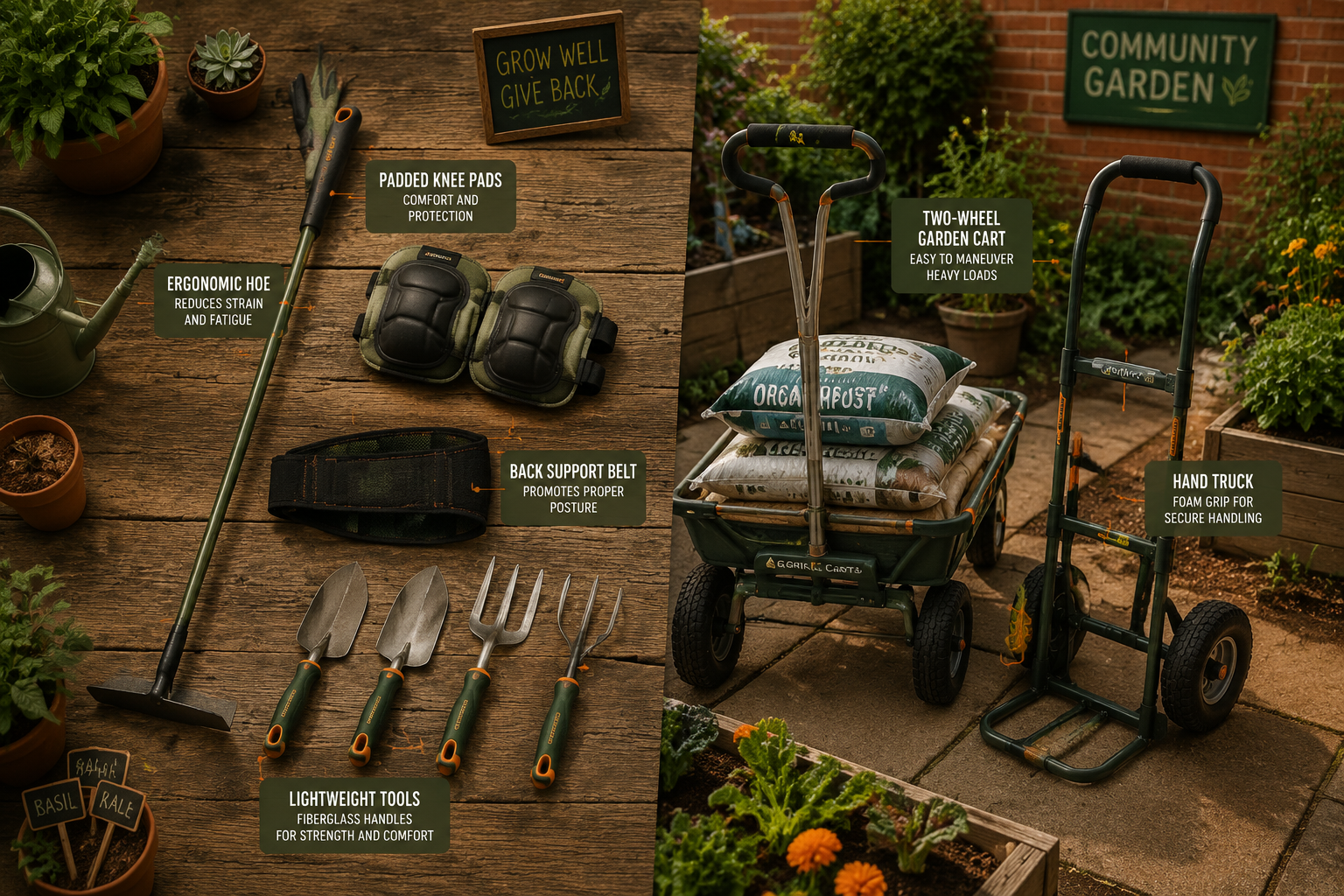
Yes, and in many cases lightweight alternatives perform just as well as their heavier counterparts. Modern materials like fiberglass, aluminum, and carbon fiber have replaced steel and hardwood in many tool designs without sacrificing durability.
Lightweight alternatives worth considering:
- Fiberglass or aluminum-handled tools instead of traditional hardwood. A fiberglass spade can weigh 30-40% less than a steel-handled equivalent.
- Compressed coir or peat-free lightweight compost blends instead of dense topsoil for container work.
- Fabric grow bags instead of heavy ceramic or concrete planters. A fabric bag weighs ounces; a ceramic pot of equivalent size can weigh 15-30 pounds empty.
- Collapsible garden carts that fold flat for storage and roll loads rather than requiring you to carry them.
- Battery-powered cultivators for soil turning instead of manual digging forks for large plots.
When Should You Ask for Help Lifting Something in a Community Garden
Ask for help any time a load exceeds your personal safe limit, is awkwardly shaped, requires you to reach or twist to place it, or when the ground is uneven or slippery. In a community garden, asking for help is not a sign of weakness; it is standard safe practice.
A useful rule: if you look at a load and feel uncertain whether you can lift it safely alone, that uncertainty is your answer. Get a second person.
Specific situations that always warrant a second person:
- Any single load over 50 pounds
- Moving large planters, raised bed frames, or water barrels
- Carrying loads up or down steps or ramps
- Working after an injury or during illness
- Any lift where you cannot see your feet or the path ahead
Many urban community gardens have informal or formal buddy systems. If yours doesn’t, suggest one. It costs nothing and prevents injuries that can sideline a gardener for weeks.
Risks of Improper Lifting Techniques for Urban Gardeners
Improper lifting in a garden setting carries real injury risk. The most common injuries are lower back muscle strains and lumbar disc injuries, but shoulder strains, knee injuries, and hernias are also documented in gardening populations.
According to the U.S. Bureau of Labor Statistics, musculoskeletal disorders account for a substantial share of work-related injuries in agriculture and landscaping sectors, with the lower back being the most frequently affected body region (BLS, 2023). While community gardeners are not occupational workers, the physical demands are comparable during active sessions.
Injury risk by task type:
| Task | Primary Risk | Body Region |
|---|---|---|
| Lifting soil bags from ground | Lumbar disc injury | Lower back |
| Carrying heavy buckets | Shoulder/rotator cuff strain | Shoulders |
| Repeated bending and lifting | Muscle fatigue strain | Lower back, hamstrings |
| Twisting with a load | Acute disc herniation | Lumbar spine |
| Prolonged kneeling | Bursitis, knee strain | Knees |
| Pushing heavy wheelbarrow | Wrist, shoulder strain | Upper body |
The good news: the vast majority of these injuries are preventable with consistent application of safe heavy lifting techniques for urban community gardeners.
Conclusion
Safe heavy lifting techniques for urban community gardeners are not complicated, but they do require consistent practice and a willingness to use the right tools and ask for help when needed. The core principles are simple: lift with your legs, keep loads close to your body, never twist your spine under load, and respect your personal weight limits.
Actionable next steps you can take today:
- Audit your current garden tools and identify one or two that could be replaced with lighter or longer-handled alternatives.
- Practice the squat-lift sequence with a light load before your next heavy work session so the movement pattern becomes automatic.
- Set a personal single-lift limit based on your age, fitness, and any existing conditions, and write it on a note you keep in your garden kit.
- Talk to your community garden coordinator about establishing a buddy system or designating heavy-lift days when multiple members are present.
- Warm up for five minutes before every session, without exception.
Gardening should be a source of health, not injury. With the right techniques and a little planning, you can do meaningful heavy work in your community garden for decades.
Frequently Asked Questions
Q: What is the correct posture for lifting a heavy bag of soil? Stand close to the bag, feet shoulder-width apart. Squat down by bending your knees and hips, keeping your back straight and chest up. Grip the bag firmly, brace your core, and stand by driving through your heels. Keep the bag against your body throughout.
Q: How heavy is too heavy to lift alone in a garden? For most healthy adults, 50 pounds is the upper limit for a solo lift under ideal conditions. In a garden setting, where loads are often at ground level and awkwardly shaped, 30-40 pounds is a more practical solo limit. Reduce this further if you are fatigued, over 60, or have any back or joint conditions.
Q: Can I use a back brace for garden lifting? A back support belt can serve as a helpful reminder to brace your core, but it does not replace proper technique. Use it as a supplement, not a substitute. If you feel you need a brace to lift safely, that is a signal the load may be too heavy or your technique needs work.
Q: What is the most common lifting injury in gardening? Lower back muscle strains and lumbar disc injuries are the most frequent, typically caused by bending at the waist to lift from ground level or twisting the spine while carrying a load.
Q: Should I stretch before heavy garden work? Light dynamic movement (walking, arm circles, hip rotations) before heavy work is beneficial. Deep static stretching before activity is less helpful and may temporarily reduce muscle strength. Save static stretching for after your session.
Q: How can older gardeners do heavy garden work safely? Older gardeners should reduce solo lift limits to 20-25 pounds, use long-handled tools to minimize bending, work with raised beds at a comfortable height, and use garden carts and hand trucks for moving heavy materials. A buddy system for heavy tasks is strongly recommended.
Q: What should I do if I feel a sharp pain during a lift? Stop immediately. Set the load down using your knees, not your back. Rest, apply ice if there is acute pain or swelling, and do not continue heavy work that session. If pain persists beyond 24-48 hours or is severe, see a healthcare provider.
Q: Are wheelbarrows or garden carts better for moving heavy soil? Both are useful. A two-wheel garden cart is more stable and easier to load and unload for bags and solid materials. A wheelbarrow is better for loose, wet materials like fresh compost or mixed soil. For most community gardeners, a two-wheel cart is the more versatile choice.
Q: How do I lift a heavy planter without hurting myself? Use two people whenever possible. If solo, empty the planter as much as possible before moving it, use a hand truck or furniture dolly, and slide rather than lift when moving short distances. Never attempt to lift a full large ceramic or concrete planter alone.
Q: How often should I take breaks during heavy garden work? Take a break every 20-30 minutes of sustained heavy work. Stand up straight, walk briefly, and hydrate. This reduces cumulative muscle fatigue, which is when most injuries occur.
Sources
- U.S. Bureau of Labor Statistics. (2023). Injuries, Illnesses, and Fatalities in Agriculture, Forestry, Fishing and Hunting. https://www.bls.gov/iif/
- National Institute for Occupational Safety and Health (NIOSH). (2021). Ergonomic Guidelines for Manual Material Handling. https://www.cdc.gov/niosh/
- American Physical Therapy Association. (2022). Preventing Back Pain During Gardening Activities. https://www.apta.org/
- Waters, T.R., Putz-Anderson, V., & Garg, A. (1994). Applications Manual for the Revised NIOSH Lifting Equation. U.S. Department of Health and Human Services.
Read next: Reducing Joint Stiffness for Scuba Divers in Cold Water: A Complete Guide. A closer look at cold water diving joint stiffness.