
Key Takeaways
- Position your desk in the “command position” so you face the room’s entrance, reducing subconscious stress and improving focus.
- Clutter is the single biggest energy disruptor for translators; a clear desk directly supports clearer thinking.
- Colors in the green, blue, and earth-tone families are best suited for sustained language work from home.
- Small live plants such as pothos, peace lily, or snake plant improve air quality and support concentration.
- Standing desks are compatible with feng shui when used with intention and balanced with seated rest periods.
- A professional feng shui consultation costs between $150 and $500 for a home office session, but many effective changes cost nothing.
- Monitor placement should prioritize both energy flow and ergonomic safety: screen at eye level, no direct glare, positioned to avoid sitting with your back to the door.
- Common freelancer mistakes include facing a wall, keeping dead plants, and using harsh overhead lighting.
- Feng shui is worth applying even on a freelancer’s budget because most high-impact changes are free.
What Is Feng Shui and How Can It Help You Work Better as a Translator
Feng shui is an ancient Chinese practice of arranging physical spaces to support the flow of energy, called “qi,” in ways that benefit the people living or working in them. For freelance translators and linguists, it offers a practical framework for designing a workspace that reduces distraction, supports mental stamina, and creates a sense of calm control.
Translation is cognitively demanding work. You’re holding two linguistic systems in your mind simultaneously, making hundreds of micro-decisions per hour, and often working in isolation for long stretches. The physical environment either supports or undermines that process. Desk feng shui for freelance translators and linguists isn’t mysticism — it’s a structured approach to workspace design that overlaps significantly with what environmental psychology research also recommends: reduce visual noise, maximize natural light, and create a sense of safety and control in your immediate surroundings.
When I first started applying feng shui principles to my translation workspace, the change I noticed most wasn’t spiritual — it was practical. I stopped losing focus every time someone walked past my door, because I had repositioned my desk to face it.
Best Desk Layout for Reducing Translation Burnout and Increasing Focus
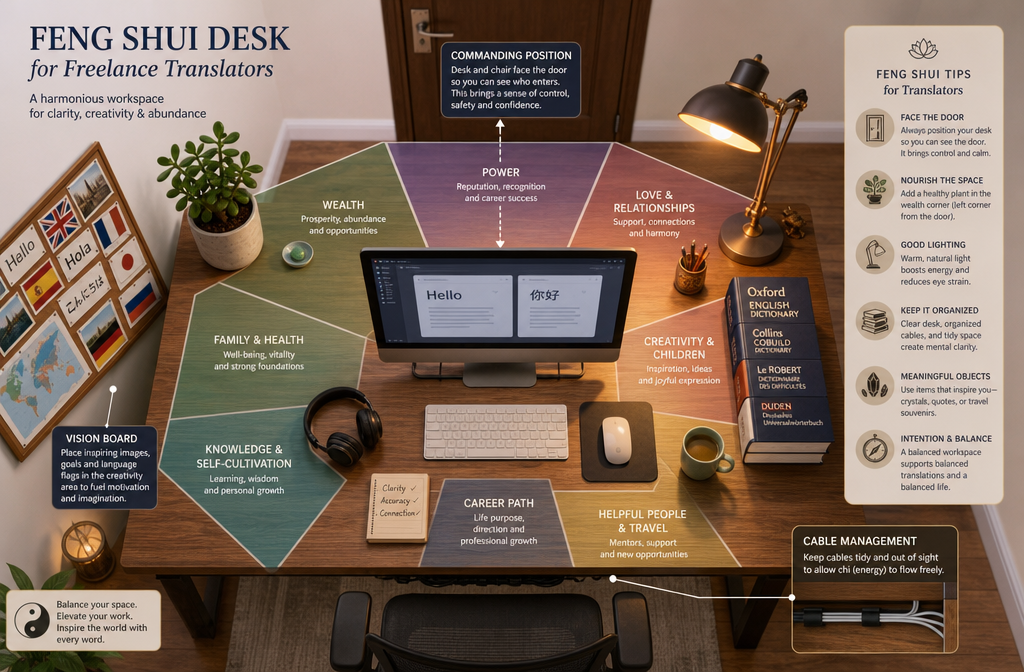
The best desk layout for translators places the desk in the “command position”: facing the room’s main entrance, with a solid wall behind you and clear sightlines to the door. This single change reduces the low-level anxiety of having your back exposed, which research in environmental psychology links to elevated cortisol and reduced concentration.
For translators specifically, the layout should also account for:
- Reference materials within arm’s reach on your dominant side, so reaching for a dictionary or style guide doesn’t interrupt your flow state.
- A clear center zone on the desk surface — nothing in the immediate typing area except your keyboard, mouse, and a single notepad.
- Secondary screens or printed source texts positioned at the same height as your primary monitor to avoid constant neck rotation.
- Cable management handled and out of sight. Tangled cables are a classic feng shui energy block, and they’re also visually distracting during long sessions.
A common mistake: placing the desk against the wall you face, so you stare at a blank surface all day. This is the opposite of the command position and is associated with feelings of stagnation — which translators often describe as “hitting a wall” mid-project.
Where Should You Place Your Computer Monitor for Optimal Energy Flow
Place your monitor directly in front of you at eye level, roughly an arm’s length away, with no direct light source behind the screen. In feng shui terms, the monitor should not be positioned so that you sit with your back to the door, and it should not face a window directly, as glare disrupts both visual comfort and qi flow.
Practical placement rules for translators:
- Screen top should align with your natural eye level when seated upright.
- If you use two monitors, center them symmetrically or place the primary screen directly ahead and the secondary at a slight angle (no more than 30 degrees).
- Avoid placing the monitor in the “death position” — directly facing the door in a straight line from the entrance. This is considered an energy drain in feng shui and also creates distraction as movement in the doorway pulls your gaze.
- Natural light should come from the side (ideally left if you’re right-handed) to reduce eye strain without creating screen glare.
The ergonomic and feng shui recommendations align here: both traditions say that your monitor placement should let you work without twisting, straining, or feeling visually exposed.
What Colors Are Most Productive for Translators Working from Home
Green, soft blue, and warm earth tones are the most productive colors for translators working from home. Green supports sustained concentration and is associated in feng shui with the wood element, which governs growth, creativity, and language. Blue calms the nervous system and supports analytical thinking. Earth tones (warm beige, terracotta, sand) provide grounding for long work sessions.
Colors to use with caution in a translation workspace:
- Red: Stimulating and energizing in short bursts, but too activating for hours of detailed linguistic work.
- Bright white: Clean but can feel clinical and harsh over long periods; soften with warm-toned accessories.
- Black: Grounding in small doses (desk surface, monitor bezel) but overwhelming as a dominant wall color.
You don’t need to repaint your walls. A few targeted additions — a green plant, a blue desk mat, a warm-toned lamp — can shift the color energy of a workspace meaningfully. When I added a sage green desk pad and a small watercolor print in blue-green tones, the room felt noticeably calmer within a day.
Which Plants Improve Concentration for Language Professionals
Live plants improve concentration for language professionals by improving air quality, reducing ambient noise slightly, and providing a natural visual rest point for tired eyes. In feng shui, plants represent the wood element and support the kind of sustained, generative energy that translation requires.
The best plants for a translator’s desk or home office:
| Plant | Why It Works | Care Level |
|---|---|---|
| Pothos | Tolerates low light, clears air, grows steadily | Very easy |
| Snake plant | Releases oxygen at night, very low maintenance | Very easy |
| Peace lily | Reduces airborne toxins, calming appearance | Easy |
| Bamboo (lucky bamboo) | Classic feng shui wood element, compact | Easy |
| Lavender (small pot) | Mild scent reduces anxiety, supports focus | Moderate |
Avoid dead or dying plants entirely. In feng shui, a dying plant is considered worse than no plant at all because it represents stagnant or declining energy. Check your plants weekly and replace them promptly if they’re struggling.
Common Feng Shui Mistakes Freelancers Make in Their Workspace
The most common feng shui mistakes freelancers make are sitting with their back to the door, tolerating clutter, using harsh overhead lighting as the only light source, and keeping broken or dead objects on the desk.
Other frequent errors specific to translation workspaces:
- Stacking unfinished projects visibly. A pile of “to-do” documents in your sightline creates constant low-grade stress. Use a drawer or closed folder system instead.
- Mixing work and personal items on the desk. Personal photos, bills, and hobby items blur the energetic boundary of your workspace and dilute focus.
- Ignoring the area directly behind the chair. A solid wall behind you is ideal. A window directly behind you is considered destabilizing in feng shui and also creates uncomfortable glare on your screen.
- Keeping non-functional technology. Old hard drives, broken headphones, and unused peripherals are energy clutter even if they’re physically tidy.
- Facing a mirror that reflects your back. This is considered a draining position in feng shui and can create a sense of being watched.
Are Standing Desks Good or Bad for Feng Shui Energy
Standing desks are compatible with feng shui when used with intention and balance. The key principle is that feng shui favors neither constant stillness nor constant movement — it favors flow. A standing desk that allows you to alternate between sitting and standing supports that balance well.
From a feng shui perspective:
- A sit-stand desk in the command position is preferable to a fixed desk in a poor position.
- The desk surface should remain uncluttered whether you’re sitting or standing.
- Avoid standing with your back to the door, even if the standing position feels more active and alert.
For translators who work long hours, alternating between sitting and standing every 45 to 60 minutes also aligns with what ergonomists recommend for reducing musculoskeletal strain. The feng shui and the ergonomic rationale point in the same direction: don’t stay locked in one position for hours.
How to Arrange Your Desk in a Small Apartment or Studio
In a small apartment or studio, the priority is creating a clear energetic and visual boundary between your work zone and your living or sleeping zone. Even a single desk in a studio can be arranged according to feng shui principles with a few targeted adjustments.
Practical steps for small-space desk feng shui:
- Face the room’s main entrance if at all possible, even if this means positioning the desk at an angle.
- Use a room divider, bookshelf, or curtain to separate the desk from the bed or sofa. This boundary is important both energetically and psychologically — it helps your brain shift between work mode and rest mode.
- Keep the desk surface minimal. In a small space, visual clutter has an outsized impact. Only keep what you’re actively using on the surface.
- Use vertical space. Wall-mounted shelves for reference books and dictionaries free up desk surface and keep materials accessible without crowding the workspace.
- Choose a desk lamp with warm light rather than relying on overhead ceiling fixtures, which tend to be harsh and unflattering in small spaces.
The biggest mistake in studio apartments is letting the desk become a catch-all surface. Once it accumulates non-work items, the energetic boundary dissolves and focus suffers.
Feng Shui Tips for Translators Who Work Long Hours
Translators who work long hours need a workspace that actively supports recovery as well as performance. The feng shui approach here focuses on reducing sensory fatigue, maintaining energy flow, and building in physical and visual rest.
Specific tips for long-hour translation work:
- Place a small plant or a piece of natural material (wood, stone, ceramic) within your sightline. Glancing at natural textures briefly between paragraphs gives your visual cortex a micro-rest.
- Use layered lighting — a warm desk lamp plus ambient room light — rather than a single harsh overhead source. This reduces eye strain significantly over an eight-hour session.
- Keep water on the desk. Water is a feng shui element associated with flow and mental clarity. Practically, hydration also directly supports cognitive performance.
- Clear your desk at the end of every workday. This ritual signals closure to your nervous system and ensures you start each session with clean energy.
- Position a small object that represents your professional identity — a favorite reference book, a pen you love, a small object from a language you work with — in the far left corner of your desk (the feng shui “wealth and purpose” zone). This is a subtle but effective way to reinforce your sense of professional identity during long, grinding sessions.
How Desk Arrangement Can Help Reduce Translator’s Neck and Back Pain
Desk feng shui for freelance translators and linguists directly addresses neck and back pain through the command position principle and monitor placement guidelines, which align closely with ergonomic standards. Sitting with your back to the door causes unconscious muscle tension in the neck and upper back — a physical response to perceived vulnerability from behind.
Beyond the command position:
- Monitor at eye level eliminates the forward head posture that causes chronic neck strain in translators who look down at screens for hours.
- Reference materials at desk height rather than on a separate surface below or to the side prevents repetitive lateral neck rotation.
- Chair positioned so feet rest flat on the floor supports lumbar alignment. Feng shui’s emphasis on grounding energy translates physically into keeping your body connected to the floor rather than perched or hunched.
- Clear space under the desk is a feng shui principle (no blocked energy beneath you) that also has a physical benefit: it allows you to shift your leg position freely throughout the day, which reduces hip flexor tightness.
If you’re experiencing persistent back or neck pain, a professional ergonomic assessment is worth the investment alongside any feng shui adjustments.
Feng Shui Elements That Boost Creativity for Language Work
The wood and water elements in feng shui are the most directly relevant to creative language work. Wood governs growth, communication, and generative thinking. Water governs flow, intuition, and the kind of associative thinking that good translation requires.
Ways to bring these elements into a translator’s workspace:
- Wood: Live plants, wooden desk surfaces, bamboo accessories, green or teal color accents.
- Water: A small tabletop fountain if space allows, blue or black color accents, a glass of water kept on the desk, imagery of water in any artwork on the walls.
- Metal element in moderation: Metal supports precision and clarity — useful for proofreading phases. Silver or white accessories, metal pen holders, or a small metal desk organizer can activate this energy without overwhelming the space.
Avoid over-representing the fire element (red, triangular shapes, candles) in a translation workspace. Fire energy is excellent for motivation and short bursts of energy but tends to make sustained, detail-oriented work harder.
Is It Worth Investing in Feng Shui If You’re a Freelancer
Yes, desk feng shui for freelance translators and linguists is worth investing in, and most of the highest-impact changes cost nothing. Repositioning your desk, clearing clutter, and adjusting your monitor placement are free. Adding a plant costs under $20. These changes can meaningfully affect your focus, comfort, and daily work quality.
If you want a professional consultation, here’s what to expect:
- Remote feng shui consultation: Typically $75 to $200, based on floor plan photos and a video call.
- In-person home office consultation: Typically $150 to $500 depending on the consultant’s experience and your location.
- Full home assessment: $300 to $800 or more.
For most freelancers, a remote consultation focused specifically on the home office is the most cost-effective option. Many consultants offer a single-room focus package. That said, you can achieve 80% of the benefit by applying the core principles yourself: command position, clutter clearance, natural elements, and intentional lighting.
FAQ
What is the command position in feng shui and why does it matter for translators? The command position means placing your desk so you face the room’s entrance with a solid wall behind you. For translators, this reduces subconscious alertness to what’s happening behind you, which frees up cognitive resources for language work.
Can I apply feng shui to a shared workspace or co-working desk? You can apply portable feng shui principles: keep your immediate desk surface clear, face the room entrance if possible, add a small plant or natural object, and use a warm-toned desk lamp. You can’t control the room, but you can control your zone.
How often should I rearrange my desk according to feng shui? There’s no fixed schedule. Reassess when you notice a persistent drop in focus, increased fatigue, or a general sense of stagnation. Seasonal decluttering (four times a year) is a practical rhythm many practitioners recommend.
Does feng shui work if I don’t believe in it? The physical and ergonomic principles embedded in feng shui — command position, clutter reduction, natural light, live plants — have independent support from environmental psychology. You don’t need to believe in qi for the practical changes to benefit your workspace.
What’s the single most important feng shui change a translator can make today? Move your desk so you face the door. If that’s not possible, place a small mirror on your desk angled to reflect the entrance. This is the highest-leverage change for focus and stress reduction.
Are crystals or feng shui cures necessary for a productive workspace? No. Crystals and decorative cures are optional enhancements. The foundational changes — position, clutter, light, and natural elements — deliver the most practical benefit and require no special objects.
What should I put in the wealth corner of my desk? The far left corner from where you sit is considered the wealth and purpose zone. For translators, placing a meaningful professional object there — a favorite dictionary, a small award, or a plant — reinforces professional identity and intention.
Is it bad feng shui to have a window behind my desk? Yes, in traditional feng shui a window directly behind you is considered destabilizing because it lacks the solid support of a wall. Practically, it also creates glare on your screen. If you can’t move the desk, hang a sheer curtain to soften the window’s energy and reduce glare.
How does feng shui address the noise issues translators face when working from home? Feng shui addresses noise indirectly through room layout and soft furnishings. Bookshelves, rugs, curtains, and upholstered furniture all absorb sound. Positioning your desk away from high-traffic areas of the home is also a feng shui principle of protecting your work zone’s energy.
Can feng shui help with translator’s block or creative stagnation? Clearing physical clutter is the most direct feng shui intervention for mental stagnation. Adding wood element objects (plants, wooden surfaces) and ensuring natural light reaches your workspace can also help shift a stuck creative state.
Conclusion
Applying desk feng shui for freelance translators and linguists doesn’t require a complete renovation or a large budget. Start with the command position — move your desk to face the door. Then clear the surface of everything you don’t actively use. Add one live plant. Adjust your monitor to eye level. These four steps alone will change how your workspace feels and performs within a week.
From there, layer in color, lighting, and elemental balance at your own pace. If you want professional guidance, a focused remote consultation is a reasonable investment. But the core principles are accessible to every freelancer regardless of budget or apartment size.
Your workspace is the environment where you do some of the most cognitively demanding work that exists — holding two languages in your mind simultaneously, hour after hour. It deserves the same intentional design you bring to your translations.
References
- Rossbach, Sarah. Interior Design with Feng Shui. Dutton, 1987.
- Kaplan, S. “The restorative benefits of nature: Toward an integrative framework.” Journal of Environmental Psychology, 1995.
- Hedge, A. “Ergonomic Workplace Design for Health, Wellness, and Productivity.” CRC Press, 2016.
Read next: Morning Routine for Night-Shift Workers in Creative Fields: A Complete 2026 Guide. A closer look at night shift morning routine.