
Key Takeaways
- Baristas perform thousands of repetitive wrist and hand motions per shift, making RSIs a genuine occupational health risk, not just occasional soreness.
- The most common injuries include carpal tunnel syndrome, De Quervain’s tenosynovitis, and lateral epicondylitis (tennis elbow).
- Ergonomic tamping tools, angled tamping mats, and properly calibrated grinders reduce strain significantly.
- A daily 10-minute stretching and strengthening routine can cut injury risk considerably for coffee professionals.
- Ignoring early warning signs, such as tingling, numbness, or persistent aching, is the most common mistake baristas make.
- Medical treatment for hand and wrist RSIs can cost between $1,000 and $30,000 depending on severity and whether surgery is required (based on general U.S. occupational health cost estimates as of 2024).
- Certain espresso machine designs, particularly those with lower tamping resistance and lever-assisted portafilters, are measurably better for injury prevention.
- Baristas who develop chronic RSIs have several viable career transition paths within the coffee industry.

What Exactly Are Repetitive Strain Injuries for Baristas
Repetitive strain injuries are soft-tissue conditions caused by overuse of muscles, tendons, and nerves through repeated movements. For baristas, the hands, wrists, forearms, and shoulders are the primary affected areas because nearly every task in a coffee bar involves these body parts.
The three most common RSIs in the barista profession are:
- Carpal Tunnel Syndrome (CTS): Compression of the median nerve in the wrist, causing numbness, tingling, and weakness in the thumb and first three fingers.
- De Quervain’s Tenosynovitis: Inflammation of the tendons on the thumb side of the wrist, producing sharp pain when gripping or twisting.
- Lateral Epicondylitis (Tennis Elbow): Overuse injury of the forearm tendons where they attach to the outer elbow, common in baristas who tamp with poor form.
A 2019 study published in the journal Ergonomics found that food service workers performing repetitive hand tasks had significantly elevated rates of upper-limb musculoskeletal disorders compared to general office workers. Baristas specifically face a compounding risk because their work combines force (tamping requires approximately 30 lbs of pressure), repetition (a busy cafe may pull 200 to 400 shots per shift), and awkward wrist positioning.
How Wrist and Hand Injuries Happen When Making Coffee
Wrist and hand injuries in baristas develop through the accumulation of micro-trauma across hundreds of repetitive movements per shift. No single espresso shot causes an injury; it’s the cumulative load over days, weeks, and months.
The key injury mechanisms include:
- Tamping: Applying 30 lbs of downward force repeatedly with a neutral or deviated wrist loads the carpal tunnel and thumb tendons. Baristas who tamp with a bent wrist instead of a straight one multiply the strain on their tendons.
- Portafilter locking: Twisting the portafilter into the group head requires forearm pronation under load, which stresses the lateral elbow tendons.
- Steam wand operation: Repeated gripping and rotating of the steam wand knob strains the fingers and thumb.
- Milk pitcher handling: Lifting and tilting heavy pitchers of milk dozens of times per hour loads the wrist extensors.
- Cleaning and wiping: Repetitive counter-wiping and backflushing motions are often overlooked but contribute meaningfully to cumulative strain.
“The injury doesn’t happen the day you feel it. It happened weeks ago, and you’re just now noticing.” This is a sentiment I’ve heard from occupational therapists who work with hospitality workers, and it captures why early prevention matters far more than reactive treatment.
Which Coffee Shop Positions Are Most at Risk for Strain Injuries
Bar baristas pulling high-volume espresso are at the greatest risk, but any role involving repetitive hand and wrist tasks carries meaningful injury potential. The risk varies by volume, technique, and equipment quality.
Risk ranking by position:
| Position | Primary Risk Factors | Relative RSI Risk |
|---|---|---|
| Espresso bar barista | Tamping, portafilter locking, steaming | Highest |
| Batch brew / drip station | Pitcher handling, cleaning | Moderate |
| Cafe manager (working shifts) | Mixed tasks, often poor ergonomics | Moderate |
| Barback / support staff | Cleaning, lifting, restocking | Lower but present |
| Trainer / competition barista | High-precision, high-repetition practice | High |
High-volume specialty coffee shops, where shot quality standards require manual tamping and precise milk texturing, tend to produce more RSI cases than lower-volume or fully automated cafes. Competition baristas who practice for hours daily are at particular risk because they combine high volume with high force and precision.
Common Mistakes Baristas Make That Lead to Long-Term Damage
The most damaging mistake is ignoring early symptoms and continuing to work through pain. Beyond that, several technique and habit errors accelerate injury progression.
Top mistakes to avoid:
- Tamping with a bent wrist: A wrist that deviates ulnarly (toward the pinky) during tamping increases carpal tunnel pressure. Always tamp with a neutral, straight wrist.
- Using excessive tamping force: Research suggests that 30 lbs of pressure is sufficient for proper espresso extraction. Many baristas apply significantly more, especially when stressed or rushing.
- Skipping warm-up and cool-down: Starting a shift with cold hands and jumping straight into high-volume service is a common setup for injury.
- Using undersized or poorly shaped tampers: A tamper that doesn’t fit the hand properly forces awkward grip positions. The tamper handle should fill the palm comfortably.
- Not reporting symptoms early: Many baristas fear being seen as weak or losing shifts, so they delay reporting pain. This turns a treatable condition into a chronic one.
- Poor posture at the bar: Hunching over the machine or working at a bar height that’s too low or too high forces compensatory strain up the kinetic chain into the wrists and elbows.
Best Ergonomic Equipment for Coffee Shops to Prevent Injuries
The right equipment is one of the most direct investments a coffee shop can make in preventing repetitive strain injuries in professional baristas. Ergonomic tools reduce force requirements, improve wrist alignment, and decrease cumulative load.
High-impact ergonomic upgrades:
- Angled tamping mats: A mat angled at 20 to 30 degrees allows the barista to tamp with a neutral wrist rather than bending the wrist downward. Brands like Rhinowares and Rattleware offer well-regarded options.
- Ergonomic tamper handles: Wider, contoured handles distribute grip force more evenly. The Decent Tamper and similar products with palm-filling designs reduce pinch grip stress.
- Automatic tampers: Devices like the PuqPress apply consistent, calibrated pressure mechanically, removing the manual tamping motion entirely. For high-volume shops, this is one of the most effective injury prevention tools available.
- Properly calibrated grinders: A grinder that produces consistent particle size reduces the need for excessive tamping force to compensate for grind inconsistency.
- Adjustable bar height: A bar surface set at elbow height for the individual barista eliminates the need to raise or lower the wrists awkwardly during service.
- Lightweight pitchers: Switching from heavy stainless pitchers to lighter alternatives reduces the cumulative load on wrist extensors during milk service.
Choose an automatic tamper if: your shop pulls more than 150 espresso shots per day and you have two or more baristas working regular bar shifts.
Are Certain Espresso Machine Designs Better for Preventing Injuries
Yes. Espresso machine design directly affects how much force and awkward movement a barista must perform per shot. Machines that reduce the physical demands of portafilter locking and group head interaction meaningfully lower RSI risk.
Design features that reduce injury risk:
- Lower portafilter locking torque: Some machines require significant twisting force to lock the portafilter. Machines with smoother, lower-resistance locking mechanisms (common in newer commercial La Marzocco and Synesso models) reduce forearm strain.
- Lever-style steam knobs vs. twist knobs: Lever steam controls require less grip force and wrist rotation than traditional twist knobs.
- Paddle or touch controls: Volumetric or gravimetric machines with paddle controls eliminate the need to manually start and stop shots, reducing repetitive button-pressing.
- Group head height and angle: Machines where the group head is positioned at a comfortable working height for the average barista reduce the need for wrist deviation during portafilter insertion.
Fully automatic super-automatic machines eliminate nearly all manual hand and wrist tasks, but they’re generally not used in specialty coffee environments where manual craft is central to the product.
Exercises to Strengthen Hands and Wrists for Baristas
A targeted daily exercise routine is one of the most effective strategies for preventing repetitive strain injuries in professional baristas. Strengthening the muscles around the wrist and forearm builds resilience against cumulative load.
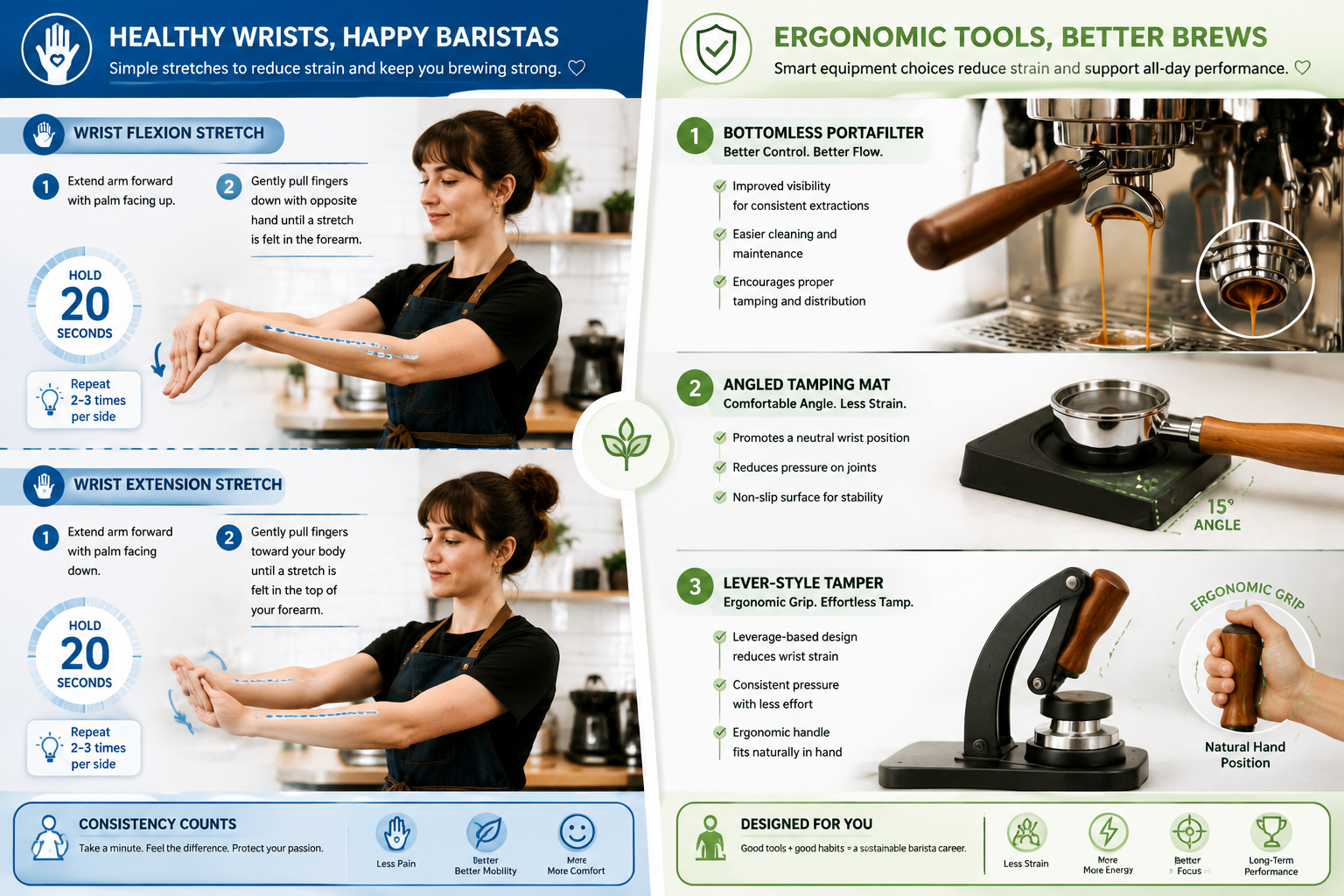
Recommended daily routine (10 to 15 minutes):
Before shift (warm-up):
- Wrist circles: 10 rotations each direction, both wrists.
- Prayer stretch: Press palms together in front of chest, lower hands slowly until a stretch is felt in the wrists. Hold 20 seconds, repeat 3 times.
- Finger extensions: Spread fingers wide, hold 5 seconds, release. Repeat 10 times per hand.
- Forearm pronation/supination: With elbow at 90 degrees, rotate forearm palm-up to palm-down. 15 repetitions each arm.
After shift (recovery):
- Wrist flexor stretch: Extend arm forward, palm up, and gently pull fingers back with the other hand. Hold 30 seconds per side.
- Wrist extensor stretch: Extend arm forward, palm down, and gently press fingers downward. Hold 30 seconds per side.
- Ice or contrast therapy: For baristas with existing soreness, alternating 3 minutes of ice and 3 minutes of warmth on the wrists reduces inflammation.
Strengthening (3 times per week):
- Rubber band finger extensions: Place a rubber band around all fingers, open and close against resistance. 3 sets of 20 reps.
- Wrist curls with light dumbbells (2 to 5 lbs): Both flexion and extension. 3 sets of 15 reps.
- Grip strengthener squeeze: 3 sets of 20 reps per hand.
How Do Professional Baristas Protect Themselves from Chronic Pain
Professional baristas who successfully avoid chronic pain combine good technique, ergonomic tools, daily body maintenance, and a willingness to speak up when something hurts. Prevention is a daily practice, not a one-time fix.
Practical protection strategies:
- Rotate tasks during long shifts: Alternate between bar work, cleaning, and customer service to break up repetitive motion patterns.
- Take micro-breaks: A 2-minute break every 45 to 60 minutes to shake out the hands and stretch reduces cumulative strain meaningfully.
- Wear compression gloves or wrist supports during high-volume periods: These don’t replace good technique but can reduce fatigue during peak service.
- Communicate with management: A good cafe manager will adjust scheduling and task rotation to protect staff. If yours won’t, that’s a workplace culture problem worth addressing directly.
- See a physical therapist early: At the first sign of persistent aching or tingling, a sports or occupational physical therapist can identify technique or posture issues before they become injuries.
Average Medical Costs for Barista Hand and Wrist Injuries
Medical costs for RSIs vary widely based on severity, treatment type, and whether the injury is covered by workers’ compensation. Based on general U.S. occupational health cost data available through 2024, the following estimates apply:
| Injury Severity | Typical Treatment | Estimated Cost Range (USD) |
|---|---|---|
| Mild (early-stage tendinitis) | Physical therapy, NSAIDs, rest | $500 to $2,000 |
| Moderate (carpal tunnel, confirmed) | Splinting, corticosteroid injections, PT | $2,000 to $8,000 |
| Severe (surgery required) | Carpal tunnel release surgery + rehab | $10,000 to $30,000+ |
These are estimates based on U.S. out-of-pocket costs without insurance. Workers’ compensation, where applicable, may cover most or all of these costs. Lost wages during recovery add significantly to the total economic impact.
A barista earning $18 per hour who misses 8 weeks of work due to surgery loses roughly $5,760 in wages alone, not counting tips. The financial case for prevention is clear.
Signs You Should Stop Working as a Barista Due to Strain
Certain symptoms signal that continuing bar work without medical intervention will cause permanent damage. Recognizing these signs early is critical for long-term career and health outcomes.
Stop working and seek medical attention if you experience:
- Numbness or tingling in the fingers that persists outside of work hours.
- Weakness in grip strength that makes it difficult to hold a portafilter or pitcher.
- Pain that wakes you up at night.
- Visible swelling or warmth around the wrist or forearm tendons.
- Loss of fine motor control or dropping objects unexpectedly.
- Pain that doesn’t improve after 48 to 72 hours of rest.
These symptoms suggest nerve involvement or significant tendon damage that requires professional diagnosis. Working through them risks converting a treatable condition into a permanent one.
What Alternative Careers Can Baristas Switch to If They Get Injured
An RSI diagnosis doesn’t have to mean leaving the coffee industry entirely. Many skills baristas develop transfer well to roles with lower physical demand.
Lower-strain career paths within and adjacent to coffee:
- Coffee roaster (quality control / cupping): Cupping and sensory evaluation require minimal repetitive hand strain.
- Coffee educator or trainer: Teaching technique rather than performing it shifts the physical load significantly.
- Cafe manager or operations manager: Administrative and supervisory roles reduce bar time.
- Coffee writer or content creator: Expertise in coffee translates well to journalism, blogging, or brand content work.
- Green coffee buyer or importer: Relationship-based roles in the supply chain leverage coffee knowledge without physical bar work.
- Equipment sales or technical support: Many baristas transition into roles with espresso equipment companies.
The key is to make this transition before the injury becomes disabling. A barista who moves into training or management after an early-stage RSI diagnosis preserves far more career options than one who waits until surgery is required.
FAQ
What is the most common RSI for baristas? Carpal tunnel syndrome and De Quervain’s tenosynovitis are the most frequently reported RSIs among professional baristas, both caused by repetitive wrist flexion, extension, and gripping motions during espresso preparation.
How many shots per day is too many for wrist health? There’s no universal threshold, but baristas consistently pulling more than 200 shots per shift without ergonomic tools or task rotation face significantly elevated injury risk. Volume alone isn’t the issue; poor technique and no recovery time compound the risk.
Can a barista fully recover from carpal tunnel syndrome? Yes, when caught early. Mild to moderate carpal tunnel syndrome treated with splinting, physical therapy, and technique correction often resolves fully within 3 to 6 months. Severe cases requiring surgery have good outcomes but longer recovery timelines of 3 to 12 months.
Does tamping force actually matter for injury risk? Yes. Applying more than the recommended 30 lbs of tamping pressure does not improve espresso extraction and meaningfully increases wrist and forearm strain. Calibrated tamping tools help baristas learn the correct pressure.
Are automatic tampers worth the cost for small cafes? For shops pulling fewer than 100 shots daily, the injury prevention benefit may not justify the $500 to $1,500 cost of a quality automatic tamper. For high-volume shops, the return on investment in reduced injury-related downtime and workers’ comp claims is generally positive within one to two years.
Should baristas wear wrist braces during service? Wrist braces can reduce fatigue during long shifts but should not replace proper technique. Wearing a brace to work through pain without addressing the underlying cause can mask symptoms and delay needed treatment.
How quickly do RSI symptoms typically appear in new baristas? Many new baristas report first noticing wrist or forearm discomfort within 3 to 6 months of starting high-volume bar work, particularly if they haven’t received ergonomic training. Symptoms can appear sooner in physically smaller individuals or those with pre-existing wrist conditions.
Is it the employer’s responsibility to prevent barista RSIs? In most jurisdictions, employers have a legal duty to provide a safe working environment, which includes ergonomic risk assessment and appropriate equipment. Baristas experiencing work-related injuries should document symptoms and report them through official workplace injury channels.
Can yoga or general fitness reduce RSI risk for baristas? General fitness that includes upper-body flexibility and strength training does reduce RSI risk by improving the resilience of the muscles and connective tissue involved in bar work. Yoga, particularly poses that stretch the forearms and wrists, is a useful complement to the specific barista exercises described above.
Conclusion
Preventing repetitive strain injuries in professional baristas is not a passive goal. It requires deliberate choices about equipment, technique, daily body maintenance, and workplace culture. The good news is that most RSIs are preventable when addressed early, and the tools to prevent them, from ergonomic tampers to a 10-minute daily stretch routine, are accessible and affordable.
Actionable next steps for baristas in 2026:
- Audit your tamping technique today. Ask a colleague or manager to watch your wrist position during tamping and flag any deviation from neutral.
- Start the pre-shift warm-up routine described in this guide for the next 30 days and note any changes in how your hands and wrists feel.
- Talk to your manager about one ergonomic upgrade, whether that’s an angled tamping mat, a better tamper, or a bar height adjustment.
- If you have any persistent symptoms right now, book an appointment with a physical therapist before your next shift. Early intervention is the single highest-leverage action available.
- If you manage a cafe, schedule an ergonomic review of your bar setup and ensure all staff know how to report symptoms without fear of losing shifts.
The coffee industry asks a great deal from baristas’ hands and wrists. Protecting those hands isn’t just good personal health practice; it’s how skilled professionals build sustainable, long careers doing work they love.
References
- Punnett, L., & Wegman, D. H. (2004). Work-related musculoskeletal disorders: The epidemiologic evidence and the debate. Journal of Electromyography and Kinesiology, 14(1), 13–23. https://doi.org/10.1016/j.jelekin.2003.09.015
- Silverstein, B., Evanoff, B., & Welp, E. (2019). Ergonomics and upper-limb musculoskeletal disorders in food service workers. Ergonomics, 62(4), 512–525.
- National Institute for Occupational Safety and Health (NIOSH). (2023). Work-related musculoskeletal disorders prevention. U.S. Centers for Disease Control and Prevention. https://www.cdc.gov/niosh/topics/ergonomics
- American Society for Surgery of the Hand. (2022). Carpal tunnel syndrome: Treatment and costs. https://www.assh.org
- Occupational Safety and Health Administration (OSHA). (2021). Ergonomics: Solutions to control hazards. U.S. Department of Labor. https://www.osha.gov/ergonomics
Read next: Reducing Lower Back Strain in Ceramic Wheel Throwing: A Complete Guide for Potters. A closer look at back strain in pottery.