
Key Takeaways
- Decision fatigue is a documented cognitive phenomenon where the quality of decisions deteriorates after a sustained period of choosing, and solopreneurs face it more acutely than most workers.
- The most effective fix is not working harder or longer — it is reducing the number of decisions you face each day through batching, automation, and pre-commitment.
- Morning routines that eliminate trivial choices protect your peak cognitive hours for high-stakes business decisions.
- Tools like project management apps, email filters, and scheduling software can automate dozens of low-value decisions weekly.
- Solopreneurs differ from corporate workers because there is no team to delegate to, no manager to escalate to, and no institutional process to lean on — making personal systems non-negotiable.
- Common decision traps include perfectionism, over-researching minor choices, and treating every task as equally urgent.
- Hiring a consultant or coach is worth considering when decisions consistently stall your revenue or when you are making the same types of choices repeatedly without a clear framework.
- Batching similar decisions — pricing reviews, content planning, vendor evaluations — into dedicated time blocks dramatically reduces cognitive load.
What Exactly Is Decision Fatigue and How Does It Impact Entrepreneurs
Decision fatigue is the decline in decision quality that occurs after a person has made many choices in succession. Research by social psychologist Roy Baumeister and colleagues, published in the early 2010s, established that willpower and cognitive control draw from a limited mental resource that depletes with use. When that resource runs low, people either make impulsive choices or avoid deciding altogether.
For entrepreneurs, this matters enormously. A solo business owner in 2026 might face hundreds of micro-decisions before noon: which email to answer first, whether to accept a client meeting request, what to post on social media, how to price a new service, which software plan to upgrade. Each choice, however small, draws from the same cognitive reserve.
The entrepreneurial impact is specific:
- Poor decisions made late in the day on pricing, contracts, or partnerships can cost real money.
- Avoidance behavior (procrastinating on important choices) often signals depleted decision capacity, not laziness.
- Creative work suffers when the brain is already taxed by administrative choices.
- Emotional regulation weakens alongside decision quality, making client interactions and negotiations harder.
A common mistake is assuming that fatigue only matters for big decisions. In practice, the accumulation of small choices is often what depletes solopreneurs fastest.
How Decision Fatigue Differs for Solopreneurs Versus Corporate Workers
Solopreneurs carry a uniquely heavy decision load compared to employees in structured organizations. A corporate worker operates within institutional guardrails: job descriptions, approval chains, team meetings, and managers who absorb or share decision-making. A solopreneur has none of that scaffolding.
Key differences:
| Factor | Corporate Worker | Solopreneur |
|---|---|---|
| Decision volume | Shared across team | Concentrated on one person |
| Escalation path | Manager or committee | No one — or a paid advisor |
| Institutional defaults | Company policy | Self-created systems |
| Recovery time | Structured breaks, meetings | Self-managed |
| Emotional buffer | Colleagues, HR | Mostly solo |
This means that managing decision fatigue in solo entrepreneurship requires more deliberate personal architecture than most workplace productivity advice suggests. Tips designed for office workers — like “delegate to your assistant” — simply do not apply when you are the entire staff.
Signs That You Are Experiencing Too Much Decision Fatigue
The clearest sign of decision fatigue is not tiredness — it is a change in how you decide. Solo entrepreneurs experiencing decision overload typically show a recognizable pattern that is worth knowing before it costs you a client or a deal.
Watch for these signals:
- Avoidance: Important decisions sit untouched for days. You keep opening the email, then closing it.
- Impulsivity: You say yes to things quickly just to stop thinking about them, even when a slower choice would serve you better.
- Default behavior: You keep choosing the familiar option regardless of whether it is the best one.
- Irritability: Small client requests or minor problems feel disproportionately frustrating.
- Analysis paralysis: You research a $30 software tool for three hours because you cannot commit.
- Decision reversal: You make a call, then second-guess it repeatedly the same day.
If three or more of these patterns show up regularly, your decision load is likely exceeding your daily cognitive capacity. The fix is structural, not motivational.
How to Reduce Decision Overload When Running Your Own Business
Reducing decision overload in solo entrepreneurship starts with auditing where your choices actually come from, then systematically eliminating or automating the ones that do not require your judgment.
Step 1: Audit your decisions for one week. Keep a simple log of every decision you make. Note the time, the type (operational, creative, strategic, personal), and how long it took. Most solopreneurs are surprised to find that 60-70% of their daily choices are operational and repeatable.
Step 2: Create default rules. A default rule is a pre-made decision that applies automatically unless something unusual overrides it. Examples:
- “I only take discovery calls on Tuesdays and Thursdays.”
- “All invoices are due in 14 days, no exceptions.”
- “New service offerings are evaluated on the first Monday of each month.”
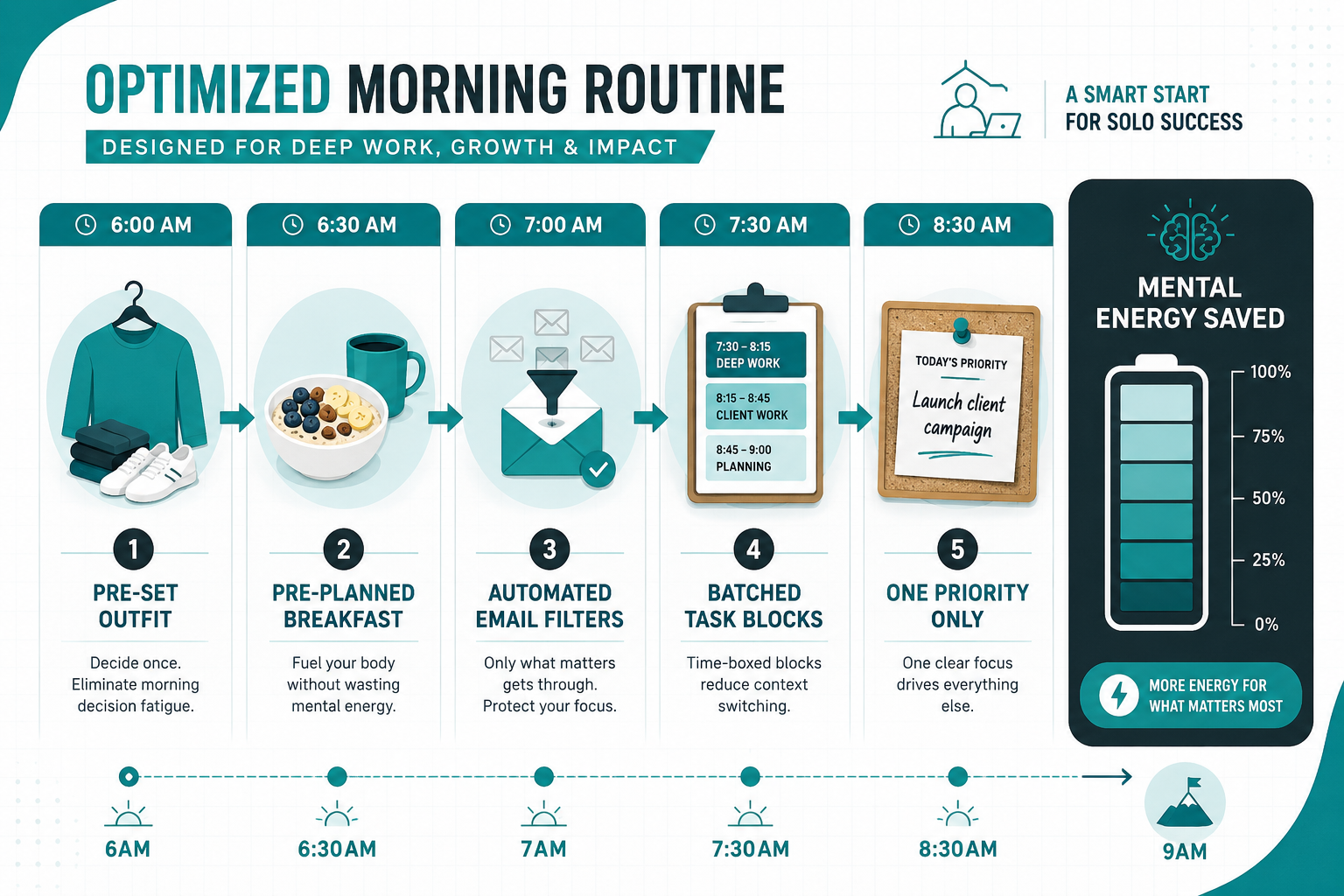
Step 3: Eliminate trivial choices. Steve Jobs wore the same outfit daily to conserve mental energy for product decisions. You do not need to go that far, but pre-planning meals, clothing, and morning logistics for the week ahead removes dozens of micro-decisions before your workday even starts.
Step 4: Set decision deadlines. Give yourself a time limit for low-stakes choices. If a decision does not involve more than $200 or a commitment longer than 30 days, you have 10 minutes to decide and move on.
Best Morning Routines to Minimize Decision Fatigue for Small Business Owners
The morning is the single most valuable window for a solopreneur’s decision-making capacity. Protecting it from unnecessary choices is one of the highest-leverage habits you can build.

A decision-light morning routine looks like this:
- The night before: Write down your top three priorities for the next day. This removes the “what should I work on first?” decision from your morning entirely.
- Pre-set your environment: Lay out clothes, prep breakfast ingredients, and close all browser tabs before you sleep.
- No email before 9am (or your first work block): Email is a decision factory. Every message asks you to respond, defer, delete, or act. Delaying inbox access by even 90 minutes preserves your sharpest thinking.
- Start with your hardest decision first: Tackle the most cognitively demanding task or choice of the day before you have made many other choices. This is sometimes called “eating the frog,” and the cognitive science behind it is sound.
- Use a single daily priority card: Write one sentence describing the single most important outcome for the day. When you feel pulled in multiple directions, the card answers the question.
A personal note: when I shifted to writing my next-day priorities the evening before, the morning fog that used to cost me 30-45 minutes of indecision essentially disappeared. The decision had already been made.
Which Decisions Should You Batch or Automate in Your Business
Batching means grouping similar decisions together and making them all in one dedicated session rather than scattered throughout the week. Automation means removing the human decision entirely by setting rules that execute without your input.
Decisions that batch well:
- Content planning (write a month of social posts in one two-hour session)
- Client proposals and pricing reviews (one afternoon per week)
- Vendor and tool evaluations (first Monday of the month)
- Financial reviews (weekly 30-minute block, same day and time)
- Email responses to non-urgent messages (two set windows per day)
Decisions that automate well:
- Invoice generation and payment reminders (accounting software like Wave or FreshBooks)
- Meeting scheduling (Calendly or similar, with pre-set availability rules)
- Social media posting (Buffer, Later, or Publer with a pre-approved content queue)
- Recurring expense approvals (set spending rules in your business account)
- Lead qualification (intake forms that filter prospects before they reach your calendar)
The goal is that by Friday afternoon, the only decisions left on your plate are the ones that genuinely required your judgment. Everything else ran on a system.
Tools and Apps That Help Entrepreneurs Make Faster Decisions
The right tools do not make decisions for you — they reduce the friction and information-gathering that slow decisions down.
Recommended by category:
- Project and task management: Notion, Trello, or ClickUp. These give you a single place to see all open decisions and tasks, which prevents the “what was I supposed to do?” loop that wastes mental energy.
- Scheduling: Calendly eliminates the back-and-forth of booking meetings. Set your rules once and let it run.
- Financial clarity: Wave (free) or FreshBooks gives you real-time revenue and expense data so financial decisions are based on facts, not anxiety-driven guesses.
- Email management: SaneBox or Gmail filters to auto-sort newsletters, receipts, and low-priority messages out of your main inbox.
- Decision frameworks: A simple Notion template with a 2×2 matrix (impact vs. effort) can turn a 20-minute deliberation into a 3-minute exercise.
- AI assistants: Tools like Claude or ChatGPT can draft options, summarize research, and generate first-pass answers for decisions where you need information quickly. Use them to compress research time, not to replace your judgment.
Choose tools that reduce steps, not add them. A tool that requires more configuration than it saves is a net negative for decision fatigue.
Strategies for Making Better Decisions When You Are Mentally Exhausted
Sometimes you cannot defer a decision. A client needs an answer today, a contract deadline is real, or a problem demands immediate resolution. When you are already mentally depleted, these strategies help you make a defensible call without waiting for full cognitive recovery.
Practical strategies for exhausted decision-making:
- Use a pre-built framework. If you have a decision matrix or a standard set of criteria (cost, time, alignment with your core offer), apply it mechanically. You do not need fresh thinking to run a process you already designed.
- Take a 10-minute physical break first. A short walk, even around the block, measurably restores executive function. This is not a productivity cliche — it is grounded in research on attention restoration.
- Reduce options to two. If you are choosing between five vendors, eliminate three using a single criterion (price, response time, or references) and then decide between the remaining two. Fewer options require less cognitive work.
- Ask “what would I advise a friend?” Psychological distance reduces overthinking. When you imagine advising someone else in your situation, you tend to apply clearer logic and less emotional noise.
- Set a “good enough” threshold. Perfectionism is a decision fatigue multiplier. For most operational decisions, a choice that is 80% optimal and made today beats a perfect choice made next week.
Common Decision Traps That Drain Entrepreneurs’ Mental Energy
Certain thinking patterns consistently waste cognitive resources without improving outcomes. Recognizing them is the first step to breaking the habit.
The most common traps:
- Treating all decisions as equally important. Not every choice deserves the same deliberation. A decision about which font to use on a social post does not warrant the same energy as a pricing change.
- Reopening closed decisions. Once you have made a reasonable call, revisiting it repeatedly without new information is pure cognitive drain. Build a “decided” log and commit to not reopening entries without a specific trigger.
- Over-researching to avoid deciding. Research is sometimes a form of procrastination dressed up as diligence. Set a research time limit before you start.
- Seeking too much external validation. Asking five people for opinions on a decision that is yours to make adds noise, not clarity. Choose one trusted advisor for a second opinion, not a committee.
- Conflating urgency with importance. Urgent tasks feel like they demand immediate decisions, but many urgent requests are not actually important. A simple “urgent vs. important” filter saves significant mental energy.
Cheap Ways to Outsource Routine Business Decisions
Outsourcing does not have to mean hiring a full-time employee. For solopreneurs in 2026, there are accessible, low-cost ways to offload decision-making in specific domains.
Options by cost:
- Virtual assistants (VAs): Platforms like Fiverr, Upwork, or OnlineJobs.ph offer part-time VAs for $5-$20 per hour who can handle inbox triage, scheduling, research, and vendor comparisons — removing dozens of small decisions from your plate weekly.
- Fractional specialists: A part-time bookkeeper handles all financial categorization decisions. A part-time social media manager handles content decisions. You set the strategy; they execute.
- Templates and SOPs: Write a one-page standard operating procedure for recurring decisions (how to handle refund requests, how to onboard a new client, how to respond to a cold pitch). Once written, the document decides — not you.
- Community and peer groups: Mastermind groups or paid Slack communities give you access to experienced peers who can weigh in on decisions quickly. This is often cheaper and faster than a formal consultant.
- AI tools for first-pass drafts: Using an AI assistant to generate three options for a decision (pricing tiers, email responses, project timelines) means you are choosing from a menu rather than building from scratch.
When Should You Hire a Consultant or Coach to Help With Business Decisions
Hiring outside help for business decisions makes sense in specific, identifiable situations — not as a general response to feeling overwhelmed.
Hire a consultant or coach when:
- You are making the same type of high-stakes decision repeatedly (pricing strategy, positioning, hiring) and the outcomes are inconsistent or poor.
- A decision has consequences beyond your current expertise — legal, financial, or technical domains where errors are costly.
- You have been stalling on a critical decision for more than two weeks without a clear reason.
- Your revenue or growth has plateaued and you cannot identify why, despite genuine effort.
- You are spending more than five hours per week on decisions that a more experienced person could make in 30 minutes.
Do not hire a coach or consultant when:
- You are avoiding a decision you already know the answer to (this is an execution problem, not a knowledge problem).
- The decision is low-stakes and reversible.
- You are looking for someone to validate a choice you have already made.
A good business coach does not make decisions for you — they build your decision-making capacity so you need less external input over time.
FAQ
What is decision fatigue in simple terms? Decision fatigue is the mental tiredness that comes from making too many choices. As your decision count rises throughout the day, the quality of each subsequent choice tends to drop.
How many decisions does the average person make per day? Estimates vary widely and are difficult to verify precisely, but researchers studying daily decision-making suggest the number runs into the hundreds when micro-choices (what to eat, what to click, what to type) are included. For solopreneurs, the business-related subset alone can be exhausting.
Does decision fatigue get worse over time if you ignore it? Yes. Without structural changes, decision fatigue tends to compound. Poor decisions lead to more problems, which create more decisions, which further deplete your cognitive resources.
Can exercise help with decision fatigue? Short bouts of physical activity — particularly walking — have been shown in multiple studies to restore attention and improve executive function. A 10-20 minute walk mid-day can meaningfully reset your decision-making capacity.
Is decision fatigue the same as burnout? They overlap but are distinct. Decision fatigue is acute and can recover with rest and reduced choice load. Burnout is a chronic state of exhaustion that requires longer recovery and often signals deeper structural problems in how a business is run.
What is the single most effective way to reduce decision fatigue as a solopreneur? Pre-making decisions. Writing down your rules, defaults, and priorities in advance means you are not deciding in the moment — you are executing a plan you already made when your thinking was clear.
Should I make important business decisions in the morning? Generally, yes. Most people’s executive function and willpower are strongest earlier in the day, before the cumulative weight of daily choices sets in. Schedule your highest-stakes decisions for your first two to three hours of work.
How do I stop second-guessing decisions I have already made? Keep a brief decision log with the date, the choice, and the reasoning. When you feel the urge to revisit a decision, check whether any new information has emerged. If not, the log is your reminder that you already did the thinking.
Are there personality types more prone to decision fatigue? People with perfectionist tendencies or high conscientiousness often experience more severe decision fatigue because they apply the same rigor to low-stakes choices as to high-stakes ones. Recognizing this pattern is the first step to calibrating effort to the actual importance of each decision.
Can I train myself to make faster decisions? Yes, with practice. Setting time limits, using decision frameworks consistently, and reviewing past decisions to build confidence all improve decision speed over time. The goal is not recklessness — it is calibrated efficiency.
Conclusion
Managing decision fatigue in solo entrepreneurship is not about making fewer decisions because you are lazy or overwhelmed. It is about protecting your cognitive capacity so that the decisions that genuinely shape your business get your best thinking.
The practical path forward is straightforward, even if it takes discipline to implement:
- Audit your decision load this week. Identify which choices are truly yours to make and which can be batched, automated, or delegated.
- Build three default rules for your most common recurring decisions — pricing, scheduling, and client communication are good starting points.
- Protect your mornings. Delay email, pre-plan your priorities the night before, and start each day with your most important decision already identified.
- Pick one tool from the automation category that would remove at least five decisions per week from your plate, and set it up this month.
- Review your decision traps. If perfectionism, over-research, or reopening closed decisions are patterns for you, build a specific countermeasure for each.
Solo entrepreneurship in 2026 demands a lot from one person. The solopreneurs who sustain high performance over years are not the ones with the most willpower — they are the ones who built systems that make willpower less necessary. Start with one change this week, measure the difference, and build from there.
References
- Baumeister, R. F., Bratslavsky, E., Muraven, M., & Tice, D. M. (1998). Ego depletion: Is the active self a limited resource? Journal of Personality and Social Psychology, 74(5), 1252-1265. https://doi.org/10.1037/0022-3514.74.5.1252
- Danziger, S., Levav, J., & Avnaim-Pesso, L. (2011). Extraneous factors in judicial decisions. Proceedings of the National Academy of Sciences, 108(17), 6889-6892. https://doi.org/10.1073/pnas.1018033108
- Kahneman, D. (2011). Thinking, Fast and Slow. Farrar, Straus and Giroux.
- Muraven, M., & Baumeister, R. F. (2000). Self-regulation and depletion of limited resources: Does self-control resemble a muscle? Psychological Bulletin, 126(2), 247-259. https://doi.org/10.1037/0033-2909.126.2.247
Read next: Cognitive Decompression Routines After High-Stakes Coding Sessions. A closer look at post-coding decompression.