
Key Takeaways
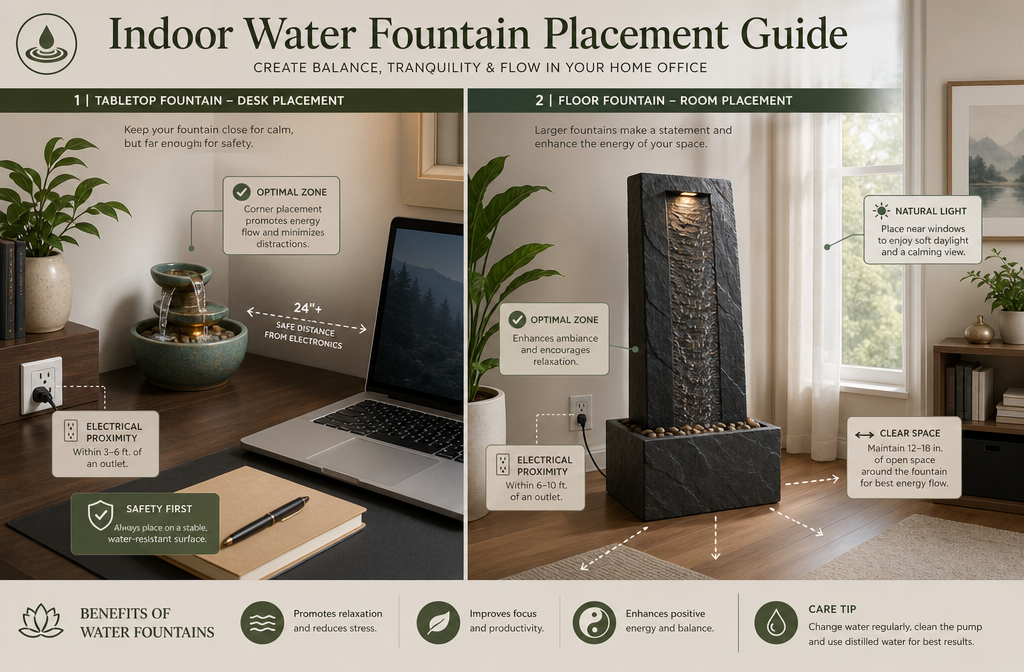
- Place your indoor fountain at least 18 to 24 inches away from computers, keyboards, and other electronics to avoid moisture damage.
- Small tabletop fountains (6 to 12 inches tall) work best for standard home office desks; larger floor fountains suit open-corner spaces.
- Ceramic and resin fountains are the most popular for home offices because they are lightweight, affordable, and easy to clean.
- Indoor fountains do add a small amount of humidity to a room, but not enough to cause problems in most well-ventilated spaces.
- The sound of flowing water can mask low-level office noise and may help people with anxiety maintain focus during work sessions.
- Budget $30 to $80 for a reliable entry-level desk fountain; premium stone or copper models run $100 to $300 or more.
- Clean your fountain every one to two weeks to prevent algae buildup, mineral deposits, and pump wear.
- Avoid placing fountains directly on wood surfaces without a waterproof mat underneath.
- The best placement for relaxation benefit is within your natural line of sight but not directly between you and your screen.
What Exactly Is an Indoor Water Fountain and How Does It Work
An indoor water fountain is a self-contained decorative feature that recirculates water through a small electric pump. Water flows from a reservoir at the base, up through a hidden tube, and spills over a surface (stone, ceramic, copper, or resin) before returning to the reservoir. The cycle repeats continuously as long as the pump is submerged in water and plugged in.
Most home office fountains run on standard 120V outlets and draw very little power, typically between 3 and 10 watts, which is less than a standard LED bulb. The pump sits at the bottom of the basin and should always stay fully submerged to avoid burning out.
Key components in most tabletop fountains:
- A submersible electric pump (usually 3 to 10 watts)
- A water reservoir or basin
- A decorative surface (stone, ceramic, resin, slate, copper)
- A recirculating tube or channel
- Optional: LED lighting, adjustable flow rate dial
The flow rate dial is worth paying attention to. A faster flow creates a louder, more energetic sound. A slower flow produces a gentle trickle, which most people find more calming in a work environment.
How Much Do Good Home Office Fountains Typically Cost
Good home office fountains range from about $25 for basic plastic tabletop models to $400 or more for handcrafted stone or copper floor pieces. For most people working from home, a mid-range fountain in the $50 to $150 range hits the sweet spot between quality and value.
Cost breakdown by category:
| Category | Price Range | Best For |
|---|---|---|
| Entry-level (plastic/resin) | $25 to $60 | Small desks, trial use |
| Mid-range (ceramic/resin) | $60 to $150 | Most home office setups |
| Premium (slate/copper) | $150 to $300 | Larger desks, long-term use |
| Floor fountains | $200 to $600+ | Corner spaces, open offices |
The pump quality matters more than the price tag. Cheap pumps run loud and wear out within a year. Look for fountains that list a replaceable pump or sell spare pumps separately. Brands like HoMedics, Teamson Home, and Pure Garden offer reliable mid-range options widely available in 2026.
Common mistake: Buying the cheapest option and then replacing it within six months ends up costing more than buying a solid mid-range model once.
Ceramic vs. Stone vs. Metal Indoor Fountains: Which Is Best for My Workspace
For most home offices, ceramic and resin fountains are the best choice because they are lightweight, affordable, and easy to clean. Stone and slate look more premium and last longer, but they are heavier and harder to move. Metal fountains (copper, stainless) add a modern edge but can develop patina or water spots if not maintained.
Material comparison:
- Ceramic: Smooth finish, easy to wipe clean, holds color well, moderate weight. Best for traditional or eclectic office styles.
- Resin: Lightweight, often mimics stone or wood textures, very affordable, durable. Best for renters or people who rearrange often.
- Slate/Stone: Heavy, natural look, excellent durability, premium feel. Best for permanent setups with a dedicated corner or shelf.
- Copper/Metal: Striking visual, develops natural patina over time, can be noisy if flow hits metal at an angle. Best for modern or industrial-style offices.
- Bamboo: Lightweight, eco-friendly aesthetic, requires careful drying to prevent mold. Best for Zen or nature-inspired spaces.
Choose ceramic or resin if you want something easy to move and maintain. Choose slate or stone if you want a long-term centerpiece that looks high-end. Choose metal if the modern aesthetic matters more than low maintenance.
Where Should I Put My Fountain to Get the Most Relaxation Benefit
Place your indoor fountain where you can see and hear it naturally during your workday, without it competing visually with your monitor or physically crowding your workspace. The ideal spot is within your peripheral vision, roughly 2 to 4 feet from your primary seating position.
Placement zones ranked by relaxation benefit:
- Corner of the desk (non-dominant side): Keeps it visible without blocking workflow. This is the most popular position for desk fountains.
- Dedicated side table or credenza: Gives the fountain its own space, reduces clutter risk, and allows a slightly larger model.
- Windowsill (with caution): Natural light enhances the visual effect of moving water, but direct sunlight accelerates algae growth.
- Bookshelf at eye level: Works well for small fountains; the sound carries nicely at head height.
- Floor corner: Best for larger floor fountains; creates ambient sound without taking up desk space.
Avoid placing the fountain directly behind your monitor. You will stop noticing it, and the sound may become an irritant rather than a comfort. Also avoid placing it near air vents, which dry out the water faster and push dust into the basin.
“The fountain should feel like a natural part of the room, not a prop you have to work around.”
Do Indoor Fountains Increase Humidity or Create Noise Problems
Indoor fountains do add a small amount of humidity to a room, but the effect is minimal in most standard home offices. A typical tabletop fountain evaporates roughly the same amount of water as a glass left open on a desk. In very dry climates or sealed rooms, this can actually be a benefit.
On humidity:
- Tabletop fountains: negligible humidity impact in rooms larger than 100 square feet
- Floor fountains with large basins: may add measurable humidity in small, sealed rooms
- If you live in a humid climate, top up water less frequently and ensure good ventilation
On noise:
The sound of a fountain is a feature, not a bug, for most people. However, a poorly adjusted or low-quality pump can create an unpleasant gurgling or rattling noise. Signs of a noise problem include:
- A grinding sound (pump needs cleaning or replacement)
- A loud splashing sound (flow rate set too high, or water level too low)
- An intermittent bubbling (air trapped in the pump)
Most noise issues are fixed by adjusting the flow rate dial, refilling the water to the correct level, or cleaning the pump intake. Fountains with adjustable flow controls are worth the slight extra cost for exactly this reason.
Are Water Features Good for People with Anxiety or Who Work from Home
Yes, research suggests that the sound of flowing water can reduce perceived stress and support a calmer mental state during focused work. A 2019 study published in the International Journal of Environmental Research and Public Health found that natural sounds, including water, were associated with lower physiological stress markers compared to silence or urban noise.
For people working from home, a fountain serves a few practical purposes beyond aesthetics:
- Sound masking: Gentle water noise covers low-level distractions like street sounds, neighbor noise, or household activity.
- Routine anchoring: Turning the fountain on at the start of the workday creates a simple ritual that signals “work mode.”
- Visual break: Watching moving water for 30 seconds is a low-effort mental reset between tasks.
- Reduced screen fatigue: Having a natural focal point in the room gives your eyes a rest from screen glare.
People with anxiety who find silence uncomfortable often report that a small desk fountain makes long solo work sessions feel less isolating. That said, if you are highly sensitive to sound, a fountain with a very slow, quiet trickle is better than a loud cascading model.
Common Mistakes People Make When Setting Up a Desk Fountain
Most setup problems come down to placement errors, water level neglect, or buying the wrong size for the space. Here are the mistakes I see most often, and how to avoid them.
Top setup mistakes:
- Placing it too close to electronics: Mist and splashing can damage keyboards, speakers, and monitors over time. Keep at least 18 inches of clearance.
- Letting the water level drop too low: A pump running without enough water burns out quickly. Check the water level every two to three days.
- Skipping the waterproof mat: Even a small splash can warp wood desks or damage paper. Always use a silicone mat or tray underneath.
- Choosing a fountain that’s too large: A fountain that takes up a third of your desk creates stress, not calm.
- Ignoring the pump noise: A rattling pump is a sign something is wrong. Address it early before the pump fails.
- Placing it near a heat source: Heaters and sunny windows increase evaporation and algae growth significantly.
- Using tap water without treatment: Hard tap water leaves mineral deposits on the fountain surface within weeks. Use distilled water or add a small amount of white vinegar to the reservoir monthly.
How to Clean and Maintain an Indoor Fountain Without Making a Mess
Clean your indoor fountain every one to two weeks to prevent algae, mineral buildup, and pump clogging. The process takes about 15 minutes and requires only a soft cloth, white vinegar, and a small brush.
Step-by-step cleaning process:
- Unplug the fountain and move it to a sink or bathtub.
- Empty the water reservoir completely.
- Remove the pump and rinse it under running water. Use a small brush (an old toothbrush works well) to clean the intake screen.
- Wipe the basin and decorative surfaces with a cloth dampened with a 50/50 mix of white vinegar and water.
- For stubborn mineral deposits, let the vinegar solution sit for 10 minutes before scrubbing gently.
- Rinse all surfaces thoroughly with clean water.
- Refill with distilled water and add a few drops of a fountain enzyme cleaner (available at most home goods stores) to slow algae growth.
- Reassemble, plug in, and check the flow rate.
Monthly: Inspect the pump cord for any wear. Replace the pump if it sounds strained or runs inconsistently. Most replacement pumps cost $10 to $20 and are widely available online.
Which Fountains Are Best for Small Home Office Spaces
For small home offices, the best fountains are compact tabletop models between 6 and 10 inches tall with a footprint no larger than a standard hardcover book. Tiered ceramic fountains, small slate panel fountains, and single-bowl resin designs all work well in tight spaces.
Top picks by space type:
- Small desk (under 40 inches wide): A single-tier ceramic bowl fountain, 6 to 8 inches tall, with a slow-drip flow.
- Medium desk (40 to 60 inches): A two-tier resin or slate fountain, 8 to 12 inches tall, placed on the non-dominant corner.
- Shelf or credenza: A narrow panel-style fountain (tall and thin) that takes up minimal horizontal space.
- Very small spaces: A USB-powered mini fountain (3 to 5 inches) that runs off your laptop. These are quiet, inexpensive, and surprisingly effective.
Avoid floor fountains entirely in rooms under 100 square feet. They overpower the space visually and acoustically.
Can Indoor Fountains Help with Focus and Productivity
Indoor fountains can support focus by providing consistent, low-level ambient sound that masks irregular distractions. This is similar to the reason many people play white noise or lo-fi music while working. The effect is most pronounced for people doing deep, solo work rather than tasks requiring active listening or video calls.
However, a fountain is not a productivity tool on its own. It works best as part of a broader workspace setup that includes good lighting, a comfortable chair, and minimal visual clutter. Think of it as one layer of a well-designed work environment.
When a fountain helps most:
- Writing, reading, or analytical tasks that benefit from a calm background
- Long solo work sessions where silence feels heavy
- Transitioning into focus mode at the start of the day
When it may not help:
- Video calls (the sound can be picked up by your microphone)
- Tasks requiring active listening or audio review
- If you find water sounds distracting rather than calming
Are Water Fountains Safe Around Electronics and Computer Equipment
Water fountains are safe around electronics as long as you maintain a minimum distance of 18 to 24 inches between the fountain and any device. The primary risks are mist from high flow rates and accidental splashing during refilling or cleaning.
Safety rules for home office fountain placement:
- Never place a fountain directly next to a desktop tower, laptop, or external hard drive.
- Keep the fountain off the same surface as your keyboard if possible.
- Use a drip tray or silicone mat under the fountain at all times.
- Set the flow rate to a gentle trickle rather than a strong cascade in enclosed desk spaces.
- When refilling, carry the fountain to a sink rather than pouring water into it at your desk.
USB-powered mini fountains are the safest option for very tight desk setups because they use minimal water and produce almost no mist.
What Size Fountain Works Best for a Typical Home Office Desk
For a typical home office desk (48 to 60 inches wide), a fountain between 8 and 12 inches tall with a base footprint of 6 to 8 inches square is the right size. This gives you a visible, audible water feature without sacrificing meaningful workspace.
A fountain that is too small gets lost visually and produces almost no sound benefit. A fountain that is too large creates a sense of clutter and makes refilling awkward. The 8 to 12 inch range is the sweet spot confirmed by most interior design guides and home office ergonomics resources.
Quick sizing guide:
- Desk under 36 inches: 5 to 7 inch fountain
- Desk 36 to 48 inches: 7 to 10 inch fountain
- Desk 48 to 60 inches: 8 to 12 inch fountain
- Desk over 60 inches or L-shaped: up to 14 inches, or consider a side table fountain
Conclusion: Making the Most of Indoor Fountains in the Home Office
Getting the placement right for indoor fountains in the home office is less complicated than most people expect. The core principles are straightforward: keep it within your line of sight, away from electronics, at the right scale for your desk, and maintained on a regular cleaning schedule.
Actionable next steps:
- Measure your available desk space and use the sizing guide above to narrow your options.
- Set a budget. For most home offices, $60 to $120 gets you a reliable, attractive fountain that will last several years.
- Choose a material that fits your office aesthetic and your willingness to maintain it. Ceramic and resin are the easiest starting points.
- Place it on the non-dominant corner of your desk with a silicone mat underneath, at least 20 inches from your nearest electronic device.
- Use distilled water from day one to avoid mineral buildup.
- Set a recurring calendar reminder to clean the fountain every two weeks.
A well-placed water feature does not transform a home office overnight, but over weeks and months, the ambient sound and visual calm it adds can make a real difference to how the space feels. That steady, quiet trickle is easy to overlook until you turn the fountain off and notice how flat the room sounds without it.
Frequently Asked Questions
How often should I refill my indoor fountain? Most tabletop fountains need a refill every two to four days, depending on room temperature and humidity. Check the water level daily until you know your fountain’s evaporation rate. Never let the pump run dry.
Can I use tap water in my indoor fountain? You can, but tap water leaves mineral deposits faster than distilled water. If you use tap water, plan to clean the fountain more frequently and add a small amount of white vinegar to the reservoir monthly to slow scale buildup.
Will my fountain’s pump be loud at night? A quality pump running at a low flow rate should be nearly silent. If you hear grinding or rattling, clean the pump intake. If the noise continues, the pump likely needs replacement. Most replacement pumps cost $10 to $20.
Can I leave my indoor fountain running all day? Yes. Submersible pumps in indoor fountains are designed for continuous operation. Running the fountain all day is safe as long as the water level stays adequate. Many people turn it off overnight to conserve electricity and reduce wear.
Do indoor fountains attract insects? Standing water can attract insects if left stagnant, but a recirculating fountain with a functioning pump keeps the water moving, which significantly reduces this risk. Adding a fountain enzyme cleaner also helps.
Is an indoor fountain appropriate for a shared home office or co-working space? It depends on the team. Some people find the sound distracting or too personal. If you share a space, start with a very quiet, low-flow model and ask for feedback before committing to a larger fountain.
How do I stop my fountain from making a loud splashing noise? Lower the flow rate using the adjustment dial, and make sure the water level is full. Loud splashing usually means water is falling too far before hitting the reservoir. Adding a small smooth stone to the basin can also soften the sound.
Can a fountain run on a smart plug or timer? Yes. Plugging your fountain into a smart plug or mechanical timer is a great way to automate your work routine. Set it to turn on when your workday starts and off when it ends.
Sources
- Gould van Praag, C. D., et al. “Mind-wandering and alterations to default mode network connectivity when listening to naturalistic versus artificial sounds.” Scientific Reports, 2017. https://www.nature.com/articles/srep45273
- Alvarsson, J. J., Wiens, S., & Nilsson, M. E. “Stress Recovery during Exposure to Nature Sound and Environmental Noise.” International Journal of Environmental Research and Public Health, 2010. https://www.mdpi.com/1660-4601/7/3/1036
- Buxton, R. T., et al. “A synthesis of health benefits of natural sounds and their distribution in national parks.” Proceedings of the National Academy of Sciences, 2021. https://www.pnas.org/doi/10.1073/pnas.2013097118
Read next: Journaling Prompts for Anyone Suffering from Creative Block. A closer look at journaling prompts for creative block.