
Key Takeaways
- Root rot is almost always caused by overwatering combined with poor drainage, not by watering frequency alone.
- Healthy Monstera albo roots are firm and white to light tan; rotted roots are brown or black, mushy, and smell sour or foul.
- Cut all rotted root material back to clean, healthy tissue using sterile scissors or a scalpel.
- Treat cut surfaces immediately with powdered cinnamon, activated charcoal, or a diluted hydrogen peroxide solution before re-rooting.
- Oversized cuttings (those with multiple nodes or large leaf mass) lose moisture faster through leaves than small cuttings, making root rot more stressful and harder to recover from.
- Never return a treated cutting to the same contaminated soil without sterilizing or replacing the growing medium.
- Recovery typically takes six to twelve weeks in optimal conditions: bright indirect light, temperatures between 65 and 85 degrees Fahrenheit, and high humidity (60 to 80 percent).
- A large Monstera albo cutting can cost anywhere from $80 to several hundred dollars in 2026, making proper treatment far more economical than replacement.
- Propagating a partially rotted cutting is possible if at least one healthy node and some viable root tissue remain.
- Prevention through proper soil mix, pot sizing, and watering habits is far more reliable than any treatment.
What Exactly Is Root Rot and How Do You Know If Your Monstera Albo Has It
Root rot is a condition where the roots of a plant decay due to fungal infection, most commonly caused by Pythium, Phytophthora, or Fusarium species that thrive in saturated, oxygen-deprived soil. For Monstera albo cuttings, the risk is especially high because large cuttings are often potted before they have developed a root system strong enough to absorb excess moisture efficiently.
Signs your Monstera albo cutting has root rot:
- Yellowing leaves that start at the base or older growth
- Wilting or drooping despite the soil feeling wet
- A sour, musty, or rotting smell coming from the pot or propagation vessel
- Brown or black roots that feel soft and collapse when touched
- Stunted growth or no new root development after several weeks
When you unpot the cutting and inspect the roots, the difference is clear. Healthy roots are white, cream, or light tan, and they feel firm and springy. Rotted roots are brown or black, slimy, and fall apart easily. In water propagation, you may also notice the water turning cloudy or developing a foul odor before the roots visually deteriorate.
Common mistake: Many growers assume yellowing leaves mean the plant needs more water. In a cutting with root rot, adding more water accelerates the problem. Always check root health before adjusting your watering routine.
Can Root Rot Be Reversed, or Is the Plant Doomed
Root rot can absolutely be reversed in most Monstera albo cuttings, provided enough healthy root or node tissue remains. The plant is not doomed unless the rot has spread to the stem itself, which is a much more serious condition called stem rot.
The key factor is how much of the root system is still viable. If more than half the roots are healthy and firm, recovery is very likely. If nearly all roots are rotted but the node and stem are intact, the cutting can still be re-rooted from scratch, though it will take longer.
When to attempt rescue vs. discard:
- Attempt rescue if: the stem is firm and green, at least one node is healthy, and the rot is confined to the roots.
- Consider discarding if: the stem is soft, black, or mushy at or above the soil line, or if the rot has moved into the petiole or leaf nodes.
What Is the Difference Between Normal Root Decay and Serious Root Rot
Not all discolored roots indicate a crisis. Normal root decay refers to the natural die-off of older, spent roots that are no longer actively absorbing nutrients. These roots are typically brown but still firm, and they do not smell foul.
Serious root rot, by contrast, involves pathogenic fungal infection. The roots are not just brown but actively decomposing. They are soft, slimy, and emit a distinct sour or sewage-like odor. The decay spreads progressively to adjacent healthy roots if left untreated.
Quick comparison:
| Feature | Normal Decay | Root Rot |
|---|---|---|
| Color | Light to medium brown | Dark brown or black |
| Texture | Firm, slightly dry | Mushy, slimy |
| Smell | Earthy, neutral | Sour, foul |
| Spread | Stays localized | Spreads to healthy roots |
| Stem impact | None | Can progress to stem |
If you are unsure, the smell test is the most reliable quick indicator. Root rot almost always produces a noticeably unpleasant odor.
How Much of the Root System Should You Cut Off
Cut off every root that is brown, black, or mushy, trimming back to where the tissue is clearly white and firm. Do not try to save borderline roots. Leaving even a small amount of infected tissue gives the fungus a foothold to re-infect the cutting.
Step-by-step root trimming process:
- Remove the cutting from its pot or propagation vessel.
- Rinse the roots gently under lukewarm running water to remove all soil or growing medium.
- Lay the cutting on a clean surface in good light so you can see the roots clearly.
- Using sterile scissors or a scalpel (wiped with isopropyl alcohol), cut each rotted root back to healthy tissue.
- If the rot extends all the way to the base of the stem, trim until you reach firm, white tissue, even if this means removing most of the roots.
- Allow the cut surfaces to air-dry for 20 to 30 minutes before applying any treatment.
Edge case: If trimming removes all roots entirely, the cutting can still be re-rooted as long as the node is healthy. Treat the cutting as a fresh propagation and follow the re-rooting steps below.
Best Treatment Methods for Saving a Monstera Albo with Root Rot
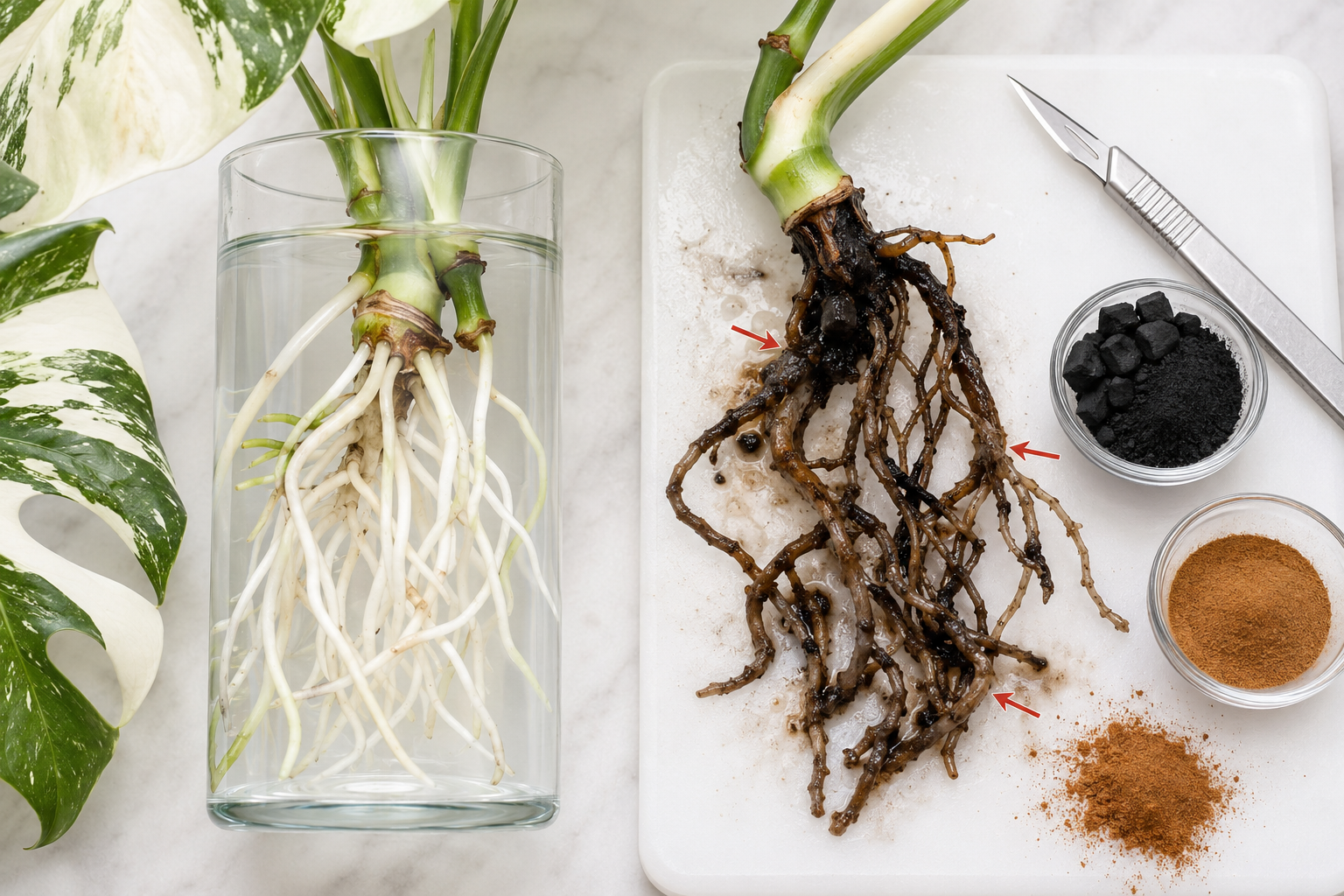
The most effective treatment approach for fixing root rot in oversized Monstera albo cuttings combines physical removal of infected tissue with an antifungal treatment, followed by re-rooting in a sterile, well-draining medium.
Antifungal treatment options after trimming:
- Powdered cinnamon: A natural antifungal agent. Dust it generously over all cut root surfaces. It is gentle, widely available, and effective for mild to moderate cases.
- Activated charcoal: Absorbs toxins and inhibits fungal growth. Mix into the new growing medium or dust directly on roots.
- Diluted hydrogen peroxide: Mix one part 3% hydrogen peroxide with four parts water. Soak the trimmed roots for five minutes, then rinse. This kills surface fungal spores effectively.
- Commercial fungicide: Products containing copper-based fungicides or thiophanate-methyl are used by professional growers for severe cases. Follow label instructions carefully, as some formulations can damage sensitive root tissue.
After treatment, re-root the cutting in one of the following substrates:
- Sphagnum moss (excellent moisture retention with good aeration)
- Perlite and coco coir mix (50/50 ratio)
- LECA (lightweight expanded clay aggregate) in semi-hydro setup
- Fresh, sterile potting mix with added perlite (at least 40 percent perlite by volume)
Avoid using the same soil or vessel without thorough sterilization. Fungal spores can persist in contaminated media and re-infect the cutting.
How Do Professional Plant Nurseries Treat Root Rot in Rare Plants
Professional nurseries handling rare plants like Monstera albo typically follow a stricter protocol than most home growers. The core difference is speed of diagnosis and the use of preventive fungicide drenches as standard practice.
Most reputable nurseries use systemic fungicides such as phosphorous acid-based products or mefenoxam (a common active ingredient in professional-grade treatments) applied as a root drench at the first sign of stress. They also maintain strict hygiene: sterilized tools, dedicated propagation areas, and single-use growing media for high-value cuttings.
For oversized cuttings specifically, professional growers often reduce leaf mass by removing one or two leaves to lower the transpiration demand on a compromised root system. This is a practical step home growers can replicate: if your cutting has three or more large leaves, remove the oldest or largest one to reduce stress while new roots develop.
Can You Propagate a Monstera Albo That Has Partial Root Rot
Yes, propagating a Monstera albo with partial root rot is a viable rescue strategy, especially for oversized cuttings where the stem carries multiple nodes. If the rot is confined to one section of the root system and at least one node is healthy, you can treat the affected area, re-root in fresh media, and propagate successfully.
How to propagate a partially rotted cutting:
- Trim all rotted roots and treat cut surfaces as described above.
- If the cutting has multiple nodes, consider dividing it into individual node cuttings to reduce the load on a compromised root system.
- Place treated cuttings in sphagnum moss or a perlite-coco coir mix in a humid environment (a clear plastic bag or propagation box works well).
- Maintain temperatures between 70 and 80 degrees Fahrenheit and provide bright, indirect light.
- Check weekly for new root development. Do not disturb the cutting unnecessarily.
Single-node cuttings from a large Monstera albo can actually be easier to re-root than the full oversized cutting because the smaller leaf mass creates less moisture stress.
What Soil and Drainage Conditions Prevent Root Rot in the First Place
The single most effective way to prevent root rot in Monstera albo cuttings is to never let the growing medium stay saturated for extended periods. This means choosing the right substrate and pot combination from the start.
Ideal growing conditions to prevent root rot:
- Soil mix: A chunky, well-aerated mix. A reliable formula is 40 percent high-quality potting mix, 40 percent perlite, and 20 percent orchid bark. This drains quickly and holds just enough moisture.
- Pot type: Terracotta pots allow passive moisture evaporation through the walls, reducing the risk of waterlogging. Avoid large plastic pots for small or recently rooted cuttings.
- Pot size: Do not overpot. A pot that is too large holds excess soil moisture that roots cannot absorb. Choose a pot only slightly larger than the root ball.
- Drainage holes: Non-negotiable. Every pot must have at least one drainage hole. Cachepots (decorative outer pots) should be emptied promptly after watering.
- Watering practice: Water thoroughly, then allow the top two inches of soil to dry before watering again. In cooler months or lower-light conditions, extend this interval further.
Are Some Monstera Albo Varieties More Susceptible to Root Rot
Monstera deliciosa ‘Albo Variegata’ is the primary variety referred to when collectors discuss Monstera albo, and all variegated Monstera deliciosa cuttings share similar susceptibility to root rot. The variegation itself does not increase susceptibility, but the way these plants are sold and propagated does.
Oversized cuttings with large leaf mass are more vulnerable than smaller cuttings because they lose more moisture through transpiration, creating an imbalance when the root system is underdeveloped or damaged. Tissue-cultured (TC) Monstera albo plants, which are becoming more available in 2026, tend to have more uniform and vigorous root systems, potentially making them slightly more resilient during establishment, though they still require proper drainage and care.
Common Mistakes People Make When Trying to Save a Plant with Root Rot
Most treatment failures come down to a handful of predictable errors. Knowing these in advance dramatically improves your odds of success.
- Not trimming aggressively enough: Leaving even a small patch of infected root allows the fungus to re-establish. When in doubt, cut more.
- Reusing contaminated soil: Fungal spores survive in old growing media. Always use fresh, sterile substrate.
- Overwatering after treatment: The instinct to “help” a stressed plant with extra water is counterproductive. Let the medium dry slightly between waterings.
- Placing the cutting in direct sun: Stressed cuttings with damaged roots cannot handle intense light. Bright, indirect light is the correct choice during recovery.
- Skipping the antifungal treatment step: Trimming alone is not always sufficient. Treating the cut surfaces prevents re-infection.
- Not addressing humidity: Monstera albo cuttings need 60 to 80 percent humidity to reduce transpiration stress while roots recover. A humidity tent or propagation box helps significantly.
How Long Does It Take a Monstera Albo to Recover from Root Rot Treatment
A Monstera albo cutting with mild to moderate root rot typically shows new root growth within three to six weeks of treatment in optimal conditions. Full recovery, meaning a well-established root system capable of supporting active leaf growth, generally takes six to twelve weeks.
Several factors influence recovery speed:
- Severity of rot: Mild cases (less than 30 percent of roots affected) recover faster than severe cases.
- Temperature: Warmer temperatures (75 to 82 degrees Fahrenheit) accelerate root development.
- Light: Bright, indirect light supports photosynthesis and energy production for root growth without stressing the plant.
- Humidity: High humidity (60 to 80 percent) reduces transpiration stress and allows the cutting to focus energy on root regeneration.
- Growing medium: Sphagnum moss and perlite-based mixes tend to produce faster root development than dense potting soil.
If you see no new root growth after eight weeks under good conditions, reassess the cutting for additional rot or stem damage.
How Much Does It Cost to Treat or Replace a Large Monstera Albo Cutting
Treating root rot at home is inexpensive. The core supplies (hydrogen peroxide, cinnamon, fresh perlite, sphagnum moss, and a new pot) typically cost $15 to $40 in total, depending on what you already have on hand.
Replacing a large Monstera albo cutting is a different story. In 2026, oversized Monstera albo cuttings with multiple nodes and established variegation patterns sell for $80 to $300 or more on platforms like Etsy, eBay, and specialty plant marketplaces, with highly variegated or rare mutation forms commanding even higher prices. Tissue-cultured plants have brought prices down from the peaks of 2021 and 2022, but large cuttings with exceptional variegation remain premium items.
This cost reality makes treatment the clear first choice. Even if you spend $40 on supplies and invest several weeks of attention, you are protecting an asset worth many times that amount.
FAQ
What does root rot smell like on a Monstera albo? Root rot produces a distinctly sour, musty, or sewage-like odor. If your pot or propagation water smells unpleasant when you lean close, root rot is very likely present.
Can I use hydrogen peroxide to treat root rot in Monstera albo? Yes. A solution of one part 3% hydrogen peroxide to four parts water, used as a five-minute soak for trimmed roots, kills surface fungal spores effectively. Rinse thoroughly before re-rooting.
Should I remove leaves from my Monstera albo cutting during root rot treatment? Removing one large leaf from an oversized cutting reduces transpiration stress and helps the plant focus energy on root regeneration. Do not remove all leaves, as the plant needs photosynthesis to recover.
Is it safe to water propagate a Monstera albo with root rot? Water propagation is acceptable after removing all rotted roots, but change the water every two to three days and add a small piece of activated charcoal to the vessel to inhibit fungal regrowth.
How do I sterilize my tools before trimming rotted roots? Wipe scissors or a scalpel with 70 percent isopropyl alcohol and allow to air-dry for 30 seconds before use. Re-sterilize between cuts if you are working on multiple plants.
Can root rot spread from one plant to another? Yes. Fungal spores can spread through shared tools, contaminated water, or direct contact between root systems. Always sterilize tools between plants and isolate any plant showing signs of root rot.
Why does my Monstera albo keep getting root rot even after treatment? Recurring root rot almost always points to a drainage or watering issue. Check that your pot has functional drainage holes, your soil mix is sufficiently chunky and aerated, and you are allowing the medium to partially dry between waterings.
Is cinnamon actually effective against root rot fungi? Cinnamon contains cinnamaldehyde, which has documented antifungal properties in laboratory settings. While it is not as potent as commercial fungicides, it is a safe and practical first-line treatment for mild root rot in home growing conditions.
How do I know when my Monstera albo cutting has fully recovered? Full recovery is indicated by firm, white new root growth, the resumption of new leaf unfurling, and stable, upright foliage. If the plant is pushing new growth, the root system is functioning.
Can I fertilize my Monstera albo during root rot recovery? No. Do not fertilize until the plant shows clear signs of new root and leaf growth. Fertilizing a stressed plant with a compromised root system can cause fertilizer burn and worsen the condition.
Conclusion
Fixing root rot in oversized Monstera albo cuttings is entirely achievable with prompt action and the right approach. The process comes down to three non-negotiable steps: remove all infected root tissue without hesitation, treat the wounds with an antifungal agent, and re-root in a fresh, sterile, well-draining medium.
Your immediate action plan:
- Unpot your cutting today and inspect the roots under good light.
- Trim every brown, black, or mushy root back to firm, white tissue using sterile scissors.
- Treat cut surfaces with powdered cinnamon or diluted hydrogen peroxide.
- Re-root in a 50/50 perlite and sphagnum moss mix in a clean container.
- Place in bright, indirect light at 75 to 80 degrees Fahrenheit with 60 to 80 percent humidity.
- Check weekly for new root development and resist the urge to overwater.
Given the value of these plants, every week of delay increases the risk of losing a cutting that could have been saved. The earlier you act, the better your odds. And once your Monstera albo is back on track, revisiting your soil mix, pot size, and watering habits will ensure root rot does not return.
References
- Agrios, G. N. (2005). Plant Pathology (5th ed.). Elsevier Academic Press. https://www.elsevier.com/books/plant-pathology/agrios/978-0-12-044565-3
- Benson, D. M. (1991). Control of Phytophthora root rot of azalea with Trichoderma species. Plant Disease, 75(5), 522–524.
- Kaminski, J. E., & Dernoeden, P. H. (2007). Seasonal Pythium species diversity, turf damage, and associated soil and weather conditions. Plant Disease, 91(6), 686–693.
- Raviv, M., & Lieth, J. H. (Eds.). (2008). Soilless Culture: Theory and Practice. Elsevier. https://www.elsevier.com/books/soilless-culture/raviv/978-0-444-52975-6
Read next: How a Robotic Lawn Mower with GPS Works: The Complete Guide. A closer look at robotic lawn mower with gps.