
Key Takeaways
- At elevations above 8,000 feet (2,400 meters), oxygen partial pressure drops significantly, making efficient breathing essential for performance and safety.
- Diaphragmatic breathing, pursed-lip breathing, and pressure breathing are the three most evidence-supported techniques for high-altitude hikers.
- Beginners can learn basic breathwork in one to two sessions; advanced techniques like the Wim Hof Method require more structured training.
- Professional breathwork coaching for hikers typically costs between $50 and $200 per session, with online courses ranging from $30 to $300.
- Hyperventilation is the most common breathing mistake hikers make at altitude and can worsen symptoms rather than help.
- People with asthma, COPD, or cardiovascular conditions should consult a physician before practicing intense breathing exercises at elevation.
- Breathwork for altitude is functionally different from meditation breathing; it targets gas exchange and respiratory muscle efficiency, not relaxation alone.
- Most hikers notice measurable improvements in oxygen saturation and perceived exertion within three to seven days of dedicated breathwork practice.
What Breathwork Is and How It Helps with Altitude Sickness
Breathwork is the deliberate control of breathing patterns to influence physical and mental states. For high-altitude hikers, it directly addresses the core problem of altitude sickness: the body’s struggle to extract enough oxygen from thin air.
At sea level, the atmosphere contains roughly 21% oxygen. The total amount available to your lungs doesn’t change at altitude, but the partial pressure of oxygen drops as elevation rises. According to the Wilderness Medical Society, at 14,000 feet (4,267 meters), the partial pressure of inspired oxygen is approximately 40% lower than at sea level. This means each breath delivers less usable oxygen to the bloodstream, triggering symptoms like headache, nausea, fatigue, and shortness of breath.
Breathwork helps by:
- Maximizing alveolar oxygen exchange through slower, deeper breaths that allow more contact time between air and lung tissue.
- Reducing carbon dioxide loss that causes blood vessels to constrict, which worsens oxygen delivery to the brain.
- Training respiratory muscles to work more efficiently under the increased workload of high-altitude breathing.
- Activating the parasympathetic nervous system, which lowers heart rate and reduces the body’s overall oxygen demand during rest.
Breathwork for high-altitude hikers adjusting to low oxygen is not a replacement for proper acclimatization schedules, but it is a proven complement that can make the difference between a miserable ascent and a manageable one.
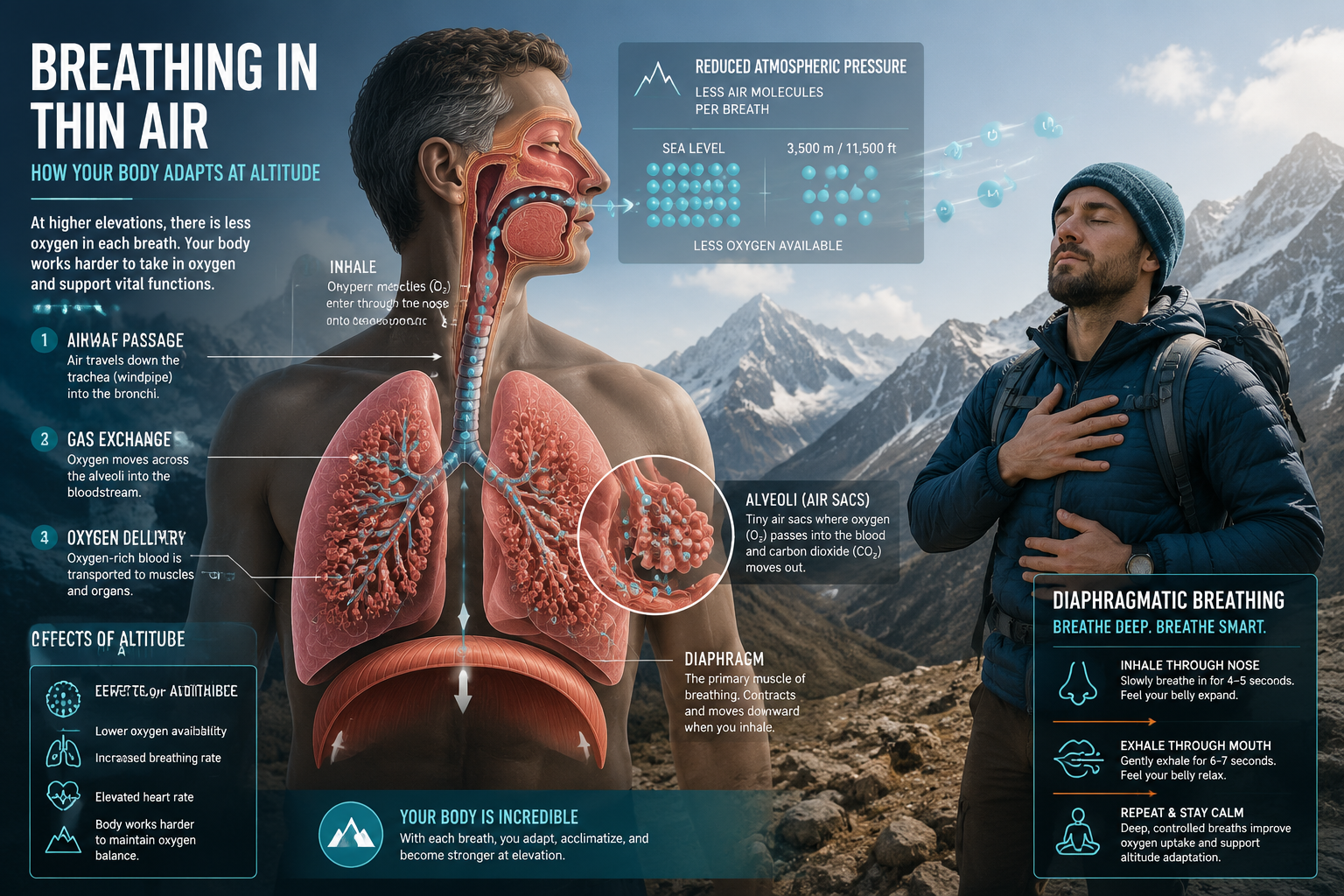
How Different Breathing Techniques Change Oxygen Absorption at High Elevations
Different techniques target different parts of the breathing cycle, and choosing the right one depends on the situation: resting at camp, climbing a steep grade, or recovering after exertion.
Diaphragmatic (Belly) Breathing This is the foundation of all altitude breathwork. By engaging the diaphragm fully, hikers increase tidal volume (the amount of air per breath) without increasing breathing rate. More air per breath means more oxygen reaches the lower lobes of the lungs, where gas exchange is most efficient. Practice: place one hand on the chest and one on the belly; the belly should rise first and higher.
Pressure Breathing Used widely by mountaineers on peaks above 18,000 feet, pressure breathing involves exhaling forcefully through pursed lips. The brief increase in airway pressure during exhalation helps keep small air sacs (alveoli) open, preventing collapse in low-pressure environments. The American Alpine Club has documented its use as standard practice among high-altitude climbers.
Rhythmic Breathing Synchronizing breath with footsteps reduces the perception of effort. A common pattern is two steps per inhale, two steps per exhale on moderate terrain, shifting to one step per breath on steep sections. This prevents the erratic, shallow panting that accelerates fatigue.
The Rest Step with Breath Reset Pause one foot forward, lock the rear knee, and take two to three slow, full diaphragmatic breaths before the next step. This technique, long used by Himalayan guides, allows oxygen saturation to partially recover during the climb itself.
Wim Hof Method (Advanced) This involves cycles of 30 rapid deep breaths followed by a breath hold. Research published in the journal PNAS (Kox et al., 2014) showed it can influence the autonomic nervous system and inflammatory response. However, it carries real risks at altitude (see the risks section below) and should only be practiced by experienced individuals at rest, never while moving.
Which Breathwork Methods Are Best for Preventing Mountain Climbing Fatigue
The best methods for preventing fatigue are those that reduce the oxygen cost of breathing itself while maintaining adequate ventilation. Rhythmic breathing and diaphragmatic breathing together form the most practical combination for active hiking.
A useful framework:
| Situation | Recommended Technique | Why It Works |
|---|---|---|
| Steady uphill climb | Rhythmic step-breath sync | Reduces perceived exertion |
| Rest stop | Diaphragmatic reset breaths | Restores SpO2 between efforts |
| Steep scramble | Pressure breathing | Keeps alveoli open under strain |
| Camp recovery | Slow 4-7-8 breathing | Lowers heart rate, aids sleep |
| Night waking (Cheyne-Stokes) | Conscious slow breathing | Interrupts irregular sleep apnea pattern |
The 4-7-8 technique (inhale for 4 counts, hold for 7, exhale for 8) is particularly useful at camp because it slows the breathing rate to around 4 to 6 breaths per minute, which research from the University of Pavia (Bernardi et al., 2001) found increases arterial oxygen saturation in healthy adults.
Common mistake: Many hikers breathe only through the mouth during hard efforts. Nasal breathing, even partially, warms and humidifies air and adds slight resistance that improves diaphragm engagement. Switch to mouth breathing only when nasal airflow genuinely can’t keep up with demand.
How Much Does Professional Breathwork Training Cost for Hikers
Professional breathwork coaching for hikers typically costs $50 to $200 per individual session, with group workshops running $75 to $150 per person. Online courses specifically designed for altitude performance range from $30 to $300 depending on depth and instructor credentials.
Here’s a breakdown of typical options in 2026:
- One-on-one coaching (in person or video call): $80 to $200 per session. Best for hikers with specific medical considerations or those preparing for technical expeditions.
- Group altitude preparation workshops: $75 to $150 per person, often offered by mountaineering schools and wilderness medicine organizations.
- Self-guided online courses: $30 to $150. Reputable providers include programs affiliated with wilderness medicine certifications.
- Expedition guide packages: Many guided Kilimanjaro, Aconcagua, or Everest Base Camp trips now include breathwork instruction as part of the pre-climb briefing at no extra charge.
If budget is a concern, free resources are genuinely useful. The Wilderness Medical Society and several mountaineering clubs publish detailed breathing guides. A few hours of practice with a free resource, combined with consistent daily training for four to six weeks before a trip, can produce results comparable to a single paid session.
Are There Risks or Side Effects of Intense Breathing Techniques at High Altitudes
Yes, and this point is often underplayed. Intense breathwork at altitude carries specific risks that don’t apply at sea level.
Hyperventilation and hypocapnia: Breathing too fast or too deeply lowers carbon dioxide levels in the blood. This causes blood vessels to constrict, including cerebral vessels, which can worsen altitude headache and, in rare cases, trigger fainting. This is the main reason the Wim Hof Method should never be practiced while standing, near water, or during physical exertion at altitude.
Syncope (fainting): Breath-hold techniques combined with low oxygen environments can cause loss of consciousness without warning. The Divers Alert Network has documented drowning deaths from breath-hold training in water; the same physiological risk applies in any unsupported environment.
Exacerbation of HAPE/HACE: High-altitude pulmonary edema (HAPE) and high-altitude cerebral edema (HACE) are life-threatening conditions. Aggressive breathing exercises will not treat these and may mask early warning signs by temporarily improving how a hiker feels.
Safe practice rules:
- Always practice intense breathwork seated or lying down, never while moving.
- Do not practice breath-hold techniques alone.
- Stop immediately if you experience tingling in the hands, vision changes, or chest tightness.
- Treat breathwork as a supplement to acclimatization, not a workaround for it.
Can Beginners Learn Breathwork or Is It Only for Experienced Mountaineers
Beginners can absolutely learn breathwork for high-altitude hiking. The foundational techniques (diaphragmatic breathing, rhythmic pacing, and pressure breathing) require no prior experience and can be learned in a single 30-minute session.
A practical beginner timeline:
- Week 1 to 2: Learn diaphragmatic breathing lying down, then standing. Practice 10 minutes daily.
- Week 3 to 4: Add rhythmic breathing during moderate exercise (stairs, treadmill incline).
- Week 5 to 6: Practice pressure breathing during harder efforts. Introduce 4-7-8 breathing before sleep.
- Pre-trip week: Run through all techniques on a day hike at the highest accessible local elevation.
Advanced techniques like the Wim Hof Method or Tummo breathing (used by Tibetan monks) do require structured learning and ideally in-person guidance. These are not necessary for most trekkers heading to destinations like Machu Picchu, Kilimanjaro, or Everest Base Camp.
Common Mistakes Hikers Make When Managing Breathing in Thin Air
The most common mistake is trying to breathe faster when feeling short of breath. This feels instinctively correct but is physiologically counterproductive at altitude.
Other frequent errors:
- Chest breathing instead of belly breathing: Shallow chest breaths use only the upper lung lobes, reducing oxygen uptake per breath by an estimated 30% compared to full diaphragmatic breaths.
- Ignoring the exhale: Most hikers focus on getting air in. But a full, complete exhale clears carbon dioxide and creates space for a richer inhale. Incomplete exhalation is a leading cause of the “air hunger” feeling at altitude.
- Breathing through the mouth exclusively: This bypasses nasal filtration, warming, and the slight resistance that supports diaphragm engagement.
- Practicing breathwork only at altitude: Techniques need to be automatic before the trip. Learning to belly breathe while gasping at 15,000 feet is far harder than building the habit at home.
- Skipping breathwork at night: Altitude disrupts sleep breathing patterns (periodic breathing or Cheyne-Stokes respiration). A few minutes of slow, conscious breathing before sleep can reduce nighttime oxygen desaturation.
How Breathwork Techniques Differ for Hiking in the Andes Versus Himalayan Ranges
The core techniques are the same, but the application differs based on elevation profile, ascent rate, and environmental conditions.

Andes (e.g., Cusco at 11,200 ft / 3,400 m; Aconcagua at 22,838 ft / 6,961 m): Most Andean trekking destinations sit between 8,000 and 15,000 feet. At these elevations, diaphragmatic breathing and rhythmic pacing are usually sufficient. Acute mountain sickness (AMS) is common but rarely escalates to HAPE or HACE at popular trekking altitudes. Andean guides often recommend “paso de tortuga” (tortoise pace) combined with nasal breathing as the primary strategy.
Himalayas (e.g., Everest Base Camp at 17,598 ft / 5,364 m; summit at 29,032 ft / 8,849 m): Above 18,000 feet, pressure breathing becomes essential rather than optional. The lower atmospheric pressure means alveolar collapse is a genuine risk during hard exertion. Himalayan climbers above 24,000 feet (the “death zone”) use supplemental oxygen, but pressure breathing remains critical even with supplemental oxygen to maximize its effectiveness.
Key differences in practice:
- Andes trekkers can often acclimatize adequately with a three to four day schedule; breathwork is a performance enhancer.
- Himalayan climbers above 20,000 feet need breathwork as a survival tool, not just a comfort measure.
- Cold, dry Himalayan air makes nasal breathing harder; a buff or balaclava over the nose helps maintain it.
Which Medical Conditions Might Prevent Someone from Using Advanced Breathing Strategies
Certain conditions require medical clearance before attempting advanced breathwork at altitude. This is not a complete list, and individual medical advice always takes priority.
Conditions requiring physician consultation before advanced breathwork:
- Asthma or COPD: Forced breathing patterns can trigger bronchospasm. Pursed-lip breathing is generally safe and actually beneficial for COPD, but hyperventilation-based techniques are not.
- Cardiovascular disease (arrhythmia, recent MI, uncontrolled hypertension): Breath holds and forceful exhalations alter intrathoracic pressure and can stress the heart.
- Epilepsy: Hyperventilation is a known seizure trigger.
- Pregnancy: Reduced oxygen reserve and altered respiratory physiology make aggressive breathwork potentially risky.
- History of spontaneous pneumothorax: Pressure breathing and forceful exhalation techniques increase pleural pressure.
- Anxiety disorders: Breath-hold techniques can trigger panic attacks in susceptible individuals.
For hikers with asthma specifically: basic diaphragmatic breathing and slow rhythmic breathing are generally safe and beneficial. A 2020 review in the journal Respiratory Medicine found that diaphragmatic breathing training improved exercise tolerance in mild-to-moderate asthma patients. The key is to avoid hyperventilation-based methods and always carry a rescue inhaler.
What Is the Difference Between Meditation Breathing and Altitude Adaptation Breathing
Meditation breathing (such as pranayama or mindfulness breathing) and altitude adaptation breathing share some techniques but serve different purposes. Meditation breathing primarily targets the nervous system, reducing stress hormones and promoting mental calm. Altitude adaptation breathing targets gas exchange efficiency, respiratory muscle endurance, and blood oxygen saturation.
The practical differences:
| Feature | Meditation Breathing | Altitude Adaptation Breathing |
|---|---|---|
| Primary goal | Nervous system regulation | Oxygen uptake efficiency |
| Typical rate | 4 to 6 breaths per minute | Varies by technique and effort |
| Breath holds | Common (kumbhaka) | Used cautiously, never during exertion |
| When practiced | Seated, at rest | At rest AND during physical activity |
| Measurable outcome | HRV, cortisol, mood | SpO2, perceived exertion, VO2 |
That said, the overlap is real and useful. Meditation breathing practiced regularly at home builds the diaphragmatic control and breath awareness that makes altitude techniques easier to execute under physical stress.
How Quickly Can Someone See Improvements in High-Altitude Performance with Breathwork
Most hikers notice measurable improvements in perceived exertion and resting oxygen saturation within three to seven days of consistent breathwork practice at altitude, combined with proper acclimatization. Pre-trip training over four to six weeks produces the most reliable results.
What the research suggests:
- A study by Bernardi et al. (2001) in the journal Circulation found that slow breathing at six breaths per minute significantly increased arterial oxygen saturation in subjects at altitude.
- Respiratory muscle training (a component of structured breathwork) has been shown in multiple sports medicine studies to reduce the oxygen cost of breathing by 10 to 15% in trained individuals, freeing up more oxygen for working muscles.
Realistic expectations for a first-time high-altitude trekker who trains breathwork for six weeks before departure:
- Reduced severity of AMS symptoms on days one and two at altitude.
- Faster recovery of SpO2 after exertion (measurable with a pulse oximeter).
- Lower perceived exertion at a given pace, especially on steep sections.
- Better sleep quality at altitude due to reduced periodic breathing episodes.
FAQ
Q: Can breathwork prevent altitude sickness entirely? No. Breathwork reduces the severity of altitude sickness symptoms and supports acclimatization, but it cannot prevent AMS, HAPE, or HACE on its own. Proper ascent rate and acclimatization schedules remain the primary prevention tools.
Q: How often should I practice breathwork before a high-altitude trip? Daily practice for at least four to six weeks before the trip is recommended. Even 10 minutes per day of diaphragmatic breathing and rhythmic practice produces meaningful adaptation.
Q: Is a pulse oximeter useful for monitoring breathwork effectiveness at altitude? Yes. A pulse oximeter measures blood oxygen saturation (SpO2) and is one of the most practical tools for tracking how well your breathing is working. Normal SpO2 at altitude varies by elevation; readings below 80% at rest warrant descent or medical attention.
Q: Does breathing through the nose really make a difference at altitude? Yes. Nasal breathing adds resistance that strengthens the diaphragm over time, warms and humidifies cold dry air, and produces nitric oxide in the nasal passages, which helps dilate airways. Switch to mouth breathing only when nasal flow genuinely can’t meet demand.
Q: Can I use breathwork to treat HAPE or HACE? No. HAPE and HACE are medical emergencies requiring immediate descent and, where available, supplemental oxygen and medication (such as dexamethasone or nifedipine). Breathwork is not a treatment for these conditions.
Q: Is the Wim Hof Method safe to practice at high altitude? Only with significant caution. The hyperventilation phase lowers CO2 and can cause fainting. It should only be practiced at rest, seated or lying down, never alone, and never during or immediately before physical exertion at altitude.
Q: How do I know if I’m hyperventilating rather than breathing correctly? Signs of hyperventilation include tingling or numbness in the hands and feet, lightheadedness, muscle cramps, and a feeling of not being able to get enough air despite breathing fast. Slow down, breathe into cupped hands briefly to raise CO2, and focus on extending the exhale.
Q: Are there breathwork apps specifically designed for altitude hikers? Several general breathwork apps (such as BreathWork, Othership, and Prana Breath) include patterns useful for altitude preparation, though none are exclusively altitude-focused as of 2026. A pulse oximeter app paired with a wearable provides more actionable altitude-specific feedback.
Q: What is the “rest step” and how does it relate to breathwork? The rest step is a mountaineering technique where you pause with the rear leg locked straight, transferring weight to the skeleton rather than muscles. Pairing it with two to three diaphragmatic breaths allows partial SpO2 recovery between steps, reducing cumulative fatigue on long climbs.
Q: Does altitude breathwork help with sleep at high elevation? Yes. Slow, diaphragmatic breathing before sleep and during nighttime waking can reduce the frequency and severity of periodic breathing (Cheyne-Stokes respiration), which disrupts sleep quality at altitude and causes significant nighttime oxygen desaturation.
Conclusion
Breathwork for high-altitude hikers adjusting to low oxygen is one of the most accessible and cost-effective tools available for improving performance and safety in the mountains. The core techniques (diaphragmatic breathing, pressure breathing, and rhythmic pacing) are learnable by anyone, require no equipment, and can be practiced anywhere.
Actionable next steps:
- Start diaphragmatic breathing practice today, 10 minutes each morning. Lie on your back, place one hand on your belly, and focus on belly-first breathing for five minutes, then repeat standing.
- Add rhythmic breathing to your next workout. Match two steps to each inhale and exhale on flat ground, then adjust to one step per breath on inclines.
- Buy a pulse oximeter ($20 to $40) and track your resting SpO2 during your pre-trip training hikes. This gives you a personal baseline and lets you measure improvement.
- Research your destination’s elevation profile and plan an acclimatization schedule. No amount of breathwork replaces adequate time at altitude.
- If you have any of the medical conditions listed above, speak with a wilderness medicine physician before your trip.
The mountains reward preparation. Building your breathing practice before you leave home means you’ll spend less time suffering at camp and more time taking in the view.
References
- Bernardi, L., et al. (2001). Effect of breathing rate on oxygen saturation and exercise performance in chronic heart failure. Circulation, 103(4), 502–507.
- Kox, M., et al. (2014). Voluntary activation of the sympathetic nervous system and attenuation of the innate immune response in humans. PNAS, 111(20), 7379–7384.
- Wilderness Medical Society. (2019). Wilderness Medical Society Clinical Practice Guidelines for the Prevention and Treatment of Acute Altitude Illness. WMS Press.
- American Alpine Club. (2022). Mountaineering: The Freedom of the Hills (9th ed.). Mountaineers Books.
- Respiratory Medicine (2020). Diaphragmatic breathing training in asthma: a systematic review. Respiratory Medicine, 162, 105861.
Read next: Footwear Selection for Plantar Fasciitis in Industrial Environments: A Complete Guide. A closer look at shoes for plantar fasciitis at work.