
Key Takeaways
- A work surface at wrist height (roughly 28 to 32 inches for most adults) is the single most important ergonomic factor for bookbinders working outdoors.
- Wind is the top practical threat to paper and adhesives on a balcony; simple barriers and weighted tools solve most problems.
- Direct sunlight degrades leather, paper, adhesives, and fabric covers within weeks of repeated exposure.
- A fully functional ergonomic balcony bookbinding space can be set up for under $500 with careful product selection.
- Bookbinders with arthritis or hand pain can work comfortably outdoors with the right tool modifications and seating.
- Compact vertical storage keeps a small balcony organized without sacrificing workspace.
- The biggest design mistake is treating the balcony like an indoor room and ignoring weather variables.
- Moisture is a slow, silent destroyer of bookbinding materials; sealed containers and weather-resistant furniture are non-negotiable.
What Makes a Balcony Workspace Good for Bookbinding
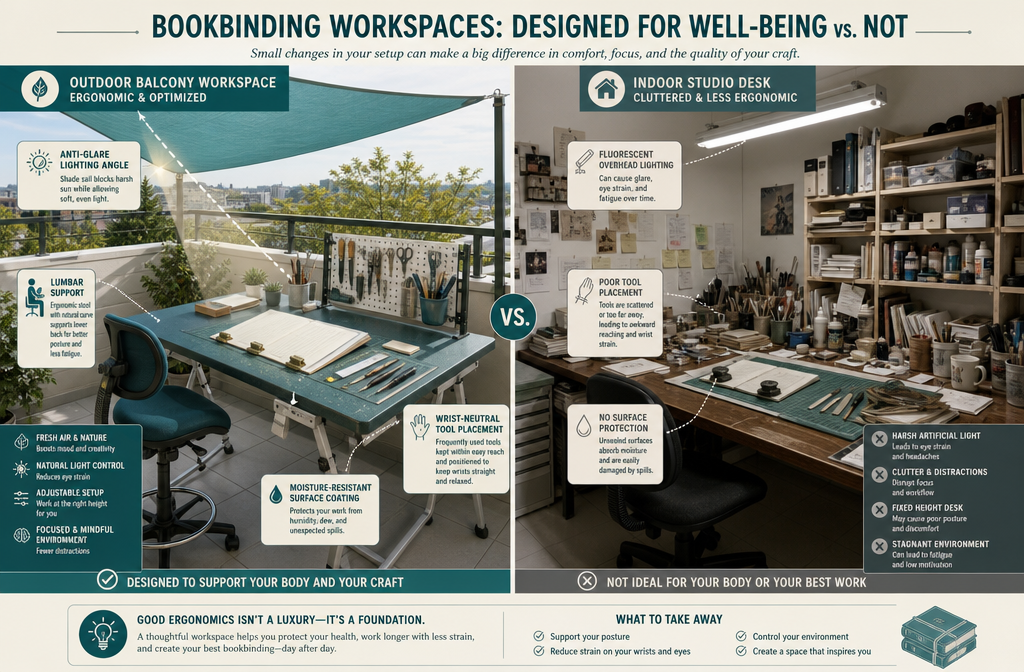
A good balcony workspace for bookbinding provides a stable, flat surface at the correct working height, reliable shade from direct sun, protection from wind, and easy access to tools and materials. Without these four elements, even a beautifully decorated outdoor space will frustrate rather than inspire.
Bookbinding is a precision craft. You’re folding signatures, piercing holes with an awl, pulling waxed thread through paper, and pressing boards flat under weight. Each task demands a surface that doesn’t wobble, light that doesn’t glare, and air that doesn’t scatter your pages. A balcony can deliver all of this, but only if the design is intentional.
The four pillars of a good bookbinding balcony:
- Stability: A table that doesn’t rock, ideally with rubber feet or clamps to the railing.
- Height: Work surface at wrist level when you’re seated, so your shoulders stay relaxed.
- Shade: A retractable awning, shade sail, or large umbrella to block UV and reduce glare on white paper.
- Containment: Railing-mounted hooks, pegboards, or a small rolling cart to keep tools within arm’s reach.
One thing I learned after setting up my own balcony studio: the direction your balcony faces matters more than its size. A north-facing balcony (in the Northern Hemisphere) gives consistent, diffused light all day. A west-facing one turns into a furnace by afternoon. Check your balcony’s orientation before buying furniture.
How Much Space Do You Really Need for a Comfortable Bookbinding Area
Most bookbinding tasks require a minimum clear work surface of 24 by 36 inches, and a total balcony footprint of about 35 to 40 square feet is enough for one person to work comfortably. Smaller spaces work if you use vertical storage and fold-away furniture.
Bookbinding doesn’t need a large footprint. Unlike woodworking or printmaking, most of the work happens in a compact zone directly in front of you. The real space requirement is about organization, not square footage.
Minimum space breakdown:
| Zone | Minimum Size | Notes |
|---|---|---|
| Primary work surface | 24″ x 36″ | Enough for an open text block plus tools |
| Tool access zone | 12″ deep behind table | Pegboard or caddy fits here |
| Seating clearance | 18″ in front of table | Room to shift, stand, stretch |
| Storage | 6 sq ft vertical | Shelving or cart beside the table |
A 6 x 6 foot balcony (36 sq ft) is workable. A 5 x 8 foot space (40 sq ft) is genuinely comfortable. If your balcony is smaller, a fold-flat wall-mounted table that drops down when needed is the most practical solution.
Best Ergonomic Chairs for Bookbinding on a Balcony
The best ergonomic seating for an outdoor bookbinding workspace is a height-adjustable stool or saddle seat with a weather-resistant frame, because bookbinding requires you to lean slightly forward and apply downward pressure, which a traditional chair with a backrest can actually hinder.
Standard office chairs are designed for computer work, where you lean back. Bookbinding is the opposite: you lean forward, press down, and rotate your wrists repeatedly. The right seat keeps your hips slightly higher than your knees and your spine naturally curved.
Top seating options for balcony bookbinders:
- Adjustable saddle stool (e.g., Salli or similar): Tilts the pelvis forward, reduces lower back pressure, works well at high worktables. Choose one with a rust-resistant aluminum or powder-coated steel frame.
- Drafting stool with footrest: Height-adjustable, supports leaning forward, footrest reduces leg fatigue. Look for UV-stable fabric or a metal seat.
- Folding director’s chair: Lightweight, packable, surprisingly supportive for shorter sessions. Not ideal for more than 90 minutes of continuous work.
- Kneeling chair (outdoor version): Reduces lumbar strain for some people, but not suitable for those with knee problems.
Choose a saddle stool if you work for more than two hours at a stretch and your table is 30 inches or higher. Choose a drafting stool if you prefer back support and work at a standard desk height. Avoid plastic garden chairs entirely; they position your hips too low and your shoulders too high.
How to Prevent Wind from Messing Up Paper and Materials
Wind is the most underestimated problem in ergonomic balcony design for passionate bookbinders. The solution is a combination of physical barriers and weighted tools, not just closing the door behind you.
Even a light breeze of 5 to 8 mph can scatter loose signatures, dry out PVA glue before it sets, and blow thread off its spool. Here’s what actually works:
Wind control strategies:
- Railing windbreak panels: Clear acrylic or polycarbonate panels clipped to the railing block wind without blocking your view or light. They’re available in standard sizes at most home improvement stores.
- Weighted paper clips and binder clips: Heavy-duty binder clips on the corners of your work hold pages flat without damaging them.
- Low-profile tool tray: A shallow tray with raised edges keeps small tools (awls, needles, bone folders) from rolling off the table.
- Magnetic mat: A thin magnetic sheet on part of your work surface holds metal tools in place.
- Retractable side screens: Fabric screens that attach to the wall and extend out like a blind. They fold away when not needed.
One practical tip: position your worktable so its long edge faces the prevailing wind direction. This reduces the surface area catching the breeze and gives you more control over your materials.
Lighting Tips for Outdoor Crafting Spaces
Natural diffused daylight is the best light for bookbinding, but direct sun creates harsh shadows and glare on white paper. The goal is to maximize diffused light while eliminating glare and UV exposure.
Lighting setup for a balcony bookbinding workspace:
- Shade sail or frosted polycarbonate roof panel: Filters direct sun into soft, even light. A frosted panel also protects from rain.
- Supplemental LED task light: On overcast days or for evening work, a clip-on LED with a color temperature of 5000K (daylight) renders paper colors accurately without eye strain.
- Avoid positioning your table facing the sun: Work with the light source to your left (if right-handed) or right (if left-handed) to reduce shadow on your work.
- Reflective white surface behind you: A light-colored wall or a portable white board bounces ambient light forward and fills in shadows.
For color-sensitive work like marbling or decorative paper selection, natural north-facing light is the gold standard. If your balcony doesn’t face north, a shade sail on the sun-facing side replicates that quality of light reasonably well.
Can I Do Bookbinding with Arthritis or Hand Pain
Yes, bookbinders with arthritis or chronic hand pain can work comfortably on a balcony with the right ergonomic adjustments. The key changes are tool modification, surface height, and pacing, not abandoning the craft.
Bookbinding involves repetitive gripping, pinching, and pressing. For someone with hand pain, these actions can become barriers. But most of them have practical workarounds.
Ergonomic adaptations for bookbinders with hand pain:
- Padded tool handles: Wrap awl and bone folder handles with self-adhesive foam grip tape to reduce pinch force.
- Wider needle holders: A thick-handled bookbinding needle holder distributes grip pressure across the palm rather than the fingertips.
- Pressing boards and clamps: Instead of pressing book blocks by hand, use a standing book press or F-clamps to apply even pressure without sustained gripping.
- Anti-fatigue mat under feet: Reduces overall body tension, which indirectly reduces hand tension.
- Warm outdoor temperatures: Working on a balcony in mild weather (65 to 75 degrees Fahrenheit) can actually benefit people with arthritis, as warmth keeps joints more supple than an air-conditioned indoor space.
- Scheduled breaks: Set a timer for 20-minute work intervals with a 5-minute rest. The Pomodoro technique works well for craft sessions.
A note from personal experience: I started using a silicone finger pad for pulling thread through tight signatures after a repetitive strain issue, and it made a significant difference within a week.
What Materials Get Damaged by Direct Sunlight
Leather, paper, fabric covers, PVA glue, and water-based adhesives are all damaged by direct sunlight. UV radiation causes leather to crack and fade, paper to yellow and become brittle, and adhesives to lose their bond strength.
Material vulnerability guide:
| Material | Sun Damage | Timeframe |
|---|---|---|
| Leather covers | Fading, cracking, drying | Weeks of daily exposure |
| Handmade paper | Yellowing, brittleness | Months |
| Printed text paper | Fading, yellowing | Months |
| PVA glue | Reduced bond strength | Hours of direct exposure while wet |
| Fabric covers (linen, cotton) | Fading | Weeks to months |
| Bookboard (binder’s board) | Warping if moisture is also present | Variable |
The practical rule: never leave bookbinding materials in direct sun, even briefly. Store everything in a UV-blocking container or a shaded cabinet when not in active use. A simple canvas tote bag is enough for short sessions.
How to Set Up a Balcony Workspace Under $500
A fully functional ergonomic balcony bookbinding workspace can be built for $400 to $500 in 2026 by prioritizing a quality work surface and seating, then filling gaps with budget-friendly storage and weather protection.
Sample $500 budget breakdown:
| Item | Estimated Cost |
|---|---|
| Adjustable-height folding table (32″ x 24″) | $80 to $120 |
| Ergonomic drafting stool (weather-resistant) | $100 to $150 |
| Shade sail (10 x 10 ft) | $40 to $70 |
| Clear acrylic windbreak panel (2 panels) | $50 to $80 |
| Pegboard + hooks (wall or railing mount) | $25 to $40 |
| Weatherproof storage bin with lid | $20 to $35 |
| LED clip-on task light (rechargeable) | $25 to $40 |
| Weighted binder clips, tool tray, misc. | $15 to $25 |
| Total | $355 to $560 |
To stay under $500, buy the table and stool secondhand (Facebook Marketplace and thrift stores regularly have drafting stools in good condition), and make your own pegboard mount from PVC pipe and railing clamps.
Compact Storage Solutions for Bookbinding Tools
Vertical storage is the best approach for small balconies. A pegboard mounted on the wall or railing, combined with a rolling tool cart, keeps every bookbinding tool accessible without consuming precious table space.
Storage solutions that work on balconies:
- Railing-mounted pegboard: Attach a small pegboard to the interior face of the balcony railing using zip ties or railing clamps. Hang awls, bone folders, scissors, and thread spools on hooks.
- Magnetic tool strip: A weather-resistant magnetic strip holds metal tools flat against the wall.
- Stackable weatherproof bins: Clear bins with snap-lock lids stack vertically and let you see contents at a glance. Store paper, boards, and adhesives separately.
- Rolling utility cart (3-tier): Fits beside the table, rolls inside when rain is coming. Top tier for active tools, middle for in-progress projects, bottom for adhesives and finishing supplies.
- Over-door organizer on balcony door: Holds small items like thread, needles, and wax blocks without using any floor or table space.
The key principle: store by frequency of use. Tools you reach for every session go on the pegboard at eye level. Materials you use once per project go in the bins at floor level.
Pros and Cons of Outdoor vs Indoor Bookbinding Spaces
Outdoor balcony bookbinding spaces offer better natural light, more ventilation for adhesive fumes, and a more pleasant working environment in good weather. Indoor spaces offer climate control, protection from weather, and year-round usability.
Direct comparison:
| Factor | Balcony | Indoor |
|---|---|---|
| Natural light quality | Excellent (diffused) | Variable |
| Adhesive fume ventilation | Excellent | Requires open window |
| Temperature control | Weather-dependent | Consistent |
| Year-round use | Seasonal (climate-dependent) | Year-round |
| Material protection | Requires active management | Easier |
| Inspiration and mood | Generally higher | Neutral |
| Noise | Variable (street noise) | Quieter |
The honest answer: a balcony is a better bookbinding environment on a pleasant day, and a worse one on a hot, windy, or humid day. The best approach is a hybrid setup: a balcony workspace for good weather, with a compact indoor fallback for the rest of the year.
Common Mistakes People Make When Designing Craft Balconies
The most common mistake in ergonomic balcony design for passionate bookbinders is choosing furniture based on appearance rather than working height. The second most common is underestimating moisture.
Mistakes to avoid:
- Table too low or too high: A standard dining table (30 inches) is fine for eating but too low for precise hand work. Aim for wrist height when seated.
- No wind plan: Setting up without any wind barrier and then abandoning the space after one frustrating session.
- Leaving materials outside: Even in a covered balcony, humidity fluctuations overnight will warp paper and boards.
- Ignoring the sun’s path: Setting up facing west and then being blinded by afternoon sun within a week.
- Buying a chair before the table: Always choose your table height first, then match the chair to it.
- No drainage consideration: Placing storage bins directly on the balcony floor where water pools after rain.
- Overcrowding the space: Adding too many items “just in case” and ending up with no clear work surface.
Which Balcony Surfaces Work Best for Delicate Paper Work
A smooth, hard, non-porous work surface is best for bookbinding on a balcony. A solid-core butcher block, a glass-topped table, or a laminate surface all work well. Avoid textured surfaces, slatted tables, or rough wood that can catch and tear delicate paper.
A cutting mat placed on top of any surface solves most texture problems and also protects the table when using awls or knives. A self-healing cutting mat (A2 or A1 size) is the single most useful surface accessory for any bookbinder.
Surface ranking for bookbinding:
- Self-healing cutting mat on solid table (best)
- Laminate or melamine surface
- Glass top (heavy, but excellent)
- Sealed butcher block
- Bare plywood (acceptable with sanding)
- Slatted wood or textured metal (avoid)
How to Protect Bookbinding Equipment from Moisture
Store all bookbinding materials in sealed, weatherproof containers when not in active use, and use silica gel packets inside storage bins to absorb ambient humidity. Metal tools should be wiped dry and stored with a light coat of tool oil if you live in a humid climate.
Moisture is the most persistent threat to a balcony bookbinding setup. Paper absorbs humidity and warps. Bookboard delaminates. PVA glue can grow mold if left in an open container. Leather develops mildew.
Moisture protection checklist:
- Use snap-lock plastic bins (not cardboard boxes) for all paper and board storage.
- Place 2 to 4 silica gel packets in each storage bin and replace them monthly.
- Store adhesives (PVA, paste, methyl cellulose) in a small cooler with a lid when working outdoors.
- Wipe metal tools (awls, needles, scissors) with a dry cloth after each outdoor session.
- Never leave a work-in-progress book block outdoors overnight; humidity changes cause warping even under a covered balcony.
- If you live in a climate with more than 60% average relative humidity, consider a small dehumidifier for your indoor storage area rather than relying on outdoor storage at all.
FAQ
Q: What is the ideal table height for bookbinding on a balcony? A: Wrist height when seated, typically 28 to 32 inches for most adults. Measure from the floor to your wrist when your arm hangs relaxed at your side.
Q: Can I leave my bookbinding tools on the balcony overnight? A: Metal tools can stay if covered, but paper, boards, adhesives, and leather should always be brought inside or stored in sealed weatherproof bins.
Q: What’s the minimum balcony size for a bookbinding workspace? A: A 5 x 6 foot (30 sq ft) balcony is the practical minimum. Smaller than that, and you’ll need a fold-away table that mounts to the wall.
Q: Does wind affect gluing and sewing as well as paper? A: Yes. Wind dries PVA glue faster than its working time allows, and it can pull thread off course during sewing. A windbreak is essential for any adhesive or sewing work outdoors.
Q: Is a balcony bookbinding setup suitable for beginners? A: Yes, with one caveat: beginners should start with a covered or shaded balcony to avoid material damage while they’re still learning how long each step takes.
Q: How do I keep my cutting mat from warping outdoors? A: Store it flat and indoors when not in use. Heat and direct sun will warp a cutting mat permanently within a single afternoon.
Q: What’s the best adhesive for outdoor bookbinding sessions? A: PVA glue in a sealed container works fine, but work in shade and keep the container closed between uses. Avoid paste adhesives on very humid days, as they take longer to dry and may not bond properly.
Q: Can I use a regular patio umbrella for shade? A: A patio umbrella provides some shade but moves with the sun and doesn’t protect from angled light. A fixed shade sail or retractable awning is more reliable for a permanent workspace.
Q: How do I stop my paper from curling in outdoor humidity? A: Keep paper in sealed bins until the moment you need it, and press finished signatures immediately under a weighted board. Working in the morning when humidity is lower also helps.
Q: Is ergonomic balcony design for passionate bookbinders different from general craft space design? A: Yes. Bookbinding requires a flat, stable, wrist-height surface and protection from wind and UV that general craft spaces may not prioritize. The forward-leaning posture of bookbinding also demands different seating than painting or knitting.
Q: What’s the best flooring for a balcony bookbinding workspace? A: A non-slip rubber mat or interlocking foam tiles provide cushioning for standing and protect dropped tools. Avoid bare concrete, which is hard on feet and can damage dropped tools.
Q: How often should I replace silica gel packets in my storage bins? A: Check them monthly. Most silica gel packets include a color indicator that changes when saturated. Replace or recharge them (by drying in an oven at low heat) every four to six weeks in humid climates.
Conclusion
Ergonomic balcony design for passionate bookbinders is not about luxury; it’s about working smarter so you can craft longer without pain or frustration. The core principles are straightforward: get your table height right, control wind and sun, protect your materials from moisture and UV, and choose seating that supports forward-leaning work rather than fighting it.
Your next steps:
- Measure your wrist height from the floor and compare it to your current or planned table height.
- Walk your balcony at different times of day to map where sun and wind hit hardest.
- Audit your current material storage and replace any cardboard boxes or open shelves with sealed weatherproof bins.
- Choose one ergonomic upgrade this month, whether that’s a drafting stool, a shade sail, or a cutting mat, and build from there.
- If you have hand pain, try one tool modification (foam grip tape on your bone folder) before your next session.
A well-designed balcony bookbinding workspace is genuinely one of the most pleasant places to practice this craft. The combination of natural light, fresh air, and the tactile satisfaction of building a book by hand is hard to match indoors. With the right setup, your balcony becomes a studio you’ll actually want to use every day.
References
- Grandjean, E. (1988). Fitting the Task to the Man: A Textbook of Occupational Ergonomics (4th ed.). Taylor & Francis.
- Ligatus Research Centre, University of the Arts London. (2015). Language of Bindings Thesaurus. https://www.ligatus.org.uk/lob/
- National Institute for Occupational Safety and Health (NIOSH). (2021). Work-Related Musculoskeletal Disorders Prevention. Centers for Disease Control and Prevention. https://www.cdc.gov/niosh
- Smith, K. A. (1995). Non-Adhesive Binding: Books Without Paste or Glue. Keith Smith Books.
- Young, L. C. (2015). Bookbinding & the Conservation of Books: A Dictionary of Descriptive Terminology. Preservation Directorate, Library of Congress. https://cool.culturalheritage.org/don/
Read next: iOS 27 Compatibility: Which iPhones Will Lose Support in 2026?. A closer look at ios 27 compatibility.