
Key Takeaways
- Dried ink residue and congealed lubricant are the leading causes of stuck typewriter keys, not mechanical failure.
- Denatured alcohol (ethanol) and PB Blaster Dry Lubricant are among the safest solvents for internal mechanisms; keep them away from painted shells.
- Never use WD-40, 3-in-1 oil, or cooking oil on vintage typewriter mechanisms — they leave sticky residue that worsens the problem.
- Professional typewriter repair typically costs between $75 and $200 for a full cleaning and adjustment, as of 2026.
- Brands like Underwood, Royal, and early Olivetti models are particularly prone to typebar jamming due to their open segment designs.
- Humidity above 60% accelerates ink residue buildup and causes metal parts to swell slightly, increasing key friction.
- A stuck key is not always a sign of serious damage — most cases are resolved with patient cleaning rather than part replacement.
- Knowing when to call a specialist matters: visible cracked typebars, bent segment slots, or seized escapement wheels usually require professional attention.
What Causes Typewriter Keys to Get Stuck in the First Place
Typewriter keys stick because dried ink, dust, and old lubricant accumulate in the typebar segment — the slotted metal comb that guides each typebar toward the platen. Over decades of storage, these substances harden into a gummy film that grips the typebars and prevents smooth movement.
There are three main culprits:
- Dried ink residue: Every keystroke drives the typebar through an inked ribbon. Over time, ink migrates down the bar and into the segment slots. Once it dries, it acts like a weak adhesive.
- Congealed lubricant: Typewriters were factory-lubricated with light oils. After 40 to 70 years, those oils oxidize into a thick, tar-like substance. This is the most common cause of truly stuck keys.
- Dust and debris: Paper fibers, eraser shavings, and airborne grit settle into the segment and mix with the other residues, forming a dense plug.
A less obvious cause is key linkage binding — the series of levers connecting the keytop to the typebar. If any pivot point in that chain corrodes or loses clearance, the key will feel stiff or fail to return. This is more common in machines stored in damp environments.
Are Old Typewriters Really Worth Restoring
Yes, in most cases a vintage typewriter is worth restoring — both financially and practically. Fully restored machines from brands like Hermes, Olympia, and Royal regularly sell for $150 to $600 on platforms like eBay and Etsy, according to seller listings tracked in 2025. Rare or aesthetically striking models (two-tone paint, colored keys) can fetch considerably more.
Beyond resale value, many collectors and writers restore typewriters for daily use. A properly maintained machine from the 1950s or 1960s can outlast most modern printers with minimal upkeep.
Choose restoration if:
- The machine types most letters and has good cosmetic condition
- The platen (rubber roller) is still soft and grippy
- Replacement ribbons are available (most standard sizes still are)
Skip restoration if:
- The platen is rock-hard and cracked (replacement is expensive)
- Multiple typebars are bent or broken
- The carriage return mechanism is seized and shows corrosion damage
How Much Does Professional Typewriter Repair Cost
Professional typewriter repair in 2026 typically runs between $75 and $200 for a standard cleaning, lubrication, and adjustment service. More complex work — replacing platens, rebuilding escapements, or sourcing rare parts — can push costs to $300 or higher.
Pricing varies by region and technician experience. Shops in major cities tend to charge more. Some repair services offer a flat “tune-up” rate that covers cleaning and basic adjustments, which is the right starting point for most stuck-key problems.
Rough cost breakdown:
| Service | Estimated Cost (2026) |
|---|---|
| Basic cleaning and key adjustment | $75 – $125 |
| Full service (clean, lube, align) | $125 – $200 |
| Platen replacement | $80 – $150 (parts + labor) |
| Escapement rebuild | $150 – $300 |
| Cosmetic restoration (paint touch-up) | $50 – $200+ |
If you’re quoted significantly more than these ranges for a basic cleaning, get a second opinion. Many typewriter enthusiast communities (like the Typewriter Database forums) can recommend reputable technicians by region.
Can I Use Household Lubricants on Vintage Typewriter Mechanisms
No. Household lubricants like WD-40, 3-in-1 oil, sewing machine oil, and cooking oil should not be used on vintage typewriter mechanisms. WD-40 is a water displacer and light solvent, not a long-term lubricant. It temporarily frees stuck parts but leaves an oily film that attracts dust and causes worse sticking within weeks.
Safe options for typewriter mechanisms:
- Denatured alcohol (ethanol): Excellent for dissolving dried ink and old grease. Apply with a cotton swab directly to the segment slots and typebar pivots. Safe on metal; keep off painted surfaces.
- PB Blaster Dry Lubricant or Tri-Flow: Penetrates, lubricates, and dries to a thin film that resists dust. These are the most commonly recommended options in the typewriter restoration community.
- Nyoil or clock oil: Very light mineral oil suitable for pivot points and escapement wheels. Use sparingly — one drop per pivot is enough.
Never use:
- WD-40 (attracts debris)
- Petroleum jelly or Vaseline (too thick, clogs segments)
- Cooking or vegetable oils (go rancid and harden)
- Silicone spray near rubber parts (degrades the platen)
What Cleaning Solvents Are Safe for Old Typewriter Paint
For painted typewriter shells, the safest cleaning approach is mild dish soap diluted in warm water, applied with a soft cloth. This removes surface grime without lifting or dulling the original lacquer finish.
For tougher spots, a small amount of isopropyl alcohol (70%) on a cotton pad works well on most post-1940s painted surfaces. Test an inconspicuous area first — some early cellulose lacquers from the 1920s and 1930s are sensitive to alcohol.
Solvents to avoid on painted shells:
- Acetone or nail polish remover (strips paint immediately)
- Denatured alcohol applied liberally (safe in small amounts on modern finishes, risky on older ones)
- Goo Gone or citrus degreasers (can cloud lacquer)
- Abrasive cleaners or scrubbing pads (scratch the finish)
A good rule: if you wouldn’t use it on a vintage car’s paint, don’t use it on your typewriter.
What’s the Difference Between Cleaning and Repairing a Stuck Typewriter Key
Cleaning removes the substance causing the key to stick — dried ink, old oil, or debris. Repair addresses a physical problem with the mechanism itself, such as a bent typebar, a broken spring, or a worn pivot.
Most stuck keys only need cleaning. You’ll know cleaning is sufficient if the key moves but feels sluggish or gummy. You’ll know repair is needed if the key doesn’t move at all even after cleaning, or if you can see visible bending or breakage when you look inside the machine.
Cleaning vs. repair decision guide:
- Key feels sticky or slow to return: start with cleaning
- Key produces a faint “clunk” but doesn’t complete its stroke: check for a broken return spring (repair)
- Key moves freely but doesn’t print: typebar may be bent away from the platen (repair)
- Multiple adjacent keys jam together: segment slot may be deformed (professional repair recommended)
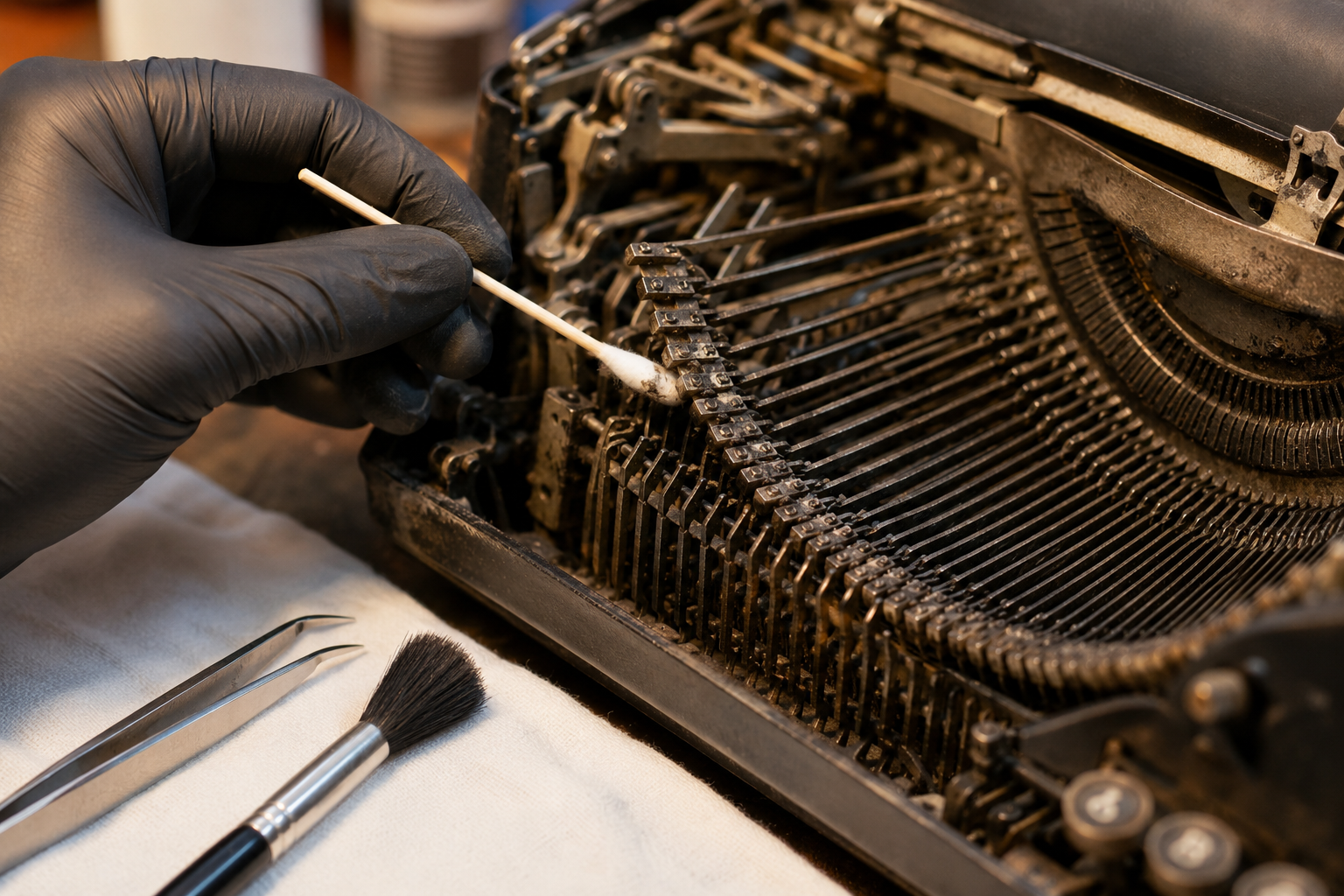
Vintage Typewriter Maintenance: How to Unstick Keys Without Damaging the Paint — Step-by-Step
The core process for vintage typewriter maintenance — specifically unsticking keys without damaging the paint — follows a clear sequence. Work from the least invasive method to the most involved, and always protect painted surfaces before applying any solvent.
What you’ll need:
- Denatured alcohol or Tri-Flow lubricant
- Fine cotton swabs and lint-free cloths
- Soft-bristle brush (a clean watercolor brush works well)
- Compressed air canister
- Flathead screwdriver (for accessing the segment cover on some models)
- Painter’s tape (to mask painted areas near the segment)
Step-by-step process:
- Remove the ribbon and advance the carriage to give yourself clear access to the typebars.
- Blow out loose debris with compressed air, directing the nozzle into the segment from the front and sides.
- Brush the segment slots with a dry soft-bristle brush to dislodge surface dust.
- Apply denatured alcohol to a cotton swab and work it into each stuck typebar’s slot. Do not flood the area — use just enough to wet the contact points.
- Work the key repeatedly by hand as the solvent softens the residue. You should feel it loosen within 30 to 60 seconds.
- Wipe away dissolved residue with a clean swab or cloth. Repeat until the key moves freely.
- Apply one drop of Tri-Flow or Nyoil to each pivot point once the segment is clean and dry.
- Test all keys at typing speed before reassembling any covers.
Protecting the paint: Before applying any solvent near the shell, lay strips of painter’s tape along the edges of the segment opening. Even denatured alcohol can dull older lacquer if it runs onto the surface.
Which Vintage Typewriter Brands Are Most Prone to Key Sticking
Open-segment designs — where the typebar slots are exposed rather than enclosed — are most vulnerable to debris accumulation. Underwood No. 5, Royal Quiet De Luxe, and early Remington portables all use open segments and are frequently cited in restoration communities as the most prone to sticking.
Machines with enclosed or semi-enclosed segments, like the Hermes 3000 and Olympia SM series, tend to stay cleaner longer but are harder to access when cleaning is needed.
Sticking tendency by brand (general estimate based on collector reports):
| Brand/Model | Sticking Tendency | Notes |
|---|---|---|
| Underwood No. 5 | High | Open segment, age (pre-1940) |
| Royal Quiet De Luxe | High | Very common, parts abundant |
| Remington Portable | Medium-High | Linkage binding common |
| Olivetti Lettera 32 | Medium | Well-sealed, but ink migrates |
| Hermes 3000 | Low-Medium | Excellent build quality |
| Olympia SM series | Low | Tight tolerances, durable |
Are There Specific Tools I Need to Fix Stuck Keys Without Scratching
Yes, using the right tools prevents scratches on painted surfaces and avoids bending delicate typebars. You don’t need an expensive kit, but a few specific items make a real difference.
Essential tools:
- Fine-tipped cotton swabs (not standard drugstore size — look for precision swabs used in electronics cleaning)
- Soft natural-bristle brush (size 4-6 watercolor brush)
- Plastic or wooden toothpick (for dislodging debris without scratching metal)
- Compressed air canister
- Needle-nose pliers with smooth jaws (for adjusting return springs only)
- Lint-free microfiber cloths
Tools to avoid:
- Metal picks or dental tools (scratch segment slots and typebars)
- Wire brushes (abrasive on plated surfaces)
- Power tools of any kind near the mechanism
How Do Professional Collectors Maintain Their Vintage Typewriters
Experienced collectors follow a consistent preventive routine rather than waiting for keys to stick. The goal in vintage typewriter maintenance is to keep residue from building up in the first place.
A typical collector maintenance schedule:
- After every use: Brush the segment with a soft brush and blow out paper dust with compressed air.
- Every 6 months: Inspect typebar pivot points for dryness; apply one drop of Nyoil if needed.
- Annually: Full segment cleaning with denatured alcohol; check all spring tensions; clean the platen with a rubber rejuvenator product.
- Storage: Keep machines covered with a cloth (not plastic, which traps moisture), in a stable environment between 45-55% relative humidity.
Many collectors also avoid leaving a ribbon installed during long storage periods, as old ribbon ink is a primary source of the residue that causes sticking.
Can Humidity and Temperature Affect Typewriter Key Performance
Yes, significantly. High humidity causes metal parts to expand slightly and promotes corrosion, both of which increase friction in the segment and key linkages. Low humidity dries out any remaining lubricant faster, leading to metal-on-metal wear.
The ideal storage range for vintage typewriters is 45% to 55% relative humidity at a stable temperature between 60°F and 75°F (15°C to 24°C). Avoid basements, attics, and garages where temperature swings are large.
A machine stored in a humid environment for years may have typebars that are lightly corroded at their pivot points. In that case, denatured alcohol alone may not free them — a penetrating lubricant like PB Blaster applied the night before cleaning can help break the corrosion bond.
What Are Common Mistakes People Make When Trying to Unstick Typewriter Keys
The most damaging mistake is using too much solvent, too fast. Flooding the segment with alcohol or oil causes the liquid to run down into areas you can’t reach and can strip lubricant from parts that were working fine.
Other common mistakes:
- Using WD-40: Feels like a quick fix but leaves a residue that causes worse sticking within weeks.
- Forcing a stuck key: Bending a typebar by pressing too hard is a repair that often costs more than the machine’s value to fix properly.
- Cleaning only the stuck key: Residue is usually distributed across the whole segment. Cleaning one key and ignoring the others means more keys will stick soon.
- Skipping the dry step: Applying lubricant before the solvent has fully evaporated traps dissolved residue in place.
- Ignoring the return springs: A key that moves forward but won’t snap back has a weak or broken return spring — no amount of cleaning fixes that.
Is It Better to Repair a Stuck Key Myself or Take It to a Specialist
For most stuck keys caused by dried ink and old lubricant, DIY cleaning is appropriate and cost-effective. The process is low-risk if you follow the steps above and avoid harsh solvents on painted surfaces.
Take the machine to a specialist when:
- Multiple keys are stuck and the segment appears deformed
- You see cracked or bent typebars
- The escapement (the mechanism that advances the carriage one space per keystroke) is not functioning
- The machine has significant sentimental or monetary value and you’re not confident in your technique
A good specialist can assess the machine in 15 minutes and tell you honestly whether a DIY approach would have worked. Many typewriter repair shops offer a free or low-cost initial assessment.
How Do I Know If My Typewriter Key Damage Is Beyond Simple Repair
A stuck key that frees up with cleaning and works normally afterward is not damaged. A key is likely beyond simple repair when the typebar itself is bent, cracked, or broken, or when the segment slot is deformed enough that the typebar can’t travel in a straight line.
Signs the damage is serious:
- The typebar visibly angles to one side even when at rest
- The key prints letters that overlap or appear off-center
- The key returns but strikes adjacent typebars on the way up
- You hear a grinding sound during the keystroke after cleaning
In these cases, the repair requires either sourcing a replacement typebar (difficult for most models) or having a technician carefully straighten the existing one. This is precise work that risks snapping the bar if done without experience.
Vintage Typewriter Maintenance FAQ
Q: How often should I clean a vintage typewriter I use regularly? A: Brush out dust and debris after every use. Do a full segment cleaning with denatured alcohol every 6 to 12 months, depending on how heavily you use the machine.
Q: Can I use rubbing alcohol instead of denatured alcohol? A: Yes, isopropyl alcohol at 90% or higher works well and is easier to find. Avoid 70% isopropyl for internal cleaning — the extra water content can promote light surface rust on unprotected metal.
Q: My key unstuck after cleaning but sticks again within a week. Why? A: This usually means residue remains in the segment slot and is re-hardening. Repeat the cleaning process two or three times, working the key vigorously between each application to fully clear the slot.
Q: Will cleaning a typewriter affect its collector value? A: A proper cleaning that preserves the original paint and decals generally maintains or improves value. Aggressive polishing, repainting, or replacing original parts reduces collector value for most machines.
Q: Is it safe to use compressed air inside a vintage typewriter? A: Yes, with care. Use short bursts and hold the can upright to prevent propellant liquid from spraying onto the mechanism. Never use an air compressor at full pressure — it can bend delicate parts.
Q: What’s the best way to store a vintage typewriter long-term? A: Cover it with a breathable cloth cover (not plastic), keep it in a stable environment at 45-55% humidity, and remove the ribbon to prevent ink migration. Store it on a flat, stable surface, not stacked.
Q: My typewriter has a sticky key but I can’t identify which one. How do I find it? A: Type the full alphabet slowly and listen for a key that sounds duller or feels heavier than the others. Then hold that typebar up manually and look at the segment slot — you’ll usually see discoloration or visible residue.
Q: Can I clean a typewriter without removing it from the case? A: For basic cleaning, yes. For a thorough segment cleaning, removing the machine from its case gives you better access and prevents solvent from dripping onto the case interior.
Q: Do electric vintage typewriters have the same sticking problem? A: Electric models from the 1960s and 1970s (IBM Selectric, for example) have different mechanisms and are less prone to typebar sticking, but their motor brushes, type elements, and print mechanisms have their own maintenance needs.
Q: How do I find a reputable typewriter repair technician? A: The Typewriter Database (typewriterdatabase.com) community forums are a reliable starting point. Local antique dealers who specialize in vintage office equipment often know repair specialists in the area.
Conclusion
Vintage typewriter maintenance — specifically learning how to unstick keys without damaging the paint — is one of the most accessible and rewarding skills for any collector or enthusiast. The vast majority of stuck keys are caused by decades of dried ink and congealed lubricant, and they respond well to patient cleaning with the right solvents.
Your immediate next steps:
- Gather your supplies: denatured alcohol or 90%+ isopropyl, fine cotton swabs, a soft brush, and compressed air.
- Identify which keys are sticking by typing the full alphabet slowly.
- Protect painted surfaces with painter’s tape before applying any solvent.
- Clean the segment methodically, working each stuck key repeatedly until it moves freely.
- Apply a single drop of Nyoil or Tri-Flow to each cleaned pivot point.
- If the machine has multiple bent typebars or a seized escapement, get a professional assessment before investing more time.
A well-maintained vintage typewriter can last another 70 years. The time you spend on proper care now is time you won’t spend on expensive repairs later.
References
- Typewriter Database Community Forums. (2023). Segment cleaning guides and lubricant recommendations. typewriterdatabase.com
- Messenger, T. (2019). The Typewriter Revolution: A Typist’s Companion for the 21st Century. Countryman Press.
- Polt, R. (2015). The Typewriter Revolution. Countryman Press.
- iFixit Typewriter Repair Guides. (2022). Vintage typewriter disassembly and cleaning procedures. ifixit.com
Read next: How to Repair Cracks in Antique Oak Furniture Using Traditional Shellac Sticks. A closer look at antique oak furniture repair.