
Key Takeaways
- Open-plan offices create unique aromatherapy challenges because scents travel and affect everyone nearby, not just the person using them.
- Lavender, bergamot, peppermint, and sweet orange are the best-supported scents for stress relief in workplace settings.
- Personal inhalers and small passive diffusers (clay or felt pads) are the safest delivery methods for shared offices.
- Always check your company’s scent policy and ask nearby colleagues before introducing any fragrance.
- Scent concentration matters more than scent type: a barely-there aroma is more effective and far less disruptive than a strong one.
- Some employees have fragrance sensitivities or allergies; pure essential oils are generally better tolerated than synthetic fragrance oils.
- The goal is stress reduction, not a spa experience. Subtlety is the entire point.
- Timing matters: diffusing during high-stress periods (before presentations, during deadline crunches) yields better results than constant background scent.
Why Open-Plan Offices Make Stress Management Harder
Open-plan offices reduce privacy, increase ambient noise, and limit personal control over the environment. These factors consistently appear in workplace stress research as significant contributors to cognitive fatigue and anxiety. A 2011 study published in the Journal of Environmental Psychology found that workers in open-plan layouts reported higher levels of distraction and lower satisfaction with their physical environment compared to those in enclosed offices (Kim & de Dear, 2013, updated in a larger 2013 sample).
The core problem is sensory overload. When you cannot control noise, temperature, or visual clutter, small interventions that restore a sense of personal agency, like a familiar calming scent, can have an outsized psychological effect. That’s the foundation of open-plan office aromatherapy as a stress relief strategy.
The key constraints:
- You share air with colleagues who did not consent to your scent choices.
- Ventilation systems can carry aromas further than expected.
- Fragrance sensitivities affect an estimated 30% of the general population, according to a 2016 study in Preventive Medicine Reports (Steinemann, 2016).
What Does the Research Actually Say About Aromatherapy and Stress?
The evidence for aromatherapy and stress relief is real but nuanced. Several peer-reviewed studies show measurable physiological effects from specific essential oils, particularly on cortisol levels, heart rate, and self-reported anxiety.
What the evidence supports:
- Lavender (Lavandula angustifolia): A 2012 randomized controlled trial in Phytomedicine found that an oral lavender oil preparation (Silexan) significantly reduced anxiety scores compared to placebo. Inhalation studies also show reduced cortisol and improved mood in stressed populations (Koulivand et al., 2013).
- Peppermint: Research published in the International Journal of Neuroscience found that peppermint aroma increased alertness and reduced fatigue, making it useful for afternoon energy slumps rather than acute stress (Moss et al., 2008).
- Bergamot and sweet orange: A 2011 study in Evidence-Based Complementary and Alternative Medicine found that sweet orange aroma reduced anxiety in dental patients, a population under acute stress (Goes et al., 2012).
- Rosemary: Associated with improved memory performance in some studies, though the stress-reduction evidence is weaker than for lavender.
What the evidence does not support:
- The idea that any scent works for everyone. Individual response varies significantly based on personal associations and prior exposure.
- Claims that aromatherapy replaces clinical treatment for anxiety disorders.
- Continuous diffusion as more effective than targeted, short-duration use.
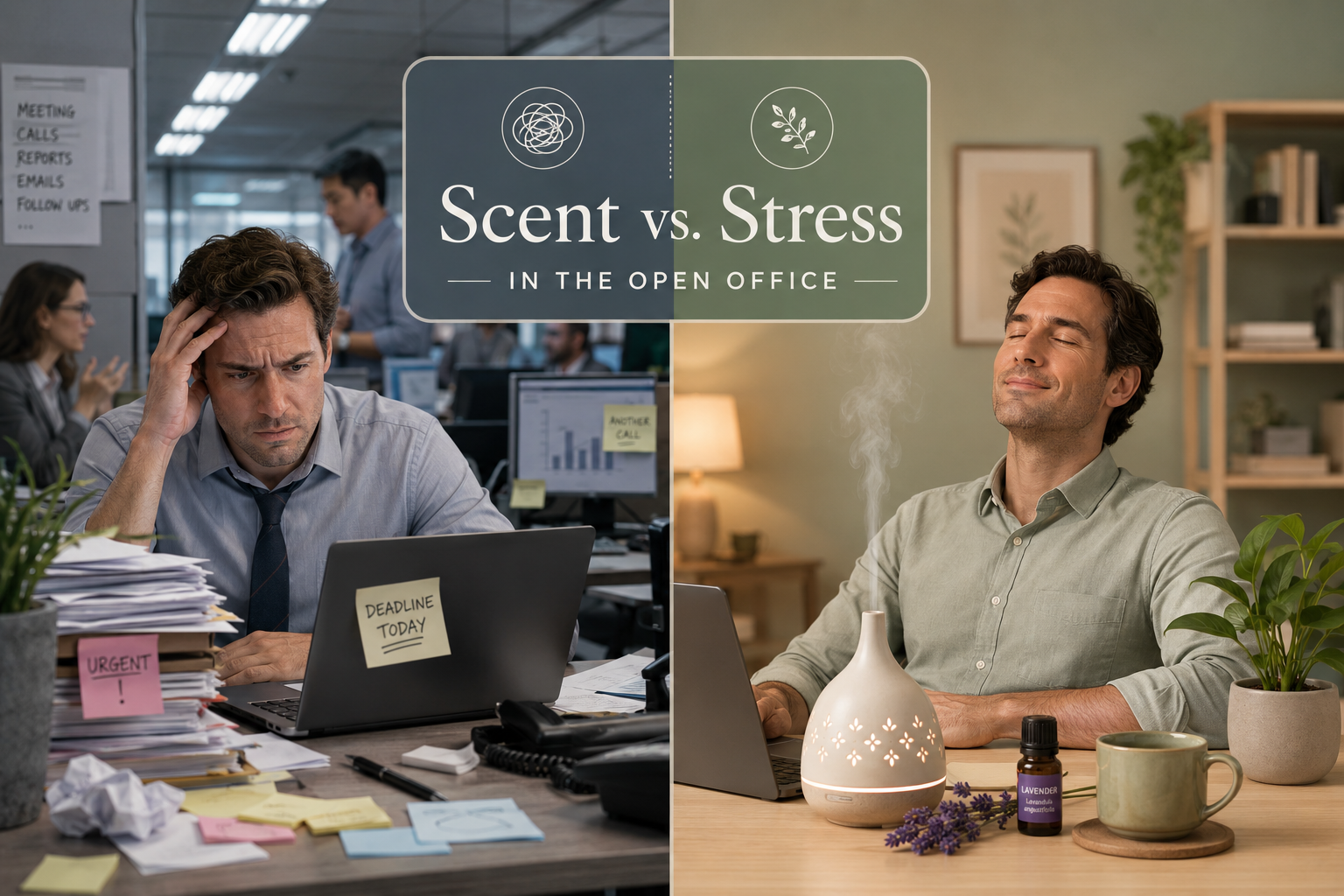
How to Practice Open-Plan Office Aromatherapy: Subtle Scents for Stress Relief Without Bothering Colleagues
The single biggest mistake people make is treating a shared office like a private room. Subtlety is not just polite; it’s actually more effective. Research on olfactory adaptation (the process by which the brain stops registering a constant smell) shows that low, intermittent scent exposure maintains psychological effect longer than a strong constant one.
Step-by-step approach for shared spaces:
- Check your workplace policy first. Many companies have scent-free or fragrance-reduced policies, especially in healthcare-adjacent or inclusive workplaces. Violating these policies, even with good intentions, can create HR issues.
- Ask the people closest to your desk. A simple “I’m thinking of using a very light lavender inhaler at my desk, would that bother you?” goes a long way. Most colleagues appreciate being asked.
- Choose the right delivery method (see the comparison table below).
- Start with personal inhalers. These are small tubes containing a cotton wick soaked in essential oil. You hold them under your nose for a few breaths. Scent stays almost entirely personal.
- If using a passive diffuser, position it close to you and away from air vents that could carry scent across the room.
- Use scent intermittently. Three to five minutes of inhalation during a stressful moment is more effective than eight hours of background diffusion.
- Observe reactions. If a colleague mentions a headache, congestion, or discomfort, stop immediately and switch to a personal inhaler.
Which Delivery Methods Work Best in Shared Offices?
Not all diffusers are equal in a shared space. The method you choose determines how far the scent travels and how much control you have.
| Method | Scent Radius | Control Level | Best For |
|---|---|---|---|
| Personal inhaler (nasal stick) | Personal only | Highest | Acute stress moments, scent-sensitive offices |
| Clay or felt pad diffuser | 1-2 feet | High | Individual desks, low-traffic areas |
| Ultrasonic mist diffuser | 10-20 feet | Low | Private offices only |
| Reed diffuser | 5-10 feet | Low-medium | Small, well-ventilated spaces |
| Scented candle | Varies widely | Very low | Not recommended in offices |
| Room spray | Immediate burst, fades | Medium | Brief use, with consent |
Decision rule: If you work within six feet of another person, use a personal inhaler or clay pad diffuser only. Reserve ultrasonic diffusers for private offices or enclosed meeting rooms where everyone present has agreed.
Which Scents Work Best for Workplace Stress Relief?
For open-plan office aromatherapy and subtle scents for stress relief, the best choices are those with both research support and broad tolerability. Avoid heavy, polarizing scents like patchouli, ylang-ylang, or strong eucalyptus, which some people find overwhelming or medicinal.
Top choices for shared workplaces:
- Lavender: Calming, widely liked, well-researched. Best for anxiety and tension headaches.
- Sweet orange or bergamot: Uplifting without being stimulating. Good for low-mood afternoons.
- Peppermint (very diluted): Energizing and focus-supporting. Use sparingly; it can be sharp at higher concentrations.
- Lemon: Clean, fresh, and associated with improved concentration in some studies. Broadly inoffensive.
- Frankincense: Grounding and calming. Less commonly used but well-tolerated.
Scents to avoid in open offices:
- Ylang-ylang (can cause headaches at higher concentrations)
- Clove or cinnamon (too strong and polarizing)
- Patchouli (strong personal associations, divisive)
- Any synthetic fragrance oil (higher likelihood of triggering sensitivities than pure essential oils)
“The goal in a shared workspace is a scent that your colleagues wouldn’t even consciously notice but that you find grounding. If someone across the room can identify what you’re diffusing, it’s too strong.”
How to Handle Scent Sensitivities and Fragrance Policies at Work
Fragrance sensitivity is more common than most people realize. According to Anne Steinemann’s 2016 research in Preventive Medicine Reports, approximately 34% of Americans report health problems from fragranced products, including headaches, breathing difficulties, and skin reactions. In an open-plan office, this means roughly one in three colleagues could be affected by your aromatherapy practice.
Practical steps to avoid causing harm:
- Always use 100% pure essential oils, not synthetic fragrance oils or perfume-grade blends.
- Keep concentrations minimal. For a clay pad diffuser, one to two drops is sufficient.
- Never diffuse in enclosed spaces like elevators, phone booths, or small meeting rooms without explicit consent from everyone present.
- If your company has a scent-free policy, honor it fully. Personal inhalers used privately (away from your desk, in a bathroom or stairwell) are the only acceptable option in these environments.
- If you manage a team, do not introduce office-wide diffusion without a team discussion and opt-out mechanism.
Common mistake: Assuming that because something is “natural” it cannot cause a reaction. Essential oils are potent chemical compounds. Lavender, for example, contains linalool and linalyl acetate, which can trigger contact dermatitis in sensitive individuals. Airborne concentrations from a small diffuser are unlikely to cause skin reactions, but respiratory sensitivity is a real concern.
Can Open-Plan Office Aromatherapy Actually Improve Productivity?
The short answer is yes, but only under specific conditions. Stress relief and productivity are linked but not identical. Reducing anxiety can improve focus and decision-making, but aromatherapy is not a performance enhancer in the direct sense.
What the evidence suggests:
- Reduced stress leads to better working memory performance, according to research on cortisol and cognitive function.
- Peppermint aroma has been associated with improved sustained attention in some controlled studies (Moss et al., 2008).
- A calmer emotional state supports better interpersonal communication, which matters in collaborative open-plan environments.
What aromatherapy cannot do:
- Compensate for poor workplace design, toxic management, or excessive workload.
- Replace adequate breaks, sleep, or exercise as stress management tools.
- Produce consistent results across all individuals due to variation in olfactory response and personal scent associations.
The most honest framing is this: open-plan office aromatherapy works best as one component of a broader personal stress management strategy, not as a standalone solution.
Frequently Asked Questions
Is aromatherapy allowed in most workplaces? It depends on company policy. Many workplaces have fragrance-reduced or scent-free policies, particularly in healthcare, food service, and inclusive corporate environments. Always check your HR policy before starting. Personal inhalers used privately are the safest option if policy is unclear.
What is the safest essential oil to use around colleagues? Lavender and sweet orange are the most broadly tolerated options. They have mild, familiar scents and are unlikely to trigger strong negative reactions at low concentrations. Avoid anything sharp, medicinal, or strongly spiced.
How do I use a personal aromatherapy inhaler at work? Hold the inhaler tube under one nostril, close the other, and inhale slowly for two to three breaths. Repeat on the other side. Use for two to five minutes during a stressful moment. The scent stays personal and does not affect colleagues.
Can I use an ultrasonic diffuser at my open-plan desk? Generally, no. Ultrasonic diffusers disperse scent across a wide area (10-20 feet or more) and are inappropriate for shared spaces without full team consent. Reserve them for private offices.
How often should I use aromatherapy for stress relief at work? Intermittent use during high-stress moments is more effective than constant background scent. Aim for two to three targeted sessions per day rather than all-day diffusion.
Are there any risks to using essential oils at work? Yes. Fragrance sensitivities affect a significant portion of the population. Some essential oils can trigger headaches, respiratory irritation, or allergic reactions. Always use pure essential oils at low concentrations, and stop immediately if a colleague reports discomfort.
Does aromatherapy work for everyone? No. Individual response varies based on personal scent associations, olfactory sensitivity, and psychological factors. Someone who associates lavender with a negative memory may find it anxiety-inducing rather than calming.
What is the difference between essential oils and fragrance oils? Essential oils are extracted directly from plants and contain the plant’s natural chemical compounds. Fragrance oils are synthetic blends designed to smell like a particular scent. For workplace use, pure essential oils are preferred because they are less likely to contain synthetic irritants.
Can I put essential oils directly on my skin at work? Only if properly diluted in a carrier oil (typically 1-2% concentration). Undiluted essential oils can cause skin irritation. For workplace stress relief, inhalation methods are simpler and safer than topical application.
What if my manager objects to my aromatherapy practice? Respect the objection and switch to a personal inhaler used privately, or discontinue entirely. Workplace harmony and policy compliance take priority over personal wellness preferences.
Conclusion
Open-plan office aromatherapy, when practiced with subtlety and consideration, is a genuinely useful tool for managing workplace stress. The research supports specific scents, particularly lavender, bergamot, and sweet orange, for measurable anxiety reduction. But the open-office context demands a different approach than personal use at home.
Actionable next steps for 2026:
- Check your company’s fragrance policy before purchasing anything.
- Start with a personal aromatherapy inhaler loaded with lavender or sweet orange essential oil.
- Use it for two to five minutes during your most stressful moments of the workday.
- Ask the two or three colleagues closest to your desk before introducing any desk-based diffuser.
- If you manage a team, raise the topic openly and create an opt-out process before implementing any shared scenting.
- Track your own stress levels for two weeks to assess whether the practice is genuinely helping.
The best version of open-plan office aromatherapy is one your colleagues never notice but that quietly anchors you through a difficult day. That’s the standard worth aiming for.
References
- Kim, J., & de Dear, R. (2013). Workspace satisfaction: The privacy-communication trade-off in open-plan offices. Journal of Environmental Psychology, 36, 18-26. https://doi.org/10.1016/j.jenvp.2013.06.007
- Koulivand, P. H., Khaleghi Ghadiri, M., & Gorji, A. (2013). Lavender and the nervous system. Evidence-Based Complementary and Alternative Medicine, 2013. https://doi.org/10.1155/2013/681304
- Moss, M., Hewitt, S., Moss, L., & Wesnes, K. (2008). Modulation of cognitive performance and mood by aromas of peppermint and ylang-ylang. International Journal of Neuroscience, 118(1), 59-77.
- Steinemann, A. (2016). Fragranced consumer products: Exposures and effects from emissions. Preventive Medicine Reports, 5, 45-47. https://doi.org/10.1016/j.pmedr.2016.11.012
- Goes, T. C., Antunes, F. D., Alves, P. B., & Teixeira-Silva, F. (2012). Effect of sweet orange aroma on experimental anxiety in humans. Journal of Alternative and Complementary Medicine, 18(8), 798-804.
Read next: Digital Detox for Analog Watch Collectors: Measuring Time Without Screens. A closer look at analog watch digital detox.