
Key Takeaways
- Silver plate tarnishes faster than solid silver because the thin plating layer reacts more readily with sulfur compounds in the air and food residue.
- The aluminum foil and baking soda bath is the safest DIY method for restoring tarnish on antique silver-plated flatware without abrading the surface.
- Chemical dip cleaners can damage 1920s silver plate by stripping the plating unevenly; use them only as a last resort and briefly.
- Cleaning antique flatware does not automatically reduce its value, but aggressive polishing or re-plating can lower collector appeal.
- Professional silver restoration typically costs between $30 and $150 per piece in 2026, depending on condition and the service required.
- Art Deco-era flatware (1920s) often features engraving and raised patterns that trap tarnish; a soft-bristle brush is essential for those details.
- Store cleaned flatware in anti-tarnish cloth rolls or bags to slow future oxidation significantly.
- Re-plating is possible for badly worn pieces and restores function, but it changes the patina collectors value.
- Clean 1920s silver-plated flatware no more than two to four times per year under normal storage conditions.
- Never soak silver-plated flatware for extended periods; moisture accelerates corrosion at the base metal layer.
What Is the Difference Between Silver Plate and Solid Silver
Silver-plated flatware has a thin layer of pure silver bonded over a base metal, usually copper, brass, or nickel silver. Solid sterling silver is at least 92.5% silver throughout the entire piece.
This distinction matters enormously when cleaning. The silver layer on 1920s flatware is typically 10 to 30 microns thick, and aggressive polishing physically removes that layer with each pass. Once the plating wears through to the base metal, no amount of polishing will bring it back. Solid sterling, by contrast, can tolerate more frequent polishing because there is no underlying base metal to expose.
How to tell the difference: Look for hallmarks. British silver plate from the 1920s is often marked “EPNS” (electroplated nickel silver) or “A1” (a quality grade). American pieces may be marked “Silver Plate,” “Triple Plate,” or carry a manufacturer’s name like Rogers, Oneida, or Reed & Barton. Sterling silver is marked “925,” “Sterling,” or carries a lion passant hallmark on British pieces.
What Causes Silver Plate to Tarnish So Quickly
Silver plate tarnishes when its surface reacts with hydrogen sulfide and sulfur dioxide in the air, forming silver sulfide, the dark gray or black layer you see on old flatware. Because the plating layer is thin and the base metal beneath it is often reactive copper or brass, tarnish can develop faster than on solid silver.
Several factors speed up tarnishing on 1920s flatware:
- Humidity: Moisture accelerates the sulfide reaction. Storing flatware in a damp environment can produce visible tarnish within weeks.
- Food residue: Eggs, onions, and rubber bands contain sulfur compounds that cause rapid, localized tarnishing.
- Air pollution: Urban environments with higher sulfur dioxide levels tarnish silver faster.
- Improper storage: Newspaper, cardboard, and unconditioned wood all off-gas acids that attack silver.
- Skin oils: Handling flatware without gloves leaves oils and salts that concentrate tarnish at fingerprint points.
The thin plating on century-old flatware also means the silver layer itself may be partially oxidized or micro-porous in places, giving tarnish more surface area to grip.
What Tools Do You Need to Safely Remove Tarnish from Delicate Silver
For safe tarnish removal on 1920s silver-plated flatware, you need soft, non-abrasive materials and gentle chemistry. The wrong tools will scratch or strip the plating.
Recommended tools and supplies:
- Soft cotton or microfiber cloths (lint-free)
- A soft-bristle toothbrush or natural-bristle detail brush for engraved areas
- Aluminum foil (heavy-duty)
- Baking soda (sodium bicarbonate)
- Non-iodized salt
- Boiling or very hot water
- A glass or ceramic baking dish (not metal)
- Commercial silver polish paste (non-abrasive formulas such as Wright’s Silver Cream or Hagerty Silver Polish)
- Rubber or nitrile gloves
- Anti-tarnish storage cloths or bags for after-care
Avoid these entirely:
- Steel wool, scouring pads, or abrasive sponges
- Toothpaste (it contains micro-abrasives)
- Bleach or ammonia-based cleaners
- Ultrasonic cleaners (vibrations can crack weakened plating)
- Dishwashers (heat, detergent, and water jets are damaging)
How to Clean and Restore Tarnish on 1920s Silver-Plated Flatware: The Aluminum Foil Method
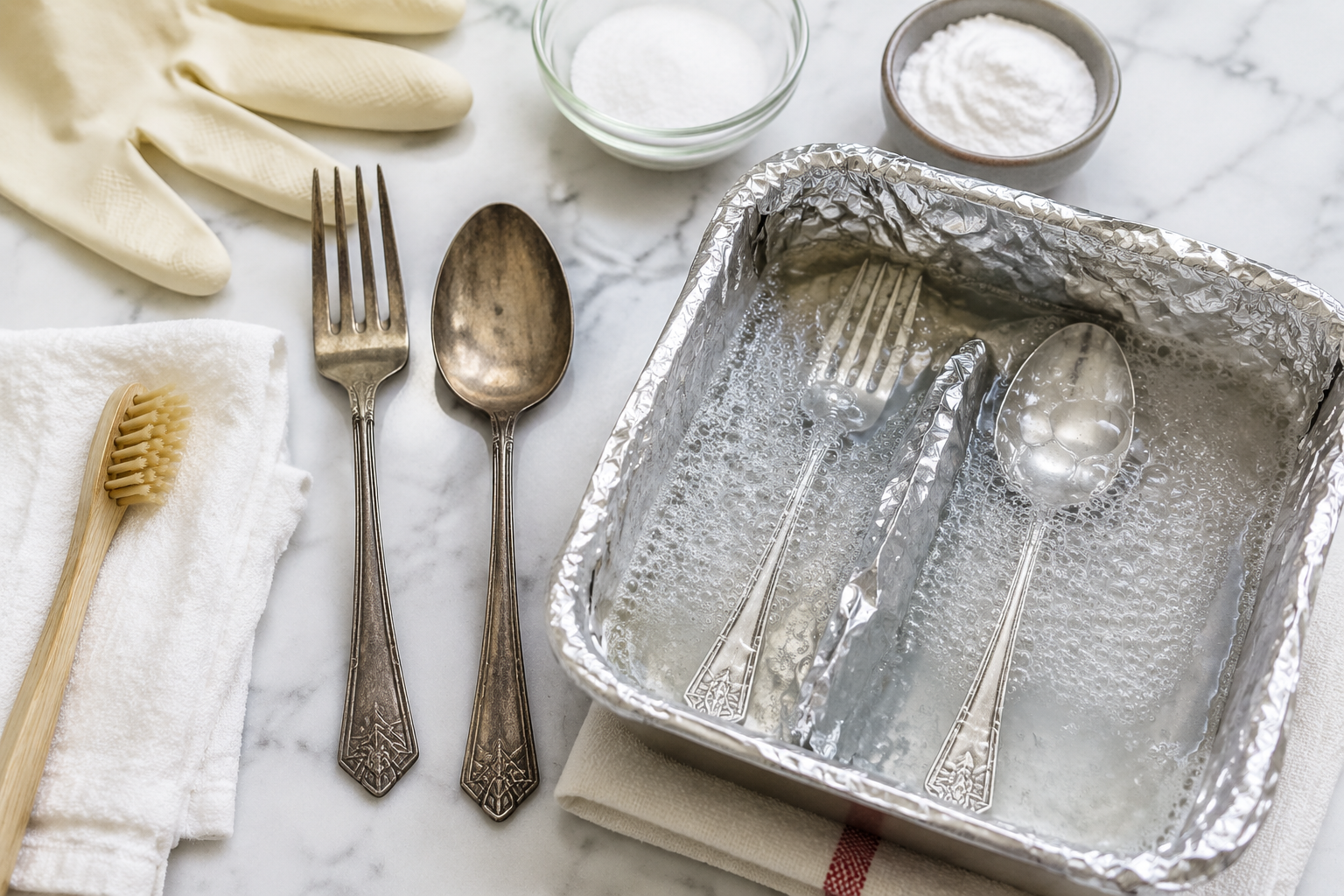
The aluminum foil and baking soda method is the most recommended DIY approach for restoring tarnish on 1920s silver-plated flatware because it uses electrochemical action rather than abrasion. The tarnish (silver sulfide) transfers from the flatware to the aluminum foil through an ionic reaction, leaving the silver surface intact.
Step-by-step process:
- Line a glass or ceramic baking dish with aluminum foil, shiny side up.
- Place the tarnished flatware in the dish so each piece touches the foil.
- Bring water to a near-boil and dissolve one tablespoon of baking soda and one teaspoon of non-iodized salt per liter of water.
- Pour the hot solution over the flatware until fully submerged.
- Wait 5 to 10 minutes. You will see light bubbling and may notice a faint sulfur smell as the reaction occurs.
- Remove pieces with tongs or rubber-gloved hands.
- Rinse thoroughly under warm running water.
- Dry immediately and completely with a soft lint-free cloth. Do not air-dry, as water spots can etch the surface.
- For remaining dull areas, apply a small amount of non-abrasive silver polish with a soft cloth, using straight (not circular) strokes.
- Buff gently and rinse again.
Edge case: If the piece has gilded (gold-washed) areas, such as the bowl of a spoon, keep those sections out of the baking soda solution. The reaction can strip gold wash from silver plate.
Are There Specific Cleaning Methods for Art Deco Era Silverware
Art Deco flatware from the 1920s often features geometric patterns, engine-turned surfaces, and deep engraving that standard polishing cloths cannot reach. These design elements require targeted cleaning techniques to avoid leaving tarnish trapped in recesses.
Methods suited to Art Deco detailing:
- Use a soft-bristle toothbrush dipped in diluted silver polish paste to work into engraved lines and geometric borders. Brush along the grain of the pattern, not across it.
- For raised medallion patterns or monograms, apply polish with a cotton swab for precision.
- After cleaning, use a dry, soft brush to remove any polish residue from recesses before buffing. Dried polish left in crevices leaves a white haze.
Art Deco pieces from manufacturers like Gorham, International Silver, or Mappin & Webb often have pattern names stamped on the reverse. Knowing the pattern can help you find manufacturer-specific care recommendations, some of which are archived in antique silver reference guides.
Is It Safe to Use Chemical Silver Cleaners on Antique Flatware
Chemical dip cleaners (such as Goddard’s Silver Dip) work quickly but carry real risk for antique silver-plated flatware. They are acidic solutions that dissolve silver sulfide, but they also strip a microscopic layer of silver with each use. On 1920s flatware with already-thin plating, repeated dipping accelerates wear.
Use chemical dips only if:
- The tarnish is severe and the foil-baking soda method has not worked.
- You are not concerned with collector value.
- You limit immersion to 10 to 20 seconds and rinse immediately.
Never use chemical dips on:
- Pieces with worn or bare spots (the acid attacks base metal aggressively).
- Gilded or oxidized (intentionally darkened) decorative areas.
- Flatware with hollow handles, which may have a resin or pitch filler that the acid can damage.
The safest position: reserve chemical dips for pieces you intend to use rather than display or sell as collectibles.
How Professionals Restore Vintage Silver from the 1920s
Professional silver restorers use a combination of ultrasonic cleaning (for solid silver, not plate), hand polishing with jeweler’s rouge, and electrochemical baths calibrated for thin plating. For pieces with bare spots or heavy wear, they offer re-plating services.
A professional restoration typically follows this sequence:
- Assessment: The restorer examines plating thickness, base metal condition, and any existing damage.
- Cleaning: A controlled chemical bath removes tarnish without over-stripping.
- Polishing: Hand polishing with progressively finer compounds restores luster to worn areas.
- Re-plating (if needed): The piece is cleaned to bare metal, then electroplated with a fresh silver layer. Quality restorers match the original plating weight where possible.
- Finishing: Final buffing and anti-tarnish treatment.
Look for restorers certified through the American Society of Jewelry Historians or members of the Silver Society. Antique dealers and auction houses such as Christie’s and Sotheby’s maintain referral lists for trusted silver conservators.
How Much Does Professional Silver Restoration Cost
Professional silver restoration for 1920s flatware ranges from roughly $30 to $150 per piece in 2026, depending on the condition, the complexity of the pattern, and whether re-plating is required. Re-plating alone typically costs $50 to $120 per piece for standard flatware, with ornate serving pieces running higher.
Cost breakdown by service type:
| Service | Estimated Cost (2026) |
|---|---|
| Professional hand polishing | $15 to $40 per piece |
| Tarnish removal and cleaning | $20 to $50 per piece |
| Silver re-plating (standard flatware) | $50 to $120 per piece |
| Re-plating (serving pieces/ornate) | $100 to $250+ per piece |
| Full set restoration (12-place setting) | $400 to $1,200+ |
These are estimates based on current market rates from restoration studios in the United States. Prices vary by region and restorer. Always request a written quote before committing.
Will Cleaning Reduce the Value of My Vintage Silver Collection
Cleaning 1920s silver-plated flatware does not automatically reduce its value, but the method and frequency matter. Light, careful cleaning that removes tarnish without stripping plating or altering the patina is generally acceptable even to collectors.
What does reduce value:
- Over-polishing: Removes the original surface and softens crisp engraving detail.
- Re-plating: Significantly reduces collector value because it alters the original surface. A re-plated piece is no longer in original condition.
- Chemical damage: Pitting or streaking from improper cleaners is permanent.
If your flatware is a complete matched set in original condition, consult an appraiser before cleaning. A set in naturally aged condition with light tarnish may be worth more to a collector than a freshly polished set with worn plating.
Can Silver Plate Be Re-Plated If It Is Badly Tarnished or Worn
Yes, silver plate can be re-plated, and for flatware that is heavily worn to bare metal, it is the only way to restore a true silver appearance. Re-plating is a professional electroplating process and cannot be done at home with consumer products.
The process involves stripping the remaining old plating, polishing the base metal, and electrodepositing a fresh layer of silver. Quality restorers can apply plating to original or heavier weights. The result is functional and attractive flatware, but it is no longer in original antique condition.
Choose re-plating if:
- The flatware is for regular use, not display or collection.
- The base metal is showing through on multiple pieces.
- Sentimental value outweighs collector value.
Avoid re-plating if:
- The set is rare, complete, and in original condition.
- You plan to sell through antique dealers or auction.
What Common Mistakes Do People Make When Cleaning Antique Silver
The most damaging mistakes when cleaning 1920s silver-plated flatware are using abrasive materials, soaking pieces too long, and skipping the drying step.
Most common errors:
- Using toothpaste: Widely recommended online, but toothpaste contains silica abrasives that scratch silver plate and dull the surface over time.
- Circular polishing motions: These create swirl marks visible under light. Always polish in straight, linear strokes following the length of the piece.
- Air-drying: Water left on silver causes water spots and, over time, micro-pitting. Always dry immediately with a soft cloth.
- Soaking in water: Extended soaking allows water to seep into hollow handles, loosening the filler and causing handles to crack or detach.
- Storing in plastic bags: Standard plastic off-gasses compounds that accelerate tarnish. Use only anti-tarnish fabric storage.
- Skipping gloves: Bare hands leave oils and salts that cause tarnish to return within days.
How Often Should You Clean 1920s Silver Flatware
For 1920s silver-plated flatware in normal storage, cleaning two to four times per year is sufficient to maintain appearance without wearing the plating prematurely. Flatware used regularly for dining may need cleaning after each use, but only with a soft cloth and warm water, not polish.
A practical schedule:
- After use: Rinse with warm water and dry immediately. No polish needed.
- Every three to six months: Light polish with a non-abrasive silver cream if tarnish is visible.
- Annually: A thorough cleaning with the aluminum foil method if tarnish is moderate.
- As needed: Professional cleaning if tarnish is severe or plating is worn.
Reducing how often you polish is the single best way to extend the life of the silver plating on antique flatware.
How to Prevent Future Tarnishing on Vintage Silverware
Preventing tarnish on 1920s silver-plated flatware is largely about controlling the environment. Sulfur compounds, humidity, and direct contact with reactive materials are the primary enemies.
Effective prevention strategies:
- Store flatware in anti-tarnish cloth rolls, bags, or drawer liners (Pacific Silvercloth is a widely available option).
- Place a piece of chalk or a silica gel packet in the storage drawer to absorb moisture.
- Keep flatware away from rubber bands, newspaper, and unconditioned wood.
- Handle pieces with cotton gloves when displaying or storing.
- Avoid storing near eggs, onions, or other sulfur-rich foods.
- Apply a thin coat of Renaissance Wax (a microcrystalline wax used by museum conservators) to display pieces to slow oxidation without altering appearance.
With proper storage, well-cleaned 1920s silver-plated flatware can remain bright for one to three years between polishing sessions.
Frequently Asked Questions
Can I put 1920s silver-plated flatware in the dishwasher? No. Dishwashers expose silver plate to high heat, harsh detergents, and water jets that strip plating, cause pitting, and loosen hollow handles. Always hand wash with mild soap and warm water, then dry immediately.
What is the fastest way to remove heavy tarnish from silver plate? The aluminum foil and baking soda electrochemical bath is the fastest safe method. For very heavy tarnish, a brief dip in a commercial silver dip cleaner (10 to 20 seconds maximum) followed by thorough rinsing can remove stubborn black tarnish, but use this sparingly on antique pieces.
Is it safe to use silver-plated flatware for eating? Yes, for most people. Silver plate is food-safe under normal use. If the plating is heavily worn and base metal (especially nickel) is exposed, some individuals with nickel sensitivity may want to avoid contact. Re-plating resolves this concern.
How do I know if my 1920s flatware is worth restoring professionally? Research the pattern name and manufacturer. Complete sets in desirable patterns from makers like Gorham, Reed & Barton, or Mappin & Webb can have meaningful resale value. Check completed sales on eBay or consult an antique silver appraiser before spending on professional restoration.
Will baking soda scratch silver plate? Baking soda in solution (dissolved in water) does not scratch. However, applying dry baking soda as a paste and scrubbing can cause micro-scratches. Always dissolve it fully in hot water before use.
Can I use olive oil or lemon juice to clean silver? Lemon juice is acidic and can etch silver plate, especially on worn pieces. Olive oil has no cleaning effect on tarnish. Neither is recommended for 1920s flatware.
How do I clean the handles of 1920s silver-plated flatware? Many 1920s flatware handles are hollow and filled with resin or pitch. Avoid soaking them. Wipe handles with a damp cloth and dry immediately. Do not submerge hollow-handled pieces in the baking soda bath.
What does “triple plate” mean on 1920s silver flatware? Triple plate refers to the number of times a piece was dipped in the silver electroplating bath during manufacturing, resulting in a thicker silver layer than standard plate. Triple-plated pieces from the 1920s are more durable and can tolerate slightly more cleaning, but still require gentle methods.
My flatware has a rainbow or iridescent tarnish. What causes it? Iridescent tarnish (sometimes called fire stain or heat tarnish) results from oxidation of the base metal showing through thin plating. It indicates the silver layer is very thin in that area. The aluminum foil method may reduce it, but re-plating is the only permanent fix.
Can I use a silver polishing cloth on antique silver plate? Yes, a pre-treated silver polishing cloth is one of the gentlest options for light tarnish on antique silver plate. Use straight strokes and light pressure. These cloths are impregnated with a mild polishing compound and are safe for regular maintenance.
Conclusion
Knowing how to clean and restore tarnish on 1920s silver-plated flatware comes down to understanding what you are working with: a thin, irreplaceable silver layer over a base metal, made a century ago by craftspeople who expected it to last. The goal is to remove tarnish without removing silver.
For most pieces, the aluminum foil and baking soda method is your best starting point. It is safe, effective, and costs almost nothing. Follow it with proper drying, careful storage in anti-tarnish cloth, and a light polish two to four times a year, and your Art Deco flatware will remain beautiful for another century.
Actionable next steps:
- Identify your flatware: Check for EPNS, A1, Sterling, or manufacturer marks to confirm it is silver plate and research the pattern.
- Assess the condition: Look for bare spots, worn plating, or loose handles before choosing a cleaning method.
- Start with the gentlest method: Try the aluminum foil bath before reaching for chemical cleaners or polish.
- Invest in proper storage: Anti-tarnish cloth storage is the single most cost-effective way to protect your collection long-term.
- Consult a professional for worn or high-value pieces: Get an appraisal before re-plating anything that may have collector value.
The flatware that survived the 1920s, the Depression, and multiple generations of family dinners deserves careful, informed handling. Treat it gently and it will keep rewarding you.
References
- Gentle, Rupert, and Rachael Feild. English Domestic Brass, 1680-1810, and the History of Its Origins. Dutton, 1975.
- Rainwater, Dorothy T. Encyclopedia of American Silver Manufacturers. Schiffer Publishing, 1986.
- Untracht, Oppi. Jewelry Concepts and Technology. Doubleday, 1982.
- The Silver Society. “Care and Conservation of Silver.” silverstudies.org (accessed 2026).
- Hagerty. “How to Polish Silver.” hagerty.com (accessed 2026).
- Victoria and Albert Museum. “Looking After Silver.” vam.ac.uk (accessed 2026).
Read next: Creating a Sphagnum Moss Pole That Stays Moist Without Daily Spraying. A closer look at sphagnum moss pole.