
Key Takeaways
- Keeping a travel journal without knowing how to draw is entirely achievable using photos, collage, stickers, and written prompts
- Printed smartphone photos are the single fastest way to add visual richness to any journal page
- Ephemera (ticket stubs, receipts, maps, candy wrappers) tells a story that drawings rarely can
- Digital journaling apps like Day One, Journey, and Google Photos journals offer structured templates for non-artists
- A functional travel journal kit costs between $15 and $50, depending on whether you go analog or digital
- Bullet-style journaling works well for travelers who dislike long-form writing
- The most common mistake beginners make is waiting until the trip is over to start documenting
- Templates and pre-designed journal spreads remove the blank-page anxiety that stops most non-artists
- Voice memos and short video clips are underused but powerful memory tools
- Consistency matters more than creativity: even three lines a day beats an elaborate entry you never write
What Are Easy Ways to Document Travel If You Cannot Draw
Keeping a travel journal without knowing how to draw starts with one simple shift: replace the sketchbook mindset with a collector’s mindset. Instead of creating images, you gather them. Printed photos, torn magazine pages, food packaging labels, and postcard images all serve the same visual purpose as a hand-drawn illustration.
Here are the most accessible non-drawing methods:
- Print photos on the go using a pocket printer like the Polaroid Hi-Print or Canon Ivy. These connect via Bluetooth and produce credit-card-sized prints in under a minute.
- Collect ephemera daily: bus tickets, restaurant receipts, museum entry stubs, luggage tags, and even sugar packets carry date stamps and location details that anchor memories.
- Use rubber stamps for borders, icons, and decorative elements. A small set of travel-themed stamps (planes, suitcases, compass roses) adds visual interest without any artistic skill.
- Write descriptively: a single well-written paragraph about the smell of a Moroccan spice market is more evocative than most amateur sketches.
- Paste maps: free tourist maps from hotel lobbies or printed Google Maps screenshots give your journal a geographic anchor.
The key insight is that visual richness does not require hand-drawn art. It requires variety of texture, color, and format, all of which are achievable through collecting and arranging.
Best Travel Journal Methods for Non-Artists
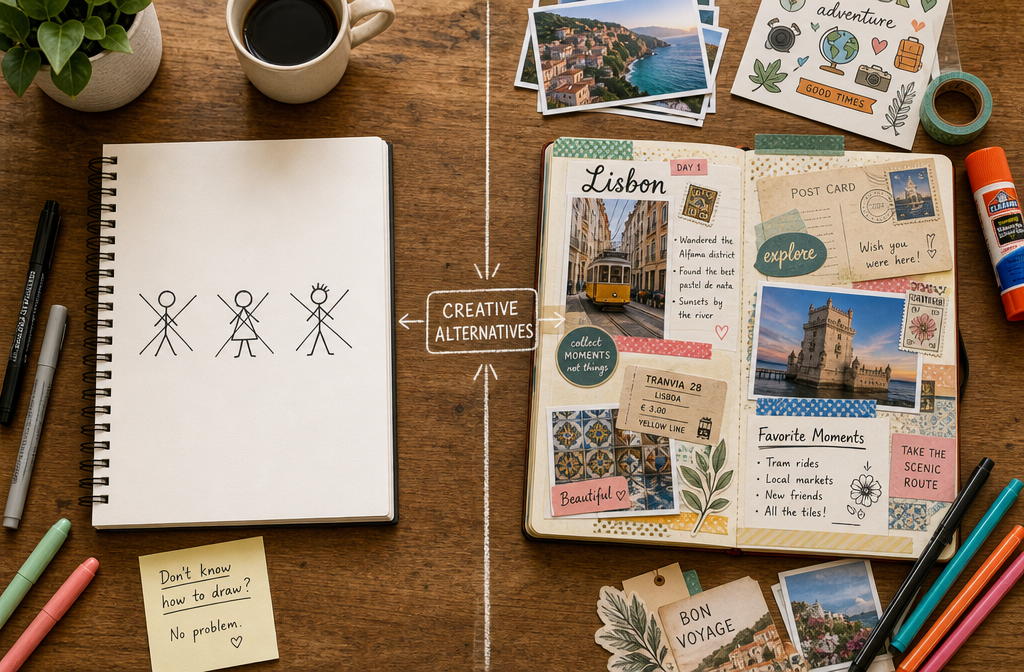
The best methods for non-artists prioritize low effort at the point of capture and high reward when you look back. Four approaches consistently work well.
1. Photo-first journaling Take photos throughout the day with the journal in mind. At the end of the day, select two or three favorites, print or tape them in, and write a caption or a short paragraph. This method takes 15 to 20 minutes per evening and produces visually strong pages.
2. Bullet travel journaling Borrowed from the bullet journal method, this approach uses short entries: a numbered list of things you did, a few words on what you ate, one sentence on how you felt. No paragraphs required. It suits travelers who find writing laborious.
3. Collage journaling Tear or cut images from local newspapers, tourist brochures, and food packaging. Arrange them on the page and add handwritten labels. This is tactile, creative, and requires zero drawing ability.
4. Hybrid digital-analog journaling Keep a physical journal for ephemera and a digital app for longer reflections. This splits the workload and lets you search your notes later.
Choose photo-first if you take a lot of photos already and want minimal extra effort. Choose bullet journaling if you tend to abandon journals because writing feels like homework. Choose collage if you enjoy making things with your hands but cannot draw.
Can I Use Photos and Stickers Instead of Drawings
Yes, and for most travelers, photos and stickers produce better-looking journal pages than amateur drawings. Photos are accurate, emotionally resonant, and require no skill. Stickers add color and personality in seconds.
A few practical tips:
- Washi tape (decorative masking tape available in hundreds of patterns) is the single most versatile non-drawing tool. Use it to frame photos, create borders, or add color blocks.
- Sticker sheets designed for journaling are widely available on Etsy and at craft stores. Sets themed around travel, food, and nature cost $2 to $8 per sheet.
- Polaroid-style borders: print photos with a white border and write the date or location in the white space. It looks intentional and clean.
- Layering: overlap photos, stickers, and torn paper edges. Layered pages look designed even when they are not.
One mistake to avoid: using too many stickers on a single page. When every inch is covered, the page loses visual hierarchy and becomes hard to read. Leave breathing room around your text.
What Technology Can Help Me Make a Travel Journal
Digital tools have made keeping a travel journal without knowing how to draw significantly easier. Several apps and devices are worth knowing about.
Journaling apps with templates:
| App | Best For | Cost (2026) |
|---|---|---|
| Day One | Long-form entries, photo integration | Free / $34.99/year premium |
| Journey | Cross-platform, AI writing prompts | Free / $29.99/year |
| Polarsteps | Automatic location tracking + photos | Free |
| Canva | Designing printable journal pages | Free / $15/month pro |
| Google Photos | Auto-generated memory collages | Free with Google account |
Hardware worth considering:
- Pocket photo printers: Canon Ivy Mini ($59), Polaroid Hi-Print ($79), Fujifilm Instax Link Wide ($99). Prices are approximate retail as of 2026.
- Voice recorder or phone voice memos: Record ambient sounds, your own impressions, or conversations (with permission). Listening back to a recording from a night market is surprisingly powerful.
- Scanning apps: Adobe Scan or Microsoft Lens let you digitize physical ephemera so you have a backup copy.
Common mistake: downloading five journaling apps and using none of them. Pick one and commit to it for a full trip before evaluating alternatives.
Are There Travel Journal Templates for Beginners
Templates are one of the most underused tools for non-artists. A template removes blank-page anxiety by giving you boxes to fill in rather than an open canvas to design from scratch.
Where to find them:
- Etsy: Search “travel journal printable template.” Hundreds of options exist, ranging from $2 to $15 for a full set. Look for A5 or A6 formats if you use a standard journal size.
- Pinterest: Free printable templates are widely shared. Search “travel journal spread template” for visual inspiration and downloadable files.
- Canva: Build your own template using drag-and-drop elements. Save it as a PDF and print multiple copies before your trip.
- Pre-made travel journals: Brands like Leuchtturm1917 and Moleskine sell travel-specific journals with pre-printed prompts such as “Today I ate,” “Today I saw,” and “One thing I want to remember.”
A good beginner template includes space for: date and location, a photo or drawing box (which you fill with a printed photo), three to five prompt lines, a small area for ephemera, and a mood or weather indicator. That structure takes about ten minutes to fill out per day.
Cheap Supplies for Making a Travel Memory Book
A complete non-artist travel journal kit does not need to cost more than $30 to $40. Here is a practical breakdown.
Budget kit (under $20):
- A5 dotted or blank notebook: $5 to $8 (Leuchtturm1917 alternatives at TJ Maxx or Amazon)
- Glue stick: $1
- Two to three rolls of washi tape: $3 to $5
- A pack of travel stickers: $2 to $4
- A fine-tip black pen: $1 to $2
Mid-range kit ($20 to $50):
- Quality journal (Leuchtturm1917 or Moleskine): $18 to $25
- Pocket photo printer + paper refills: $60 to $80 (one-time cost, paper refills $10 to $15 per 20 sheets)
- Washi tape set (10 rolls): $8 to $12
- Sticker sheets (5 to 10 sheets): $10 to $20
- Watercolor brush pens (for adding color without drawing skill): $8 to $15
What to skip: expensive art supplies, calligraphy sets, or elaborate embossing tools. They add weight and pressure. Start simple.
One practical tip: buy your washi tape and stickers before you travel. Airport and tourist shops charge a significant premium for the same products.
Tips for Creating a Meaningful Travel Journal When You Are Not Creative
Meaningful journals come from honest, specific observation, not artistic talent. The most memorable entries I have read (and written) are specific: not “the food was good” but “the lamb tagine at the blue-tiled restaurant near the medina gate, eaten at a low table while a cat watched from the doorway.”
Practical tips for non-creative travelers:
- Use sensory prompts: What did you smell? What was the loudest sound? What texture did you touch? Sensory details create vivid memories without requiring visual skill.
- Write the awkward moments: The missed train, the mispronounced word, the restaurant that was closed. These make better stories than perfect highlights.
- Date everything: A journal entry without a date loses half its value within a year.
- Carry your journal, not just your phone: The act of physically writing or pasting something in a journal creates a stronger memory than tapping a note into your phone.
- Set a daily minimum: Even one sentence and one piece of ephemera per day keeps the journal alive. You can expand later.
“The goal is not a beautiful object. The goal is a reliable record of how a place felt when you were inside it.”
What Do Professional Travelers Put in Their Journals
Professional travel writers, bloggers, and journalists tend to keep journals that are more functional than decorative. Their entries prioritize detail capture over aesthetics.
Common elements in a professional traveler’s journal:
- Exact names and spellings: restaurant names, street names, people’s names, hotel names. These are impossible to reconstruct from memory.
- Overheard dialogue and quotes: a sentence a local said, a sign’s exact wording, a menu description.
- Logistics notes: bus numbers, ticket prices, opening hours, contact details. Practical information that research cannot always recover.
- Emotional checkpoints: how they felt at a specific moment, not just what they saw.
- Rough maps and diagrams: even a non-artist can draw a simple map of a neighborhood layout or a seating arrangement. These are functional, not decorative.
- Questions to research later: things they noticed but did not understand.
The lesson for non-professional travelers is the same: specificity is the most valuable thing you can put in a journal. A specific, ugly journal entry beats a vague, beautiful one every time.
Which Travel Journal Style Works Best for People Who Do Not Like Writing a Lot
For travelers who find writing burdensome, bullet journaling and visual-first formats work best. Both minimize the amount of text required while still producing a meaningful record.
Bullet travel journal format:
- Date and location (one line)
- Three to five bullet points of facts: what you did, where you ate, who you met
- One sentence of feeling or observation
- One photo or piece of ephemera
This takes five to eight minutes per day and produces a complete, searchable record.
Visual-first format: Fill the page primarily with photos, stickers, and ephemera. Write only captions and short labels. The visual elements carry the narrative.
Voice-to-text option: If writing feels slow, speak your entry into your phone and use a transcription app (Apple Dictation, Google Docs voice typing, or Otter.ai). Edit the transcript into your journal later. This suits people who talk easily but write slowly.
Mistakes to Avoid When Starting a Travel Journal
The most common mistake is waiting. Travelers who plan to journal “when they get home” rarely do. Memory degrades fast: within 24 hours, specific sensory details begin to fade.
Other mistakes worth avoiding:
- Buying an expensive journal and being afraid to ruin it: Use a mid-price journal you are willing to write messily in. Precious objects stay blank.
- Trying to document everything: Selective documentation is better than exhaustive documentation. Three vivid entries beat ten incomplete ones.
- Skipping days and giving up: A gap in your journal is not a failure. Write “skipped two days, too tired” and move on.
- Comparing your journal to Instagram aesthetics: Curated journal spreads on social media represent hours of work by people who journal professionally. Your journal is for you.
- Not labeling photos: A printed photo with no date or location becomes unidentifiable within two years.
FAQ
Do I need to be artistic to keep a good travel journal? No. The most meaningful travel journals are specific and honest, not beautiful. Photos, ephemera, and short written observations produce a complete record without any artistic skill.
What is the easiest way to start a travel journal as a complete beginner? Buy a blank A5 notebook, a glue stick, and a pack of washi tape. On day one of your trip, paste in a ticket or receipt, write the date and location, and add two sentences about your day. That is a complete entry.
Can I keep a travel journal entirely on my phone? Yes. Apps like Day One, Journey, and Polarsteps support photos, location tagging, and text entries. A digital journal is easier to search and harder to lose than a physical one.
How much time should I spend on my travel journal each day? Ten to fifteen minutes per day is enough for a meaningful record. More is fine, but do not let journaling compete with experiencing your trip.
What should I do if I miss several days? Write a brief summary entry covering the missed days. Use photos to jog your memory. Do not abandon the journal because of a gap.
Are travel journal templates worth buying? Yes, for beginners. A template removes the blank-page problem and gives you a consistent structure. Spend $3 to $10 on a printable set before your first trip.
What is washi tape and why do journal users recommend it? Washi tape is decorative paper tape from Japan, available in hundreds of colors and patterns. It sticks lightly, tears cleanly, and adds color and structure to a journal page without any drawing skill. It is sold at craft stores and online for $1 to $3 per roll.
Can voice memos replace written journal entries? They can supplement them effectively. Record ambient sounds and spoken observations, then transcribe the most useful parts into your journal. Voice memos alone are harder to browse and search than written entries.
What pocket photo printer is best for travel journaling in 2026? The Canon Ivy Mini and Polaroid Hi-Print are both compact and reliable. The Canon produces slightly sharper prints; the Polaroid has a wider color range. Both connect via Bluetooth and use ZINK (zero-ink) paper, so you do not need ink cartridges.
How do I keep my travel journal from getting damaged while traveling? Store it in a zip-lock bag or a slim waterproof pouch. Avoid packing it at the bottom of a bag where it can get bent. A rubber band around the cover keeps loose ephemera from falling out.
Conclusion
Keeping a travel journal without knowing how to draw is not a compromise. It is a different approach with its own strengths. A page filled with a printed photo, a bus ticket, a strip of washi tape, and three honest sentences captures a place just as accurately as a watercolor sketch, and often more personally.
Actionable next steps for 2026:
- Before your next trip, buy a mid-price blank notebook, a glue stick, and two rolls of washi tape. Total cost: under $15.
- Download one journaling app (Day One or Journey) and set a daily reminder for 9 p.m.
- On day one of your trip, collect one piece of ephemera and write the date, location, and two sentences. That is your baseline habit.
- If you want printed photos, order a pocket photo printer before you leave or use a local print kiosk on arrival.
- Review your journal within one week of returning home. Add any missing dates or labels while memory is still fresh.
The blank page is the only real barrier. Once you paste in that first ticket stub, the rest follows naturally.
References
- Ryder Carroll. The Bullet Journal Method. Portfolio/Penguin, 2018.
- Day One app. https://dayoneapp.com
- Journey app. https://journey.cloud
- Polarsteps. https://www.polarsteps.com
- Leuchtturm1917 travel notebooks. https://www.leuchtturm1917.us
Read next: Optimizing Caffeine: Tea Blends for Sensitive Coffee Drinkers. A closer look at low caffeine tea blends.