
Key Takeaways
- Prolonged sitting combined with road vibration is the leading cause of coccyx pain in truck drivers, not just posture alone.
- A quality coccyx-cutout or memory foam seat cushion is the single fastest way to reduce pressure on the tailbone during a shift.
- Adjusting seat height, tilt, and lumbar support correctly can cut pressure on the coccyx by a significant margin without spending any money.
- Short movement breaks every 90 to 120 minutes are more effective than one long break per day for managing inflammation.
- Piriformis stretches, hip flexor stretches, and pelvic tilts are the three most useful exercises for truckers with coccyx discomfort.
- Persistent pain lasting more than six weeks, or pain accompanied by numbness or bowel changes, warrants a doctor visit.
- Ergonomic air-ride seats are available as aftermarket upgrades and can dramatically reduce vibration-related coccyx stress.
- Treatment costs range from under $30 for a basic cushion to several thousand dollars for surgery, but most drivers never need the latter.
- Certain drivers, including those with higher body weight, prior tailbone injuries, or older seat equipment, face greater risk.
- Tailbone pain from driving has a distinct pressure-and-vibration pattern that differs from coccydynia caused by a fall or fracture.
What Causes Tailbone Pain for Truck Drivers
Tailbone pain in truck drivers results from a combination of sustained pressure on the coccyx, repetitive low-frequency vibration from the road, and limited ability to shift body position during long hauls. Unlike office workers who can stand up freely, truck drivers are constrained by the cab environment for hours at a stretch.
The coccyx, or tailbone, is the small triangular bone at the very base of the spine. When a person sits, especially on a firm or poorly contoured surface, body weight concentrates directly on this bone and the surrounding soft tissue. Add road vibration in the 4 to 8 Hz range (the frequency range most damaging to the spine, according to research published in the journal Ergonomics), and the tissue around the coccyx becomes inflamed over time.
Key contributing factors include:
- Sitting for six or more consecutive hours without postural change
- Seats with worn-out foam that no longer distributes weight evenly
- Hard or uneven road surfaces that transmit shock directly to the seat
- Leaning forward toward the steering wheel, which shifts weight to the tailbone
- Previous coccyx injury that left scar tissue or minor misalignment
- Excess body weight that increases downward pressure on the coccyx
“Most drivers don’t realize the vibration is doing as much damage as the sitting. The two together are what make trucking uniquely hard on the tailbone.”
Are Certain Truck Drivers More Prone to Tailbone Problems
Yes. Drivers with prior coccyx injuries, those who carry more body weight, women (whose coccyx is angled differently and more exposed during sitting), and drivers operating older trucks with worn suspension are statistically more likely to develop coccyx pain. Age also plays a role, as the cushioning discs around the coccyx thin with time.
Higher-risk profiles:
- Drivers over age 45 with high annual mileage
- Women, due to anatomical differences in pelvic structure
- Drivers who have had a previous fall or direct impact to the tailbone
- Operators of older truck models without air-ride cab suspension
- Drivers with a BMI above 30, where increased seat pressure is measurable
If you fall into more than one of these categories, preventive measures matter more, not less. Starting with a good cushion and a proper seat adjustment before pain develops is far easier than treating established inflammation.

Differences Between Tailbone Pain from Driving vs. Other Causes
Tailbone pain from driving has a gradual, cumulative onset and typically feels like a dull ache or pressure at the very base of the spine that worsens as the shift goes on and eases after standing for 20 to 30 minutes. This distinguishes it from coccydynia caused by a fall (sudden sharp pain, often with bruising) or from referred pain originating in the lumbar spine or sacroiliac joint (which tends to radiate into the buttocks or legs).
Quick comparison:
| Cause | Onset | Character | Relieved by |
|---|---|---|---|
| Prolonged driving | Gradual, builds over hours | Dull ache, pressure | Standing, movement |
| Fall or direct impact | Sudden, acute | Sharp, localized | Rest, ice |
| Lumbar disc issue | Variable | Radiating, shooting | Position change |
| Sacroiliac dysfunction | Gradual | Deep ache, one-sided | Specific stretches |
| Pilonidal cyst | Gradual | Throbbing, skin-level | Medical treatment |
If your pain radiates down one or both legs, or if you notice numbness or tingling, the source is likely higher in the spine and needs medical evaluation rather than cushion adjustments alone.
Best Seat Cushions to Prevent Tailbone Pain While Driving
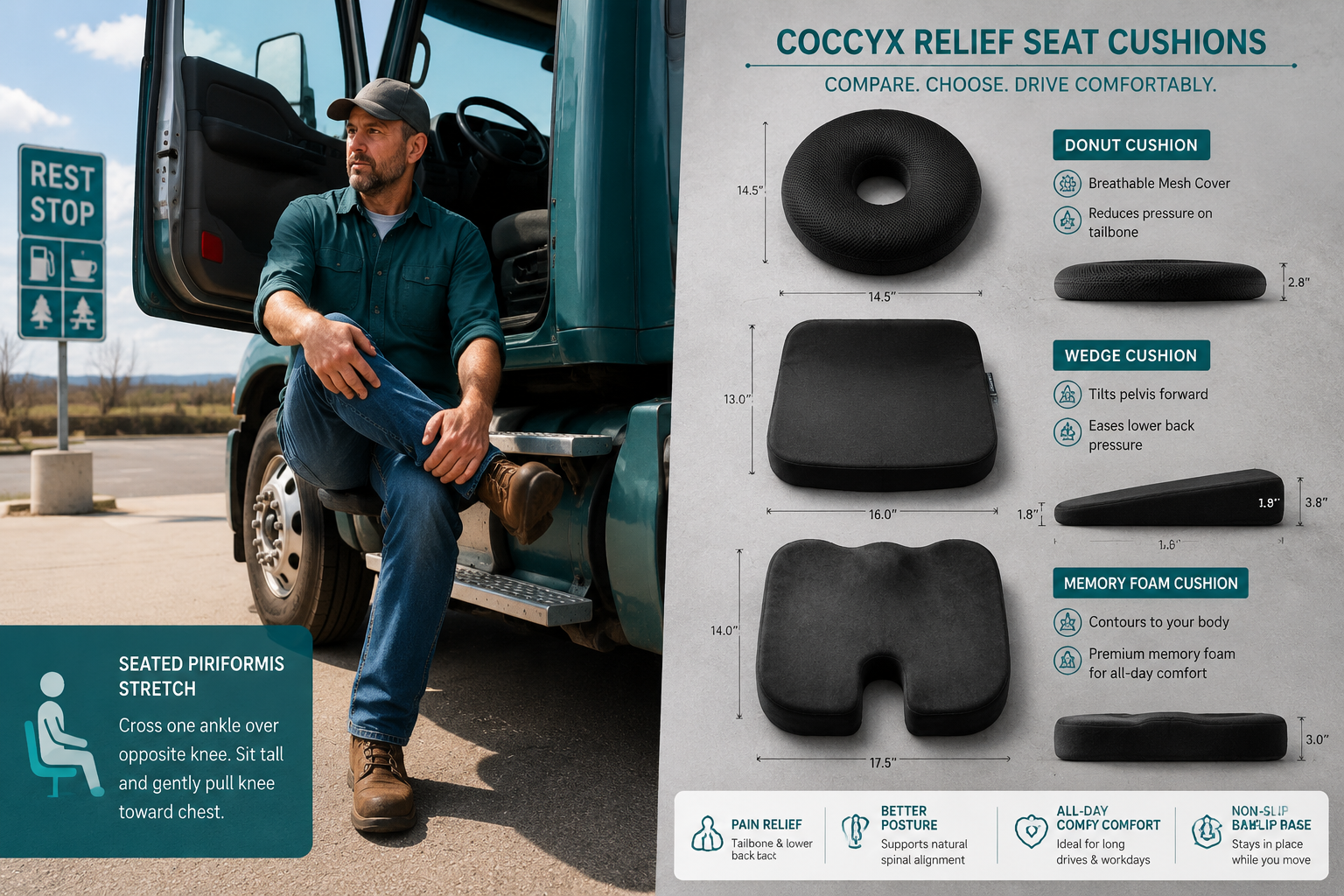
The best seat cushions for truck drivers with tailbone pain are coccyx-cutout designs made from high-density memory foam or gel-infused foam. These cushions have a U-shaped or wedge cutout at the rear that suspends the tailbone in open air, eliminating direct pressure on the coccyx entirely.
Top cushion types for truckers:
- Coccyx-cutout memory foam cushion: Best all-round choice. The cutout removes pressure; memory foam distributes weight across the sit bones. Prices range from $25 to $80.
- Gel seat cushion: Slightly cooler than foam, good for warm cabs. Less durable over multi-year use. Around $30 to $60.
- Inflatable donut cushion: Highly adjustable pressure, easy to pack. Less stable at highway speeds. Around $15 to $35.
- Wedge cushion (no cutout): Tilts the pelvis forward, reducing coccyx contact. Good for drivers whose pain is more lumbar than coccyx. Around $20 to $50.
- Air-bladder cushion systems: Premium option with adjustable firmness zones. Around $80 to $200.
Choose a coccyx-cutout cushion if your pain is directly at the base of the spine and worsens after sitting. Choose a wedge cushion if your discomfort is more in the lower back and you tend to slouch. For overnight hauls, a combination of a coccyx cushion plus a lumbar roll addresses both zones.
One practical note: non-slip backing matters. A cushion that slides on a vinyl truck seat defeats its own purpose. Check for rubber or silicone grip backing before buying.
How to Adjust Your Truck Seat to Reduce Tailbone Pressure
Correct seat adjustment is free and can reduce coccyx pressure immediately. The goal is to position the pelvis in a neutral tilt so body weight lands on the sit bones (ischial tuberosities) rather than the tailbone.
Step-by-step seat adjustment checklist:
- Set seat height so your hips are at or slightly above knee level. This tilts the pelvis forward naturally.
- Adjust seat tilt to a very slight forward angle (1 to 3 degrees). A flat or backward-tilted seat pushes weight onto the coccyx.
- Set lumbar support so it fills the natural inward curve of your lower back. Without lumbar support, the spine rounds and the tailbone takes more load.
- Set seat distance from pedals so your knees are slightly bent (about 120 degrees) when pedals are fully depressed. Reaching for pedals causes you to slide forward on the seat, increasing coccyx contact.
- Check steering wheel position. If you’re reaching forward or upward, your torso tilts and shifts weight backward onto the tailbone. Bring the wheel closer if your truck allows it.
- Inspect seat foam. Press down on the seat. If you can feel the metal frame through the foam, the cushion is dead and needs replacement or supplementing.
Are There Special Ergonomic Seats for Long-Haul Truck Drivers
Yes. Air-ride suspension seats are the most effective ergonomic upgrade available for long-haul trucks. These seats use a pneumatic bladder to isolate the driver from road vibration, which is one of the two main causes of coccyx pain. Brands like National Seating, Seats Inc., and Bostrom manufacture seats specifically for commercial truck cabs.
Key features to look for in an ergonomic truck seat:
- Air-ride suspension with adjustable damping
- Adjustable lumbar support with both height and depth control
- Seat pan depth adjustment (important for drivers with shorter or longer thighs)
- Armrests that reduce upper-body tension transmitted to the lower spine
- Seat heating (reduces muscle stiffness in cold weather, which indirectly reduces coccyx strain)
Air-ride seats typically cost between $800 and $2,500 installed. Owner-operators can justify this as a health and productivity investment. Company drivers should request an ergonomic assessment through their fleet’s safety department, as many larger carriers have programs to accommodate documented medical needs.
Stretches and Exercises for Truckers with Tailbone Discomfort
Regular stretching is one of the most evidence-supported tailbone pain relief strategies for long-distance truck drivers. The muscles most involved in coccyx pain are the piriformis, the hip flexors, and the pelvic floor muscles, all of which tighten during prolonged sitting and pull on the structures around the coccyx.
The five most effective stretches for truck drivers:
Piriformis stretch (seated): Sit on the edge of the truck step or a rest stop bench. Cross one ankle over the opposite knee. Lean forward gently until you feel a deep stretch in the outer hip. Hold 30 seconds each side.
Standing hip flexor stretch: Step one foot forward into a lunge position beside the truck. Lower the back knee toward the ground. Hold 20 to 30 seconds. This releases the psoas, which pulls the pelvis out of alignment when tight.
Pelvic tilt (standing): Stand with your back against the truck door. Flatten your lower back against the surface by tightening your abs and tilting your pelvis slightly upward. Hold 5 seconds, repeat 10 times.
Knee-to-chest pull: Lie on your back on a flat surface (a rest stop lawn works). Pull one knee toward your chest and hold 20 seconds. Alternate sides. This decompresses the sacrococcygeal joint directly.
Cat-cow stretch: On hands and knees, alternate arching and rounding the spine slowly. Ten repetitions mobilize the entire lower spine and reduce stiffness around the coccyx.
Timing matters: Do these at every fuel stop or rest break, not just once a day. Short, frequent movement interruptions are more effective than one long stretching session.
Quick Relief Techniques for Tailbone Pain During Long Drives
When pain flares during a haul, several in-cab techniques can provide immediate relief without stopping. The most effective quick relief strategies for tailbone pain during long drives include shifting weight distribution, using a cushion, applying heat, and adjusting posture.
In-cab relief options:
- Shift your weight every 20 to 30 minutes by leaning slightly to one side for a minute. This temporarily unloads the coccyx.
- Use a small rolled towel placed just above the tailbone (not under it) to support the sacrum and reduce coccyx contact with the seat.
- Apply a heat patch (adhesive disposable heat wraps are legal to use while driving and widely available at truck stops) to the lower back to reduce muscle tension around the coccyx.
- Engage your core lightly by sitting tall and drawing your navel slightly inward. This reduces the load on the coccyx by distributing it through the trunk muscles.
- Take a 5-minute walk at every mandatory break. Even brief walking resets blood flow to the compressed tissue and reduces inflammation buildup.
Avoid sitting on a hard wallet in your back pocket. This is a surprisingly common cause of asymmetric coccyx pressure that many drivers overlook.
Common Mistakes Truckers Make That Worsen Tailbone Pain
Several habits that seem harmless actually accelerate coccyx damage. Knowing what not to do is as important as knowing what to do when applying tailbone pain relief strategies for long-distance truck drivers.
The most common mistakes:
- Ignoring early symptoms. Mild aching that gets dismissed for weeks becomes chronic inflammation that takes months to resolve.
- Using a donut cushion with the hole directly under the tailbone. Paradoxically, this can increase pressure at the edges of the hole. A coccyx-cutout cushion is designed more carefully for this purpose.
- Sitting on a thick wallet. Creates a tilt that loads one side of the coccyx unevenly.
- Relying on pain medication alone. Anti-inflammatories reduce pain signals but don’t address the mechanical cause. Drivers who only medicate often worsen the underlying issue.
- Skipping breaks to make better time. The short-term mileage gain is not worth the long-term injury cost.
- Buying the cheapest cushion. Very thin foam cushions compress completely within hours, providing no benefit. Minimum 3-inch thickness for memory foam is a reasonable baseline.
When Should I See a Doctor About Persistent Tailbone Pain
See a doctor if your tailbone pain has lasted more than six weeks despite self-care, if the pain is severe enough to disrupt sleep, or if you notice any of the following symptoms alongside the pain: numbness or tingling in the legs, difficulty with bowel or bladder function, visible swelling or redness at the base of the spine, or pain that worsens when lying down (which suggests a non-mechanical cause).
A primary care physician will typically start with X-ray imaging to rule out fracture or dislocation. If the X-ray is normal, a referral to a physical therapist or a pain management specialist is the usual next step. In rare cases, a corticosteroid injection into the coccygeal joint provides relief when conservative measures have failed. Surgery (coccygectomy, or surgical removal of the coccyx) is a last resort and is rarely recommended unless all other options have been exhausted over 12 to 24 months.
How Much Does Tailbone Pain Treatment Typically Cost
Treatment costs vary widely depending on severity and approach. Most truck drivers resolve their pain with low-cost interventions.
| Treatment | Estimated Cost (2026) |
|---|---|
| Coccyx seat cushion | $25 to $80 |
| Physical therapy (per session, US average) | $75 to $150 |
| Chiropractic adjustment (per session) | $60 to $120 |
| Corticosteroid injection (with insurance copay) | $30 to $200 |
| Corticosteroid injection (without insurance) | $300 to $600 |
| Air-ride seat upgrade | $800 to $2,500 |
| Coccygectomy surgery (US, without insurance) | $15,000 to $35,000 |
Most drivers with driving-related coccyx pain spend $50 to $300 total on a cushion, a few physical therapy sessions, and over-the-counter anti-inflammatories. The expensive interventions are reserved for cases where the coccyx is structurally damaged.
Can Tailbone Pain Be Permanently Fixed or Just Managed
For most truck drivers, tailbone pain from driving can be fully resolved, not just managed, if the mechanical causes are addressed early. Drivers who make ergonomic changes, stretch regularly, and take breaks as required by law typically recover completely within four to twelve weeks.
Chronic coccydynia (pain lasting more than three months) is harder to resolve and may require professional treatment, but even then, the majority of patients achieve significant long-term relief through physical therapy and injection therapy. True permanent damage requiring surgery is uncommon in drivers whose pain comes from pressure and vibration rather than a traumatic injury.
The honest answer: if you keep doing the same thing that caused the pain, it will not go away. Permanent relief requires permanent habit change, specifically in how you sit, how often you move, and what equipment you use.
Alternative Careers for Truckers with Chronic Tailbone Issues
If chronic coccyx pain makes long-haul driving medically unsustainable, several related careers allow drivers to use their industry knowledge without the same physical demands. These include:
- Local or regional delivery driving (shorter shifts, more frequent exits from the cab)
- Dispatcher or fleet coordinator (desk-based, but with ergonomic office chair options)
- Truck driving instructor (shorter in-cab sessions, more standing time)
- Logistics coordinator or freight broker (office or remote-based)
- DOT compliance officer (inspection-based work with varied postures)
Many drivers with chronic pain successfully transition to local routes as a first step, which reduces daily sitting time from 10 to 11 hours to 4 to 6 hours and often allows the coccyx to recover sufficiently to continue working in the industry.
FAQ
Q: Can I drive a truck with tailbone pain? Yes, most drivers can continue working while managing tailbone pain, provided they use a proper cushion, take required breaks, and are not experiencing neurological symptoms like leg numbness. If pain is severe enough to distract from safe driving, stop and seek medical advice.
Q: How long does it take for tailbone pain to go away with a cushion? Most drivers notice reduced pain within the first few days of using a quality coccyx-cutout cushion. Full resolution of inflammation typically takes two to six weeks of consistent use combined with stretching.
Q: Is it safe to use a heating pad while driving? Adhesive disposable heat wraps (like ThermaCare) are safe for driving. Plugged-in electric heating pads are not recommended while operating a vehicle due to distraction and cord hazards.
Q: Does losing weight help tailbone pain? Yes. Reducing body weight decreases the downward pressure on the coccyx during sitting. Even a modest weight reduction of 10 to 15 pounds can meaningfully reduce coccyx load.
Q: Are chiropractic adjustments effective for coccyx pain from driving? Some drivers report relief from chiropractic care, particularly if the sacroiliac joint is involved. Evidence is mixed for direct coccyx manipulation. It is a reasonable option to try if physical therapy alone has not helped after four to six weeks.
Q: Can I claim workers’ compensation for tailbone pain as a truck driver? Potentially, yes. Occupational injuries from cumulative physical stress are generally covered under workers’ compensation in most US states. Document your symptoms, report them to your employer promptly, and consult an occupational health physician for evaluation.
Q: What over-the-counter medications help tailbone pain? Ibuprofen (an NSAID) is the most commonly recommended OTC option because it addresses both pain and inflammation. Acetaminophen reduces pain but not inflammation. Always follow dosage instructions and consult a pharmacist if you take other medications.
Q: Is a donut cushion or a coccyx-cutout cushion better for truck drivers? A coccyx-cutout cushion is generally better for truck drivers. Donut cushions were originally designed for post-surgical recovery and can create uneven pressure at the hole edges during long sitting periods. The cutout design provides more stable, targeted relief.
Conclusion
Tailbone pain is one of the most common and most preventable occupational health issues in long-haul trucking. The core tailbone pain relief strategies for long-distance truck drivers come down to three practical pillars: reduce pressure with the right cushion and seat setup, interrupt sitting with regular movement, and strengthen the surrounding muscles through consistent stretching.
Your immediate action steps:
- Buy a coccyx-cutout memory foam cushion (at least 3 inches thick) before your next long haul.
- Spend 10 minutes adjusting your seat using the checklist in this guide.
- Set a phone reminder to do a 5-minute stretch at every fuel stop.
- If pain has been present for more than six weeks or includes leg symptoms, book a doctor appointment this week.
Most drivers who commit to these changes report meaningful improvement within a month. The ones who wait until the pain is unbearable face a much longer recovery. Your spine is the tool your livelihood depends on. Treat it accordingly.
References
- Seidel, H. (1993). Whole-body vibration. Ergonomics, 36(10), 1085-1094. https://doi.org/10.1080/00140139308967984
- Maigne, J.Y., & Doursounian, L. (2000). Coccydynia: A study of 51 patients. Spine, 25(23), 3072-3079.
- National Institute for Occupational Safety and Health (NIOSH). (2015). Whole-Body Vibration. Centers for Disease Control and Prevention. https://www.cdc.gov/niosh/topics/vibration/
- Foye, P.M. (2017). Coccydynia (tailbone pain). Medscape. https://emedicine.medscape.com/article/309486-overview
- American Physical Therapy Association. (2021). Clinical Practice Guidelines for Low Back Pain. APTA. https://www.apta.org
Read next: Desk Setup Optimization for Day Traders with Chronic Neck Pain: A Complete 2026 Guide. A closer look at trading desk setup for neck pain.