
Key Takeaways
- The cello’s playing position creates a forward head posture, rounded upper back, and uneven shoulder loading that accumulate into injury over time.
- The most effective posture correction exercises for cellists target the thoracic spine, rotator cuff, deep neck flexors, and hip flexors simultaneously.
- Professional cellists typically combine targeted strengthening, daily stretching, and periodic sessions with a physiotherapist who specializes in performing arts medicine.
- Common mistakes include practicing too long without breaks, ignoring chair height, and gripping the bow with excessive tension.
- Bad cello posture can lead to long-term problems including thoracic outlet syndrome, cervicogenic headaches, and repetitive strain injuries of the wrist and forearm.
- Yoga poses such as cat-cow, thread-the-needle, and supported fish pose are well-supported by performing arts physiotherapists for musicians.
- A session with a musician-focused physiotherapist in 2026 typically costs between $90 and $200 USD per visit depending on location and specialization.
- Corrective exercises should be done before and after practice sessions, not just on rest days.
- Equipment choices, including chair type, endpin angle, and shoulder rest alternatives, directly affect posture quality.
- Right-handed and left-handed cellists share most postural risks, but bow arm shoulder loading differs slightly between them.
What Causes Bad Posture for Cellists
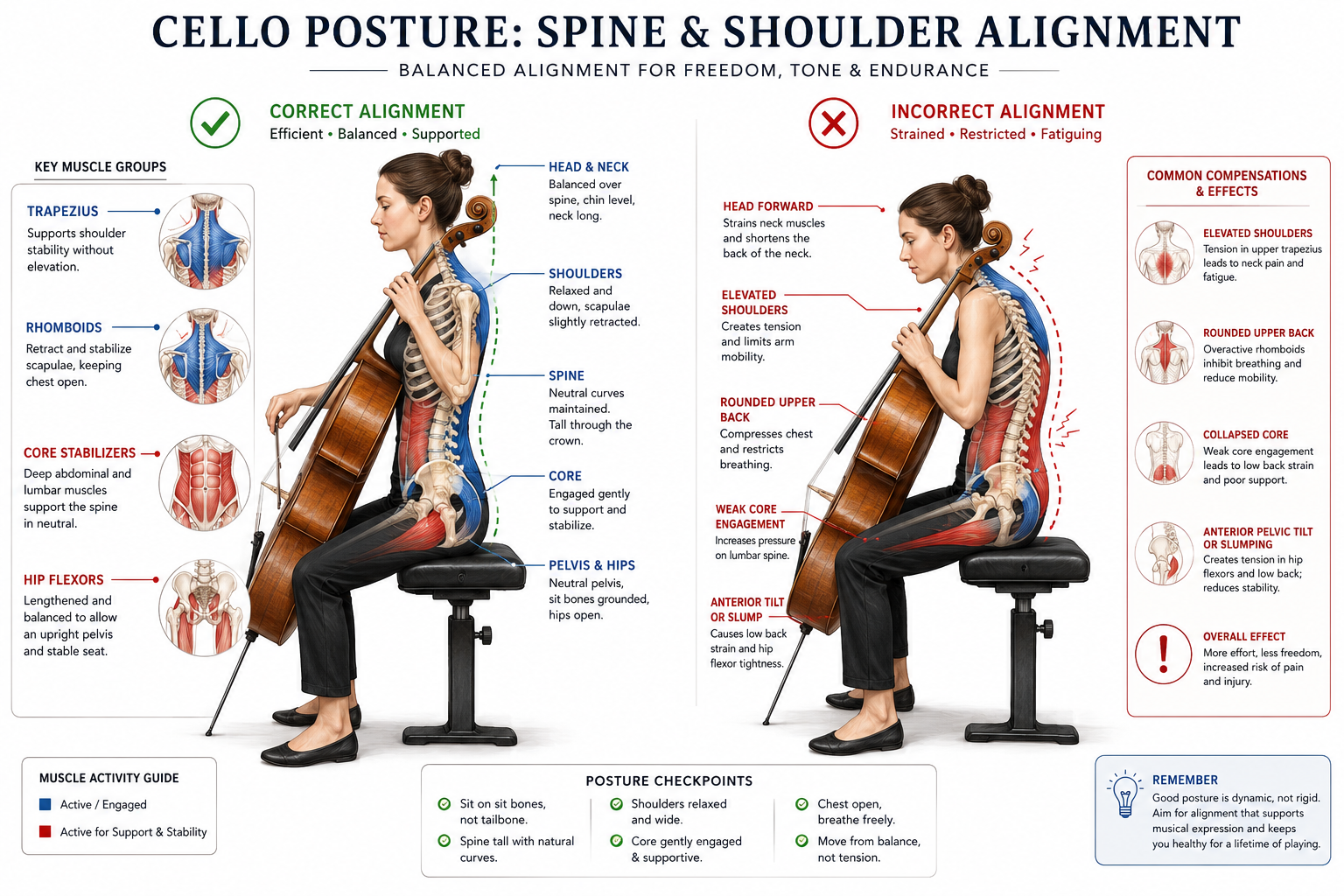
Bad posture in cellists develops primarily because the instrument requires the player to hold an asymmetrical, forward-reaching position for long, repeated sessions. The left arm extends across the body to finger the strings while the right arm draws the bow in a sweeping arc, creating uneven muscular demand on both sides of the torso.
Several structural factors compound this:
- Forward head posture: Cellists frequently lean toward the instrument to watch their bow placement or read music, pulling the head 2 to 4 inches forward of the neutral spine position. For every inch the head moves forward, the effective load on the cervical spine roughly doubles (according to estimates cited in performing arts medicine literature).
- Rounded upper back (thoracic kyphosis): The hunched position needed to bring the arms forward causes the thoracic spine to flex chronically, shortening the pectoral muscles and weakening the mid-back.
- Hip and pelvis tilt: Sitting on the front edge of a chair, which many teachers recommend for tone production, can tilt the pelvis posteriorly, flattening the lumbar curve and loading the lower back.
- Unequal shoulder height: The bow arm shoulder tends to elevate and protract over time, while the fingerboard arm develops different tension patterns.
Understanding these root causes is the first step toward choosing the right posture correction exercises specifically for cellists.
Which Muscle Groups Do Cellists Need to Strengthen
Cellists need to prioritize the deep core stabilizers, mid-back retractors, rotator cuff muscles, and deep neck flexors. These are the muscle groups that counteract the forward-collapsing forces of the playing position.
Priority muscle groups:
| Muscle Group | Why It Matters for Cellists |
|---|---|
| Deep core (transversus abdominis, multifidus) | Stabilizes the lumbar spine during long sitting sessions |
| Rhomboids and mid-trapezius | Counteracts rounded upper back and protracted shoulders |
| Rotator cuff (infraspinatus, teres minor) | Protects the shoulder joint during bowing movements |
| Deep neck flexors (longus colli, longus capitis) | Corrects forward head posture |
| Gluteus medius and hip flexors | Supports neutral pelvic tilt while seated |
| Serratus anterior | Keeps the shoulder blade flat against the rib cage |
Neglecting any one of these groups creates a weak link that eventually shows up as pain or restricted range of motion.
Common Posture Mistakes Cellists Make When Practicing
The most common posture mistakes cellists make are practicing in marathon sessions without breaks, sitting too far back on the chair, and allowing the scroll of the cello to drift too far to the left. Each of these errors loads the spine and shoulders in ways that accumulate into injury.
Top mistakes to watch for:
- Sitting too far back: This encourages posterior pelvic tilt and lumbar rounding. Sit on the front third of the chair seat with both feet flat on the floor.
- Scroll drift: When the cello scroll drifts left of the player’s left shoulder, the left arm overreaches, straining the shoulder and upper back.
- Bow grip tension: Gripping the bow tightly activates the forearm flexors continuously, leading to tendinopathy of the wrist and elbow.
- Ignoring asymmetry: Many students practice for 90 minutes or more without ever addressing the postural imbalance they’re reinforcing.
- Chair height mismatch: A chair that is too low forces the knees above the hips, tilting the pelvis backward and rounding the lower back.
- No warm-up: Starting practice cold without mobilizing the thoracic spine and shoulders sets the stage for micro-trauma.
What Are the Signs That My Current Cello Posture Is Damaging My Body
The clearest signs that cello posture is causing harm include persistent neck or upper back pain after practice, tingling or numbness in the fingers, headaches that begin at the base of the skull, and shoulder pain that worsens with bowing. These symptoms should not be dismissed as normal soreness.
Specific warning signs:
- Pain or stiffness in the neck, upper back, or lower back that lasts more than 24 hours after a session
- Numbness, tingling, or weakness in the left hand or fingers (possible thoracic outlet or nerve compression)
- Clicking or catching sensation in the shoulder joint during bowing
- Wrist pain or forearm tightness that does not resolve with rest
- Headaches originating at the base of the skull (cervicogenic headache pattern)
- Fatigue in the upper back within the first 20 minutes of playing
Any combination of these symptoms warrants a consultation with a physiotherapist who works with musicians before continuing at full practice intensity.
Can Bad Cello Posture Lead to Long-Term Health Problems
Yes, untreated postural dysfunction in cellists can lead to serious long-term conditions. Research published in performing arts medicine journals consistently shows that string players are among the most injury-prone professional musicians, with overuse injuries and postural syndromes accounting for a significant proportion of career-ending problems.
Long-term risks include:
- Thoracic outlet syndrome: Compression of nerves and blood vessels between the collarbone and first rib, often caused by chronically elevated and protracted shoulders.
- Cervicogenic headaches and cervical disc issues: Sustained forward head posture accelerates disc degeneration in the cervical spine.
- Focal dystonia: A neurological condition involving involuntary muscle contractions in the hand or arm, partly linked to repetitive strain patterns.
- Tendinopathy: Chronic overuse of the forearm flexors and extensors leads to tendon degeneration at the elbow and wrist.
- Lumbar disc problems: Sustained posterior pelvic tilt and lumbar flexion increase intradiscal pressure over years of practice.
The good news is that consistent posture correction exercises specifically for cellists, started early, can interrupt these patterns before they become structural.
Best Posture Correction Exercises Specifically for Cellists
The best posture correction exercises for cellists address thoracic extension, shoulder blade retraction, deep core activation, and neck alignment in a coordinated daily routine. These exercises do not require a gym and can be done in 15 to 20 minutes before or after practice.
Core and Lumbar Stabilization
Dead bug exercise:
- Lie on your back with knees bent at 90 degrees, arms pointing toward the ceiling.
- Slowly lower the right arm overhead and extend the left leg simultaneously, keeping the lower back pressed into the floor.
- Return and repeat on the other side. Do 3 sets of 8 repetitions per side.
Bird-dog:
- Start on hands and knees with a neutral spine.
- Extend the right arm forward and left leg back simultaneously, holding 3 seconds.
- Return slowly. Do 3 sets of 10 per side.
Thoracic Spine Mobilization
Foam roller thoracic extension:
- Place a foam roller horizontally under the mid-back (around T6-T8 level).
- Support your head with your hands and gently extend over the roller for 30 seconds.
- Move the roller slightly up and repeat, working through the upper back.
Cat-cow (spinal segmentation): Perform 10 slow repetitions, pausing at each end range for 2 seconds. Focus on moving each spinal segment individually rather than just the extremes.
Shoulder Retraction and Rotator Cuff
Band pull-apart:
- Hold a resistance band at shoulder width with arms extended in front.
- Pull the band apart, squeezing the shoulder blades together.
- Return slowly. Do 3 sets of 15.
Side-lying external rotation:
- Lie on your side with the top arm bent at 90 degrees, elbow at your side.
- Rotate the forearm upward, keeping the elbow pinned to the ribs.
- Do 3 sets of 12 per side with a light weight (1 to 3 kg).
Deep Neck Flexor Activation
Chin tuck:
- Sit or stand tall. Gently draw the chin straight back, creating a “double chin.”
- Hold 5 seconds. Release. Repeat 10 times.
- This directly counters forward head posture and activates the longus colli.
Best Stretches to Improve Cello Playing Position
The most effective stretches for cellists target the pectorals, hip flexors, cervical extensors, and thoracic rotators. These are the muscles that shorten and tighten in response to the cello playing position.
Daily stretching routine for cellists:
- Doorway chest stretch: Stand in a doorway with arms at 90 degrees, lean forward gently. Hold 30 seconds, 2 repetitions. Targets pectoralis major and minor.
- Hip flexor lunge stretch: Step one foot forward into a lunge, lower the back knee to the floor, and tuck the pelvis under. Hold 45 seconds per side. Targets iliopsoas.
- Levator scapulae stretch: Tilt the ear to the shoulder, then rotate the nose toward the armpit. Hold 30 seconds per side. Targets the muscle that commonly causes neck-to-shoulder pain in string players.
- Thread-the-needle: From hands and knees, slide one arm under the body along the floor, rotating the thoracic spine. Hold 30 seconds per side. Excellent for thoracic rotation restriction.
- Suboccipital release: Lie on your back with a rolled towel under the base of the skull. Relax for 5 minutes. Releases the muscles that contribute to cervicogenic headache.
Are There Specific Yoga Poses That Help Musicians
Yes, several yoga poses are particularly well-suited to musicians and are frequently recommended by performing arts physiotherapists. Poses that emphasize thoracic extension, shoulder opening, and hip flexor lengthening address the exact postural imbalances created by cello playing.
Most useful yoga poses for cellists:
- Supported fish pose (Matsyasana): Lie over a bolster or folded blanket placed under the thoracic spine. Opens the chest and reverses thoracic kyphosis. Hold 3 to 5 minutes.
- Puppy pose (Uttana Shishosana): From hands and knees, walk the hands forward and lower the chest toward the floor. Excellent for thoracic and shoulder mobility.
- Reclined pigeon (Supta Kapotasana): Releases the hip external rotators and piriformis, which tighten from prolonged sitting.
- Eagle arms (Garudasana arms): Wraps the arms to stretch the posterior shoulder capsule and rhomboids, counteracting the effects of sustained bow arm positioning.
- Warrior I: Combines hip flexor lengthening with thoracic extension and shoulder elevation, addressing multiple cello-related restrictions at once.
A 20-minute yoga sequence using these poses three times per week is a practical complement to the targeted strengthening exercises described above.

What Exercises Can Prevent Repetitive Strain Injury for Cellists
Preventing repetitive strain injury (RSI) in cellists requires a combination of eccentric forearm strengthening, wrist mobility work, and load management during practice. RSI in cellists most commonly affects the wrist extensors, the medial elbow (golfer’s elbow pattern), and the finger flexor tendons.
RSI prevention exercises:
- Eccentric wrist extension (Tyler twist or reverse Tyler twist): Using a flexible bar or resistance band, perform slow eccentric wrist extensions to load the extensor tendons. Evidence from sports medicine supports eccentric loading for tendinopathy prevention (Alfredson et al., 1998, though originally for Achilles tendon, the principle has been applied broadly in tendon rehabilitation).
- Finger extension with rubber band: Place a rubber band around all five fingers and spread them apart. Do 3 sets of 20. Counteracts the chronic flexion demand of fingering.
- Forearm pronation/supination with a weighted dowel: Slowly rotate a light weighted rod from palm-up to palm-down. Builds rotator endurance for bowing.
- Grip strength with a stress ball: Moderate grip strengthening supports the tendons of the hand and wrist.
Load management rules:
- Follow a 10% rule: do not increase weekly practice time by more than 10% per week.
- Take a 5-minute movement break every 25 to 30 minutes of practice.
- Alternate technically demanding passages with easier repertoire to vary muscular demand.
How Do Professional Cellists Prevent Back Pain
Professional cellists prevent back pain through a combination of structured physical conditioning, strategic practice scheduling, and regular work with sports medicine or performing arts physiotherapy professionals. Many top-level orchestral cellists treat physical conditioning as a non-negotiable part of their professional routine, similar to how athletes approach training.
Common strategies used by professional players:
- Pilates and core conditioning: Many professional orchestras now offer Pilates programs for their string players. Core stability is the foundation of a pain-free playing position.
- Alexander Technique: A method that teaches musicians to become aware of and change habitual movement patterns. Several conservatories include Alexander Technique as part of the curriculum.
- Feldenkrais Method: Uses gentle movement sequences to re-educate the nervous system about efficient posture and movement.
- Regular physiotherapy check-ins: Many professionals see a physiotherapist monthly or quarterly even when not injured, to catch postural drift before it becomes a problem.
- Strength training: Compound movements like deadlifts (performed with proper form and appropriate load) build the posterior chain strength that supports upright posture during long rehearsals.
Differences Between Amateur and Professional Cello Posture Techniques
The main difference between amateur and professional cello posture is not the ideal position itself, but the consistency with which professionals maintain it and the physical conditioning that supports it. Both groups aim for the same neutral spine, relaxed shoulders, and balanced weight distribution, but professionals have typically spent years developing the muscular endurance to hold that position reliably.
Key differences in practice:
- Endurance: Professionals can maintain good posture through a 2-hour rehearsal because their core and mid-back muscles are conditioned for it. Amateurs often start with good posture and collapse into dysfunction as fatigue sets in.
- Body awareness: Professional training emphasizes proprioceptive awareness, the ability to feel when posture has shifted, and self-correct in real time.
- Bow arm mechanics: Professional cellists typically use a more relaxed, weight-transfer approach to bowing rather than pressing, which reduces shoulder and forearm loading significantly.
- Endpin angle: Professionals are more likely to experiment with and optimize endpin length and angle to fit their body proportions, reducing compensatory posture.
- Recovery habits: Professionals are more likely to have structured warm-up and cool-down routines around practice.
Is Posture Correction Different for Right vs Left-Handed Cellists
For the vast majority of cellists, the instrument is played in the standard orientation regardless of hand dominance, meaning the left hand fingers the strings and the right hand holds the bow. So in practice, posture correction exercises specifically for cellists apply almost identically to all players.
The one meaningful difference is that a small number of cellists do play in a mirrored orientation (left-hand bow, right-hand fingerboard). For these players, the same exercise principles apply but the asymmetrical loading patterns are reversed: the right shoulder will show the bow arm elevation and protraction issues, and the left forearm will carry the bowing repetitive strain risk.
For standard-orientation cellists who happen to be left-hand dominant, research in sports science suggests that left-hand-dominant individuals may have slightly different shoulder stabilizer recruitment patterns, but there is no strong evidence that this requires a fundamentally different corrective exercise approach.
How Much Does a Posture Correction Session With a Musician Physiotherapist Cost
In 2026, a session with a physiotherapist who specializes in performing arts medicine typically costs between $90 and $200 USD per visit in major U.S. cities, with variation depending on location, session length, and the provider’s specialization level. In the UK, private sessions range from approximately £70 to £140. In Australia, expect AUD $100 to $180 per session.
Cost factors to consider:
- Initial assessments are usually longer (60 to 90 minutes) and cost more than follow-up sessions.
- Some health insurance plans cover physiotherapy but may not specifically cover performing arts medicine specialists.
- Many conservatories and music schools offer subsidized or free access to physiotherapy services for enrolled students.
- Online telehealth consultations with performing arts physiotherapists are available and typically cost 20 to 30% less than in-person visits.
- Organizations such as the Performing Arts Medicine Association (PAMA) maintain directories of qualified providers.
For most cellists, 4 to 6 initial sessions followed by monthly check-ins is a reasonable starting framework, though individual needs vary considerably.
Recommended Equipment to Support Proper Cello Playing Stance
The right equipment choices directly reduce postural strain for cellists. The most impactful equipment decisions involve the chair, the endpin, and any support accessories used to stabilize the instrument.
Equipment recommendations:
- Chair: Use a firm, flat-seated chair at a height that allows the hips to be level with or slightly above the knees. Avoid soft chairs or those with backward-tilting seats. Some cellists use a wedge cushion to encourage anterior pelvic tilt.
- Endpin length and angle: The endpin should position the cello so the upper bout rests lightly against the sternum without requiring the player to lean forward. Bent endpins (angled 10 to 15 degrees) are popular for reducing the forward lean required.
- Endpin anchor or strap: On slippery floors, an endpin anchor prevents the cello from sliding, which otherwise forces the player to grip the instrument with the knees and legs, creating hip and lower back tension.
- Bow hold aids: For students developing bow technique, lightweight bow hold guides can help establish a relaxed grip without excessive tension.
- Music stand height: Position the stand so the music is at eye level when sitting in proper posture. Looking down at music on a low stand is a major driver of forward head posture.
How Often Should Cellists Do Corrective Exercises
Cellists should perform posture correction exercises at least three to five times per week, with a short 5-minute mobility routine done daily before every practice session. Frequency matters more than session length, especially for postural re-education.
Practical scheduling framework:
- Daily (5 minutes before practice): Cat-cow, chin tucks, band pull-aparts, and one hip flexor stretch. This primes the postural muscles before loading them with playing.
- Three times per week (15 to 20 minutes): Full corrective routine including dead bug, bird-dog, foam roller thoracic extension, side-lying external rotation, and the full stretching sequence.
- Weekly: One yoga or Pilates session focused on the poses described above.
- Monthly: Self-assessment or physiotherapy check-in to evaluate whether postural habits are improving or drifting.
The most common mistake is doing corrective exercises only when pain appears. Consistency during pain-free periods is what prevents the pain from returning.
FAQ
Q: How long does it take to see improvement from posture correction exercises? Most cellists notice reduced muscle fatigue and improved awareness within 2 to 4 weeks of consistent daily practice. Structural postural changes typically take 3 to 6 months of regular exercise.
Q: Can I do posture correction exercises on the same day I practice? Yes, and it is recommended. A short mobility routine before practice and a stretching cool-down afterward is more effective than doing exercises only on rest days.
Q: Do I need a physiotherapist to start posture correction exercises, or can I begin on my own? You can begin the basic exercises described in this guide independently. However, if you have existing pain, numbness, or tingling, see a physiotherapist before starting to rule out conditions that require specific management.
Q: Is the Alexander Technique worth the cost for cellists? For cellists with persistent postural habits that do not respond to standard exercises, the Alexander Technique offers a different approach by addressing the underlying movement patterns. Many professional musicians find it valuable, though it requires a series of lessons to see results.
Q: At what age should young cellists start posture correction exercises? Postural awareness and basic mobility work are appropriate from the time a student begins lessons. Young cellists benefit most from short, playful movement breaks rather than formal exercise programs, which become more appropriate in the teenage years.
Q: Can bad posture cause problems in my left hand specifically? Yes. Forward head posture and rounded upper back can compress the brachial plexus, producing numbness, tingling, or weakness in the left hand and fingers, a pattern consistent with thoracic outlet syndrome.
Q: What is the single most important exercise for a cellist with upper back pain? Foam roller thoracic extension is widely regarded by performing arts physiotherapists as the most immediately effective exercise for cellists with upper back pain, as it directly reverses the thoracic kyphosis created by playing.
Q: Should I stop playing if I have posture-related pain? Not necessarily. Relative rest (reducing volume and intensity) combined with corrective exercises is usually more effective than complete rest. Consult a physiotherapist to determine the right balance for your specific situation.
Q: Does playing cello standing up help with posture? Standing while playing (using a longer endpin) removes the seated pelvic tilt issue but does not eliminate shoulder and neck postural demands. Some cellists alternate between sitting and standing during practice to vary the load.
Q: Are there apps or tools that help cellists monitor posture? Several posture monitoring apps use smartphone cameras or wearable sensors to provide real-time feedback on spinal alignment. While not a substitute for professional assessment, they can be useful for building awareness during practice.
Conclusion
Posture correction exercises specifically for cellists are not optional maintenance, they are a core part of sustainable musicianship. The cello’s physical demands are real, and without a deliberate counter-strategy, the asymmetrical loading of the spine, shoulders, and forearms accumulates into pain and, eventually, injury.
The path forward is straightforward. Start with a daily 5-minute pre-practice routine of cat-cow, chin tucks, and band pull-aparts. Add a three-times-weekly strength session targeting the core, mid-back, and rotator cuff. Stretch the chest, hip flexors, and neck consistently. Review your equipment setup, particularly chair height, endpin angle, and music stand position. And if you have symptoms that have persisted for more than two weeks, book a session with a performing arts physiotherapist rather than waiting for things to resolve on their own.
The cellists who play into their 50s, 60s, and beyond are not the ones with exceptional genetics. They are the ones who treated their body as part of their instrument, and maintained it accordingly.
References
- Alfredson, H., Pietilä, T., Jonsson, P., & Lorentzon, R. (1998). Heavy-load eccentric calf muscle training for the treatment of chronic Achilles tendinosis. The American Journal of Sports Medicine, 26(3), 360-366.
- Brandfonbrener, A. G. (2009). Musculoskeletal problems of instrumental musicians. Hand Clinics, 19(2), 231-239.
- Fishbein, M., Middlestadt, S. E., Ottati, V., Straus, S., & Ellis, A. (1988). Medical problems among ICSOM musicians: overview of a national survey. Medical Problems of Performing Artists, 3(1), 1-8.
- Nyman, T., Wiktorin, C., Mulder, M., & Johansson, Y. L. (2007). Work postures and neck-shoulder pain among orchestra musicians. American Journal of Industrial Medicine, 50(5), 370-376.
- Performing Arts Medicine Association (PAMA). https://www.artsmed.org
- Zaza, C. (1998). Playing-related musculoskeletal disorders in musicians: a systematic review of incidence and prevalence. CMAJ, 158(8), 1019-1025.
Read next: Sourcing Vintage Furniture Online: Search Strategies for Rare Design Classics. A closer look at sourcing vintage furniture online.