
Quick Answer
The best storage systems for avid board gamers with small apartments combine vertical shelving (particularly IKEA Kallax units), wall-mounted racks, and under-furniture bins to maximize every cubic foot of space. Most collectors in apartments under 600 square feet can house 50 to 150 games without sacrificing livable space by stacking vertically, decanting components into labeled bags, and treating shelving as furniture. Cost ranges from nearly free (repurposed bins) to $300 or more for custom built-in solutions.
Key Takeaways
- IKEA Kallax shelves are the most widely recommended storage unit for board game collections because standard game boxes fit the 13-inch cube openings almost perfectly
- Storing board games vertically (spine out, like books) is safe for most games and saves significant shelf space
- Collectors in apartments under 500 square feet benefit most from multi-purpose furniture such as ottomans with storage, bed risers, and wall-mounted shelving
- Custom board game organizers and inserts cost between $10 and $80 per game and reduce box footprint by allowing component decanting
- Humidity above 60% and direct sunlight are the two biggest threats to board game box longevity in small, poorly ventilated apartments
- The most common mistake new collectors make is buying storage after the collection grows, rather than planning a system from the first purchase
- Vacuum-sealed bags work for storing loose components but are not recommended for full game boxes with cardboard trays
- A single 4×4 Kallax unit (roughly 57 inches square) can hold between 32 and 48 standard-sized board game boxes
- Budget-friendly options include dollar-store bins, repurposed wine crates, and stackable magazine files for card games
- Aesthetics matter in small apartments: storage that doubles as decor reduces visual clutter and makes the collection a feature, not an eyesore
What Are the Best Board Game Storage Solutions for Tiny Apartments
For avid board gamers with small apartments, the best storage solutions are vertical shelving units, wall-mounted racks, and multi-use furniture that hides games inside. The goal is to treat your collection like a library, not a pile.
Top solutions ranked by practicality for small spaces:
| Solution | Best For | Approx. Cost | Space Efficiency |
|---|---|---|---|
| IKEA Kallax (4×2 or 4×4) | Collections of 20-80 games | $60-$150 | High |
| Wall-mounted floating shelves | Card games, small boxes | $20-$80 | Very High |
| Under-bed storage bins | Overflow, rarely played games | $15-$40 | High |
| Ottoman with storage | Living room display + storage | $80-$200 | Medium |
| Stackable clear bins (closet) | Components, expansions | $10-$30 | Medium |
| Custom built-in shelving | Serious collectors, long-term renters | $200-$600+ | Very High |
The single most effective move for a small apartment is going vertical. Most people store games in stacks on the floor or in closets. Moving to a dedicated shelf unit instantly reclaims floor space and makes the collection accessible.
Are IKEA Kallax Shelves Actually Good for Board Game Storage
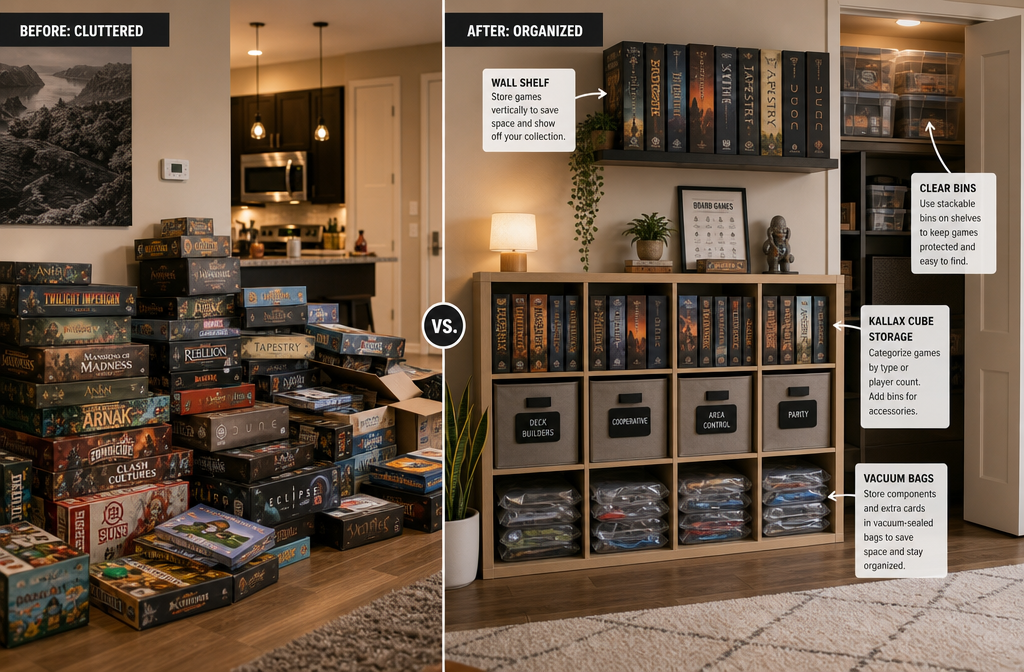
Yes, IKEA Kallax shelves are genuinely excellent for board game storage, and the board gaming community has adopted them as a near-universal standard. Each cubby measures approximately 13 x 13 x 15 inches, which fits the majority of standard board game boxes (typically 10-12 inches square) standing upright with room to spare.
Why Kallax works so well:
- Standard game boxes (Ticket to Ride, Catan, Pandemic) fit upright in each cubby without modification
- Larger boxes (Gloomhaven, Twilight Imperium) fit lying flat across two cubbies or on top of the unit
- The open-face design makes it easy to read box spines and pull games quickly
- Kallax units double as room dividers in studio apartments
- Add-on doors and drawers (sold separately by IKEA) let you hide the collection when guests arrive
One limitation to know: Very large “big box” games like Gloomhaven (estimated weight around 21 lbs per publisher data) should be stored flat on a lower shelf or the floor to avoid warping the cubby shelf over time.
A 4×4 Kallax (16 cubbies) retails for approximately $150 as of 2026 and can hold between 32 and 48 standard games depending on box size. That makes it one of the best dollars-per-game-stored options available.
Can I Store Board Games Vertically Without Damaging the Box
Storing board games vertically is safe for the vast majority of games and is actually the preferred method for serious collectors. Standing games upright like books keeps boxes from warping under weight, makes spines readable, and uses shelf depth efficiently.
When vertical storage works fine:
- Games with sturdy two-piece lift-lid boxes (most modern games)
- Games where components sit in a foam or cardboard insert that holds them in place
- Any game where the lid fits snugly on the base
When to store flat instead:
- Games with loose, heavy metal components (coins, miniatures) that could shift and damage the box sides
- Games with a single tray and no insert, where pieces will tumble
- Very old games with fragile, thin cardboard boxes
A practical fix: place a rubber band around the box or use a binder clip on each side before standing it vertically. Many collectors also use aftermarket foam inserts (from companies like Folded Space or The Broken Token) to lock components in place, making vertical storage safe for almost any game.
What Do Serious Board Game Collectors Use to Organize Their Collections
Serious collectors in small apartments rely on a layered system: primary shelving for display, secondary storage for overflow, and component-level organization inside each box. The goal is fast retrieval and minimal footprint.
The collector’s toolkit:
- Aftermarket inserts: Laser-cut foam or cardboard inserts from Folded Space, The Broken Token, or Insert Here replace flimsy original trays, reduce box height by 20-40%, and keep components sorted
- Bead organizers and zip bags: Small hardware-store bead organizers or labeled zip-lock bags sort tokens, cards, and meeples inside the box
- Catalog apps: Apps like BoardGameGeek’s collection tracker or Dicebreaker help collectors log what they own, rate play frequency, and identify games to cull
- Spine labels: Printed or hand-written spine labels make scanning a shelf fast, especially for games with blank or dark box sides
- Decanting: Removing components from original boxes entirely and storing them in labeled tins or bags, then discarding bulky boxes — a space-saving move for games played often
The culling habit is what separates serious collectors from overwhelmed ones. Most experienced collectors review their collection once or twice a year and sell or donate games that haven’t been played in 12 months. In a small apartment, this discipline is non-negotiable.
How Much Do Custom Board Game Shelves and Organizers Typically Cost
Custom board game organizers (inserts) cost between $10 and $80 per game, depending on complexity and material. Custom shelving built specifically for a small apartment runs $200 to $600 or more for a professional installation.
Cost breakdown by category:
- Laser-cut cardboard inserts (e.g., Folded Space): $10-$25 per game — good for most mid-weight games
- Laser-cut foam inserts (e.g., The Broken Token): $25-$80 per game — best for heavy games with many components
- DIY foam inserts (craft foam + cutting mat): $2-$8 per game — time-intensive but very cheap
- IKEA Kallax 4×4: Approximately $150 (2026 retail)
- IKEA Kallax 2×4: Approximately $90 (2026 retail)
- Floating wall shelves (set of 3): $20-$60 depending on brand and weight rating
- Custom built-in shelving (contractor-built): $300-$800+ depending on apartment size and materials
For most people, the best value is a Kallax unit plus foam inserts for the 5-10 most-played games. That combination costs $200-$350 total and handles collections of 30-60 games comfortably.
Which Storage Options Work Best for People with Limited Closet Space
For board gamers with limited closet space, the best approach is to move the collection out of the closet entirely and into living space using furniture that doubles as storage. Closets are inefficient for board games because shelves are rarely the right depth and stacking damages boxes.
Best non-closet options for small apartments:
- Kallax as a room divider: In a studio or open-plan apartment, a Kallax placed perpendicular to a wall creates a defined “game zone” and stores the collection on both sides
- Under-bed rolling bins: A queen bed typically has 9-12 inches of clearance, enough for flat-stored games in shallow rolling bins. This works well for large-format games played rarely
- TV console with deep shelving: Many TV consoles have 12-16 inch deep lower shelves that fit standard game boxes lying flat
- Entryway bench with storage: A storage bench near the door holds 8-15 games in the seat compartment and is completely hidden from view
- Staircase storage (if applicable): In loft apartments or townhouses, the space under stairs is often wasted and can be fitted with custom pull-out shelves
“The best storage system for a small apartment is the one that makes your collection look intentional, not accidental.”
The key principle: every piece of storage furniture should serve at least two purposes. A shelf that only holds games is a luxury a small apartment can’t afford.
How Do I Protect Board Game Boxes from Dust and Humidity
Board game boxes are most damaged by humidity above 60%, direct sunlight, and dust accumulation over time. In small apartments, especially older buildings, humidity control is often the biggest challenge.
Protection strategies:
- Humidity: Keep a small hygrometer near your shelves. If humidity regularly exceeds 55-60%, use a plug-in dehumidifier or moisture-absorbing packets (silica gel) near the collection. Cardboard warps and mold grows above 65% humidity
- Sunlight: UV light fades box art and weakens cardboard. Avoid placing shelves in direct sunlight. If the only wall space is near a window, use UV-filtering window film (available for under $30 at most hardware stores)
- Dust: Open shelves accumulate dust. Wipe boxes down every few months with a dry microfiber cloth. For long-term storage of rarely played games, store them in large zip-lock bags or fabric bins with lids
- Stacking weight: Never stack more than 3-4 heavy games on top of each other. Weight warps the bottom box over months
Can I store board games in vacuum-sealed bags? Vacuum sealing is not recommended for full game boxes because the pressure crushes cardboard trays and warps lids. It works fine for storing loose components (sleeved card decks, bagged tokens) separately, but not as a whole-game storage method.
What Storage Solutions Work for People with Less Than 500 Square Feet
In apartments under 500 square feet, every storage system for avid board gamers must be multi-functional and vertical. The math is simple: floor space is too valuable to dedicate to storage furniture that does only one thing.
Practical system for under-500 sq ft:
- Choose one primary display shelf (a 2×4 Kallax works well — it’s about 57 inches wide and 30 inches tall, so it fits under most windows)
- Use under-bed rolling bins for the bottom 20% of the collection (games played less than once a year)
- Digitize rulebooks to reduce the need to keep every insert and manual
- Set a hard cap on collection size — for example, “no more games than fit on this shelf” — and enforce it by selling before buying
- Prioritize games that punch above their weight in replay value relative to box size (small-box games like Coup, Love Letter, or Arboretum take up almost no space)
How many board games fit in a typical apartment storage unit? A single 4×4 Kallax holds 32-48 standard games. A 2×4 Kallax holds 16-24. Under-bed bins (queen size) typically fit 6-12 large flat games. A well-organized 500 sq ft apartment can realistically store 60-100 games without the space feeling overwhelmed.
What Are the Cheapest Ways to Store a Board Game Collection
The cheapest storage systems for avid board gamers with small apartments cost almost nothing and rely on repurposed household items and budget retail finds.
Budget options under $30:
- Wine crates: Free or $5-$10 from liquor stores. Stack two or three, open side facing out, and they hold games upright like a cubby shelf
- Milk crates: $5-$8 each at hardware stores. Stack them and zip-tie together for a stable, modular shelf
- Dollar-store bins with lids: Good for card games, small-box games, and component storage in a closet
- Stackable magazine files: $1-$3 each. Stand card games and small-box games upright inside them on any shelf
- Repurposed bookshelves: A standard bookshelf with adjustable shelves set 12-13 inches apart holds most games upright. Check Facebook Marketplace or Craigslist for free or near-free options
The cheapest effective system: A free bookshelf from a neighbor, shelves adjusted to 13 inches apart, games stored spine-out. Total cost: $0. This beats a $150 Kallax for someone just starting a collection.
What Mistakes Do New Board Game Collectors Make with Storage
The most common mistake new collectors make is treating storage as an afterthought rather than planning it from the start. By the time the collection reaches 20-30 games, the lack of a system creates real problems.
Top mistakes and how to avoid them:
- Stacking games on the floor: Weight warps boxes and makes retrieval a frustrating excavation. Fix: any dedicated shelf, even a cheap one, is better than floor stacking
- Ignoring box size variation: Not all games are the same size. Buying a shelf without measuring your largest games first leads to wasted space or games that don’t fit
- Keeping every insert and manual: Most rulebooks are available as free PDFs on publisher websites or BoardGameGeek. Removing paper inserts can reduce box thickness by 10-20%
- Never culling the collection: In a small apartment, a game that hasn’t been played in a year is dead weight. Sell it, donate it, or trade it
- Buying storage furniture that only stores games: In a small apartment, every piece of furniture must earn its floor space by doing more than one job
- Ignoring humidity: New collectors often don’t think about environmental damage until they open a box and find warped cards or a musty smell
FAQ
Q: How do I store oversized board game boxes like Gloomhaven in a small apartment? Store very large games flat on the bottom shelf of a Kallax or on the floor under a table. Gloomhaven-sized boxes (roughly 17 x 11 x 6 inches) don’t fit standard cubbies upright. Alternatively, use aftermarket inserts to decant components into smaller containers and discard the original box.
Q: Is it safe to store board games in a storage unit or garage? Only if the unit is climate-controlled. Uncontrolled environments with temperature swings and humidity above 60% will warp cardboard and damage cards within months. A climate-controlled storage unit is a reasonable overflow option for rarely played games.
Q: How do I organize board games so I can find what I want quickly? Organize by play frequency, not alphabetically. Keep the 10-15 most-played games at eye level and within easy reach. Use spine labels for fast scanning. Less-played games go on higher or lower shelves.
Q: Do board game sleeves affect how games fit on a shelf? Yes. Sleeved cards are noticeably thicker and often won’t fit back in the original tray. Store sleeved decks in rubber-banded stacks or in a separate card box, and adjust shelf spacing accordingly.
Q: Can I use pegboard for board game storage? Pegboard works well for hanging accessories (dice bags, small tins, card game boxes) but isn’t practical for standard-sized board game boxes due to weight. Use it as a supplement to a main shelf, not a replacement.
Q: What’s the best way to store board game expansions? Store expansions in the same box as the base game if they fit, or in a labeled zip bag kept behind the base game on the shelf. Avoid giving expansions their own shelf space unless they’re very large.
Q: How often should I reorganize my board game collection? Once or twice a year is enough for most collectors. Use the reorganization as a culling opportunity: if you haven’t played a game in 12 months, seriously consider whether it deserves shelf space.
Q: Are there apps that help manage a board game collection in a small space? Yes. BoardGameGeek’s app lets you log your collection, track plays, and identify low-play games worth selling. Some collectors also use simple spreadsheets to track box dimensions and plan shelf layouts before buying new furniture.
Q: What is the best way to store card-only games like Dominion? Card-only games store well in binder pages, card boxes, or labeled zip bags. Many Dominion players discard the original box entirely and store the full card library in a single craft storage box with dividers, saving significant space.
Q: How do I make my board game shelf look good in a small apartment? Face boxes spine-out on open shelves for a library look. Use consistent lighting (LED strip lights inside shelves are cheap and effective). Group games by box color or size for visual consistency. Remove or hide damaged boxes.
Conclusion
Building effective storage systems for avid board gamers with small apartments is less about finding the perfect product and more about committing to a system before the collection outgrows the space. The practical path forward is straightforward: start with a Kallax or equivalent vertical shelf, store games upright like books, protect against humidity and sunlight, and cull the collection regularly.
Actionable next steps:
- Measure your current storage space and count your games before buying anything
- Choose one primary shelf unit sized to your collection (a 2×4 Kallax for under 25 games, a 4×4 for larger collections)
- Invest in foam or cardboard inserts for your 5-10 most-played games to reduce box bulk
- Set a hard collection cap based on available shelf space and enforce it
- Add a small hygrometer near your shelves and address humidity if it regularly exceeds 60%
- Review the collection every 6-12 months and sell or donate games that aren’t being played
A well-organized game collection in a small apartment isn’t a compromise. It’s a design choice that makes the hobby more enjoyable and the space more livable.
References
- BoardGameGeek Community Forums. (2023). Kallax shelf dimensions and board game storage guide. https://boardgamegeek.com/forum
- IKEA Product Specifications. (2024). Kallax shelf unit dimensions and weight ratings. https://www.ikea.com/us/en/p/kallax-shelf-unit/
- Folded Space. (2023). Board game insert catalog and box size reduction data. https://www.foldedspace.net
- The Broken Token. (2022). Organizer product line and component storage solutions. https://www.thebrokentoken.com
Read next: Zero-Waste Bathroom: Transition Tips for Highly Sensitive Skin. A closer look at zero-waste bathroom.