
Key Takeaways
- Ear fatigue is a measurable, physiological event that directly degrades mixing accuracy, often without the engineer noticing in the moment.
- The 85 dB SPL threshold and the 60/60 rule (60 minutes at no more than 60% volume) are widely cited starting points for safe studio monitoring, though individual tolerance varies.
- Scheduled silence breaks of 10 to 15 minutes per hour are among the most effective and zero-cost auditory decompression tools available.
- Professional hearing protection for studio work differs significantly from consumer earplugs: flat-response attenuators preserve tonal balance while reducing overall SPL.
- Mixing and mastering engineers, live sound engineers, and studio monitor operators carry the highest occupational risk for noise-induced hearing loss (NIHL).
- Common mistakes include monitoring at excessive levels to compensate for fatigue, skipping breaks during creative flow, and relying on headphones for extended sessions without volume management.
- Symptoms such as tonal dullness, high-frequency loss, tinnitus after sessions, and difficulty distinguishing subtle EQ differences all signal the need for immediate auditory decompression.
- Scientific literature confirms that cumulative noise exposure, not single loud events, accounts for most occupational hearing loss in audio professionals.
- Recovery protocols range from free (silence, sleep, hydration) to professional audiological evaluation, which typically costs between $150 and $400 USD per session in the United States as of 2026.
- Long-term hearing preservation is a professional skill, not an optional wellness trend.
What Is Auditory Decompression and Why Do Audio Pros Need It
Auditory decompression refers to the deliberate process of reducing auditory load on the ears and auditory nervous system after sustained exposure to sound. For audio engineers and producers, it is a practical discipline that prevents cumulative hearing damage and restores the perceptual accuracy needed for quality work.
The term borrows from the concept of decompression in diving: just as a diver must ascend slowly to prevent physiological harm, an audio professional must allow their auditory system to recover from pressure before returning to critical listening tasks.
Audio professionals need auditory decompression strategies because their work demands consistent, accurate hearing across an entire career. A mastering engineer who loses 6 dB of sensitivity at 8 kHz will make EQ decisions that sound correct to them but are audibly wrong on reference systems. The stakes are both professional and personal.
Why it matters more in 2026: Remote production, home studio culture, and the rise of immersive audio formats (Dolby Atmos, spatial audio) mean many engineers now work longer sessions with less natural environmental variation. The risk of chronic overexposure has increased, not decreased.
How Does Ear Fatigue Impact Sound Mixing and Production Quality
Ear fatigue is a temporary reduction in hearing sensitivity caused by sustained exposure to sound. It directly impairs the ability to make accurate judgments about frequency balance, dynamics, stereo imaging, and spatial depth.
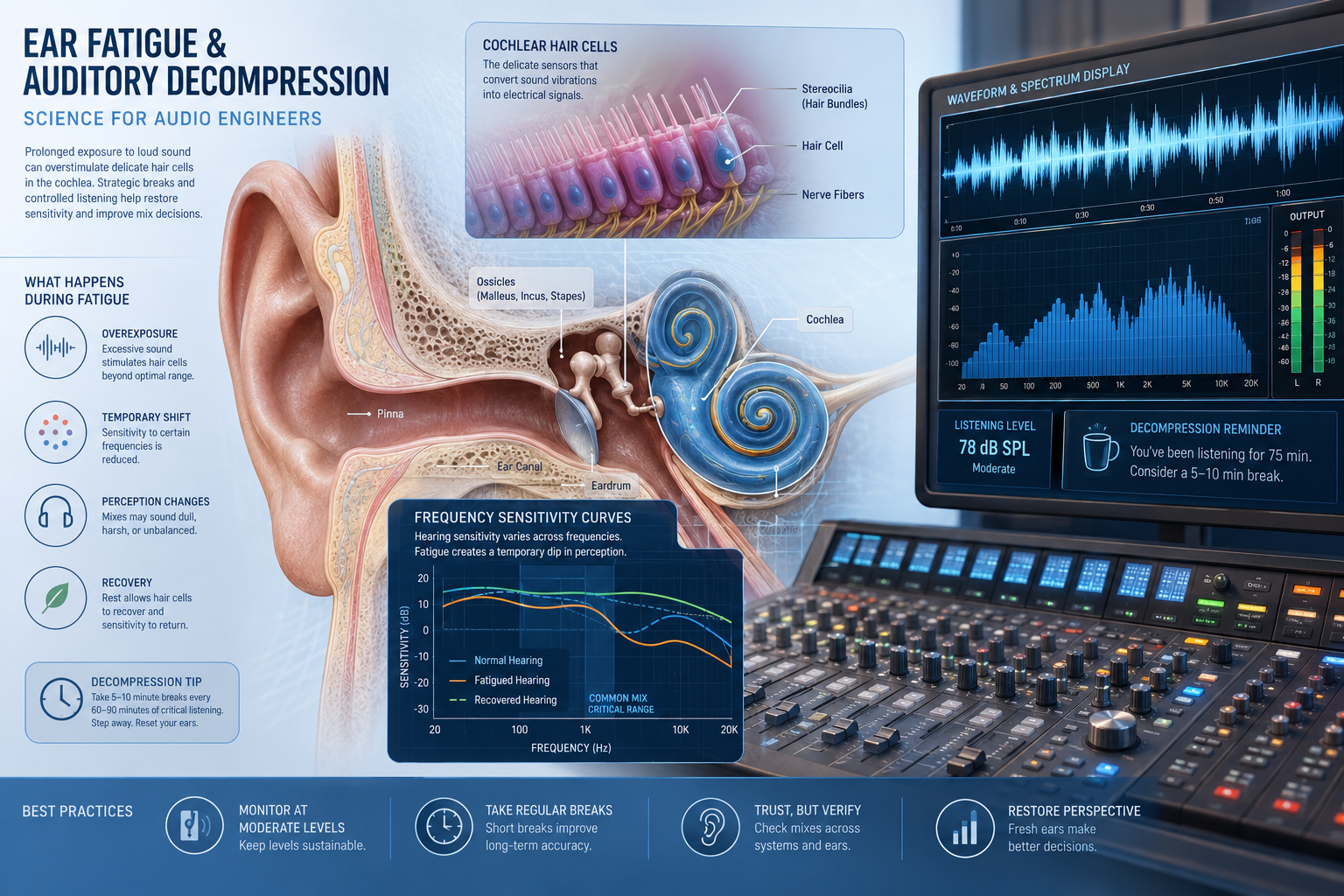
When the cochlear hair cells responsible for high-frequency detection are overstimulated, they temporarily reduce their firing rate. This means an engineer experiencing fatigue will perceive high-frequency content as quieter than it actually is, often compensating by boosting treble frequencies unnecessarily. The result: mixes that sound harsh or brittle on fresh ears.
Specific ways ear fatigue degrades production quality:
- Reduced sensitivity to the 2 kHz to 8 kHz range, where presence, clarity, and intelligibility live
- Difficulty distinguishing subtle compression artifacts or distortion
- Misjudging stereo width and depth in mix decisions
- Overcompensating on low-end because bass frequencies are perceived as relatively louder when highs are fatigued
- Making mastering decisions (loudness, limiting) that are inconsistent with the intended result
A common scenario: an engineer works a six-hour session without breaks, then spends the final hour wondering why the mix sounds “dull.” They add 3 dB of air at 12 kHz. The next morning, the mix is painfully bright. That is ear fatigue in action.
Best Techniques to Reset Hearing Sensitivity After Long Studio Sessions
The most effective auditory decompression strategies for audio engineers and producers combine immediate recovery tactics with longer-term habits. No single technique works in isolation.
Immediate reset techniques (during or after sessions):
- Silence breaks: Step away from all audio for 10 to 15 minutes per hour. Complete silence, not ambient music or podcasts, is required for genuine recovery.
- Low-level listening: After a break, return to the mix at a very low monitoring level (around 70 dB SPL or conversational volume) to recalibrate perception before making critical decisions.
- Reference track comparison: Play a well-known, commercially mastered reference track at the same level as your mix. This recalibrates your expectation baseline.
- Sleep: Overnight rest is the single most effective recovery tool for temporary threshold shift (TTS), the clinical term for the hearing sensitivity reduction caused by noise exposure.
- Hydration: The inner ear’s fluid balance is affected by overall hydration. Drinking adequate water supports cochlear function, though this is a supporting factor, not a primary treatment.
- Cold air or outdoor walks: Brief exposure to a quiet outdoor environment resets the auditory nervous system and reduces the cognitive fatigue that compounds perceptual errors.
Longer-term habits that support hearing recovery:
- Consistent monitoring level calibration (many engineers use 79 to 83 dB SPL for mixing, measured with a sound level meter)
- Alternating between speakers and headphones to vary the acoustic load
- Ending sessions at a fixed time rather than pushing through fatigue
How Much Does Professional Auditory Recovery Training Cost
Professional auditory recovery support ranges from free self-managed protocols to formal audiological care. The cost depends on whether an engineer is managing routine fatigue or addressing actual hearing damage.
Cost breakdown as of 2026 (United States estimates):
| Service | Estimated Cost |
|---|---|
| Audiologist baseline hearing test | $150 to $250 per session |
| Comprehensive audiological evaluation | $250 to $400 per session |
| Custom flat-response musician’s earplugs (molded) | $150 to $300 per pair |
| Tinnitus retraining therapy (TRT) program | $2,000 to $5,000 (full course) |
| Online hearing health courses for audio pros | $50 to $200 |
| Self-managed protocols (silence, sleep, hygiene) | Free |
Most audio engineers do not need formal recovery training unless they are experiencing persistent tinnitus, noticeable threshold shift, or difficulty with critical listening tasks that does not resolve after rest. In those cases, an audiologist referral is the appropriate next step, not a YouTube tutorial.
Decision rule: If symptoms resolve fully after a night of sleep, self-managed auditory decompression strategies are appropriate. If symptoms persist for more than 48 hours or recur regularly, seek professional audiological evaluation.
Differences Between Amateur and Professional Hearing Protection Methods
Amateur hearing protection and professional hearing protection serve different goals. Standard foam earplugs reduce all frequencies unevenly, cutting high frequencies far more than low frequencies. This makes them unsuitable for critical listening environments because they distort the perceived tonal balance of sound.
Professional methods use flat-response attenuation:
- Custom-molded musician’s earplugs with interchangeable acoustic filters (typically -9 dB, -15 dB, or -25 dB options) reduce all frequencies equally, preserving tonal accuracy while lowering overall SPL.
- In-ear monitors (IEMs) used by live performers function as both monitoring tools and hearing protection by delivering a controlled signal directly to the ear, reducing the need for high stage volume.
- Electronic hearing protection (used more in live sound than studio work) uses microphones and speakers inside the ear cup to deliver a processed, level-limited version of the environment.
Amateur methods (foam or basic earmuffs):
- Inexpensive ($1 to $20)
- High attenuation but uneven frequency response
- Appropriate for non-critical environments (power tools, concerts as an audience member)
- Not suitable for monitoring or mixing tasks
Common mistake: Many young engineers avoid hearing protection entirely because they believe it compromises their ability to hear accurately. Flat-response professional earplugs eliminate this concern. The real compromise is losing hearing permanently.
Which Audio Engineering Roles Are Most at Risk for Hearing Damage
Not all audio roles carry equal risk. The highest-risk positions involve sustained exposure to high SPL levels with limited control over the listening environment.
Highest-risk roles:
- Live sound engineers (FOH and monitor): Regularly exposed to 95 to 110 dB SPL for extended periods during concerts and festivals.
- Studio monitor engineers and mix engineers: Long daily sessions at moderate-to-high levels accumulate significant dose over a career.
- Mastering engineers: Spend the most time in critical listening environments, often with very controlled levels, but session duration can be extreme.
- Broadcast and post-production engineers: Headphone-heavy workflows increase risk due to proximity of the sound source to the ear.
- Music producers: Often combine long headphone sessions with speaker monitoring, compounding exposure.
Lower-risk roles (by comparison):
- Sound designers working primarily at low monitoring levels
- Remote session musicians using IEMs with controlled output
- Podcast editors working with voice-only content at conversational levels
The key variable is cumulative noise dose, not peak level alone. An engineer working at 85 dB for 10 hours accumulates more damage than one exposed to 95 dB for 30 minutes, according to NIOSH dose-response models.
Common Mistakes Audio Engineers Make That Lead to Hearing Strain
The most damaging mistakes are behavioral, not technical. Most hearing strain in audio professionals is preventable.
Top mistakes:
- Monitoring at high levels to compensate for fatigue. When ears are tired, engineers often turn up the volume to hear detail more clearly. This accelerates damage rather than solving the underlying problem.
- Skipping breaks during creative flow. The subjective experience of being “in the zone” masks the physiological reality of accumulating fatigue.
- Extended headphone sessions without volume management. Headphones deliver sound directly to the ear canal, making overexposure easier to achieve without realizing it.
- Ignoring early warning signs. Mild tinnitus after a session, slight muffling, or difficulty distinguishing high-frequency detail are early signals that are often dismissed.
- No baseline hearing test. Without a documented audiogram, engineers cannot measure whether their hearing is changing over time.
- Relying on loudness for emotional impact. Mixing at high levels to feel the music is a habit that serves the emotion of the session but damages the tool you need to do the work.
How Often Should I Take Listening Breaks During Music Production
Audio engineers and producers should take a minimum of 10 to 15 minutes of complete silence for every 60 minutes of active listening. This is the most widely supported guideline among audiologists who work with music professionals.
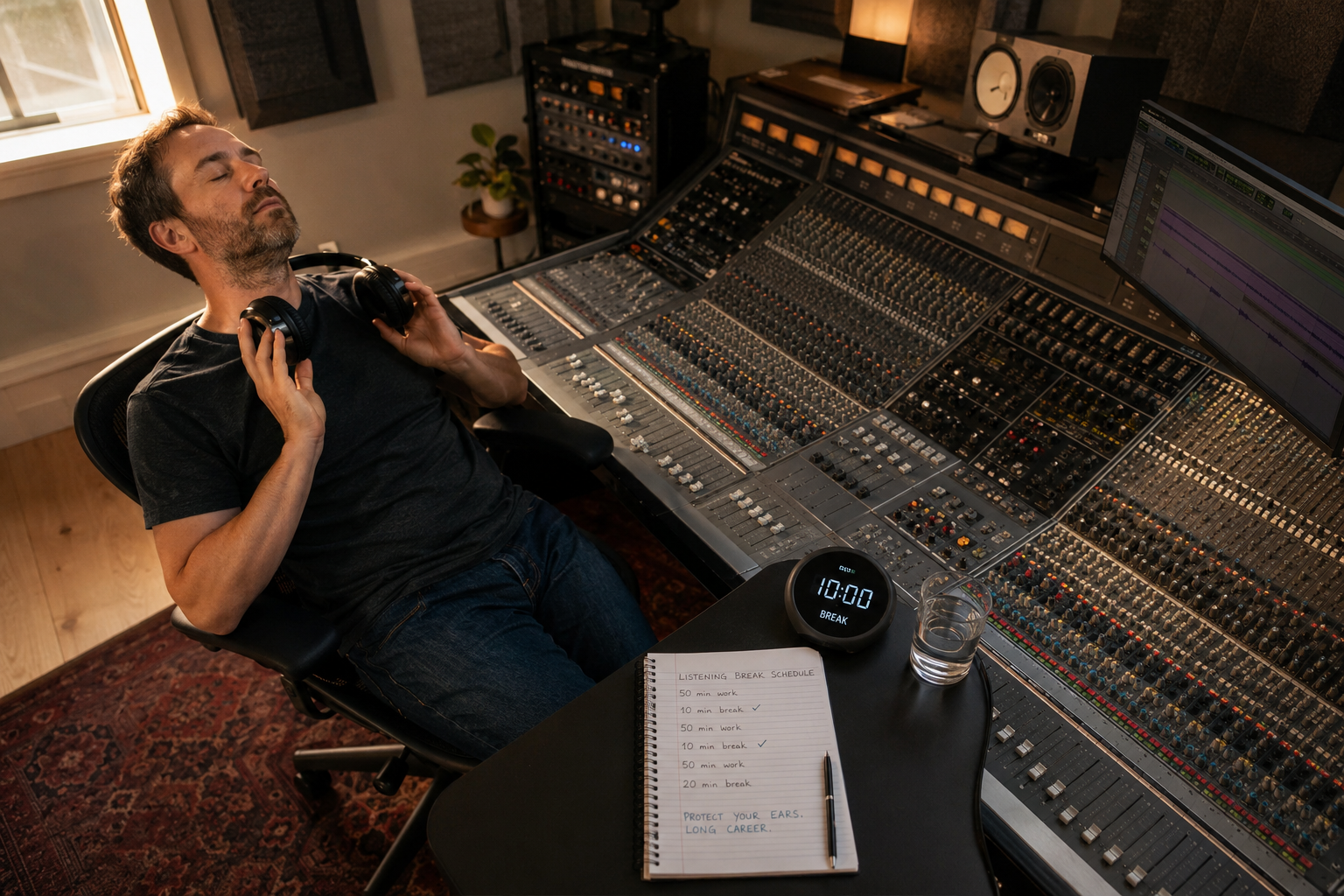
Practical break schedule for a full production day:
- Every 45 to 60 minutes: 10 to 15 minute silence break
- After 3 to 4 hours: 30-minute break minimum, preferably outdoors or in a quiet space
- After 6 to 8 hours: End the critical listening session. Administrative tasks, file management, or non-critical work can continue.
Some engineers use the Pomodoro technique (25 minutes on, 5 minutes off) adapted for audio work, taking a longer break every two cycles. The specific interval matters less than the consistency of the habit.
Edge case: During mastering or final mix review sessions, where concentration is highest and stakes are greatest, some engineers prefer shorter, more frequent breaks (every 30 minutes) rather than longer, less frequent ones. The goal is to arrive at each critical decision with fresh ears, not to accumulate hours at the console.
Recommended Ear Rest and Recovery Protocols for Professional Musicians and Engineers
Effective auditory decompression strategies for audio engineers and producers include both short-term session management and long-term career-level protocols.
Daily protocol:
- Begin each session with a 5-minute low-level listening warm-up rather than jumping immediately to critical decisions
- Monitor at the lowest level that allows accurate judgment (most engineers find 75 to 83 dB SPL sufficient)
- Log session duration and approximate monitoring level to track cumulative exposure over weeks and months
- End each workday with at least 2 hours of low-noise activity before sleep
Weekly protocol:
- Schedule at least one full day with minimal audio exposure (below 70 dB SPL throughout the day)
- Review any persistent symptoms (tinnitus, muffling, sensitivity changes) and note whether they resolved with rest
Annual protocol:
- Audiologist hearing test to document baseline and track changes over time
- Review and update monitoring calibration in the studio
- Assess whether equipment changes (new headphones, monitors, room treatment) have affected typical monitoring levels
Alternative Hearing Preservation Strategies for Recording Studio Environments
Beyond breaks and earplugs, several environmental and technical strategies reduce auditory load in studio settings.
Room acoustics: A well-treated room requires lower monitoring levels to achieve accurate perception. Bass buildup from untreated rooms forces engineers to monitor louder to hear low-frequency detail clearly. Acoustic treatment is, indirectly, a hearing preservation tool.
Monitor calibration: Using a sound level meter (SPL meter) to calibrate monitoring levels to a fixed reference point prevents the gradual level creep that happens when engineers unconsciously turn up the volume over a session.
Metering tools: Loudness meters (LUFS-based) and SPL meters visible in the DAW reduce the temptation to judge loudness by ear, which in turn reduces the tendency to monitor at excessive levels.
Lighting and environment: Bright, harsh studio lighting increases cognitive stress, which compounds auditory fatigue. Softer, adjustable lighting reduces overall sensory load during long sessions.
Workflow design: Structuring sessions so that the most critical listening tasks happen in the first two hours, when ears are freshest, produces better results and reduces the total time spent at high monitoring levels.
What Equipment Helps Prevent Hearing Loss in Loud Sound Environments
The right equipment makes auditory decompression strategies for audio engineers and producers significantly easier to maintain consistently.
Essential equipment:
- SPL meter or calibrated measurement microphone: Allows objective monitoring level calibration. Options range from $20 smartphone apps (lower accuracy) to dedicated hardware meters ($100 to $500).
- Custom flat-response musician’s earplugs: The single most important protective equipment for live sound engineers. Brands such as Etymotic and Sensaphonics are well-regarded in the professional audio community.
- In-ear monitors with volume-limiting capability: For performers and monitor engineers, IEMs with built-in limiting prevent accidental overexposure.
- Volume-limiting headphone amplifiers: Devices that cap output at a set SPL level, useful for long headphone-based production sessions.
- Acoustic treatment panels: Bass traps, broadband absorbers, and diffusers reduce the SPL required for accurate monitoring in a room.
What does not help as much as marketed:
- Consumer “hearing protection” earbuds with noise cancellation: These are designed for comfort, not flat-response attenuation.
- Generic foam earplugs for studio monitoring: They distort frequency perception and are not suitable for critical listening.
Symptoms That Indicate You Might Need Auditory Decompression Techniques
Specific symptoms signal that the auditory system is under stress and that immediate decompression is needed. Recognizing these early prevents temporary threshold shift from becoming permanent hearing loss.
Symptoms requiring immediate action (stop the session):
- Ringing, buzzing, or tonal tinnitus during or immediately after a session
- A sense of muffled or “underwater” hearing after leaving the studio
- Difficulty distinguishing high-frequency content (cymbals, sibilance, air) that was clear earlier in the session
- Ear pressure or a feeling of fullness in one or both ears
- Headache localized around the temples or jaw (often associated with tension from concentrated listening)
Symptoms requiring professional evaluation (persistent across multiple days):
- Tinnitus that does not resolve after 48 hours of rest
- Noticeable asymmetry in hearing between left and right ears
- Difficulty understanding speech in noisy environments
- Hyperacusis (increased sensitivity to everyday sounds)
Common mistake: Treating tinnitus as a normal part of the job. It is not. Tinnitus is a symptom of auditory stress or damage. Normalizing it delays intervention and increases the risk of permanent change.
Scientific Research on Long-Term Hearing Health for Sound Professionals
The scientific literature on occupational hearing loss in audio professionals consistently supports the need for structured auditory decompression strategies. The evidence base is clear, even if specific protocols vary.
Key findings from peer-reviewed research:
- A 2014 study published in the International Journal of Audiology found that professional musicians showed significantly higher rates of noise-induced hearing loss and tinnitus compared to non-musician control groups, with prevalence of tinnitus reaching 52% in some musician samples (Jansen et al., 2014).
- The World Health Organization estimated in 2019 that over 1 billion young people globally are at risk of hearing loss due to unsafe listening practices, a figure that includes music industry professionals (WHO, 2019).
- Research on temporary threshold shift (TTS) confirms that recovery from moderate noise exposure (85 to 95 dB SPL for 2 hours) typically occurs within 16 to 24 hours with adequate rest, but repeated exposure without recovery accelerates permanent threshold shift (PTS) (Melnick, 1991).
- NIOSH (National Institute for Occupational Safety and Health) recommends an 85 dB SPL limit for an 8-hour workday, with a 3 dB exchange rate (every 3 dB increase halves the permissible exposure time).
The consensus across audiology research is that cumulative, moderate-level exposure over years is more damaging than occasional loud events, and that behavioral interventions (breaks, level management, protection) are effective at reducing risk.
FAQ
What is the 60/60 rule for audio engineers? The 60/60 rule recommends listening at no more than 60% of maximum volume for no longer than 60 minutes at a time before taking a break. It is a practical guideline for headphone users and applies well to home studio producers.
Can ear fatigue cause permanent hearing damage? Temporary ear fatigue (temporary threshold shift) is reversible with rest. However, repeated episodes without adequate recovery time can progress to permanent threshold shift, which is irreversible. The transition depends on the level, duration, and frequency of exposure.
How long does it take for ears to recover from a loud session? Mild fatigue from a moderate session (80 to 85 dB SPL for 2 to 3 hours) typically resolves within 8 to 16 hours with quiet rest. More intense exposure may require 24 to 48 hours. If symptoms persist beyond 48 hours, consult an audiologist.
Are noise-canceling headphones a substitute for hearing protection? No. Noise-canceling headphones reduce ambient noise so you can listen at lower volumes, which is helpful. But they are not rated hearing protection devices and do not replace flat-response musician’s earplugs in high-SPL environments.
What monitoring level should I use when mixing? Most professional mix engineers calibrate their monitoring to 79 to 83 dB SPL for extended sessions, measured with a pink noise reference signal and an SPL meter. Some prefer lower levels (70 to 75 dB SPL) for long sessions and check at higher levels only briefly.
Is tinnitus reversible? Acute tinnitus caused by a single loud exposure often resolves with rest. Chronic tinnitus from cumulative damage is frequently permanent. Early intervention and avoidance of further exposure are the most important factors in limiting progression.
Do audio engineers need annual hearing tests? Yes. An annual audiogram provides a documented baseline and allows early detection of threshold changes. Many engineers do not notice gradual high-frequency loss because it happens slowly. A test makes the change measurable and actionable.
What is the best free auditory decompression strategy? Complete silence breaks of 10 to 15 minutes per hour cost nothing and are among the most effective interventions supported by audiology research. Sleep is the single most effective recovery tool overall.
Can room acoustics affect hearing health? Yes. Poor room acoustics (excessive bass buildup, flutter echo, high ambient noise) cause engineers to monitor at higher levels to hear accurately. Acoustic treatment reduces the SPL needed for critical listening, which directly reduces cumulative noise dose.
Are in-ear monitors safer than stage wedges for live performers? Generally yes, because IEMs deliver a controlled signal at a predictable level directly to the ear, replacing the need for loud stage monitors. However, IEMs can also cause damage if output levels are set too high. Volume management is still required.
Conclusion
Auditory decompression strategies for audio engineers and producers are not optional wellness advice. They are professional maintenance for the primary tool of the trade: your hearing.
The core actions are straightforward. Monitor at calibrated, measured levels. Take 10 to 15 minutes of silence per hour of critical listening. Use flat-response hearing protection in high-SPL environments. Get a baseline audiogram and repeat it annually. Recognize the early symptoms of fatigue and respond to them immediately rather than pushing through.
Actionable next steps for 2026:
- Book a baseline audiogram with an audiologist if you do not have one on file.
- Purchase an SPL meter (hardware or a calibrated app) and measure your current monitoring level this week.
- Set a timer during your next session and enforce a 10-minute silence break every 60 minutes.
- Research custom flat-response musician’s earplugs if you work in live sound or attend loud events regularly.
- Review your headphone usage: if you use headphones for more than 3 hours daily, implement a volume cap and alternating break schedule.
The engineers who work at the highest level for the longest careers are not the ones with the best ears at 25. They are the ones who protected those ears consistently for decades. Start that practice now, regardless of where you are in your career.
References
- Jansen, E. J. M., Helleman, H. W., Dreschler, W. A., & de Laat, J. A. P. M. (2009). Noise induced hearing loss and other hearing complaints among musicians of symphony orchestras. International Archives of Occupational and Environmental Health, 82(2), 153–164.
- Melnick, W. (1991). Human temporary threshold shift (TTS) and damage risk. Journal of the Acoustical Society of America, 90(1), 147–154.
- National Institute for Occupational Safety and Health (NIOSH). (1998). Criteria for a Recommended Standard: Occupational Noise Exposure. U.S. Department of Health and Human Services. https://www.cdc.gov/niosh/docs/98-126/
- World Health Organization. (2019). Hearing Loss Due to Recreational Exposure to Loud Sounds: A Review. WHO Press. https://www.who.int/publications/i/item/hearing-loss-due-to-recreational-exposure-to-loud-sounds
Read next: Vagus Nerve Stimulation Techniques Using Cold Water Immersion: A Complete Guide. A closer look at vagus nerve cold water.