
Key Takeaways
- Scent travels directly to the limbic system, the brain region that governs emotion and memory, which is why certain smells can shift your mood within seconds.
- Your fragrance preferences reveal genuine personality traits: people drawn to woody, earthy scents tend toward introversion and groundedness, while those who prefer citrus often score higher in openness and energy.
- Lavender, chamomile, and sandalwood are the most research-supported scents for reducing anxiety and promoting relaxation; peppermint and citrus are best for alertness.
- Different rooms benefit from different fragrance profiles: calming scents in the bedroom, energizing ones in the home office, and welcoming, neutral scents in living areas.
- Layering more than two to three scent families at once creates olfactory fatigue and can cause headaches, especially in small spaces.
- Essential oil diffusers offer more control over scent intensity and are generally safer for people with allergies than paraffin candles, which release low levels of volatile organic compounds.
- Seasonal fragrance shifts are psychologically real: research in environmental psychology links seasonal scent cues to mood regulation and a sense of temporal grounding.
- People with anxiety or stress respond best to single-note or simple two-note fragrances rather than complex blends.
- Fragrance sensitivity is partly genetic and partly conditioned by personal memory associations, which means no universal “best” scent exists.
- Affordable reed diffusers and soy candles can perform as well as luxury options for most everyday home fragrance needs.
What Does Your Choice of Home Fragrance Say About Your Personality
Your fragrance choices are a reliable, if informal, window into your personality. Research in sensory psychology consistently links scent preferences to core personality dimensions such as openness to experience, emotional sensitivity, and introversion versus extroversion.
Here is a rough guide to what common fragrance preferences suggest:
| Fragrance Family | Common Personality Traits |
|---|---|
| Citrus (lemon, grapefruit, bergamot) | Energetic, sociable, optimistic, action-oriented |
| Woody/Earthy (cedar, vetiver, patchouli) | Grounded, introverted, thoughtful, tradition-oriented |
| Floral (rose, jasmine, peony) | Warm, romantic, empathetic, emotionally expressive |
| Fresh/Clean (linen, green tea, cucumber) | Minimalist, organized, detail-focused |
| Spicy/Warm (cinnamon, clove, amber) | Creative, sensory-driven, bold, comfort-seeking |
| Gourmand (vanilla, tonka bean, caramel) | Nurturing, nostalgic, home-centered |
These are tendencies, not diagnoses. A person who loves vetiver in winter may reach for bergamot in summer. What matters is noticing your consistent pulls across seasons and moods, because those patterns reveal what your nervous system genuinely finds soothing or stimulating.
Common mistake: Choosing a home fragrance based on what smells good in a store or in someone else’s home. Fragrance behaves differently in your space because of room size, ventilation, existing furniture materials, and even your own skin chemistry if you are near the source.
How Do Different Scents Impact Mood and Emotional State
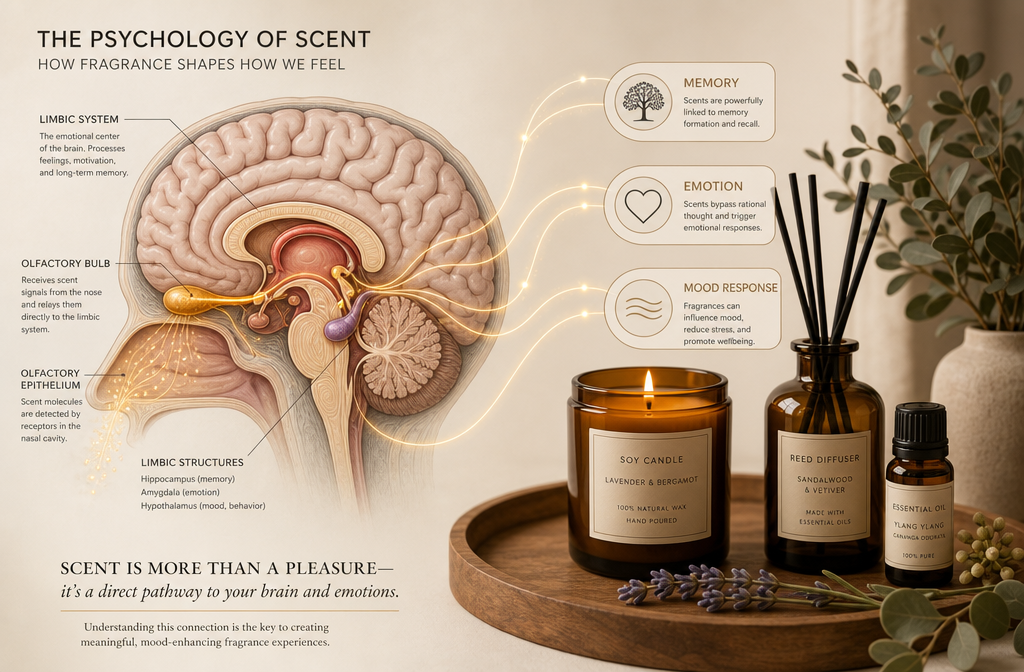
Scent impacts mood faster than any other sensory input because the olfactory nerve connects directly to the amygdala and hippocampus, the brain structures responsible for emotional response and memory. Unlike sight or sound, scent bypasses the thalamus entirely.
This is the core insight behind the psychology of scent: finding your signature home fragrance is not just an aesthetic decision. It is a neurological one.
Key mood effects by scent category:
- Lavender: Reduces cortisol levels and heart rate; multiple studies, including research published in the journal Frontiers in Behavioral Neuroscience (2019), support its use for anxiety reduction.
- Peppermint: Increases alertness and cognitive performance; useful in work-from-home environments.
- Citrus (especially lemon): Associated with elevated serotonin activity and reduced perceived stress in clinical settings.
- Ylang-ylang: Lowers blood pressure and promotes calm, though some people find it too heavy in large doses.
- Rosemary: Linked to improved memory retention and mental clarity in several small-scale studies.
- Vanilla: Triggers associations with warmth and safety; widely used in hospitality environments to increase perceived comfort.
The effect is not purely chemical. Much of it is conditioned. If you grew up in a home where cinnamon meant safety and warmth, that association is encoded in your limbic system and will activate every time you smell it.
Which Fragrance Notes Work Best for Relaxation vs. Energy
For relaxation, choose base and middle notes with low volatility: lavender, sandalwood, chamomile, cedarwood, and vetiver. For energy, choose top notes with high volatility: citrus, peppermint, eucalyptus, and rosemary.
Relaxation-focused scents:
- Lavender (most studied; effective at low concentrations)
- Roman chamomile
- Sandalwood
- Frankincense
- Bergamot (despite being a citrus, it has documented calming properties at moderate concentrations)
Energy and focus scents:
- Peppermint
- Lemon and grapefruit
- Eucalyptus
- Spearmint
- Rosemary
Decision rule: Choose relaxation scents for evening use, bedrooms, and meditation spaces. Choose energy scents for morning routines, home offices, and exercise areas. Avoid energy scents after 7 p.m. if you have trouble winding down, because their stimulating effect on the nervous system can delay sleep onset.
What Fragrances Work Best for People with Anxiety or Stress
People with anxiety or stress benefit most from simple, single-note or two-note fragrances rather than complex blends. The reason is straightforward: complex scents require more cognitive processing, which can itself be mildly activating for an already-stressed nervous system.
Best home scents for anxiety:
- Lavender (single note or paired with chamomile) — the most consistently supported option in clinical aromatherapy literature.
- Frankincense — used in contemplative traditions for centuries; modern research suggests it may activate TRPV3 channels in the brain associated with reduced anxiety.
- Cedarwood — contains cedrol, a compound linked to sedative effects in animal studies; anecdotally reported as grounding by many people with anxiety.
- Vetiver — heavy, earthy, and slow-releasing; often described as “anchoring” by therapists who use aromatherapy as a complementary tool.
- Bergamot — citrusy but calming; a useful bridge scent for people who find pure florals or woods too heavy.
Edge case: Some people with anxiety have developed negative associations with specific scents (for example, a hospital smell linked to a traumatic event). In those cases, even a clinically “calming” scent can trigger distress. Always trust your personal response over general recommendations.
What Fragrances Suit Different Rooms
Room function should drive fragrance choice. The bedroom calls for calming, sleep-supportive scents; the living room benefits from welcoming, neutral-to-warm scents; the home office needs focus-enhancing scents; and the kitchen and bathroom work best with fresh, clean profiles.
Room-by-room guide:
| Room | Recommended Scent Profile | Example Notes |
|---|---|---|
| Bedroom | Calming, sleep-supportive | Lavender, chamomile, sandalwood |
| Living room | Welcoming, warm | Vanilla, amber, light wood |
| Home office | Focus-enhancing | Peppermint, rosemary, lemon |
| Kitchen | Fresh, appetite-neutral | Citrus, green herbs, clean linen |
| Bathroom | Spa-like, clean | Eucalyptus, mint, white tea |
| Entryway | Memorable, welcoming | Cedar, bergamot, light floral |
Quick example: I switched my home office from a vanilla candle to a peppermint diffuser blend and noticed a measurable difference in how quickly I settled into focused work. The vanilla was comforting but cognitively “soft.” The peppermint created a mental signal that work time had begun.
Are Essential Oil Diffusers Better Than Candles for Home Fragrance
For most people, ultrasonic essential oil diffusers offer more control, longer run times, and fewer air quality concerns than paraffin candles. However, “better” depends on your priorities.
Comparison:
| Factor | Essential Oil Diffuser | Candle |
|---|---|---|
| Scent control | High (adjustable intensity) | Low (fixed once lit) |
| Air quality | Neutral to positive | Paraffin releases low-level VOCs |
| Safety | No open flame | Open flame risk |
| Ambiance | Minimal visual effect | Warm, visual glow |
| Cost per use | Lower long-term | Higher if using premium candles |
| Allergy risk | Lower (no combustion) | Higher with paraffin; soy is safer |
Choose a diffuser if: you have respiratory sensitivities, pets, children, or you want precise control over scent intensity throughout the day.
Choose a candle if: ambiance and the ritual of lighting a flame matter to you, and you use soy or beeswax rather than paraffin to reduce VOC exposure.
Soy and beeswax candles are meaningfully cleaner-burning than paraffin. If candles are your preference, that distinction matters for both air quality and fragrance purity.
Cost Comparison of Luxury vs. Affordable Home Scent Diffusers
Affordable reed diffusers and ultrasonic diffusers perform comparably to luxury options for everyday home fragrance. The main differences at higher price points are ingredient quality, scent complexity, and bottle aesthetics rather than functional superiority.
Approximate price ranges (2026):
- Budget reed diffusers: $8 to $20; typically last 4 to 8 weeks
- Mid-range reed diffusers: $25 to $60; better oil concentration, longer throw
- Luxury reed diffusers (e.g., Diptyque, Maison Margiela): $80 to $200+; premium ingredients, complex accords, design objects
- Budget ultrasonic diffusers: $15 to $35 for the device; essential oils $5 to $15 per bottle
- Mid-range ultrasonic diffusers: $40 to $80; quieter, better mist output, timer functions
- Luxury ultrasonic diffusers: $100 to $300+; design-forward, app-controlled, hotel-grade output
Practical guidance: For most rooms under 300 square feet, a $25 to $40 reed diffuser or a $30 ultrasonic diffuser with quality essential oils will deliver results indistinguishable from luxury alternatives. Invest in higher-quality options for entryways and living rooms where scent impression matters most to guests.
Common Mistakes People Make When Selecting Home Fragrances
The most common mistake is choosing a fragrance based on a brief in-store sniff rather than a 30-minute wear test in your actual space. Scent evolves as it diffuses, and what smells balanced in a store can become overwhelming or flat at home.
Other frequent errors:
- Using the same scent in every room. Scent uniformity removes the psychological cues that help your brain transition between rest, work, and social modes.
- Overloading intensity. More is not better. A diffuser running at full output in a small bedroom creates olfactory fatigue, not relaxation.
- Ignoring seasonal shifts. Heavy base notes like oud and patchouli that feel grounding in winter can feel suffocating in summer heat.
- Mixing too many scent families. A woody candle plus a floral diffuser plus a citrus spray in the same room creates olfactory noise, not a signature.
- Choosing based on trend rather than personal response. If a scent is popular but makes you feel vaguely uneasy, no amount of aesthetic appeal will override your nervous system’s response.
How to Layer Scents Without Creating Olfactory Overwhelm
Layering home fragrances works best when you stick to one scent family and vary only the intensity and format. The goal is depth, not complexity.
A practical layering approach:
- Choose a single dominant scent family (for example, woody/earthy).
- Use one primary source: a diffuser or a candle, not both simultaneously.
- Add a secondary layer through a linen spray or room mist using a complementary note within the same family (cedar and vetiver work together; cedar and jasmine compete).
- Keep the secondary layer subtle, roughly 20 to 30 percent of the overall scent presence.
- Ventilate the room for 10 minutes before adding a second layer if switching scents.
Rule of thumb: If you can identify more than two distinct scents when you walk into a room, you have layered too heavily. A signature home fragrance should read as a single, unified impression.
Why Some People Are More Sensitive to Certain Fragrance Notes
Fragrance sensitivity has two distinct causes: genetic variation in olfactory receptor genes and conditioned emotional associations built up over a lifetime. Both are real and both deserve respect.
Roughly 1 in 1,000 people carry a genetic variant that makes them unable to detect certain musks entirely (a condition called specific anosmia). More broadly, variations in OR gene expression mean that the same fragrance can smell completely different to two people in the same room.
Beyond genetics, personal history shapes sensitivity. A person who associates pine with a difficult childhood memory will find pine-heavy scents activating rather than calming, regardless of what clinical research says about the scent’s general properties.
For people with heightened sensitivity: Start with single-note fragrances at low concentrations. Avoid synthetic musks and aldehydes, which are the most common triggers for headaches and sensory overload. Natural essential oils tend to be better tolerated than synthetic fragrance oils, though neither is universally safe.
Do Seasonal Scents Really Make a Psychological Difference
Yes, seasonal scents create a genuine psychological effect. Research in environmental psychology supports the idea that seasonal scent cues help regulate mood and reinforce a sense of temporal rhythm, which is particularly important for people who work from home and lose natural seasonal markers.
Seasonal scent guide:
- Spring: Green, floral, and fresh notes (hyacinth, lily of the valley, green tea)
- Summer: Citrus, aquatic, and light herbal notes (lemon, sea salt, basil)
- Autumn: Warm spice and wood notes (cinnamon, clove, cedar, apple)
- Winter: Deep, resinous, and gourmand notes (frankincense, vanilla, oud, pine)
Rotating your home fragrance with the seasons is one of the simplest and most underused tools in the psychology of scent: finding your signature home fragrance does not mean choosing one scent forever. It means building a personal scent wardrobe that shifts with your environment and emotional needs.
What Home Fragrances Work Well for People with Allergies or Sensitivities
People with allergies or chemical sensitivities should prioritize fragrance-free or single-ingredient essential oil options and avoid synthetic fragrance compounds, which are among the most common contact allergens.
Safer options for sensitive individuals:
- Unscented beeswax candles with a single drop of a tested essential oil
- Hydrosols (floral waters) rather than concentrated essential oils; these are far lower in allergen concentration
- Single-note essential oils such as pure lavender or pure cedarwood, diffused at low intensity and for short periods (30 to 60 minutes maximum)
- Avoid: Synthetic musks, oakmoss, tree moss, cinnamal, eugenol, and isoeugenol (common allergens listed in EU fragrance allergen regulations)
Practical tip: Always patch-test a new fragrance in a single room with good ventilation before committing to whole-home use. If you notice headache, eye irritation, or respiratory discomfort within 20 minutes, discontinue and ventilate.
FAQ
Q: How do I find my signature home fragrance if I have never thought about it before? Start by noting which scents you seek out naturally: the coffee shop you prefer, the soap you keep buying, the candle aisle you linger in. Those instinctive pulls reveal your baseline fragrance preferences more reliably than any quiz.
Q: Can home fragrance genuinely reduce stress, or is it placebo? Both mechanisms are real. Certain compounds in lavender and bergamot have documented effects on cortisol and heart rate. But the placebo component, meaning the comfort of a familiar, positive scent association, is also a legitimate psychological benefit. Either way, the outcome is reduced stress.
Q: How long should I run a diffuser each day? Most aromatherapy guidelines suggest 30 to 60 minutes of diffusion at a time, with breaks in between. Continuous diffusion can cause olfactory fatigue and, in some people, mild headaches or respiratory irritation.
Q: Are luxury candles worth the price for home fragrance? For most people, no. The primary advantages of luxury candles are scent complexity, cleaner ingredients, and aesthetic design. A well-formulated soy candle in the $20 to $35 range will deliver comparable mood effects for everyday use.
Q: Can pets be harmed by home fragrances? Yes. Cats are particularly sensitive to essential oils because they lack certain liver enzymes needed to metabolize phenols. Tea tree, eucalyptus, clove, and cinnamon oils are especially risky around cats. Dogs are more tolerant but can still be affected by high concentrations. Always diffuse in ventilated spaces and allow pets to leave the room.
Q: How often should I change my home fragrance? There is no fixed rule. Many people rotate seasonally (four times per year) and find that sufficient for psychological freshness. If you notice you have stopped smelling your current fragrance, that is olfactory adaptation, and a brief break of a few days will reset your sensitivity.
Q: What is the best home fragrance for a first impression when guests arrive? Entryway and living room scents that work universally well for guests include light cedar, bergamot, and subtle vanilla. These are warm but not polarizing, and they signal cleanliness and welcome without being aggressive.
Q: Is it safe to use essential oils in a home with a baby? Most aromatherapists and pediatric health organizations recommend avoiding essential oil diffusion around infants under three months entirely, and using only very diluted, tested oils (lavender being the most studied) around older infants. Always consult a pediatrician before introducing any fragrance into a baby’s environment.
Conclusion
The psychology of scent: finding your signature home fragrance is ultimately about self-knowledge as much as it is about fragrance chemistry. Your nervous system has preferences built from genetics, memory, and lived experience, and those preferences are more reliable than any trend guide.
Actionable next steps:
- Spend one week noticing which scents you seek out naturally in daily life, without trying to choose a home fragrance yet.
- Identify the two or three rooms in your home where mood matters most (bedroom, office, living room) and assign a distinct scent purpose to each.
- Start with a single-note essential oil or a simple two-note candle rather than a complex blend, and test it for at least three days before deciding.
- If you have allergies or sensitivities, begin with a hydrosol or a very low-concentration diffusion of a single tested oil.
- Build a small seasonal rotation of two to four fragrances across the year to maintain psychological freshness and reinforce the natural rhythm of the seasons.
Your home’s scent is one of the few environmental factors you can control completely. Used thoughtfully, it becomes one of the most effective and affordable tools for shaping how you feel in the place where you spend the most time.
References
- Frontiers in Behavioral Neuroscience. (2019). “Effects of lavender on anxiety and stress.” Frontiers Media. https://www.frontiersin.org/journals/behavioral-neuroscience
- Herz, R. S. (2009). “Aromatherapy facts and fictions: A scientific analysis of olfactory effects on mood, physiology and behavior.” International Journal of Neuroscience, 119(2), 263–290.
- Spence, C. (2015). “On the nose: The relative contributions of the chemical senses to the perception and memory of wine.” Flavour, 4(1).
- European Commission. (2012). EU Cosmetics Regulation 1223/2009, Annex III: List of Restricted Fragrance Allergens. https://ec.europa.eu/growth/sectors/cosmetics
Read next: At-Home Tea Tasting: A Guide to Rare Oolong Varieties. A closer look at oolong tea tasting.