
Grounding techniques for hypervigilance in crowded public spaces are sensory-based, cognitive, or physical exercises that interrupt the nervous system’s threat-detection loop and return your attention to the present moment. They work by activating the parasympathetic nervous system, which counteracts the fight-or-flight response triggered by hypervigilance. Most techniques can be done silently and discreetly, making them practical for use in airports, shopping malls, public transit, and other busy environments.
Key Takeaways
- Hypervigilance is a state of heightened alertness often linked to PTSD, generalized anxiety disorder, and other trauma-related conditions. It makes crowded spaces feel threatening even when they are not.
- The 5-4-3-2-1 sensory method is one of the most evidence-supported grounding techniques for panic and hypervigilance in public settings.
- Grounding works by redirecting the brain’s attention from perceived threat to concrete, present-moment sensory input, calming the nervous system.
- Most grounding techniques are free, require no equipment, and can be done without drawing attention to yourself in public.
- For people with PTSD, grounding techniques should be used alongside professional therapy, not as a standalone treatment.
- Children and teenagers can use modified versions of adult grounding methods, adapted for shorter attention spans and developmental stage.
- Signs that hypervigilance is becoming unmanageable include avoiding all public spaces, inability to work or socialize, and constant physical tension that does not resolve.
- Grounding techniques typically begin showing noticeable effects within a few weeks of consistent daily practice, though immediate relief is possible from the first use.
- Common mistakes include waiting until full panic sets in before grounding, using techniques too quickly, and not practicing them during calm periods.
- Therapy for hypervigilance, including EMDR and CBT, typically costs between $100 and $300 per session in the United States, though sliding-scale and online options exist.
What Are Grounding Techniques and How Do They Help with Anxiety
Grounding techniques are structured mental or physical exercises designed to anchor a person to the present moment by engaging the senses, the body, or rational thought. They help with anxiety by interrupting the brain’s automatic threat-scanning loop and giving the nervous system a concrete, non-threatening focus.
When someone experiences anxiety or hypervigilance, the brain’s amygdala (the threat-detection center) fires rapidly, flooding the body with stress hormones like cortisol and adrenaline. Grounding techniques work because they activate the prefrontal cortex, the part of the brain responsible for rational thought, which can dampen the amygdala’s alarm signals.
There are three broad categories:
- Sensory grounding: Engaging sight, touch, smell, taste, or hearing to anchor attention to the physical world (for example, pressing your feet firmly into the floor).
- Cognitive grounding: Using mental tasks like counting backward, naming categories, or reciting facts to redirect attention away from anxious thoughts.
- Physical grounding: Using body-based actions like controlled breathing, muscle tension and release, or holding something cold to shift the nervous system’s state.
For people using grounding techniques for hypervigilance in crowded public spaces specifically, sensory and physical methods tend to work fastest because they don’t require sustained concentration, which is difficult when the environment feels overwhelming.
Why Do Some People Feel More Anxious in Crowds Than Others
Some people are neurologically and experientially primed to perceive crowds as threatening, while others are not. The difference comes down to a combination of trauma history, nervous system sensitivity, and learned threat associations.
Crowds present a specific challenge: unpredictable movement, noise, proximity to strangers, and limited escape routes. For most people, the brain processes this as mildly stimulating. For someone with a sensitized threat-detection system, the same environment registers as dangerous.
Key factors that increase crowd anxiety include:
- Trauma history: Past experiences of assault, accidents, or public humiliation can condition the brain to treat similar environments as high-risk.
- PTSD: Post-traumatic stress disorder rewires threat detection, making the nervous system fire at lower and lower thresholds over time.
- Sensory processing sensitivity: Some people are neurologically wired to process sensory input more intensely, making crowds overstimulating rather than just busy.
- Generalized anxiety disorder (GAD): Chronic worry amplifies perceived risk in any unpredictable environment.
- Panic disorder: A history of panic attacks in public spaces creates anticipatory anxiety, where the fear of having an attack becomes its own trigger.
Understanding why you feel more anxious in crowds is useful because it points to the right type of grounding technique. Someone with PTSD may need trauma-informed grounding, while someone with sensory sensitivity may benefit more from noise-reduction strategies combined with physical anchoring.
What Mental Health Conditions Cause Hypervigilance
Hypervigilance is a symptom, not a diagnosis on its own. It appears most commonly in PTSD, anxiety disorders, and certain trauma-related conditions, and it means the nervous system is stuck in a persistent state of high alert.
Conditions most associated with hypervigilance:
| Condition | How Hypervigilance Presents |
|---|---|
| PTSD | Constant scanning for threats, exaggerated startle response, difficulty relaxing |
| Generalized Anxiety Disorder | Persistent worry about safety, over-monitoring of environment |
| Panic Disorder | Heightened body awareness, fear of physical symptoms |
| Complex PTSD (C-PTSD) | Chronic hypervigilance rooted in prolonged trauma, often from childhood |
| Social Anxiety Disorder | Hyper-focus on others’ reactions and judgments |
| OCD | Vigilance around specific feared triggers or contamination |
Hypervigilance in crowded spaces is especially common in people with PTSD and C-PTSD, because crowds contain many of the environmental variables (noise, unpredictability, proximity) that trauma survivors learn to monitor closely.
How to Stop Feeling Overwhelmed in Crowded Places
The fastest way to stop feeling overwhelmed in a crowded place is to interrupt the sensory overload cycle before it escalates to full panic. This means using a grounding technique at the first sign of distress, not after anxiety has peaked.
A practical three-step approach for crowded environments:
- Pause and anchor. Stop walking if possible. Press your feet firmly into the ground and feel the floor beneath you. This simple physical action signals to your nervous system that you are stable and stationary.
- Slow your breath. Breathe in for four counts, hold for two, breathe out for six. The longer exhale activates the vagus nerve, which directly reduces heart rate and anxiety. Do this for at least three full cycles.
- Name your environment. Look around and silently name five things you can see that are not threatening: a coffee cup, a blue coat, a window, a sign, a child’s shoe. This redirects the brain’s threat-scanning toward neutral observation.
Preparation strategies (before entering a crowded space):
- Identify exits when you arrive. Knowing where exits are reduces the brain’s need to constantly scan for them.
- Choose less crowded entry times when possible (for example, off-peak hours at grocery stores or museums).
- Carry a grounding object in your pocket, such as a smooth stone or a textured keychain, to use as a tactile anchor.
- Use noise-canceling earbuds or earplugs to reduce auditory overload without fully disconnecting from the environment.
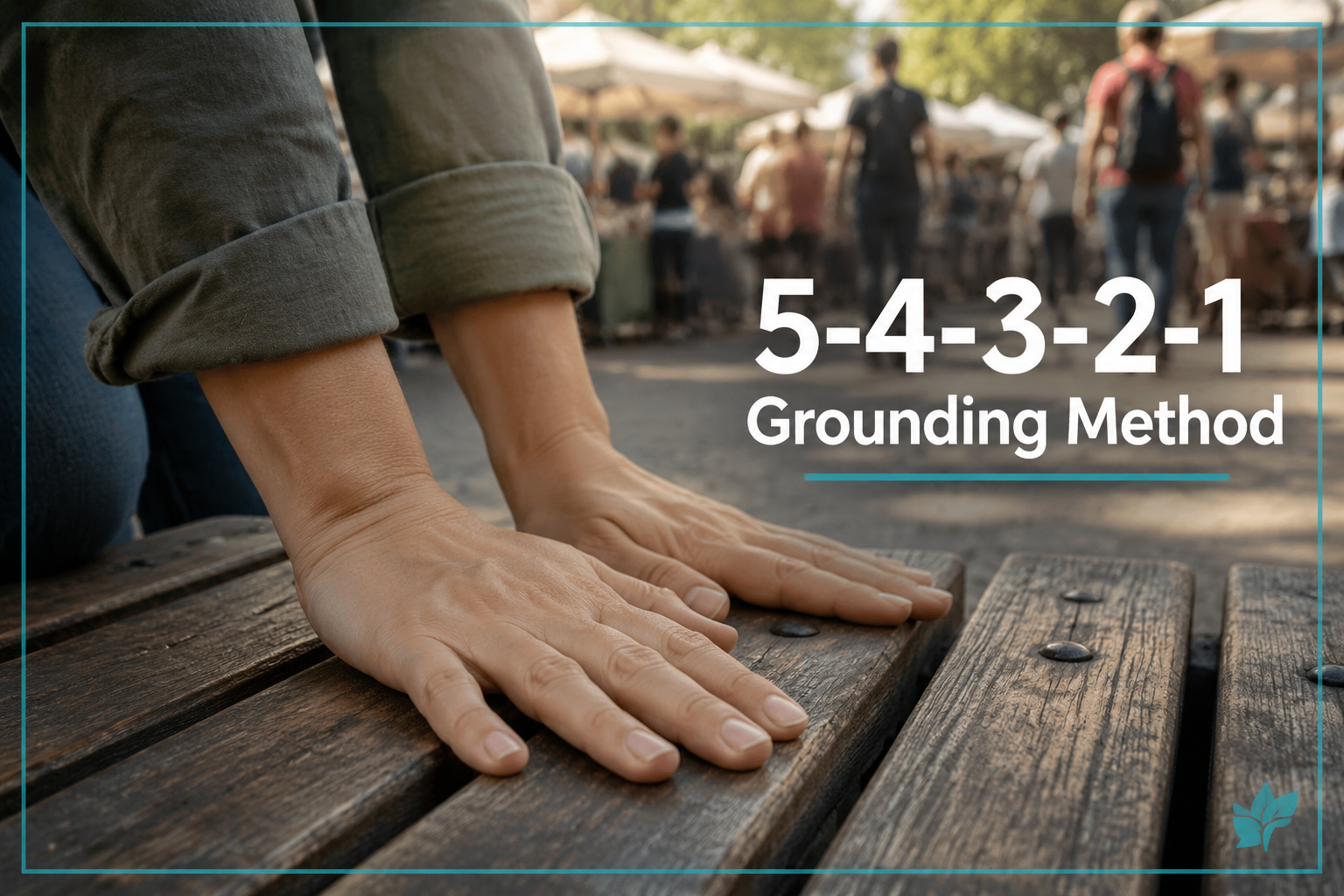
Best 5-4-3-2-1 Sensory Grounding Method for Panic Attacks
The 5-4-3-2-1 method is one of the most widely recommended grounding techniques for panic attacks and hypervigilance in crowded public spaces. It works by systematically engaging all five senses, pulling the brain out of a threat-focused state and into present-moment awareness.
How to do the 5-4-3-2-1 method:
- 5 things you can SEE: Look around and name five specific objects. Be precise: not just “a person” but “a woman in a red jacket carrying a paper bag.”
- 4 things you can TOUCH: Notice physical sensations. The texture of your jeans, the weight of your bag strap, the temperature of the air on your arms, the hardness of the floor.
- 3 things you can HEAR: Listen for distinct sounds. A distant announcement, the hum of an air conditioner, footsteps on tile.
- 2 things you can SMELL: Even subtle scents count. Coffee, someone’s perfume, fresh air from a nearby door.
- 1 thing you can TASTE: A piece of gum, a sip of water, or simply notice the taste in your mouth.
The method takes roughly two to four minutes and can be done while standing in a line, sitting on a bench, or waiting for a train. It requires no equipment and draws no attention from others.
Common mistake: People often rush through the exercise when they’re panicking, naming items quickly without actually engaging the senses. Slow down deliberately. The point is to actually feel, see, and hear each item, not just list them mentally.
Are Grounding Techniques Different for People with PTSD
Yes, grounding techniques for people with PTSD require some important modifications. Standard grounding works for general anxiety, but PTSD involves trauma triggers that can make certain sensory inputs re-traumatizing rather than calming.
For trauma survivors, the following adjustments matter:
- Avoid body-scan techniques if the body itself is a trauma trigger. Some PTSD survivors find body-focused grounding (like progressive muscle relaxation) distressing because it draws attention to physical sensations associated with trauma. In these cases, external-focus grounding (looking at objects, naming things in the room) is safer.
- Use a “safe place” anchor. Trauma-informed therapists often help clients develop a mental image of a genuinely safe place, which can be recalled during grounding to provide emotional containment alongside sensory anchoring.
- Practice during calm periods, not just crises. For people with PTSD, grounding needs to be an overlearned skill, practiced daily when calm, so it’s accessible during high-distress moments.
- Work with a therapist. Grounding is a stabilization skill in trauma therapy, not a cure. It should be used alongside evidence-based trauma treatments like EMDR (Eye Movement Desensitization and Reprocessing) or trauma-focused CBT.
“Grounding is the foundation of trauma stabilization. It doesn’t process the trauma, but it gives the nervous system a way to return to safety long enough to function.” This reflects the standard clinical framing used in trauma-informed care.
Grounding Techniques That Work for Kids and Teenagers
Children and teenagers can use grounding techniques effectively, but the methods need to match their developmental stage and attention span. Abstract cognitive techniques work less well for younger children; concrete, sensory-based methods work better.
For children (ages 5-12):
- Butterfly hug: Cross arms over the chest and alternately tap each shoulder in a slow rhythm. This bilateral stimulation is used in child-adapted EMDR and is calming and self-contained.
- Five finger breathing: Spread one hand wide and trace each finger slowly with the other hand’s index finger, breathing in as you go up each finger and out as you go down.
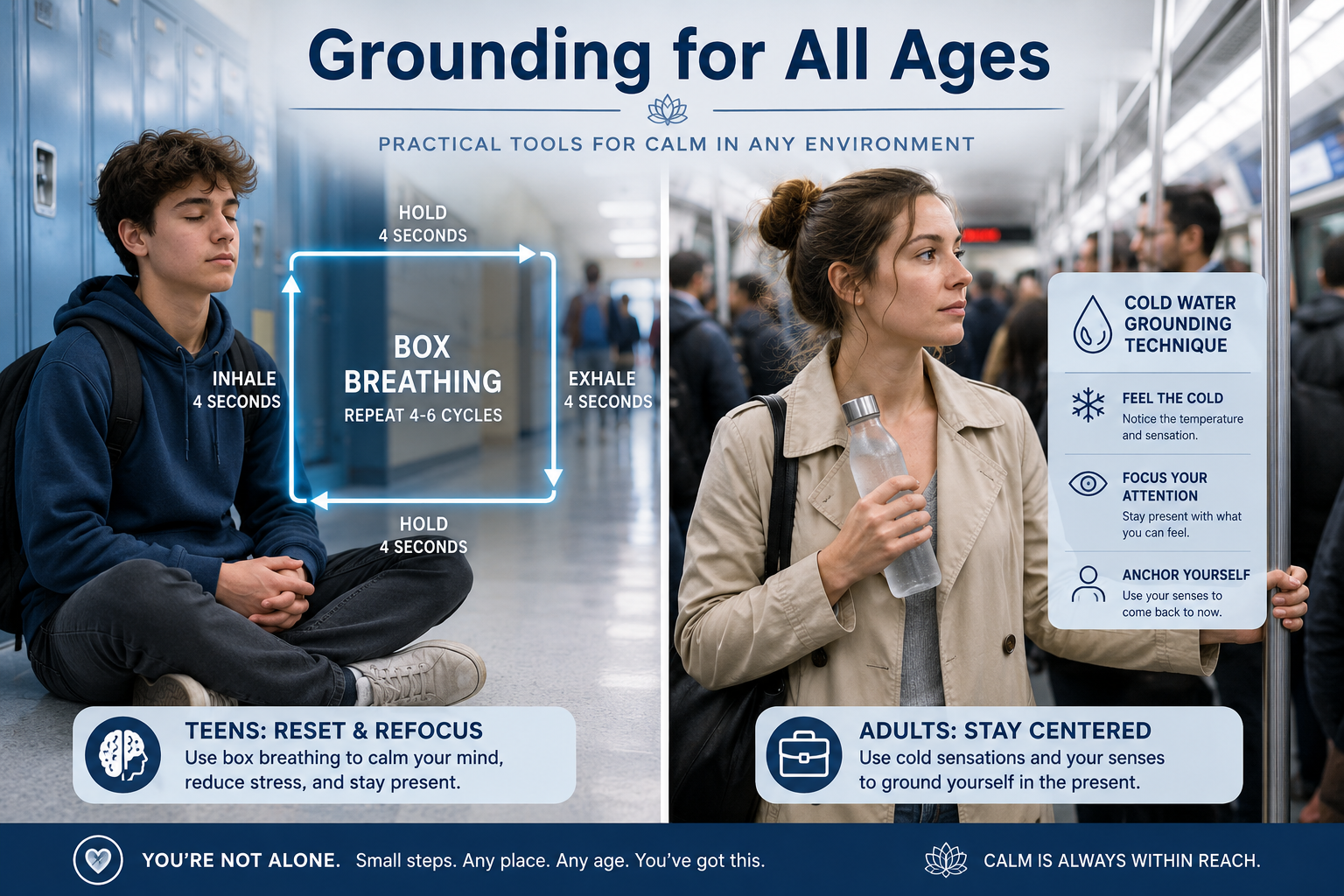
- Cold water: Hold a cold water bottle or splash cold water on the wrists. The temperature shift is a fast, effective physiological reset.
For teenagers (ages 13-18):
- The standard 5-4-3-2-1 method works well for most teenagers, especially if framed as a skill rather than a “therapy exercise.”
- Box breathing: Breathe in for four counts, hold for four, out for four, hold for four. Many teenagers find the structure easier to follow than open-ended breathing instructions.
- Music anchoring: Listening to a specific, familiar song through earbuds can serve as an auditory grounding anchor in public spaces. The song should be calming and associated with safety, not high-energy or emotionally charged.
The key for both age groups is to practice the technique at home before needing it in public, so it feels familiar rather than foreign during a stressful moment.
Cheap and Quick Grounding Techniques You Can Do in Public
Most effective grounding techniques cost nothing and take under five minutes. You don’t need an app, a therapist present, or any special equipment.
Free, discreet techniques for public use:
- Feet-to-floor grounding: Press both feet flat on the floor and notice the pressure. Say silently: “My feet are on the ground. I am here. I am safe.” Repeat three times.
- Temperature contrast: Hold a cold drink or press the inside of your wrist against a cool surface (a metal railing, a glass window). Cold activates the dive reflex, which slows heart rate quickly.
- Counting backward by threes: Starting from 100, count backward by threes (100, 97, 94…). This occupies the prefrontal cortex and interrupts the anxiety loop.
- Name a category: Silently name every type of dog breed, country in Europe, or fruit you can think of. The mental task redirects attention without requiring any physical movement.
- Slow exhale: Simply extend your exhale to be longer than your inhale. No counting required. Breathing out slowly for six to eight seconds activates the parasympathetic nervous system.
Low-cost tools worth considering:
- A small textured object in your pocket (a polished stone, a rubber ring, a coin with an interesting texture) costs almost nothing and provides immediate tactile grounding on demand.
- Noise-canceling earbuds reduce auditory overload and can be found for under $30.
How Much Do Therapy Sessions for Hypervigilance Cost
Professional therapy for hypervigilance, particularly trauma-focused therapy, typically costs between $100 and $300 per session in the United States as of 2026, depending on the therapist’s credentials, location, and treatment type.
Cost breakdown by therapy type:
| Therapy Type | Typical Cost per Session (US, 2026) | Notes |
|---|---|---|
| Standard CBT | $100-$200 | Most widely available |
| EMDR | $150-$250 | Requires specialized training |
| Somatic therapy | $120-$220 | Body-focused trauma work |
| Online therapy platforms | $60-$100 | Sliding scale often available |
| Community mental health centers | $0-$50 | Income-based sliding scale |
Ways to reduce cost:
- Many therapists offer sliding-scale fees based on income. Ask directly.
- Open Path Collective is a US-based network of therapists offering sessions at $30-$80 for people with financial need.
- Some insurance plans cover mental health therapy, including trauma treatment. Check your plan’s mental health benefits before assuming it’s out-of-pocket.
- Group therapy for anxiety and PTSD is significantly cheaper than individual sessions and can be equally effective for some people.
Signs That My Hypervigilance Is Becoming Unmanageable
Hypervigilance becomes unmanageable when it starts consistently preventing normal daily functioning. Occasional heightened alertness in genuinely crowded or unfamiliar spaces is normal. Chronic, disabling hypervigilance is not.
Signs to take seriously:
- You avoid all or most public spaces, including places you need to go (grocery stores, workplaces, medical appointments).
- You cannot relax even in spaces you know are safe, such as your own home.
- You experience physical symptoms daily: muscle tension, headaches, jaw clenching, stomach problems, or chronic fatigue from sustained alertness.
- You scan exits and threats automatically and cannot stop even when you want to.
- Relationships are affected because you avoid social situations or require constant reassurance.
- You use alcohol, cannabis, or other substances to manage public anxiety.
- Grounding techniques that used to help have stopped working or feel inaccessible during distress.
If three or more of these apply, a referral to a mental health professional is warranted. Hypervigilance at this level is treatable, but grounding techniques alone are unlikely to be sufficient.
Alternative Treatments to Medication for Anxiety in Public Spaces
Medication is not the only option for managing hypervigilance and public anxiety. Several non-pharmacological treatments have strong evidence behind them and are used by clinicians as first-line or adjunct approaches.
Evidence-supported alternatives:
- EMDR (Eye Movement Desensitization and Reprocessing): Particularly effective for PTSD-related hypervigilance. The American Psychological Association recognizes EMDR as an evidence-based treatment for PTSD (APA, 2017).
- Trauma-focused CBT: Addresses the thought patterns that fuel hypervigilance and teaches systematic desensitization to feared environments.
- Somatic experiencing: A body-based therapy developed by Peter Levine that works with the physical manifestations of trauma stored in the nervous system.
- Mindfulness-based stress reduction (MBSR): An eight-week structured program with strong research support for reducing anxiety and stress reactivity (Kabat-Zinn, 1990).
- Prolonged exposure therapy: Gradually re-introduces avoided public environments in a controlled, supported way to reduce avoidance behavior.
- Vagus nerve stimulation exercises: Non-invasive techniques like humming, cold-water face immersion, and slow diaphragmatic breathing that directly activate the parasympathetic nervous system.
These approaches work best when tailored to the individual. Someone whose hypervigilance is rooted in a single traumatic event may respond quickly to EMDR, while someone with C-PTSD from childhood may need longer-term somatic work.
Common Mistakes People Make When Trying to Manage Hypervigilance
The most common mistake is waiting until anxiety is at its peak before attempting to ground. By that point, the nervous system is so activated that grounding is much harder to access. The most effective use of grounding techniques for hypervigilance in crowded public spaces is early, at the first sign of discomfort.
Other frequent mistakes:
- Practicing only during crises. Grounding is a skill that needs to be rehearsed during calm moments so it’s automatic when needed. Practice the 5-4-3-2-1 method at home daily, not just when panicking.
- Expecting immediate full relief. Grounding reduces distress; it doesn’t eliminate it instantly. Expecting complete calm within 30 seconds sets up disappointment and abandonment of the technique.
- Using avoidance as a long-term strategy. Avoiding crowded spaces reduces anxiety short-term but strengthens the fear response long-term. Grounding should support gradual re-engagement with avoided spaces, not replace it.
- Ignoring physical needs. Hunger, dehydration, poor sleep, and caffeine overuse all lower the threshold for hypervigilance. Managing these basics reduces baseline anxiety significantly.
- Using grounding to suppress rather than regulate. The goal is to return to a functional window of tolerance, not to feel nothing. Trying to force complete emotional numbness can backfire.
How Long Does It Take for Grounding Techniques to Start Working
Grounding techniques can provide partial relief within minutes of first use. Consistent, meaningful reduction in hypervigilance typically takes two to six weeks of daily practice.
The timeline depends on several factors:
- Severity of hypervigilance: Mild anxiety may respond in days. PTSD-level hypervigilance takes longer and benefits from professional support.
- Consistency of practice: Daily practice during calm periods accelerates skill acquisition. Irregular use slows progress.
- Whether underlying trauma is being addressed: Grounding manages symptoms. If the root cause (unprocessed trauma, untreated anxiety disorder) is not addressed, grounding provides ongoing management but not resolution.
- Individual nervous system variability: Some people are more physiologically responsive to breathing and sensory techniques than others.
A reasonable expectation: after two weeks of daily practice, most people report that grounding feels more accessible and effective during distress. After six to eight weeks, many report a noticeable reduction in baseline hypervigilance in public spaces.
FAQ
What is the fastest grounding technique for a panic attack in public? The single fastest technique is a prolonged exhale: breathe in for four counts, then breathe out slowly for six to eight counts. This directly activates the vagus nerve and can reduce heart rate within 60 to 90 seconds. Combine it with pressing your feet firmly into the floor for added effect.
Can grounding techniques replace medication for PTSD? No. Grounding techniques are stabilization tools, not treatments for PTSD. They help manage symptoms in the moment but do not process underlying trauma. Medication and evidence-based therapies like EMDR or trauma-focused CBT are the primary treatments for PTSD. Grounding works best as a complement to these approaches.
Is it normal to feel worse after grounding the first few times? Some people feel frustrated or more aware of their anxiety when they first try grounding, because the technique draws attention to their internal state. This usually passes with practice. If grounding consistently increases distress, try switching to an external-focus method (naming objects in the room) rather than a body-focused one.
How do I explain grounding techniques to my child without making them anxious about anxiety? Frame it as a “superpower for feeling calm” rather than something you do when scared. Practice it as a game at home: “Let’s see how many things we can name that are blue.” Children who learn grounding as a neutral skill use it more readily under stress.
Are there grounding apps worth using? Several apps include guided grounding exercises, including Calm, Headspace, and PTSD Coach (a free app developed by the US Department of Veterans Affairs). PTSD Coach is particularly useful for trauma-related hypervigilance because it was designed specifically for that population.
Can grounding help with hypervigilance caused by a medical condition? Hypervigilance can sometimes have medical causes, including hyperthyroidism, certain medications, or neurological conditions. If your hypervigilance is sudden-onset or accompanied by physical symptoms like heart palpitations or sweating, see a doctor to rule out medical causes before assuming it’s purely psychological.
How is grounding different from distraction? Distraction moves attention away from distress by replacing it with something unrelated (scrolling a phone, watching TV). Grounding moves attention toward present-moment sensory reality. Grounding is generally more effective for hypervigilance because it teaches the nervous system that the present environment is safe, rather than simply avoiding the anxious feeling.
Do grounding techniques work for social anxiety specifically? Yes, though social anxiety may benefit more from cognitive grounding techniques (like naming facts about the environment or focusing on a specific task) than from purely sensory methods. Exposure-based therapy combined with grounding is the most effective approach for social anxiety in public spaces.
Conclusion
Grounding techniques for hypervigilance in crowded public spaces are among the most practical, accessible tools available for managing anxiety in real-world environments. They require no equipment, no prescription, and no privacy. The 5-4-3-2-1 sensory method, slow exhale breathing, temperature-based grounding, and feet-to-floor anchoring can all be done discreetly in a train station, a shopping mall, or a busy street.
The key is to start early, practice consistently, and match the technique to your specific situation. People with PTSD should use grounding as part of a broader treatment plan, not as a standalone fix. Children and teenagers benefit from age-adapted versions of the same core methods.
Actionable next steps:
- Choose one grounding technique from this guide and practice it for five minutes daily this week, during a calm moment, not during a crisis.
- Carry a small tactile grounding object in your pocket before your next trip to a crowded space.
- If your hypervigilance is significantly limiting your daily life, contact a licensed mental health professional and ask specifically about trauma-informed care or CBT for anxiety.
- Download PTSD Coach (free, from the US Department of Veterans Affairs) if you want a structured, evidence-based grounding resource on your phone.
- Revisit this guide after two weeks of practice and note which techniques are working best for your specific environment and nervous system.
Managing hypervigilance in public is a learnable skill. The nervous system that learned to scan for threats can also learn to return to safety.
References
- American Psychological Association. (2017). Clinical practice guideline for the treatment of PTSD. https://www.apa.org/ptsd-guideline
- Kabat-Zinn, J. (1990). Full catastrophe living: Using the wisdom of your body and mind to face stress, pain, and illness. Delacorte Press.
- Levine, P. A. (1997). Waking the tiger: Healing trauma. North Atlantic Books.
- National Center for PTSD, U.S. Department of Veterans Affairs. (2023). PTSD Coach app. https://www.ptsd.va.gov/appvid/mobile/ptsdcoach_app.asp
- van der Kolk, B. (2014). The body keeps the score: Brain, mind, and body in the healing of trauma. Viking.
- Shapiro, F. (2018). Eye movement desensitization and reprocessing (EMDR) therapy: Basic principles, protocols, and procedures (3rd ed.). Guilford Press.
Read next: Sensory Overload Reduction Techniques for Adult ADHD Freelancers. A closer look at sensory overload reduction.