
Somatic tremoring exercises are a body-based practice that deliberately activates the nervous system’s natural shaking reflex to discharge stored tension and stress. Developed primarily through the TRE (Tension and Trauma Releasing Exercises) method by Dr. David Berceli, these exercises can be done at home with no equipment beyond a yoga mat. Most people notice a shift in their stress levels within two to four sessions, though deeper results from chronic stress typically take four to eight weeks of consistent practice.
Key Takeaways
- Somatic tremoring works by triggering involuntary muscle tremors that release tension held in the body’s deep core muscles, particularly the psoas.
- The shaking you feel during these exercises is a normal, healthy neurogenic response, not a sign that something is wrong.
- TRE (Tension and Trauma Releasing Exercises) is the most researched somatic tremoring protocol and is accessible to most adults at home.
- People with active PTSD, dissociative disorders, or certain cardiovascular conditions should work with a certified practitioner before practicing alone.
- Online guided classes range from free YouTube resources to paid programs costing roughly $15 to $200 per month depending on format.
- Practicing two to three times per week for 15 to 30 minutes is the general recommendation for stress relief; daily practice is not always better.
- Children and older adults can practice modified versions, but age-appropriate adjustments and medical clearance are advised.
- No special equipment is needed beyond a yoga mat or soft floor surface.
- Common mistakes include over-tremoring in early sessions and skipping the grounding cool-down phase.
- Somatic tremoring complements but does not replace professional mental health treatment for clinical PTSD or anxiety disorders.
What Exactly Is Somatic Tremoring and How Does It Help Stress
Somatic tremoring is a body-based stress-release technique that uses the body’s own neurogenic tremoring reflex to discharge accumulated tension from the muscles and nervous system. Unlike talk therapy or breathing exercises that work primarily through the mind, somatic tremoring bypasses cognitive processing and works directly at the physiological level.
The core idea comes from observing animals in the wild. After a life-threatening event, animals shake vigorously and then return to calm behavior. Humans have the same reflex, but social conditioning teaches us to suppress it. Over years of chronic stress, that suppressed tension accumulates in the deep postural muscles, particularly the iliopsoas (the psoas muscle), which runs from the lumbar spine through the pelvis. This muscle is sometimes called the “muscle of the soul” in somatic work because it contracts strongly during fear responses.
How the mechanism works:
- Chronic stress keeps the sympathetic nervous system (fight-or-flight) in a low-grade activated state.
- The psoas and surrounding muscles hold residual contraction from repeated stress responses.
- Somatic tremoring exercises fatigue these muscles in a controlled way, triggering involuntary tremors.
- Those tremors signal the parasympathetic nervous system (rest-and-digest) to activate.
- The result is a measurable drop in muscle tension and a shift toward a calmer baseline.
A 2015 study published in the Journal of Military, Veteran and Family Health found that TRE-based somatic tremoring reduced PTSD symptoms and anxiety in veterans, supporting the physiological model behind the practice (Berceli et al., 2015).

How Is Somatic Tremoring Different from Other Stress Relief Techniques
Somatic tremoring is distinct from yoga, meditation, breathwork, and progressive muscle relaxation because it relies on an involuntary, bottom-up neurological process rather than deliberate top-down control. You are not consciously relaxing your muscles; your nervous system is doing it for you.
Here is a quick comparison:
| Technique | Mechanism | Voluntary or Involuntary | Primary Target |
|---|---|---|---|
| Somatic Tremoring (TRE) | Neurogenic tremor reflex | Involuntary | Deep core muscles, nervous system |
| Progressive Muscle Relaxation | Conscious tension and release | Voluntary | Surface muscle groups |
| Breathwork (e.g., box breathing) | Vagal tone regulation | Voluntary | Autonomic nervous system |
| Yoga | Stretching, breath, mindfulness | Voluntary | Flexibility, mind-body awareness |
| Meditation | Cognitive reappraisal, attention | Voluntary | Mind, cortisol regulation |
The key advantage of somatic tremoring is that it does not require you to think your way out of stress. For people whose chronic stress is stored in the body as physical tension, headaches, or jaw clenching, cognitive approaches often fall short because the problem is not in the mind alone.
Why Am I Shaking During Somatic Tremor Therapy and Is That Normal
The shaking is the entire point. When you feel tremors during somatic tremoring exercises, it means your nervous system is doing exactly what it is designed to do.
These tremors are called neurogenic tremors, meaning they originate from the nervous system, not from weakness or illness. They are distinct from pathological shaking (such as tremors caused by Parkinson’s disease or hypothermia) because they are rhythmic, self-limiting, and followed by a sense of calm and warmth.
What the shaking typically feels like:
- Fine vibrations starting in the legs or pelvis
- Warmth spreading through the lower back
- Occasional larger muscle twitches
- A sense of release or even mild euphoria afterward
Some people feel mild emotional responses during tremoring, such as a brief wave of sadness or laughter. This is also normal and reflects the body processing stored stress. If you feel overwhelmed, simply bring your feet flat to the floor, take a few slow breaths, and pause the session. You are always in control of stopping the tremors.
Can Somatic Tremoring Help with PTSD and Anxiety
Yes, there is meaningful evidence that somatic tremoring can reduce symptoms of both PTSD and anxiety, particularly when used alongside professional support. It is not a standalone cure, but it addresses the physiological component of these conditions that talk therapy alone often does not reach.
Research context:
- A 2012 study by Berceli and Napoli found that TRE reduced anxiety and improved sleep quality in participants with stress-related symptoms.
- A 2015 peer-reviewed study in the Journal of Military, Veteran and Family Health reported significant reductions in PTSD symptoms among veterans who practiced TRE over six weeks (Berceli et al., 2015).
- The practice aligns with Peter Levine’s Somatic Experiencing model, which proposes that trauma is stored as incomplete physiological responses in the body, not only as memories.
Important distinction: For clinical PTSD, somatic tremoring works best as a complement to therapy, not a replacement. If you have a trauma history, starting with a certified TRE provider (even for just two or three sessions) before practicing alone at home is strongly recommended.
Who Should NOT Do Somatic Tremoring Exercises
Most healthy adults can practice somatic tremoring safely at home, but certain groups should proceed with caution or avoid unsupervised practice.
Avoid unsupervised somatic tremoring if you:
- Have been diagnosed with a dissociative disorder (e.g., dissociative identity disorder)
- Are in an acute phase of PTSD with active flashbacks or severe hyperarousal
- Have a history of psychosis or are currently experiencing psychotic symptoms
- Have recently had surgery, especially on the spine, hips, or knees
- Are pregnant (modified versions may be possible with medical guidance)
- Have a cardiovascular condition that restricts physical exertion
What medical conditions might prevent somatic tremoring:
Conditions like severe osteoporosis, active herniated discs, or uncontrolled epilepsy are reasons to consult a physician before starting. The floor-based positions involved in TRE require some hip and knee mobility, so people with significant joint issues may need modified positions.
“The exercises are self-regulating, but self-regulation requires a baseline of nervous system stability. If your system is already in crisis, adding more activation is not the right first step.” – This reflects the clinical guidance widely shared by certified TRE providers.
How to Do Somatic Tremoring Exercises for Releasing Chronic Stress at Home
You do not need a gym, a therapist present, or any equipment beyond a mat. The standard TRE sequence takes about 20 to 30 minutes and follows a progressive series of positions that fatigue the leg and hip muscles before moving to the floor.
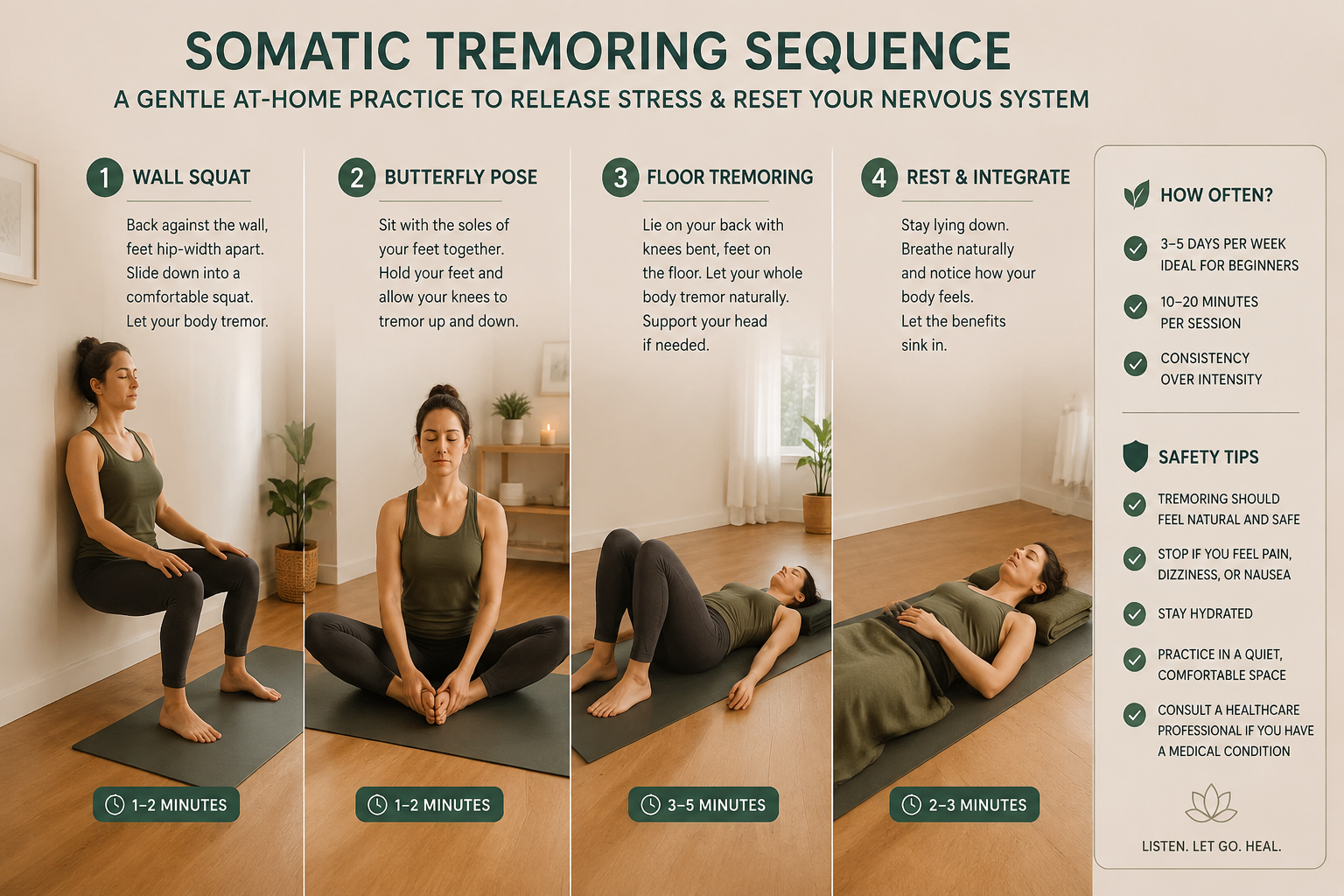
Basic TRE Home Sequence (Beginner Version):
- Wall squat (2 minutes): Stand with your back against a wall, feet shoulder-width apart, and slide down until your thighs are at roughly a 45-degree angle. Hold until your legs feel mildly fatigued (not painful).
- Standing hip circles (1 minute): Step away from the wall, feet hip-width apart, and make slow circles with your hips. This loosens the hip flexors.
- Butterfly stretch (2 minutes): Sit on the mat, bring the soles of your feet together, and let your knees fall out to the sides. Lean forward slightly. This opens the inner thighs and groin.
- Supine position (main tremoring phase, 10 to 20 minutes): Lie on your back, bend your knees, and bring the soles of your feet together again (similar to the butterfly but lying down). Let your knees fall out. Place your arms at your sides. Wait. Tremors typically begin within two to five minutes.
- Grounding cool-down (5 minutes): When you are ready to stop, bring your feet flat to the floor, straighten your legs, and rest quietly. Breathe slowly. Notice how your body feels.
Common mistakes to avoid:
- Forcing or exaggerating the tremors. Let them happen naturally.
- Practicing for too long in early sessions. Start with 10 minutes of tremoring and build up gradually.
- Skipping the cool-down. Grounding after tremoring is essential for integrating the experience.
- Practicing immediately before bed in early weeks, as some people find it activating rather than calming at first.
How Long Does It Take to Feel Results from Somatic Tremoring
Most people notice some shift in muscle tension or mood after their first one or two sessions. Meaningful, sustained relief from chronic stress typically emerges after four to eight weeks of regular practice.
General timeline:
- Session 1 to 2: Novelty, mild tremors, curiosity about the sensation. Some people feel immediate lightness; others feel tired.
- Weeks 1 to 2: Improved sleep quality and reduced muscle tension are the most commonly reported early changes.
- Weeks 4 to 8: Reduction in baseline anxiety, less reactivity to stressors, and improved mood regulation.
- 3 to 6 months: Deeper shifts in chronic patterns, including reduced jaw clenching, better posture, and lower resting heart rate (anecdotally reported by long-term practitioners).
Results vary based on how long the chronic stress has been present, whether trauma is involved, and how consistently you practice.
How Often Should I Practice Somatic Tremoring for Best Results
Two to three sessions per week is the most widely recommended frequency for stress relief, with each session lasting 15 to 30 minutes. Daily practice is not necessarily better and can occasionally lead to over-processing in early stages.
Frequency guidelines by goal:
- General stress maintenance: 2 sessions per week, 15 to 20 minutes each
- Active chronic stress relief: 3 sessions per week, 20 to 30 minutes each
- Trauma recovery (with professional support): As directed by your practitioner, often starting at 1 session per week
Listen to your body. If you feel emotionally raw, unusually fatigued, or irritable after sessions, reduce frequency and duration. This is a signal that your nervous system needs more integration time, not more tremoring.
How Much Do Online Somatic Tremoring Classes Typically Cost
Online somatic tremoring classes range from free to approximately $200 per month, depending on whether you choose self-guided videos, live group classes, or one-on-one sessions with a certified TRE provider.
Cost breakdown (2026 estimates):
| Format | Typical Cost | Best For |
|---|---|---|
| Free YouTube videos | $0 | Beginners exploring the practice |
| Self-paced online course | $30 to $80 one-time | Independent learners |
| Monthly subscription platform | $15 to $50/month | Ongoing guided practice |
| Live group online class | $15 to $40 per session | Community and accountability |
| One-on-one certified TRE provider | $80 to $200 per session | Trauma history, personalized guidance |
Are There Free YouTube Videos to Learn Somatic Tremoring
Yes, there are free YouTube resources for learning somatic tremoring exercises for releasing chronic stress at home. Searching “TRE exercises tutorial” or “neurogenic tremoring beginner” on YouTube returns a range of guided sessions from certified practitioners. The TRE for All organization, founded by Dr. David Berceli, also maintains educational content online.
When evaluating free videos, look for instructors who:
- Hold a TRE certification or somatic therapy credential
- Include clear guidance on when to stop or slow down
- Provide a grounding cool-down at the end of the session
- Mention contraindications for people with trauma histories
Free resources are a legitimate starting point, but if you have any trauma history or mental health diagnosis, investing in at least one session with a certified provider first is worth the cost.
Can Kids or Older Adults Do Somatic Tremoring Exercises
Children and older adults can practice modified versions of somatic tremoring, but both groups benefit from additional guidance and precautions.
For older adults (65+):
- The wall squat position may need to be shortened or replaced with a chair-supported version.
- People with osteoporosis or balance issues should have a chair nearby.
- Start with shorter sessions (10 minutes) and ensure the floor surface is well-padded.
- Medical clearance from a physician is advisable if there are existing joint, cardiovascular, or neurological conditions.
For children:
- Children naturally tremor and shake more readily than adults. Many somatic practitioners note that children often need less structured prompting.
- Parental or caregiver presence is recommended for children under 12.
- Keep sessions short (5 to 10 minutes) and framed as a playful body activity rather than a therapeutic intervention.
- Children with trauma histories should only practice with a trained somatic therapist.
What Equipment Do I Need to Do Somatic Tremoring at Home
Somatic tremoring requires almost no equipment. A yoga mat or soft carpet, comfortable clothing, and a quiet space are all you need to get started.
Basic setup:
- Yoga mat or exercise mat (essential for floor positions)
- Comfortable, non-restrictive clothing
- A wall for the initial squat exercise
- A folded blanket or pillow for head support during floor work
Optional additions:
- A journal to note observations after sessions
- A timer to avoid over-practicing in early weeks
- Soft background music (instrumental, no lyrics) if silence feels uncomfortable
No special props, devices, or supplements are needed. The practice works through your body’s own physiology, not external tools.
Frequently Asked Questions
Is somatic tremoring the same as TRE? TRE (Tension and Trauma Releasing Exercises) is the most widely known and researched form of somatic tremoring. The terms are often used interchangeably, though somatic tremoring is the broader category that includes other neurogenic tremoring approaches within somatic therapy.
Can I do somatic tremoring if I have never done yoga or body-based practices? Yes. No prior experience with yoga, meditation, or bodywork is needed. The exercises use basic positions that most adults can access, and the tremoring itself is involuntary once triggered.
What if I do not feel any tremors in my first session? This is common. Some people need two to four sessions before tremors begin, especially if they have a highly controlled nervous system or significant body tension. Increasing the duration of the wall squat (fatiguing the legs more) often helps initiate tremoring.
Is it normal to feel emotional during or after a session? Yes. Brief waves of emotion, including sadness, laughter, or a sense of relief, are normal responses as stored tension releases. If emotions feel overwhelming, slow down, ground yourself, and consider working with a practitioner.
Can somatic tremoring replace my current therapy or medication? No. Somatic tremoring is a complementary practice. It does not replace professional mental health treatment, psychiatric medication, or medical care. Always inform your healthcare provider that you are adding this practice.
How do I know if I am doing it correctly? The main indicator is that tremors arise naturally and feel rhythmic and self-limiting. You should feel a sense of release or warmth, not pain or distress. If you feel pain, stop immediately.
Can I practice somatic tremoring during pregnancy? The standard floor-based TRE positions are not recommended during pregnancy due to the supine position and the intensity of core muscle activation. Modified versions may be possible in the first trimester, but consult your obstetrician before starting.
What is the difference between somatic tremoring and a panic attack? Panic attacks involve hyperventilation, a sense of dread, and loss of control. Neurogenic tremors in somatic tremoring feel rhythmic, are not accompanied by fear, and are followed by calm. If you feel panic during a session, stop, breathe slowly, and seek support.
Conclusion
Somatic tremoring exercises for releasing chronic stress at home offer a practical, low-cost, and physiologically grounded way to address stress that has settled into the body as persistent tension. The practice does not require you to analyze your stress or force relaxation. It works by giving your nervous system permission to complete what it started.
Actionable next steps:
- Start with one free YouTube TRE tutorial this week. Choose a video from a certified practitioner and keep your first session to 10 minutes.
- Set a realistic schedule: two sessions per week for the first four weeks.
- Keep a brief journal after each session, noting physical sensations, mood, and sleep quality. This helps you track progress and notice patterns.
- If you have a trauma history or a relevant medical condition, book one session with a certified TRE provider before practicing independently.
- Pair somatic tremoring with one other stress-reduction habit, such as a short daily walk or consistent sleep timing, for compounding benefit.
The body knows how to heal itself. Somatic tremoring is simply a way of getting out of its way.
References
- Berceli, D., & Napoli, M. (2006). A proposal for a mindfulness-based trauma prevention program for social work professionals. Complementary Health Practice Review, 11(3), 153–165.
- Berceli, D., Salmon, M., Bonifas, R., & Ndefo, N. (2014). Effects of self-induced unclassified therapeutic tremors on quality of life among non-professional caregivers: A pilot study. Global Advances in Health and Medicine, 3(5), 45–48. https://doi.org/10.7453/gahmj.2014.032
- Berceli, D., Ciucur, D., & Kezelman, C. (2015). TRE (Tension and Trauma Releasing Exercises): A revolutionary new method for stress/trauma recovery. Journal of Military, Veteran and Family Health, 1(2).
- Levine, P. A. (1997). Waking the Tiger: Healing Trauma. North Atlantic Books.
- van der Kolk, B. (2014). The Body Keeps the Score: Brain, Mind, and Body in the Healing of Trauma. Viking.
Read next: Meal Planning Tips for Shift Workers with Acid Reflux. A closer look at meal planning acid reflux.