
Key Takeaways
- A 35- to 45-liter backpack is the sweet spot for three weeks of European train travel without checking bags.
- Seven to ten clothing items, chosen for mix-and-match versatility, cover a full three-week trip when you do laundry twice.
- Merino wool and synthetic fabrics dry overnight, resist odor, and pack smaller than cotton.
- European trains have no enforced weight limits for personal luggage, but overhead racks and luggage areas are limited in size.
- Doing laundry at a laundromat or hostel costs roughly 5 to 10 euros per load in most Western European cities (estimate based on typical 2025 pricing).
- The single biggest packing mistake is bringing “just in case” items that never get used.
- Packing cubes, a compression sack, and a slim toiletry bag are the three accessories that genuinely save space.
- Leave behind the laptop if a tablet or phone covers your needs; skip the full-size umbrella, multiple pairs of shoes, and bulky towels.
- Buying a cheap replacement item in Europe is almost always easier than hauling it from home.
- One bag travel is not just for backpackers; it works equally well for business travelers, couples, and older travelers who want mobility.
What Size Backpack Is Best for Traveling Around Europe by Train
The best backpack size for three weeks of European train travel is between 35 and 45 liters. This range fits in overhead compartments, meets most airline carry-on size requirements for budget carriers like Ryanair and easyJet (typically 40 x 20 x 25 cm for the smallest allowance, though policies vary), and sits comfortably on your back during the ten-minute sprint between platforms at Roma Termini.
Why not go smaller? A bag under 30 liters forces extreme minimalism that most travelers find stressful for trips longer than ten days. Why not go bigger? Anything over 50 liters becomes unwieldy on crowded trains, tempts you to overpack, and may not fit in hostel lockers.
Popular options in 2026 that travelers consistently recommend include the Osprey Farpoint 40, the Tom Bihn Synik 30 (for very disciplined packers), and the Tortuga Setout 45. Each has a clamshell opening that makes airport security and unpacking far easier than top-loading hiking packs.
Decision rule: Choose 35 liters if you run cold, pack minimally, and plan mostly warm-weather destinations. Choose 40 to 45 liters if you need a laptop, plan for mixed weather, or are traveling for work alongside leisure.
How Many Clothes Do You Really Need for Three Weeks in Europe
Most travelers need seven to ten clothing items total for a three-week European trip, not counting underwear and socks. That number sounds impossibly low until you factor in laundry every four to five days and the reality that you will wear the same outfit on a train that no one on the next train will ever see.
A practical base wardrobe for three weeks:
- 3 to 4 tops (mix of short and long sleeve)
- 1 pair of versatile trousers or jeans
- 1 pair of lightweight shorts or a second trouser
- 1 dress or smart casual option (if your itinerary includes nicer dinners)
- 1 lightweight jacket or fleece
- 1 rain shell (packable)
- 3 to 5 pairs of underwear
- 3 pairs of socks
- 2 pairs of shoes maximum (one walking, one casual/smart)
Common mistake: Packing one outfit per day. You do not need 21 shirts. Wear each top two or three times before washing. Europeans do this routinely; it is not unhygienic when fabrics are chosen well.
What Are the Most Versatile Clothing Items for Travel
The most versatile travel clothing items are neutral-colored, wrinkle-resistant pieces that can dress up or down and layer easily. Merino wool tops are the single best investment for multi-week travel because they resist odor for two to three wears, dry in three to four hours, and pack to the size of a fist.
Top versatile picks:
- Merino wool crew-neck or button-down: Wears as a casual top, layers under a jacket for smart-casual, and dries overnight after hand-washing.
- Dark slim-fit trousers in a synthetic blend: Looks presentable enough for a restaurant, comfortable enough for a six-hour train ride.
- Packable down or synthetic jacket: Compresses to the size of a grapefruit, handles cold train cars and cool evenings.
- Neutral sneakers (black, white, or grey): Pairs with everything and handles cobblestones better than dress shoes.
- Lightweight scarf: Doubles as a blanket on overnight trains, a layer in air-conditioned museums, and a style element.
Choose merino if you run warm, hate doing laundry, or are visiting cities in summer. Choose synthetic blends if you are on a budget, since quality merino wool pieces cost 60 to 120 USD each (estimate based on typical brand pricing from brands like Icebreaker and Uniqlo’s wool line).
Can You Do Laundry Easily While Traveling Through Europe
Yes, doing laundry in Europe is straightforward and inexpensive. Most cities have self-service laundromats (called “laverie” in France, “lavanderia” in Italy, “Waschsalon” in Germany) within walking distance of train stations and tourist areas. A wash-and-dry cycle typically costs 5 to 10 euros and takes about an hour.
Your laundry options ranked by convenience:
- Self-service laundromat: Cheapest, most common, takes 60 to 90 minutes. Bring coins or a card.
- Hostel or hotel laundry service: Convenient but costs 2 to 4 euros per item at many properties.
- Hand-washing in the sink: Free, works for underwear and merino wool tops, takes overnight to dry.
- Airbnb with a washing machine: Ideal if you are staying two or more nights; ask before booking.
Practical tip: Plan a laundry day every four to five days. Do it in a city where you have a full day anyway, like a rest day in Paris or Florence. Bring a small travel-size detergent packet (or buy one at any European supermarket for under a euro) for sink washing between laundromat visits.
What’s the Weight Limit for Carry-On Bags on European Trains
European trains do not enforce weight limits on personal luggage. Unlike airlines, Eurostar, Thalys, Intercity, and regional rail services across the continent let you bring as much as you can physically carry. The practical limit is what fits in overhead racks (typically bags up to about 70 cm long) or the luggage areas at the ends of carriages.
Where size does matter:
- Budget airline connections: If your train trip includes even one Ryanair or Wizz Air flight, their carry-on rules are strict (Ryanair’s free personal item must fit under the seat: 40 x 20 x 25 cm as of 2026; a paid cabin bag can be 55 x 40 x 20 cm). A 40-liter backpack often passes as a personal item if it is not stuffed to bursting.
- Overnight trains: Luggage goes on racks above couchette beds or in end-of-car storage. Bags over 60 liters become genuinely awkward.
- Metro and tram connections: A large rolling suitcase on a packed Paris Metro is a social offense. A backpack is not.
Bottom line: The train itself will not stop you, but your own back and the airline leg of your trip will.
Tips for Packing Light Without Looking Like a Tourist
Packing light does not mean looking like you slept in a hostel dorm for three weeks. The difference between a seasoned one-bag traveler and someone who looks disheveled comes down to fabric choice, color coordination, and one or two quality accessories.
Practical strategies:
- Stick to a three-color palette. Choose two neutrals (navy, grey, black, or olive) and one accent. Every piece mixes with every other piece.
- Invest in one good pair of shoes. A clean, simple leather or leather-look sneaker reads as smart casual in most European cities.
- Avoid logo-heavy or obviously “outdoor” gear. A merino wool top looks like a regular shirt. A bright orange moisture-wicking hiking top does not.
- Keep your bag compressed. A 40-liter pack that is two-thirds full and cinched down looks like a day bag. The same pack stuffed to its frame looks like a camping expedition.
- Carry a small tote or day bag. A lightweight foldable tote (20 to 30 grams) lets you leave your main pack at the hotel and explore with just your wallet, phone, and water bottle.
What Should You Definitely Not Pack When Traveling Light in Europe
The items that most reliably waste space and weight are things packed “just in case” that never get used. First-time European train travelers consistently over-pack in four categories: shoes, electronics, toiletries, and “maybe” clothing.
Leave these behind:
- More than two pairs of shoes. Shoes are the heaviest, bulkiest items in any bag. Two pairs maximum.
- Full-size toiletries. European pharmacies and supermarkets sell shampoo, sunscreen, and toothpaste everywhere. Bring travel-size for the first day or two and buy locally.
- A full-size umbrella. A packable rain jacket handles rain better and takes up a fraction of the space.
- A laptop (if a tablet or phone will do). A 13-inch laptop weighs 1.2 to 1.5 kg. A tablet weighs 400 to 500 grams. If you are not working remotely, the phone is enough.
- More than one “nice” outfit. One smart-casual option handles 95% of European dinner and nightlife situations.
- Physical guidebooks. Download offline maps and guides on your phone.
- A dedicated travel pillow. Fold your jacket.
How to Pack Clothes to Minimize Wrinkles and Save Space
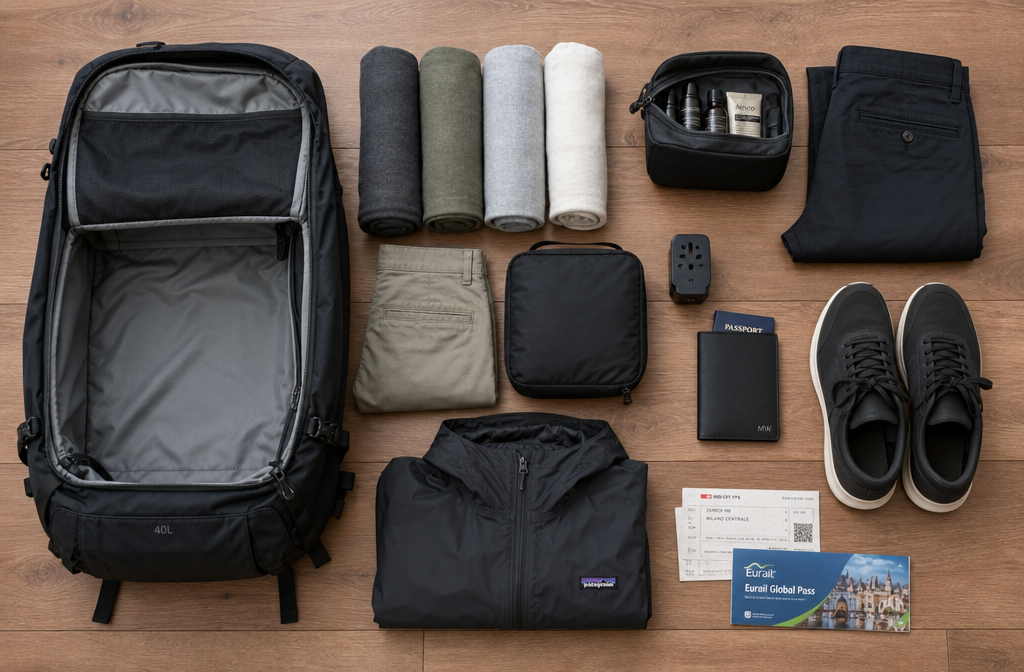
Rolling clothes tightly and using packing cubes reduces wrinkles and saves roughly 20 to 30% more space than flat folding (a commonly cited estimate among travel gear reviewers, though exact savings vary by garment type). The bundle wrapping method, where clothes are wrapped around a central core, reduces wrinkles even further for dress shirts and trousers.
Step-by-step packing method:
- Lay your largest, most wrinkle-prone item (trousers, jacket) flat across the bottom of the bag.
- Roll t-shirts, underwear, and socks tightly and place in a packing cube.
- Place the packing cube in the center of the bag as the “core.”
- Wrap the larger items around the cube.
- Place shoes in shoe bags along the sides (soles facing outward).
- Toiletry bag goes on top for easy TSA access.
Packing cubes worth using: Two small cubes (one for tops, one for bottoms/underwear) and one compression cube for bulky items like a fleece or rain jacket. Avoid buying a full set of eight cubes for a 40-liter bag; you will run out of room for the cubes themselves.
Is It Cheaper to Buy Clothes in Europe or Pack Everything
For most items, it is cheaper to pack what you already own than to buy in Europe, but the gap is smaller than most travelers expect. Fast fashion (Zara, H&M, Primark) is widely available across Europe at prices comparable to or slightly lower than North American equivalents. Specialty outdoor or travel clothing brands (Arc’teryx, Patagonia, Icebreaker) are often 15 to 25% more expensive in Europe due to import costs and VAT.
When buying in Europe makes sense:
- You forgot something genuinely essential (a phone charger, a basic t-shirt).
- You want a local souvenir that doubles as a wearable (a Portuguese linen shirt, an Italian leather belt).
- You packed too much and want to ship items home rather than carry them.
When it does not make sense: Buying a full travel wardrobe in Europe to avoid packing. The time cost, decision fatigue, and language barrier make it inefficient unless you enjoy shopping as part of the trip.
What Tech and Electronics Can You Leave Behind to Save Weight
Most travelers can leave behind 30 to 50% of the electronics they instinctively pack. A smartphone in 2026 replaces a camera, guidebook, map, alarm clock, boarding pass wallet, translation device, and entertainment system.
Electronics audit:
| Device | Keep or Leave? | Reason |
|---|---|---|
| Smartphone | Always keep | Replaces 10 other items |
| Laptop | Leave if possible | Heavy; tablet or phone covers most needs |
| Tablet | Keep if you need it for work or long flights | Lighter than a laptop |
| Dedicated camera | Only if photography is a core goal | Phone cameras are excellent in 2026 |
| E-reader | Worth it for heavy readers | Weighs 170 to 200 grams, replaces multiple books |
| Portable speaker | Leave | Adds weight with minimal benefit |
| Universal adapter | Always keep | One compact unit covers all European outlets |
| Portable battery (10,000 mAh) | Keep | Essential for long travel days |
One adapter covers it all: Europe uses Type C, E, F, G, and I outlets depending on country. A single universal travel adapter (not a voltage converter; modern electronics handle dual voltage automatically) handles every country on a standard Eurail itinerary.
How Backpackers Manage with Just One Small Bag for Weeks
Experienced one-bag travelers succeed through systems, not willpower. The mindset shift is treating your bag as a fixed constraint rather than a container to fill. When everything must fit, every item earns its place by serving two or more purposes.
The core systems that work:
- The “one in, one out” rule: If you buy something new (a book, a souvenir shirt), something leaves the bag.
- Wearing your bulkiest items on travel days: Wear your heaviest shoes, your jacket, and your thickest layer on the train or plane. They do not count against your bag’s capacity.
- Checking in digitally: Boarding passes, museum tickets, and rail reservations live on your phone. No paper accumulation.
- Shipping souvenirs home: Most European post offices offer affordable international shipping. Buy freely; mail it home rather than carry it.
I traveled for 22 days across seven countries in 2024 with a 38-liter pack and wore the same five tops in rotation. By day ten, I had stopped thinking about clothing entirely. That mental freedom, not the lighter bag, was the real benefit.
Common Packing Mistakes First-Time European Train Travelers Make
The most common mistake is packing for every possible scenario rather than the most likely ones. First-time travelers routinely bring formal wear for restaurants that turned out to be casual, rain gear for cities that were sunny, and cold-weather layers for a trip that stayed warm throughout.
Mistakes ranked by frequency:
- Packing too many shoes (the single most common weight problem).
- Bringing full-size toiletries when travel-size or local purchases work fine.
- Not accounting for laundry and packing 14 to 21 days of clothing as a result.
- Choosing cotton over synthetics or merino, leading to slow-drying, wrinkled clothes.
- Forgetting that European cities involve a lot of walking and packing shoes that look good but destroy feet.
- Packing a bag that is too large and then filling it.
- Not testing the packed bag before leaving home. Walk around the block with a fully packed bag. If it is uncomfortable for ten minutes, it will be unbearable after six hours.
Which Travel Accessories Actually Help with Minimalist Packing
Three accessories genuinely improve one-bag travel: packing cubes, a slim toiletry bag, and a packable day bag. Everything else is optional and often ends up unused.
Accessories worth buying:
- Packing cubes (2 to 3 small ones): Keep clothes organized and compressed. Eagle Creek and Peak Design make durable options.
- Slim hanging toiletry bag: Hooks on any bathroom towel bar, keeps liquids accessible, and fits the TSA 3-1-1 rule in one pocket.
- Packable tote bag (20 to 30 grams): Folds to the size of a credit card, handles grocery runs and day trips.
- Cable organizer pouch: Keeps charging cables, adapters, and earbuds from tangling at the bottom of your bag.
- Microfiber towel: Many hostels charge 2 to 3 euros to rent a towel. A 40 x 80 cm microfiber towel weighs under 100 grams and dries in 30 minutes.
Accessories that sound useful but rarely are: Neck wallets (uncomfortable; a slim front-pocket wallet works better), luggage scales (useful once at the airport, dead weight the rest of the trip), and travel-size everything kits sold as bundles (usually low quality and redundant).
Conclusion: Your Action Plan for One-Bag European Train Travel
Packing light for three weeks of European train travel is a skill, not a talent. It comes down to a 40-liter bag, ten clothing items chosen for versatility and quick drying, a laundry plan every four to five days, and the discipline to leave the “just in case” items at home.
Your next steps:
- Audit your current travel bag. If it is over 45 liters, consider whether a smaller bag would serve you better before investing in new gear.
- Lay out everything you plan to pack, then remove one-third of it. This single exercise, done honestly, is the most effective packing tool available.
- Buy two or three merino wool or synthetic tops if you do not already own them. This one fabric change reduces the clothing volume you need more than any other single decision.
- Book your first laundromat visit in advance. Knowing where it is removes the anxiety of running low on clean clothes.
- Test your packed bag at home. Walk with it for 20 minutes. If it is uncomfortable, repack before you leave.
The goal of packing light is not minimalism for its own sake. It is the freedom to move quickly, skip the baggage carousel, board any train without a reservation for your luggage, and arrive somewhere new without the physical and mental weight of too much stuff.
FAQ
What is the best backpack brand for one-bag European travel? Osprey, Tortuga, and Tom Bihn are consistently rated highest for one-bag travel. The Osprey Farpoint 40 and Tortuga Setout 45 offer the best balance of capacity, comfort, and airline carry-on compatibility for most travelers.
Can I bring a 40-liter backpack as a carry-on on European budget airlines? It depends on the airline. Ryanair and Wizz Air have strict size limits for free carry-on bags. A 40-liter pack often exceeds the free personal item allowance but fits within the paid cabin bag allowance. Check the specific airline’s current policy before flying.
How do I keep my clothes from smelling after multiple wears? Choose merino wool or silver-infused synthetic fabrics, which resist odor-causing bacteria. Air garments out overnight rather than stuffing them back in your bag immediately after wearing.
Is it safe to leave my backpack in a hostel locker? Yes, most hostels provide lockers. Bring a small padlock (TSA-approved if flying) to secure your bag. A 40-liter pack fits in most standard hostel lockers; bags over 50 liters sometimes do not.
Do I need travel insurance if I am only carrying a carry-on? Travel insurance is recommended regardless of luggage size. It covers medical emergencies, trip cancellations, and lost or stolen items, including electronics and documents, none of which are covered by your bag size.
What is the lightest way to carry documents and money in Europe? A slim front-pocket wallet with RFID blocking holds cards, cash, and a folded copy of your passport. Keep your actual passport in a hidden interior pocket of your bag, not on your body, when not needed for check-in.
Can couples share one bag for three weeks? Two people sharing one bag for three weeks is very difficult unless both are experienced minimalist packers. Two separate 35-liter bags is a more practical approach than one 65-liter shared bag.
What should I do with dirty laundry in my bag? Use a lightweight dry bag or a simple stuff sack to separate dirty clothes from clean ones. This prevents odor transfer and keeps your packing organized throughout the trip.
Is it worth buying a packing cube set? Two or three individual small cubes are worth it. Full sets of six to eight cubes are often redundant for a 40-liter bag and add unnecessary weight and cost.
What European cities are hardest to navigate with a large bag? Venice, Prague, and Paris are the most challenging due to cobblestones, stairs, and crowded public transit. A compact backpack is a significant practical advantage in all three.
References
- Osprey Packs. (2023). Farpoint 40 Travel Backpack product specifications. https://www.ospreypacks.com
- Ryanair. (2025). Baggage policy and allowances. https://www.ryanair.com/gb/en/useful-info/help-centre/faq-overview/faqs/baggage
- Tortuga Backpacks. (2022). How to choose a travel backpack size. https://www.tortugabackpacks.com/blogs/pack/travel-backpack-size
- Icebreaker. (2024). Why merino wool for travel. https://www.icebreaker.com/en-us/blogs/journal/why-merino-wool-for-travel
- Eagle Creek. (2023). Pack-It packing cubes overview. https://www.eaglecreek.com
Read next: 5 Investment Pieces That Will Never Go Out of Style: A Timeless Fashion Guide. A closer look at investment pieces.