
Key Takeaways 🧳
- A standard carry-on (typically 22 × 14 × 9 inches / 56 × 36 × 23 cm for most U.S. airlines) holds more than most travelers think when packed strategically.
- A capsule wardrobe of 10–14 neutral, mix-and-match clothing items covers two weeks without repeating full outfits.
- Packing cubes are the single biggest upgrade you can make to your packing system.
- Rolling clothes (especially knits) saves more space than folding and reduces wrinkles.
- TSA liquids rules (3-1-1: containers of 3.4 oz/100 ml or less, in one quart-sized clear bag) still apply in 2026 for U.S. domestic and most international flights.
- Plan to do one small laundry load mid-trip (hotel sink or laundromat) to cut your clothing count nearly in half.
- Wear your bulkiest items on travel days to save bag space.
- Shoes take the most space — limit yourself to two to three pairs maximum.
- Toiletries, tech gear, and documents need their own dedicated zones in the bag.
- A well-packed carry-on saves you money (no checked bag fees), time (no baggage claim), and stress.
Why Most Travelers Overpack (And How to Stop)
Most people overpack because they plan for worst-case scenarios that rarely happen. They pack “just in case” outfits, duplicate toiletries, and shoes for every possible occasion. The result is a 50-pound checked bag for a beach vacation.
Learning how to pack a carry-on for a two-week vacation starts with a mindset shift: you’re not packing for every possibility, you’re packing for the most likely reality of your trip.
The core problem is that most travelers pack by category (“I need shirts, pants, shoes…”) instead of by outfit. When you plan actual outfits for actual days, you immediately see how much overlap exists.
“The goal of packing light is not to own less — it’s to carry only what earns its place on every day of the trip.”
Common overpacking mistakes to avoid:
- Packing “backup” outfits for scenarios that won’t happen
- Bringing full-size toiletries when travel-size or refillable bottles work fine
- Including shoes that only match one outfit
- Packing items you can easily buy at your destination if needed
- Not accounting for laundry as a mid-trip option
What Size Carry-On Do You Actually Need?
For a two-week trip, you need the largest carry-on your airline allows — typically a 22 × 14 × 9 inch (56 × 36 × 23 cm) hard or soft-sided bag that fits in the overhead bin.
Different airlines have slightly different size limits, so always check before you fly. Here’s a quick reference for major carriers in 2026:
| Airline | Max Carry-On Size | Personal Item Allowed? |
|---|---|---|
| American Airlines | 22 × 14 × 9 in | Yes |
| Delta Air Lines | 22 × 14 × 9 in | Yes |
| United Airlines | 22 × 14 × 9 in | Yes |
| Southwest Airlines | 24 × 16 × 10 in | Yes |
| Ryanair (Europe) | 55 × 40 × 20 cm | Paid upgrade required |
| easyJet (Europe) | 56 × 45 × 25 cm | Yes (smaller bag) |
| Lufthansa | 55 × 40 × 23 cm | Yes |
Important: Budget European airlines like Ryanair and Wizz Air have strict size and weight limits. If your trip includes a budget European leg, verify the specific airline’s current policy before packing.
Choose a soft-sided bag if you’re close to the size limit — soft bags compress slightly to fit in tight overhead bins. Choose a hard-sided bag if you’re carrying fragile items or want better protection.

How to Build a Two-Week Capsule Wardrobe for a Carry-On
A capsule wardrobe is a small set of versatile pieces that mix and match into many different outfits. For a two-week trip, you need roughly 10–14 clothing items that work together.
The formula: 3 bottoms + 5–6 tops + 1 layer + 1–2 pairs of shoes (plus sandals or sneakers worn on the plane) = two weeks of outfits.
Clothing List by Category
Tops (5–6 items):
- 3 short-sleeve shirts or blouses (neutral colors: white, grey, navy)
- 1–2 long-sleeve shirts or lightweight sweaters
- 1 dressier top for evenings out
Bottoms (3 items):
- 1 pair of jeans or chinos (wear these on the plane — they’re the heaviest)
- 1 pair of lightweight pants or a skirt
- 1 pair of shorts or a casual dress
Layers & outerwear (1 item):
- 1 lightweight packable jacket or cardigan (wear it on the plane if bulky)
Shoes (2–3 pairs max):
- 1 pair of comfortable walking shoes or sneakers (wear on travel day)
- 1 pair of sandals or flats
- Optional: 1 pair of dressier shoes if your itinerary requires it
Underwear & socks:
- 7 pairs of underwear (plan to wash mid-trip)
- 5–6 pairs of socks
- 1–2 sports bras or undershirts as needed
Fabric matters: Choose wrinkle-resistant, quick-dry fabrics like merino wool, polyester blends, or nylon. Merino wool is especially good — it resists odor, dries fast, and works in multiple climates.
Pro tip: Stick to a 2–3 color palette for your entire wardrobe. When everything coordinates, you can create far more outfit combinations from fewer pieces.
The Best Packing System: Cubes, Rolling, and Zones
A good packing system is what separates a chaotic, overstuffed bag from one that’s easy to navigate every day of your trip.
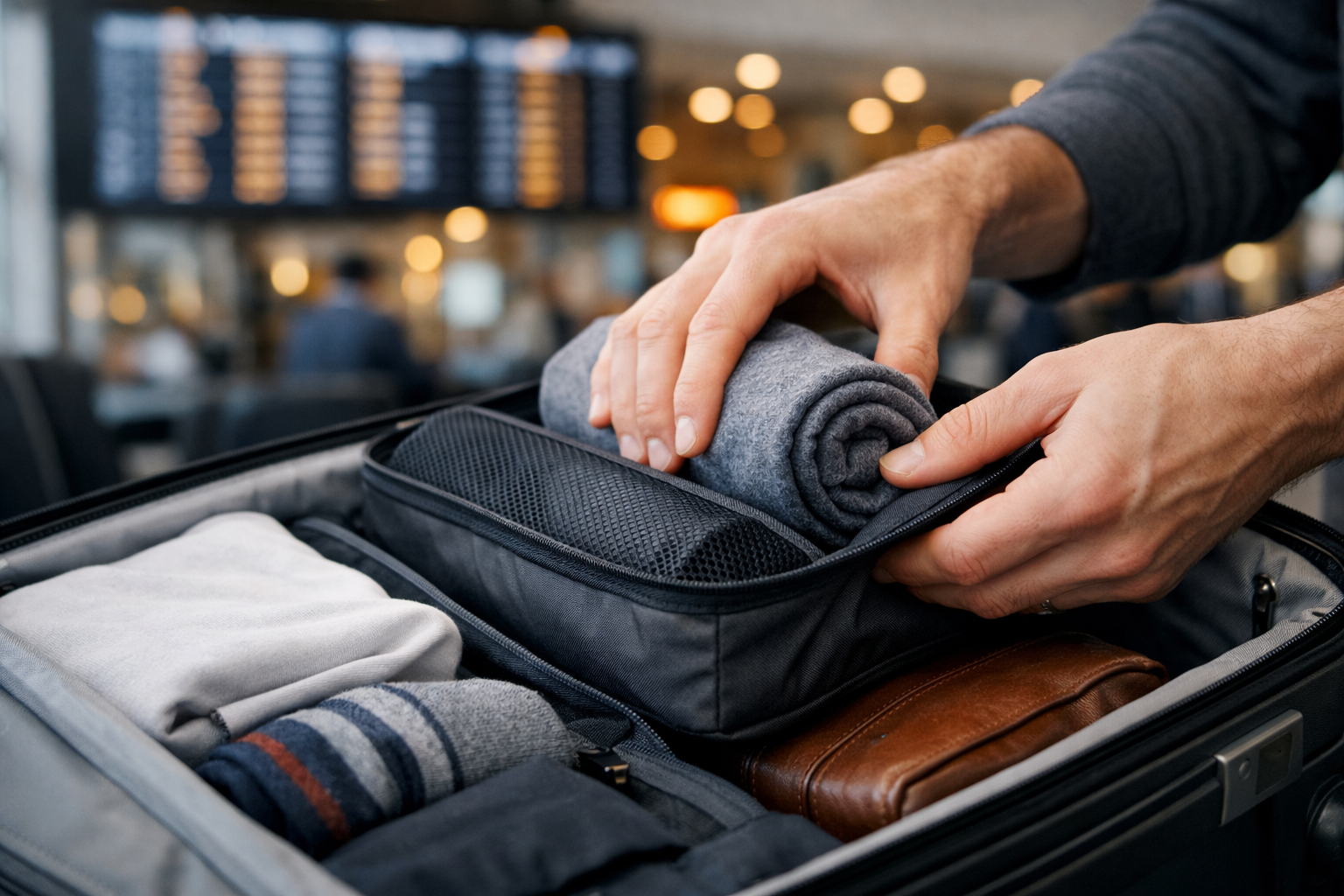
Packing cubes are rectangular zip pouches that compress clothing and keep categories separated. They’re the most practical upgrade for anyone learning how to pack a carry-on for a two-week vacation.
How to Use Packing Cubes Effectively
- Assign one cube per category: tops, bottoms, underwear/socks, accessories.
- Roll clothes before placing them in cubes — rolling (especially for t-shirts, jeans, and knitwear) reduces volume by 20–30% compared to flat folding (an estimate based on commonly reported packing guides; individual results vary by fabric and technique).
- Use compression cubes for bulky items like sweaters or jeans.
- Stack cubes vertically in your bag so you can see everything at once when you open it.
Bag Zones
Divide your carry-on into three zones:
| Zone | What Goes Here |
|---|---|
| Bottom layer | Heaviest items: shoes (in a shoe bag), jeans, compression cube |
| Middle layer | Packing cubes with clothing |
| Top layer / lid pocket | Toiletries bag, tech pouch, documents, items you need during the flight |
Shoes tip: Pack shoes sole-to-sole in a reusable bag or shower cap to keep the rest of your clothes clean.
How to Handle Toiletries in a Carry-On for Two Weeks
Toiletries are where most people waste the most space. The TSA 3-1-1 rule (containers of 3.4 oz/100 ml or less, all fitting in one quart-sized clear zip bag) limits your liquid volume, but that’s actually enough for two weeks if you’re smart about it.
What to bring:
- Travel-size or refillable bottles for shampoo, conditioner, body wash, and face wash
- Solid alternatives (solid shampoo bars, solid sunscreen sticks, solid deodorant) eliminate liquid restrictions entirely
- Toothpaste (travel size)
- Moisturizer and SPF in one product if possible
- Razor (disposable or safety razor without the blade in carry-on)
- Any prescription medications in original labeled containers
What to buy at your destination:
- Full-size sunscreen (heavy and liquid)
- Shampoo and conditioner if staying in hotels (most provide them)
- Any non-essential personal care items
Common mistake: Packing a full toiletry bag “just in case” and then never using half of it. Audit your toiletry bag before every trip and remove anything you didn’t use last time.
Tech, Documents, and the Personal Item Strategy
Your personal item (a backpack or tote bag that fits under the seat in front of you) is essentially a second bag — use it wisely.
What to keep in your personal item:
- Laptop or tablet + charger
- Headphones
- Passport, boarding passes, travel insurance documents
- Wallet and phone
- Any medications or valuables
- A change of clothes (in case your carry-on is gate-checked)
- Snacks and a reusable water bottle
Tech packing tips:
- Use a single multi-port USB-C charger instead of multiple adapters
- A universal travel adapter covers most destinations
- Download offline maps, entertainment, and documents before you fly
Keeping one change of clothes in your personal item is the best insurance against gate-checked bags. If the overhead bins fill up and your carry-on gets checked at the gate, you still have what you need for the first day.
The Mid-Trip Laundry Strategy
Doing laundry once during a two-week trip is the single most effective way to pack lighter. It cuts your clothing needs almost in half.
Options for mid-trip laundry:
- Hotel laundry service: Convenient but expensive. Good for one or two key items.
- Laundromat: Cheapest option. Takes 1–2 hours. Easy to find in most cities.
- Sink washing: Works well for underwear, socks, and lightweight synthetic fabrics. Hang to dry overnight.
- Airbnb with a washer: If you’re staying in an apartment, this is the easiest option.
Plan your laundry day around Day 7 or 8 of a 14-day trip. Pack quick-dry fabrics so sink-washed items are dry by morning.
Step-by-Step Checklist: How to Pack a Carry-On for a Two-Week Vacation
Use this checklist before every trip:
Planning phase (1 week before):
- Check your airline’s carry-on size and weight limits
- Choose your destination’s typical weather and activities
- Plan 14 days of outfits on paper (not in your head)
- Identify overlapping pieces and cut duplicates
Packing phase (1–2 days before):
- Lay out every item on your bed before packing
- Remove anything that doesn’t match at least 3 other items
- Fill toiletry bag with travel-size products only
- Roll all clothing and fill packing cubes
- Pack shoes at the bottom, cubes in the middle, toiletries and tech on top
- Fill personal item with valuables, tech, and one change of clothes
- Weigh your bag if your airline has a weight limit
Travel day:
- Wear your heaviest shoes and jacket on the plane
- Keep documents and boarding pass accessible in your personal item
- Confirm carry-on fits in the overhead bin before boarding
FAQ: Packing a Carry-On for Two Weeks
Q: Can you really fit two weeks of clothes in a carry-on?
Yes. With a capsule wardrobe of 10–14 mix-and-match pieces, packing cubes, and one mid-trip laundry session, a standard 22-inch carry-on holds everything most travelers need for two weeks.
Q: What’s the best carry-on bag for a long trip?
A lightweight, hard-sided spinner in the maximum allowed dimensions works well for most travelers. Soft-sided bags offer more flexibility if you’re tight on space. Brands like Away, Rimowa, and Osprey are popular in 2026 — but the bag matters less than how you pack it.
Q: How do I pack for both warm and cold weather in one carry-on?
Use a layering system: lightweight base layers, a mid-layer (merino cardigan), and one packable outer layer. This covers a wide temperature range without bulk.
Q: Should I use packing cubes or compression bags?
Packing cubes are better for organization and everyday access. Compression bags save more space but are harder to repack on the road. For a two-week trip, compression cubes (which do both) are the best option.
Q: What if my carry-on gets gate-checked?
Keep a change of clothes, medications, valuables, and your laptop in your personal item. Gate-checked bags are returned at the jet bridge in most cases, but it’s not guaranteed on all routes.
Q: How many pairs of shoes should I pack for two weeks?
Two to three pairs maximum. Wear your bulkiest pair on travel day. Choose shoes that work across multiple outfit types — a clean white sneaker or a neutral loafer covers most situations.
Q: Can I bring a razor in my carry-on?
Disposable razors and cartridge razors are allowed in carry-on bags. Safety razor blades must be in checked luggage. Electric razors are allowed in carry-on bags.
Q: How do I keep clothes wrinkle-free in a carry-on?
Roll knits and casual items. Use the ranger roll technique for jeans and thicker fabrics. Pack dress shirts and blouses flat between cubes. Quick-dry and wrinkle-resistant fabrics (polyester, merino wool, nylon) help significantly.
Q: Is it worth buying travel-specific clothing?
For frequent travelers, yes. Merino wool t-shirts, travel pants with stretch fabric, and packable jackets are genuinely useful. For occasional travelers, you can manage with what you already own by choosing the right pieces.
Q: What’s the biggest mistake people make when packing a carry-on?
Packing without planning outfits first. If you don’t know exactly how each item will be worn, you’ll overpack by default.
📺 Recommended Video: How to Pack a Carry-On for Two Weeks
For a visual walkthrough of the packing system described in this guide, this YouTube video from travel creator Kara and Nate demonstrates their real-world carry-on packing process for extended trips, including how they organize packing cubes and build a capsule wardrobe:
▶ Watch: “How We Pack Carry-On Only for Long Trips” – Kara and Nate (YouTube)
(Search “carry-on only packing two weeks” on YouTube for multiple practical video guides from experienced travel creators.)
Conclusion: Your Next Steps
Packing a carry-on for a two-week vacation is a learnable skill, not a talent. The first time takes more planning. By your third or fourth trip, it becomes automatic.
Your action plan:
- This week: Check your airline’s carry-on dimensions and buy a set of packing cubes if you don’t own one.
- Before your next trip: Plan your outfits on paper first. Lay everything out on the bed and remove anything that doesn’t match at least three other items.
- On travel day: Wear your heaviest shoes and jacket. Keep valuables and one change of clothes in your personal item.
- Mid-trip: Plan a laundry day around Day 7 so you arrive home with clean clothes and a lighter bag.
The payoff is real: no checked bag fees, no baggage claim wait, no lost luggage, and the freedom to move through airports and cities without dragging a heavy bag behind you. Once you travel carry-on only, it’s very hard to go back.
References
- Transportation Security Administration (TSA). 3-1-1 Liquids Rule. TSA.gov. https://www.tsa.gov/travel/security-screening/whatcanibring/items/liquids (2023)
- American Airlines. Carry-on Baggage Policy. AA.com. https://www.aa.com/i18n/travel-info/baggage/carry-on-baggage.jsp (2024)
- Ryanair. Cabin Bag Policy. Ryanair.com. https://www.ryanair.com/gb/en/useful-info/help-centre/faq-overview/faq?id=luggage-allowance-what-is-the-cabin-bag-policy (2024)
Read next: Packing Light: Fitting Three Weeks of European Train Travel Into One Bag. A closer look at packing light for train travel.