
A robotic lawn mower with GPS uses satellite signals, and in premium models a fixed base station, to pinpoint its location on your lawn with high accuracy. It compares that position against a stored digital map of your yard to navigate, cut grass, and avoid obstacles, all without a buried perimeter wire. Setup takes anywhere from five minutes to a few hours depending on the technology, and the mower handles the rest autonomously.
Key Takeaways
- Standard GPS gives a robotic mower 2–5 meter accuracy; RTK-GPS narrows that to 1–3 centimeters, enabling clean edges and straight mowing lines [2]
- RTK systems use a fixed base station in your yard that corrects satellite signal errors in real time via radio link [2]
- Newer Network RTK (NRTK) technology eliminates the physical base station entirely, cutting setup time to under five minutes in some cases [4]
- You map your lawn boundaries using a smartphone app, creating a virtual “invisible fence” instead of burying wire [2]
- GPS mowers can handle multiple zones, navigating passageways between front and back yards automatically [2]
- Signal quality drops under dense tree canopies or near tall structures; some models compensate with LiDAR or computer vision [1][3]
- As of 2026, the premium navigation tier combines RTK satellite positioning with computer vision for the most reliable performance [4]
- Floating cutting decks on high-end models adapt to uneven terrain, maintaining consistent cut quality on slopes [2]
What Is a Robotic Lawn Mower with GPS, and How Is It Different from Older Models?
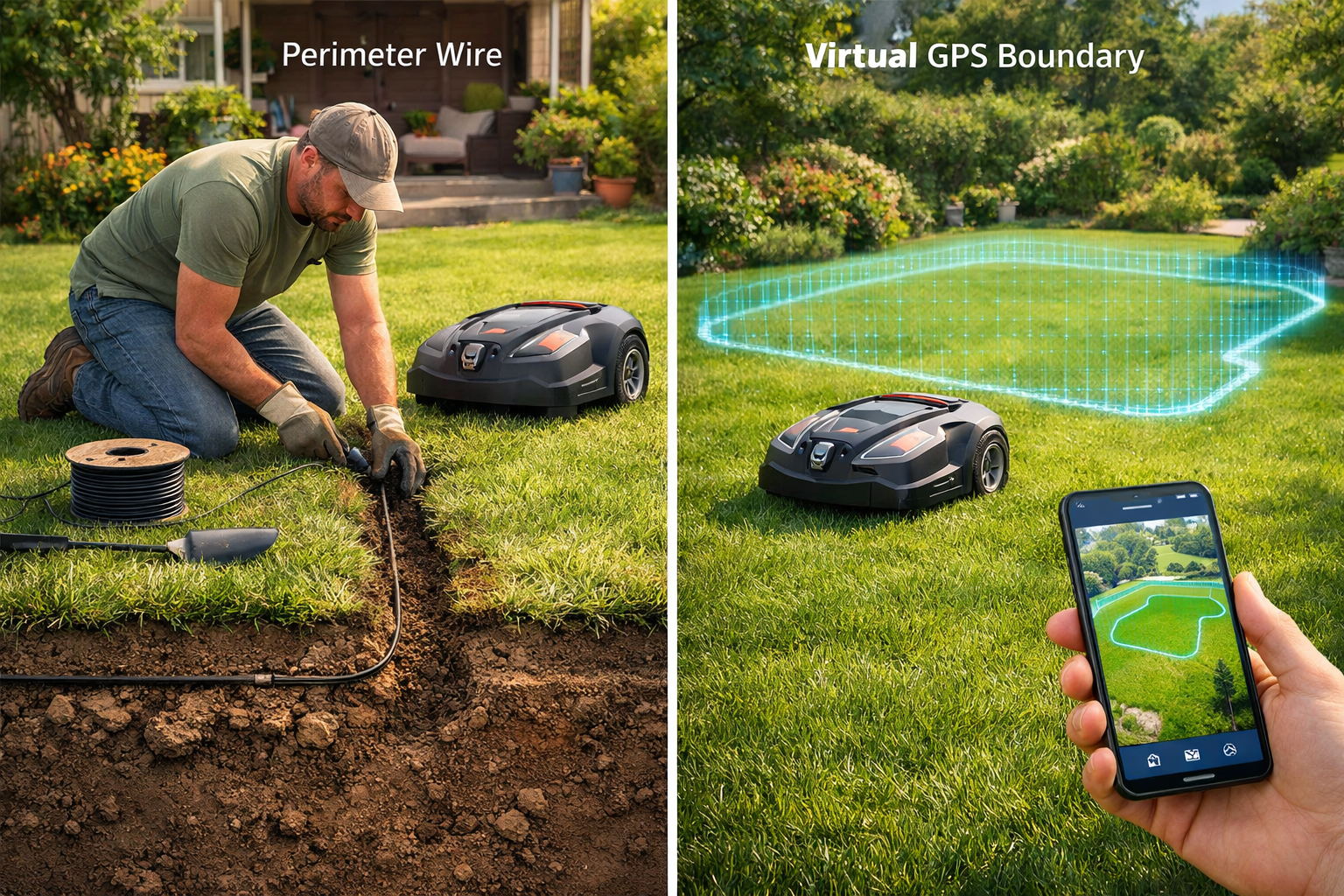
A robotic lawn mower with GPS navigates your yard using satellite positioning rather than a physical boundary wire buried in the ground. This is the core difference from first-generation robot mowers, which required homeowners to install a perimeter wire around the lawn’s edge before the mower could operate.
Older wire-based mowers work like bumper cars: they cut randomly within a boundary they detect electrically. GPS mowers, by contrast, know exactly where they are at all times and follow a planned path. The result is more consistent coverage, cleaner edges, and far simpler installation for most yards.
Why this matters for homeowners: No digging, no wire breaks, no reconfiguring when you change your garden layout. You update the digital map on your phone instead.
How Does GPS Satellite Navigation Actually Work in These Mowers?
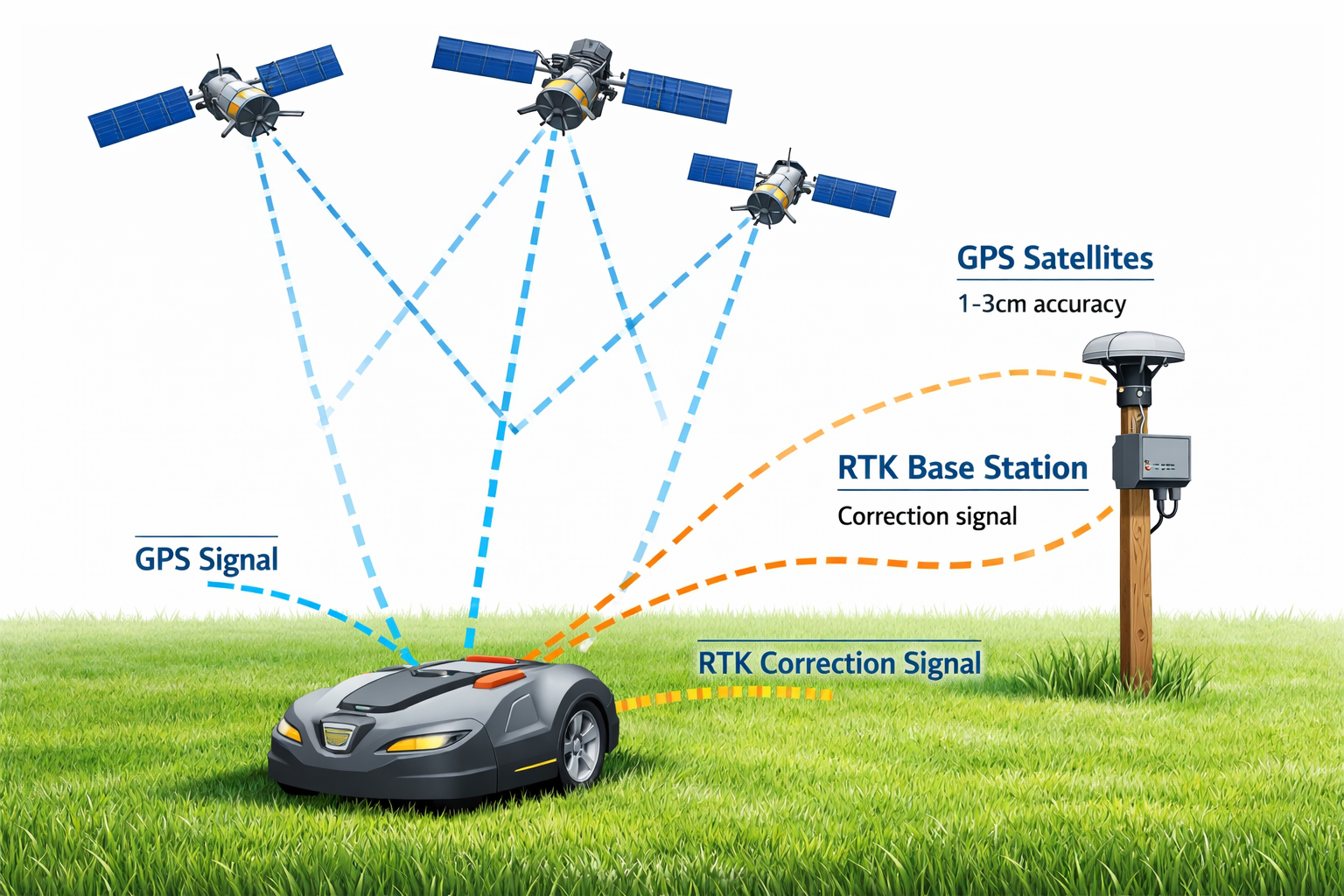
The mower receives timing signals from at least four satellites belonging to global navigation satellite systems, including the American GPS network and the European Galileo system. By measuring the time each signal takes to arrive, the mower’s onboard processor calculates its position through a process called triangulation [2].
Standard GPS achieves 2–5 meter accuracy under good conditions. That’s fine for basic navigation across an open field, but it’s not precise enough for tight lawn edges or avoiding a flower bed by a narrow margin [2].
Here’s how the three-part hardware system fits together [2]:
- Satellite receiver on the mower — picks up raw positioning signals from multiple satellites
- RTK base station (high-end models) — a fixed unit installed in your yard that calculates atmospheric and signal errors, then sends real-time corrections to the mower via a radio link
- Onboard control processor — compares the corrected location data against the stored digital map and makes continuous decisions about steering, speed, and cutting pattern
“RTK-GPS delivers 1–3 centimeter accuracy compared to standard GPS’s 2–5 meter range, enabling razor-sharp virtual boundaries and perfectly straight mowing lines.” [2]
This level of precision is what allows a GPS robot mower to cut right up to a garden edge without constantly overshooting it.
What Is RTK-GPS and Why Does It Matter for Lawn Mowing Precision?
RTK stands for Real-Time Kinematic. It’s a correction technique that transforms ordinary GPS from a rough positioning tool into a centimeter-accurate navigation system, and it’s the reason premium robotic lawn mowers with GPS can mow in straight, parallel lines rather than random patterns [2].
How RTK correction works, step by step:
- The base station is placed at a known fixed point in your yard
- It continuously receives the same satellite signals as the mower
- Because its exact position is known, it can calculate how much error exists in the current satellite signal (caused by atmospheric interference, signal bounce, etc.)
- It transmits those corrections to the mower via a short-range radio link
- The mower applies the corrections in real time, shrinking its positioning error from meters to centimeters
Common mistake: Many buyers assume any GPS robot mower has RTK precision. It doesn’t. Budget models use standard GPS (2–5 meter accuracy), which is adequate for large, simple lawns but struggles with complex shapes, narrow passageways, or yards with many obstacles.
Choose RTK if: Your lawn has irregular edges, flower beds close to the mowing area, narrow gates between zones, or slopes where drift compounds positioning errors.
What Is Network RTK, and Is It Better Than a Base Station?
Network RTK (NRTK) is a newer approach that delivers centimeter-level accuracy without requiring a physical base station in your yard. Instead of relying on a local reference antenna, NRTK connects to a network of reference stations and receives corrections via cellular or satellite data link [4].
At CES 2026, several manufacturers revealed NRTK-equipped mowers that reduce setup time from the typical 5–6 hours of traditional RTK installation to under five minutes [4]. Navimow’s EFLS™ technology, for example, uses triple-frequency NRTK to boost positioning accuracy by 30% compared to standard NRTK, while maintaining stable signals in tight or obstructed areas [3].
| Feature | Standard GPS | RTK-GPS (Base Station) | Network RTK (NRTK) |
|---|---|---|---|
| Accuracy | 2–5 meters | 1–3 centimeters | 1–3 centimeters |
| Setup time | Minutes | 5–6 hours | Under 5 minutes [4] |
| Hardware needed | Receiver only | Receiver + base station | Receiver + data connection |
| Performance near obstacles | Moderate | Good | Good to excellent [3] |
| Best for | Large, simple lawns | Complex yards, precision edges | Most yard types, easy setup |
Edge case: NRTK depends on network connectivity. In rural areas with poor cellular coverage, a local RTK base station may still be the more reliable choice.
How Do You Map Your Lawn Boundaries with a GPS Robotic Mower?
Mapping is the setup step that replaces burying a perimeter wire. You use a smartphone app to walk the mower around the edges of your lawn and any obstacles you want it to avoid. As you walk, the mower logs GPS coordinates at regular intervals, building a digital map of your yard [2].
Typical mapping process:
- Open the manufacturer’s app and start a new zone
- Walk the mower slowly along the outer boundary of your lawn
- Walk around any obstacles: trees, garden beds, patio furniture
- Mark passageways between zones if your yard has separate areas
- Save the map; the app converts the GPS coordinates into a virtual boundary
- Run a test cycle and adjust any sections where the mower gets too close to edges
The resulting digital map supports complex shapes, including curves and angles that would be difficult or impossible to replicate with physical wire [2]. You can also set multiple zones and schedule the mower to work in the front yard in the morning, then automatically navigate through a defined passageway (minimum 1 meter wide) to the backyard in the afternoon [2].
Personal note: The first time I watched a GPS mower navigate through a narrow garden gate on its own, following a path I’d mapped on my phone the week before, it felt genuinely impressive. No wire, no manual guidance, just a mower that knew exactly where it was going.
How Does a Robotic Lawn Mower with GPS Handle Obstacles and Uneven Terrain?
GPS positioning tells the mower where it is, but it doesn’t automatically detect a garden chair someone moved since the last mow. This is where additional sensors matter.
Most GPS robotic mowers combine satellite positioning with at least one of the following:
- Ultrasonic sensors — detect objects within a short range and trigger a stop or reroute
- Bump sensors — physical contact triggers a course change
- Computer vision / cameras — identify and classify objects in the mower’s path
- LiDAR — maps the immediate environment in 3D using laser pulses
As of 2026, the premium configuration pairs RTK satellite positioning with computer vision, appearing in flagship models from brands including NexLawn and Segway [4]. Segway’s solid-state LiDAR, integrated directly into the mower body rather than externally mounted, delivers nearly 200,000 data points across 96 beams for detailed terrain mapping [4].
For uneven ground, high-end models like the Sunseeker Elite X7 feature floating cutting decks that physically adapt to the contour of the lawn. This prevents the mower from scalping raised sections or missing low spots, delivering a consistent cut even on slopes and dense turf [2].
What Are the Limitations of GPS Navigation in Robot Mowers?
A robotic lawn mower with GPS performs best in open areas with a clear view of the sky. Signal reliability drops under dense tree canopies, near tall buildings, or in areas with significant radio interference [1][3].
Specific situations where GPS accuracy degrades:
- Heavy tree cover: Satellite signals are partially blocked or reflected, increasing positioning error
- Tall fences or walls: Multipath interference (signals bouncing off surfaces) confuses the receiver
- Narrow urban lots: Surrounding structures limit the number of visible satellites
- Severe weather: Heavy rain and atmospheric disturbances can affect signal quality
Manufacturers address this in different ways. Navimow’s EFLS™ system creates an independent positioning network using LiDAR that doesn’t rely on satellite signals in obstructed areas [3]. Some models store the last known good position and slow down or pause when signal confidence drops below a threshold.
Bottom line for buyers: If your yard has significant tree cover over the mowing area, check whether the model you’re considering has a secondary positioning system. A GPS-only mower may struggle in those conditions.
How Does a Robotic Lawn Mower with GPS Compare to a Wire-Based Robot Mower?
The choice between GPS and wire-based navigation comes down to yard complexity, installation tolerance, and budget.
Wire-based mowers:
- Lower upfront cost (many models under $600)
- Installation requires burying wire, which takes several hours and can be damaged by digging
- Mow in random patterns, which still achieves full coverage over time but leaves less precise edges
- Reliable in any weather and under tree cover (no satellite dependency)
- Difficult to reconfigure if your garden layout changes
GPS robotic mowers:
- Higher upfront cost (RTK models typically $1,000–$3,500+ as of 2026)
- Setup is faster and non-invasive, especially with NRTK models [4]
- Mow in systematic, parallel lines for a cleaner visual result
- Easier to update boundaries via app when you change garden beds
- Performance can vary under heavy tree cover without supplementary sensors [1]
Choose a GPS mower if: You want wire-free setup, have a complex yard shape, or plan to change your garden layout over time.
Choose a wire-based mower if: You have a simple, open lawn, want the lowest possible cost, and don’t mind the one-time installation effort.
FAQ: Robotic Lawn Mowers with GPS
Q: Do GPS robot mowers need Wi-Fi to work?
Most GPS mowers use Wi-Fi or Bluetooth to connect to the app for setup and scheduling. Once the map is saved, many models can mow without an active Wi-Fi connection, though NRTK models need a cellular or network data link for real-time corrections.
Q: How long does it take to set up a GPS robotic mower?
Standard RTK models with a base station take 5–6 hours including installation and mapping. NRTK models can be ready in under five minutes [4]. Wire-free setup is one of the main advantages over traditional robot mowers.
Q: Can a GPS robot mower handle slopes?
Yes, most models handle slopes up to 35–45 degrees. High-end models with floating cutting decks manage uneven terrain more effectively [2]. Check the manufacturer’s slope rating before buying if your yard has significant inclines.
Q: What happens if the GPS signal drops mid-mow?
Most mowers pause, return to the last known position, or navigate to the charging station using backup sensors. Premium models with LiDAR or computer vision can continue operating in degraded GPS conditions.
Q: Is a GPS robot mower safe around children and pets?
GPS mowers include lift sensors, tilt sensors, and obstacle detection that stop the blades immediately if the mower is picked up or encounters resistance. Always follow manufacturer guidelines and supervise young children around any powered garden equipment.
Q: How accurate is standard GPS for lawn mowing?
Standard GPS achieves 2–5 meter accuracy, which is sufficient for basic navigation on large, open lawns but too imprecise for clean edges or complex yard shapes [2].
Q: Can one GPS mower cover multiple separate lawn areas?
Yes. Modern GPS mowers support multi-zone navigation and can be scheduled to move between zones automatically through defined passageways at least 1 meter wide [2].
Q: Do GPS robot mowers work in the rain?
Most are rated for light rain. Many include rain sensors that send the mower back to its charging station during heavy rainfall. Check the IP rating for your specific model.
Q: How often do I need to remap my lawn?
Only when your garden layout changes significantly, such as adding a new bed or removing a tree. Minor changes, like moving furniture, are handled by the mower’s obstacle sensors.
Q: What is the lifespan of a GPS robotic mower?
Most quality models last 5–10 years with regular blade replacement and battery maintenance. Blades typically need replacing every 1–3 months depending on lawn size and grass type.
Conclusion: Is a GPS Robotic Mower Right for You?
A robotic lawn mower with GPS represents a genuine step forward from wire-based predecessors. The technology is mature enough in 2026 to handle most residential yards reliably, and NRTK models have removed the biggest barrier to adoption: the complicated setup process.
Actionable next steps:
- Assess your yard’s tree cover. If more than 30% of your mowing area sits under dense canopy, prioritize models with LiDAR or computer vision as a backup to GPS.
- Measure your lawn’s complexity. Lots of curves, narrow passageways, or multiple zones favor RTK or NRTK precision over standard GPS.
- Set a realistic budget. Entry-level GPS mowers start around $800–$1,000; RTK models with full precision start closer to $1,500–$2,000. NRTK models are becoming more competitive in 2026 [4].
- Check the app ecosystem. The quality of the mapping app matters. Look for user reviews specifically about the setup and remapping experience.
- Plan for blade maintenance. Budget for replacement blades every 1–3 months; this is the main ongoing cost after purchase.
The core promise of a GPS robot mower is straightforward: you map it once, schedule it, and it handles the rest. For most homeowners, that’s exactly what it delivers.
References
[1] Best Robot Lawn Mower Without Perimeter Wire – https://sunseekertech.com/us/blog/best-robot-lawn-mower-without-perimeter-wire
[2] GPS Robot Lawn Mower Explained – https://sunseekerelite.com/global/blog/gps-robot-lawn-mower-explained
[3] Best Robotic Lawn Mowers – https://navimow.com/blogs/buying-guide/best-robotic-lawn-mowers
[4] Best Robotic Mowers CES 2026 Complete Buyers Guide – https://www.futurescapeusa.com/latest-news/best-robotic-mowers-ces-2026-complete-buyers-guide
Read next: iPhone 18 Pro: What to Expect from the New C2 Chip. A closer look at iphone 18 pro c2 chip.